

Bill Gates Thinks Everyone Will Have Personal AI Assistant in 5 Years

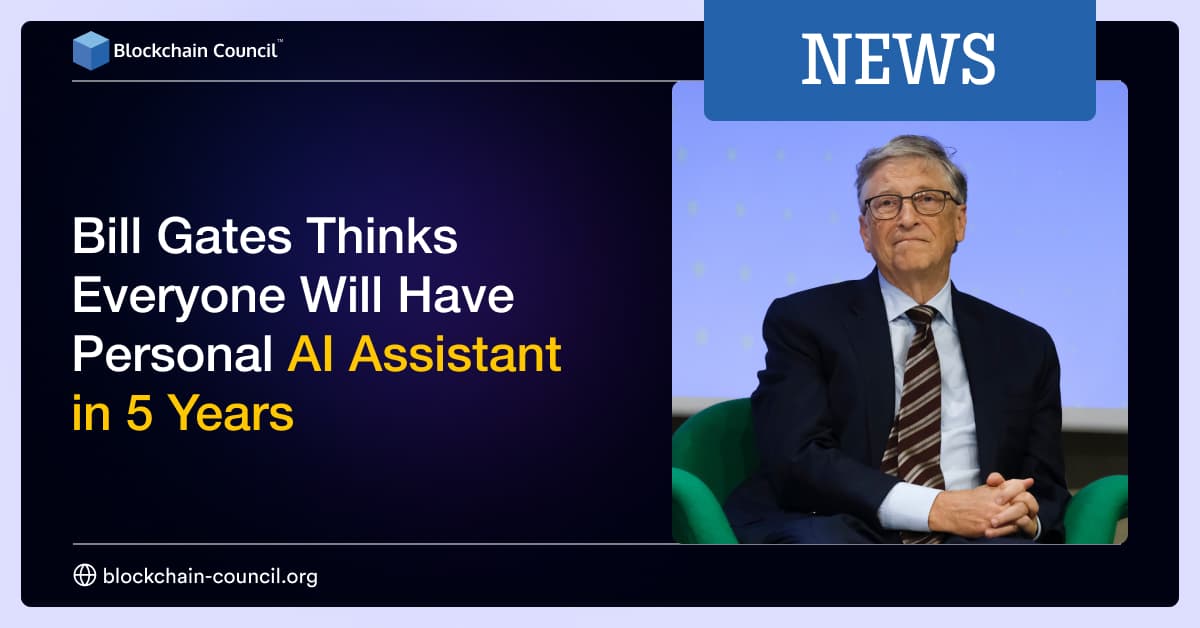
In a recent blog post on GatesNotes, Bill Gates, co-founder of Microsoft, shared his groundbreaking insights on the future of computing, boldly stating that within the next five years, Artificial Intelligence (AI) will revolutionize our interaction with technology. Gates, renowned for his accurate technological forecasts, highlighted the limitations of current software, describing it as “pretty dumb.” This revelation underscores the need for significant improvements, paving the way for a revolutionary shift in the computing landscape.
Gates envisions a future where the reliance on multiple applications for distinct tasks becomes obsolete. Instead, users will engage with their devices in everyday language, issuing commands and receiving seamless responses. This transformation, driven by advanced AI, promises a more intuitive and personalized computing experience. Gates refers to this concept as the era of the “agent,” AI-powered assistants capable of understanding natural language and executing a myriad of tasks based on user preferences.

Gates stated, “In the near future, anyone who’s online will be able to have a personal assistant powered by artificial intelligence that’s far beyond today’s technology.” This marks a bold departure from the current state of software, which he perceives as limited.
While the idea of AI agents isn’t novel, Gates initially introduced it in his 1995 book ‘The Road Ahead.’ Today, with recent advancements in AI, this vision inches closer to reality. Gates predicts that these AI-driven agents will revolutionize various facets of human life, including healthcare, education, productivity, entertainment, and shopping. He added, “Agents are smarter. They’re proactive — capable of making suggestions before you ask for them.”
Gates foresees a world where everyone online will have access to a personal AI assistant, surpassing the capabilities of current technology. These advanced assistants will provide tailored and efficient support, marking a paradigm shift where technology evolves from being a mere tool to an intelligent companion, enriching our daily lives. He emphasized, “If the number of companies that have started working on AI just this year is any indication, there will be an exceptional amount of competition, which will make agents very inexpensive.”
This prediction from Gates emphasizes the rapid pace of technological innovation and its potential to reshape our digital interactions profoundly. According to Gates, the technological landscape is on the brink of a significant transformation, with AI agents becoming an integral part of daily life. He envisions a scenario where AI agents surpass the functionalities of traditional productivity tools, becoming indispensable in various professional settings. Gates believes that these agents will be available for businesses, aiding in tasks such as business plan creation, presentations, and even generating product visuals.
Contrary to a single dominating company in the AI agent business, Gates anticipates a competitive market with a multitude of companies entering the domain. While he acknowledges that AI agents may come with a price tag, he believes that intense competition will make them highly affordable. He stated, “Today, agents are embedded in other software like word processors and spreadsheets, but eventually they’ll operate on their own. Whether you work in an office or not, your agent will be able to help you in the same way that personal assistants support executives today.”
Gates illustrates the vast potential of these AI agents in simplifying life’s complexities. From sending flowers to a friend recovering from surgery to facilitating reunions with old college roommates, these agents are envisioned to be capable of handling a wide array of tasks. He said, “If your friend just had surgery, your agent will offer to send flowers and be able to order them for you.”
The integration of Natural Language Processing (NLP) is seen as a key factor in enhancing the problem-solving abilities of these AI assistants, making them more advanced than current voice-activated digital assistants. Christopher Alexander, the Chief Analytics Officer of Pioneer Development Group, highlighted, “NLP enabled assistants differ from Siri because NLP is actually a coding language. This means the NLP AI assistant will have significantly greater functionality because it possesses far greater problem-solving abilities.”
While Gates envisions a future where users may have to pay for such advanced AI assistance, he anticipates that market competition will drive costs down, making these agents accessible to a broader audience. However, the willingness of consumers to pay for this technology remains a question, with potential pricing models and user demand influencing its adoption.
Bill Gates’ foresight into the future of personal AI assistants unveils a compelling vision where technology becomes an indispensable and proactive companion in our daily lives. As advancements in AI continue, the realization of Gates’ predictions within the next five years could redefine the way we interact with and perceive technology, ushering in an era of unprecedented convenience and efficiency.
Related Articles
View All
News
Tesla Unveils Its New Flying Roadster: What We Know
Tesla unveiled a redesigned Roadster that uses SpaceX-style thrusters to leap into the air. Learn how the Tesla flying car works, its three versions, claimed specs, reservations and what is still unproven.

News
Institutional Tokenized Asset Adoption Hits New Milestones in 2026
Institutional tokenized asset adoption is moving from pilots to production, led by tokenized treasuries, stablecoins, private credit, and real estate.

News
AI and Blockchain Integration in 2026: Enterprise Use Cases Moving Into Production
AI and blockchain integration in 2026 is moving into production across finance, supply chain, healthcare, identity, and decentralized AI infrastructure.
Trending Articles
The Role of Blockchain in Ethical AI Development
How blockchain technology is being used to promote transparency and accountability in artificial intelligence systems.
AWS Career Roadmap
A step-by-step guide to building a successful career in Amazon Web Services cloud computing.

Top 5 DeFi Platforms
Explore the leading decentralized finance platforms and what makes each one unique in the evolving DeFi landscape.