Labor Day Offer Ends Soon | Flat 25% OFF | Code: LABOR
Blockchain Council
Toshendra Kumar Sharma

Toshendra Kumar Sharma

1143 articles published

Can-Blockchain-Private-Key-be-Hacked
Blockchain

Can Blockchain Private Key be Hacked?

A blockchain private key is extremely difficult to crack through brute-force attacks because modern blockchains use cryptographic keys with enormous possible key spaces. The more realistic danger is theft rather than mathematical cracking. Malware, phishing sites, compromised devices, exposed backups, cloud-stored screenshots, and leaked seed phrases can give attackers control of a wallet. Anyone who obtains a private key can authorize transactions from the corresponding account, which is why offline storage and hardware wallets are commonly recommended for stronger protection.


Thailand-Revenue-System-to-track-taxes-using-Blockchain (2)
Blockchain

Thailand Revenue System to Track Taxes Using Blockchain

In 2018, Thailand’s Revenue Department began exploring blockchain to improve tax administration, particularly by tracking VAT payments and reducing fraudulent refund claims. The proposed system used distributed ledger records to verify transactions and VAT invoices, while machine learning and AI were also considered for detecting tax evasion. Thailand later implemented blockchain technology for its VAT refund service for tourists, showing how the experiment developed into a practical tax application.

Can-Blockchian-build-balance-to-the-work-industry
Blockchain

Can Blockchain Build Balance to the Work Industry?

Blockchain could bring greater balance to the work industry by improving transparency, trust, and portability of employment records. Verifiable credentials can help workers prove skills and experience across employers, while smart contracts can automate contracts and payroll. Blockchain-based systems may also give freelancers and gig workers greater control over professional identities and records. However, privacy, regulation, scalability, implementation costs, and governance remain significant barriers.

Blockchain-to-break-the-power-of-webgiants
Blockchain

Blockchain to Break the Power of Web Giants

Blockchain could reduce the dominance of web giants by shifting parts of digital identity, data ownership, payments, and application governance away from centralized platforms. Web3 systems use decentralized networks, wallets, smart contracts, and user-controlled assets to let people interact without depending entirely on a single company. However, decentralization brings its own challenges, including scalability, usability, security, governance, and uneven distribution of influence. Apparently removing middlemen does not remove human complexity.

Is-Blockchain-in-a-war-with-other-technologies
Blockchain

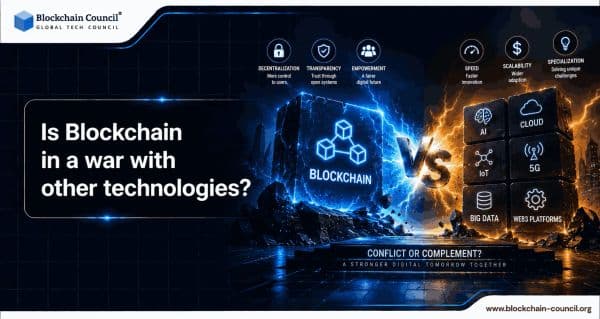
Is Blockchain in a war with other technologies?

Blockchain is not really “at war” with technologies such as AI, IoT, cloud computing, or traditional databases. Each solves different problems. Blockchain specializes in shared, tamper-resistant records and decentralized trust, while AI provides intelligent analysis, IoT collects real-world data, and cloud platforms provide scalable computing infrastructure. Increasingly, these technologies are being integrated rather than treated as substitutes, although scalability, interoperability, latency, security, and cost can create technical trade-offs.

How-will-Quantum-computing-affect-the-Blockchain
Blockchain

How will Quantum Computing affect the Blockchain?

Quantum computing could significantly affect blockchain security because sufficiently powerful quantum computers may break public-key cryptography such as ECDSA, which many blockchains use for digital signatures and transaction authorization. Hash functions are also affected by quantum algorithms, but generally less severely. The main defense is migration toward post-quantum cryptography, with NIST already publishing quantum-resistant standards that blockchain networks can potentially adopt.

Blockchain-to-help-Cannabis-Transformation
Blockchain

Blockchain to help Cannabis Transformation

Blockchain can support the transformation of the regulated cannabis industry by creating tamper-resistant records across the supply chain, from cultivation and harvesting to testing, processing, distribution, and retail. Research into blockchain-based cannabis traceability shows how smart contracts and distributed ledgers can improve seed-to-sale tracking, regulatory oversight, product provenance, and data integrity.

5-simple-ways-in-which-Blockchain-can-help-the-refugees (1)
Blockchain

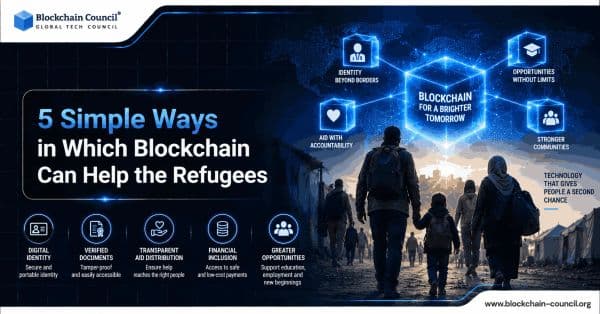
5 Simple Ways in Which Blockchain Can Help the Refugees

Blockchain can support refugees in five practical ways: delivering cash or vouchers more efficiently, coordinating assistance between humanitarian organizations, improving transaction traceability, supporting portable digital identity systems, and reducing reliance on costly financial intermediaries. The World Food Programme’s Building Blocks network already serves more than one million refugees in Jordan and Bangladesh, while UNHCR has also piloted blockchain-based cash assistance for displaced people in Ukraine.

How-Blockchain-will-build-value-without-cryptos
Blockchain

How Blockchain Will Build Value Without Cryptos?

Blockchain can create value without relying on cryptocurrencies. Permissioned blockchain networks can give businesses a shared, tamper-resistant record for supply chains, digital credentials, compliance, auditing, document verification, and cross-company workflows. Smart contracts can automate agreed business rules without requiring a native cryptocurrency, while cryptographic records improve provenance and accountability. In practice, the useful bit is often verifiable coordination, not speculative tokens.

Top-3-Projects-solving-real-world-problem-using-Blockchain
Blockchain

Top 3 Projects Solving Real World Problems Using Blockchain

Three blockchain projects show how the technology can address practical problems beyond cryptocurrency. WFP’s Building Blocks coordinates humanitarian assistance and supports more than one million refugees in Jordan and Bangladesh. Energy Web uses blockchain-backed verification for renewable energy, environmental markets, and clean-energy tracking. UNICEF-backed StaTwig applies blockchain to vaccine supply chains, helping track individual vaccine vials and reduce waste. These projects illustrate blockchain’s potential in humanitarian aid, energy, and healthcare.

How-can-Blockchain-help-election-rigging-in-India
Blockchain

How can Blockchain help Election Rigging in India?

Blockchain could potentially strengthen parts of India’s election infrastructure by creating tamper-evident, auditable records and improving transparency in processes such as remote voting. India’s National Informatics Centre has already developed and demonstrated a blockchain-based remote voting proof of concept under Election Commission directions, using blockchain to securely store encrypted remote votes and ballot information. However, blockchain alone cannot prevent every form of electoral manipulation, and any voting system must also protect ballot secrecy, voter authentication, accessibility, independent auditing, and coercion resistance.