

Can Blockchain Private Key be Hacked?
 Toshendra Kumar Sharma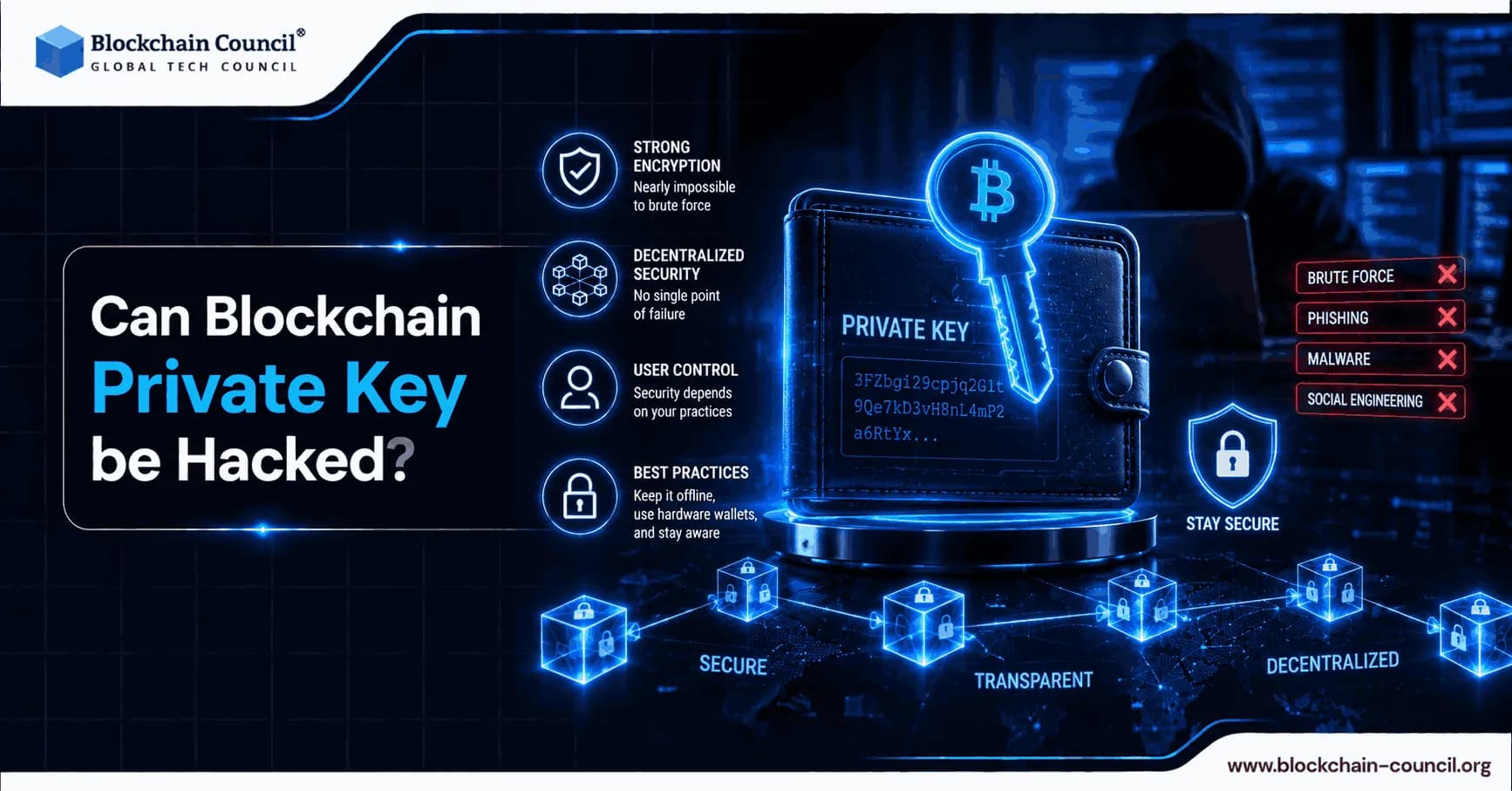
Private keys are the single point of control over blockchain assets, which makes the question of whether they can be hacked one of the most important things anyone holding crypto should understand clearly. The short answer is that directly breaking the cryptography behind a properly generated private key is effectively impossible with current technology. The longer, more useful answer is that private keys get compromised constantly, just not through brute force math. Understanding that distinction is exactly what separates someone who protects their assets confidently from someone who loses everything to a preventable mistake. Anyone serious about understanding this space in depth should look at the Certified Blockchain Expert program from Blockchain Council, which builds the cryptographic and security foundations this entire topic rests on.
This article breaks down how private keys actually work, the real ways they get compromised, and how to protect yours properly.

How Private Keys Actually Work
The Math Behind Blockchain Private Keys
A blockchain private key is essentially a very large random number, typically 256 bits long on networks like Bitcoin and Ethereum. That number gets run through elliptic curve cryptography to generate a corresponding public key and, from there, a public address. The entire system depends on the fact that generating a public key from a private key is easy, while reversing the process, calculating the private key from a known public key, is computationally infeasible.
Why Brute Forcing a Private Key Is Not Realistic
A 256-bit keyspace contains more possible combinations than there are atoms in the observable universe. Even using every computer currently on Earth running continuously, brute forcing a single properly generated private key would take longer than the universe has existed. This is why, when people ask whether a private key can be hacked, the honest technical answer is that the cryptography itself is not the weak point. The weak point is almost always somewhere else entirely.
So How Do Private Keys Actually Get Compromised?
Nearly every real-world private key theft happens through human error, poor security practices, or social engineering, not through anyone actually cracking the underlying math. Understanding these attack patterns in depth is core material in the Certified Blockchain Security Professional program from Blockchain Council, which walks through exactly these threat vectors alongside practical defense strategies for developers, security teams, and everyday users.
Phishing and Fake Wallet Apps
Fake wallet applications, cloned websites, and phishing emails remain one of the most common ways attackers steal private keys and seed phrases. A user believing they are entering their recovery phrase into a legitimate wallet interface may actually be handing it directly to an attacker who then drains the wallet within minutes.
Malware and Clipboard Hijacking
Malicious software can monitor a device for copied wallet addresses and silently swap them with an attacker's address during a transaction, or it can log keystrokes to capture a typed seed phrase directly. This type of attack does not need to break any cryptography at all. It simply waits for the user to expose their own key through normal, careless use.
Weak or Poorly Generated Seed Phrases
Some early or poorly built wallet software used weak random number generation, producing private keys that were technically valid but far more predictable than they should have been. Attackers have successfully targeted these weak generation patterns in the past, which is why using well-audited, reputable wallet software matters just as much as the underlying blockchain security itself.
Exchange and Custodial Breaches
Many users never actually hold their own private keys, instead trusting an exchange to hold funds on their behalf. When an exchange gets breached, attackers are not cracking individual user keys. They are compromising the exchange's centralized key management system, which is why custodial platforms remain one of the largest sources of large-scale crypto theft.
How to Protect Your Private Keys
Hardware Wallets and Cold Storage
Storing private keys on a hardware wallet, disconnected from the internet, dramatically reduces exposure to malware and remote attacks. Cold storage solutions keep the key generation and signing process isolated from any internet-connected device, which closes off the most common attack surface entirely.
Multisignature Wallets
Multisignature setups require multiple private keys to authorize a transaction, meaning a single compromised key is not enough for an attacker to move funds. This approach is increasingly standard for businesses, DAOs, and high-value personal holdings, since it removes the single point of failure that a standard wallet depends on. Understanding how to properly configure and audit this kind of setup is a real technical skill, and professionals building or securing these systems often round out their knowledge with a general Tech Certification to strengthen the broader systems and infrastructure security practices that sit alongside blockchain-specific knowledge.
Safe Seed Phrase Storage Habits
A seed phrase written on paper and stored in a fireproof safe is often safer than any digital storage method, since it cannot be remotely accessed by malware or a phishing site. Avoid storing seed phrases in cloud notes, screenshots, or password managers connected to the internet, since these create digital copies that attackers actively search for once they gain access to a compromised device or account.
Future-Ready Skills
As technology becomes increasingly important across industries, students need opportunities to develop future-ready skills early in their education. A World Tech Olympiad can introduce students to areas such as artificial intelligence, coding, cybersecurity, robotics, and computational thinking while encouraging curiosity and continuous learning. The cybersecurity professionals now protecting blockchain systems and private key infrastructure often trace their interest in security back to exactly this kind of early, structured exposure to technology and problem solving.
Building a Career Protecting Blockchain Systems
Private key security is one of the fastest growing specializations within blockchain, since every project, exchange, and wallet provider needs people who genuinely understand how attackers think, not just how cryptography works in theory. Blockchain Council's structured programs give aspiring security professionals a clear path into this specialization, rather than leaving them to piece together fragmented security advice from forums and outdated blog posts. Once you have the technical foundation, being able to explain security risks clearly to non-technical clients, employers, or users becomes just as valuable, which is why many professionals in this field also pick up a general Marketing Certification to sharpen how they communicate risk and build trust with audiences who may not understand the underlying technology.
Can a blockchain private key be hacked? Not through the math itself, at least not with any technology available today. It absolutely can be compromised through phishing, malware, weak key generation, or careless storage, which means the real security work lies in protecting the human and operational layer around the key, not the cryptography underneath it.
FAQs
1. Can a blockchain private key be hacked?
A private key is designed to be extremely difficult to derive through brute force because it relies on strong cryptography. However, attackers can steal private keys through phishing, malware, insecure backups, compromised devices, or other security weaknesses.
2. Can someone guess a blockchain private key?
Practically, guessing a properly generated private key is not a realistic attack because the possible key space is extremely large. The greater risk is usually obtaining the key through theft, scams, malware, or poor storage practices.
3. What happens if a private key is stolen?
If an attacker obtains a private key, they may be able to sign transactions and transfer the associated assets without the owner's permission. Blockchain networks generally cannot reverse a valid transaction simply because the private key was compromised.
4. Can hackers steal private keys from crypto wallets?
Yes. Hackers can target wallets through malware, phishing websites, malicious browser extensions, compromised computers, and insecure backups. Wallet security therefore depends not only on blockchain cryptography but also on how the keys are stored and accessed.
5. Can a private key be hacked through the blockchain?
Generally, the blockchain does not expose enough information to make recovering a properly generated private key practical. Public-key cryptography is specifically designed to prevent an attacker from calculating the private key from publicly available information.
6. Can a public key be used to find a private key?
A public key is intentionally shareable, while the private key must remain secret. Modern blockchain cryptography is designed so that deriving the private key from the public key is computationally impractical under the security assumptions of the cryptographic system.
7. Can quantum computers hack blockchain private keys?
Powerful future quantum computers could potentially threaten some public-key cryptographic systems. However, this is different from saying that today's blockchain private keys can simply be hacked by existing computers. Blockchain networks are researching and developing cryptographic approaches that can address future quantum risks.
8. Can phishing expose a blockchain private key?
Yes. Phishing is one of the most common practical ways users can lose control of their wallets. Attackers may create fake wallet websites, support accounts, or messages designed to trick users into revealing private keys or recovery phrases.
9. Is a seed phrase the same as a private key?
A seed phrase, also called a recovery phrase, is not exactly the same as an individual private key. It can be used to restore a wallet and generate the keys associated with its accounts, so anyone who obtains the recovery phrase may gain access to the wallet's assets.
10. Can someone hack a private key stored on a computer?
A private key stored on an internet-connected computer can be exposed if the device is infected with malware or otherwise compromised. Keeping sensitive keys offline can significantly reduce exposure to remote attacks.
11. Are hardware wallets safer for private keys?
Hardware wallets are generally considered a strong option because they are designed to keep private keys isolated from internet-connected environments. They can significantly reduce the risk of private-key theft from compromised computers or phones.
12. Can screenshots expose private keys?
Yes. Taking screenshots of private keys or recovery phrases can create additional security risks because images may automatically synchronize with cloud services. Ethereum's security guidance specifically recommends avoiding screenshots of seed phrases and private keys.
13. Can a private key be stolen from cloud storage?
Yes. Storing private keys or recovery phrases in cloud services creates an additional attack surface. If an account or synchronized device is compromised, attackers could potentially obtain the stored credentials.
14. What is the biggest threat to blockchain private keys?
The biggest practical threats often involve human error and poor security practices rather than breaking the underlying cryptography. Phishing, malware, fake wallets, leaked recovery phrases, insecure backups, and social engineering can all result in key compromise.
15. Can a crypto exchange hack expose private keys?
Yes. When users keep assets with a custodial exchange, the exchange or another third party controls the underlying keys. A security breach, operational failure, or other compromise can therefore affect users' access to their assets.
16. How can you protect a blockchain private key?
Keep the private key or recovery phrase secret, avoid storing it in screenshots or unsecured cloud services, use trusted wallet software, keep devices updated, and consider cold or hardware storage for significant holdings. Never give a private key or recovery phrase to someone claiming to be wallet support.
17. Can malware steal a blockchain private key?
Yes. Malware can potentially monitor devices, access wallet files, capture sensitive information, or interfere with transactions. Keeping private keys isolated from general-purpose internet-connected devices can reduce this risk.
18. What should you do if your private key is compromised?
Treat a compromised private key as unsafe and move assets to a newly generated secure wallet as quickly as possible, if you still have control. Do not continue using the compromised key for long-term storage because an attacker who possesses it may also have the ability to spend the associated assets.
19. Can blockchain transactions be reversed after a private key hack?
Usually, no. Blockchain transactions are generally designed to be final once confirmed, so a transaction authorized by a compromised private key may not be reversible through the blockchain itself.
20. Is blockchain private-key security completely hack-proof?
No technology should be described as completely hack-proof. The cryptography behind major blockchain networks can provide strong protection, but users can still lose keys through phishing, malware, compromised devices, scams, or insecure storage.
Related Articles
View All
Blockchain
How to Write a PRD for Blockchain Products: Key Sections, Examples, and Best Practices
Learn how to write a PRD for blockchain products with key sections, practical examples, tokenomics, security, governance, and success metrics.

Blockchain
Blockchain Product Manager vs Traditional Product Manager: Key Differences Explained
Learn how a blockchain product manager differs from a traditional PM across tokens, wallets, governance, analytics, metrics, risk, and skills.

Blockchain
Blockchain Product Manager Job Description: Key Responsibilities and Daily Tasks
Learn what a blockchain product manager does, including responsibilities, daily tasks, required skills, salary signals, and how to prepare for the role.
Trending Articles
AWS Career Roadmap
A step-by-step guide to building a successful career in Amazon Web Services cloud computing.
What is AWS? A Beginner's Guide to Cloud Computing
Everything you need to know about Amazon Web Services, cloud computing fundamentals, and career opportunities.
Claude AI Tools for Productivity
Discover Claude AI tools for productivity to streamline tasks, manage workflows, and improve efficiency.