

Is Blockchain in a war with other technologies?
 Toshendra Kumar Sharma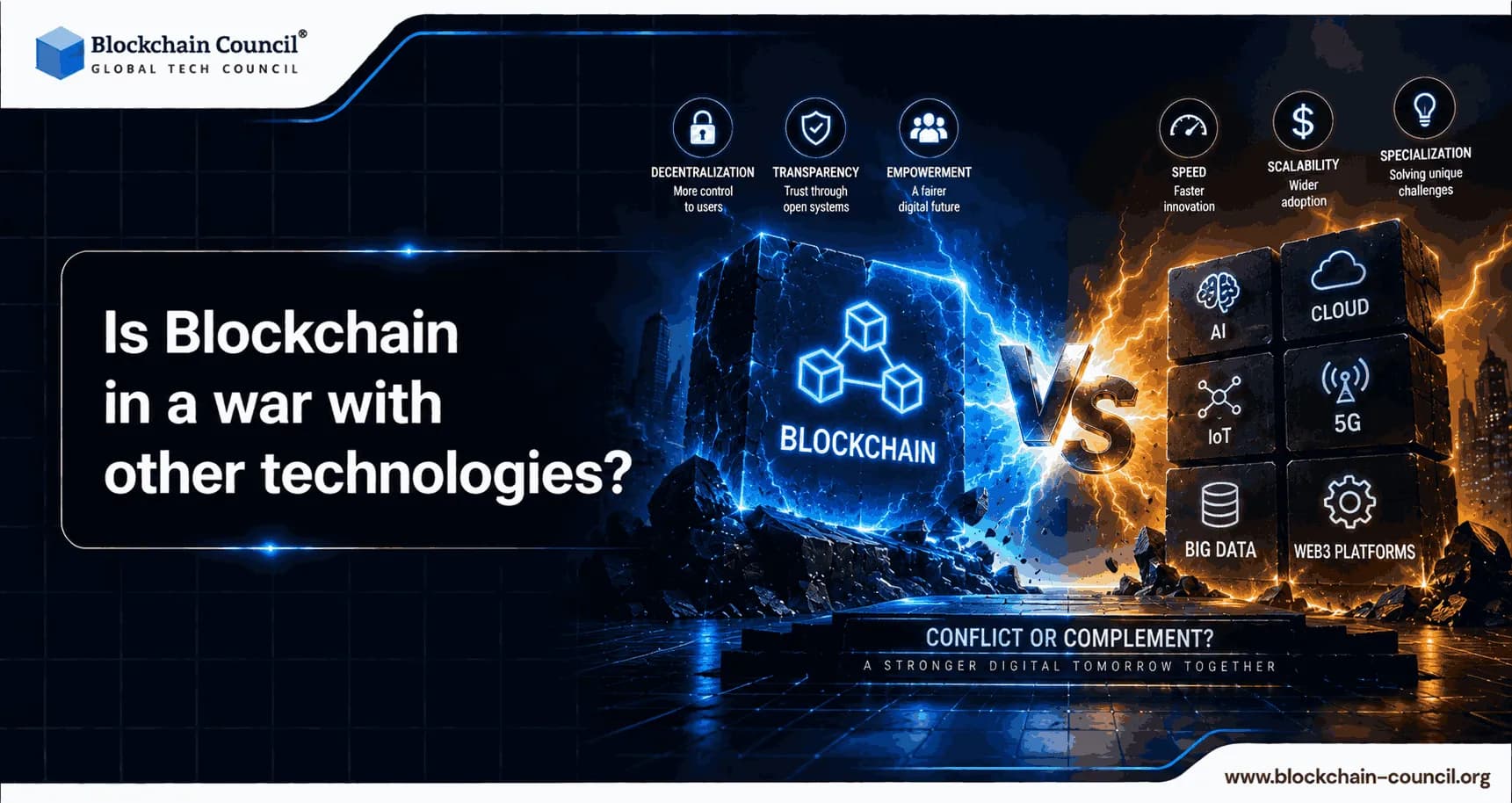
Technology headlines love a good rivalry, blockchain versus traditional databases, blockchain versus cloud computing, blockchain versus artificial intelligence, each framed as a zero sum battle where one technology must inevitably replace the other. The reality looks considerably less like a war and considerably more like convergence, with blockchain increasingly working alongside these other technologies rather than trying to eliminate them entirely. Many people trying to understand this dynamic accurately start with a Certified Blockchain Expert credential to build genuine technical clarity about where blockchain genuinely competes with existing systems, and where it actually depends on them.
In this article, we will look at the specific technologies blockchain is most often framed as competing against, whether that competitive framing genuinely holds up, and where blockchain and these other technologies are actually converging rather than fighting for the same territory.

Why the "War" Framing Is Genuinely Misleading
Describing blockchain's relationship with other technologies as a war implies a zero sum outcome, one technology wins, the other becomes obsolete. This framing makes for compelling headlines, but it consistently fails to describe how these technologies actually get deployed in real, production systems. Most genuinely successful blockchain implementations do not replace traditional databases, cloud infrastructure, or AI systems entirely. They integrate with them, using each technology for the specific problem it solves best, rather than forcing a single technology to handle every layer of a system alone.
Understanding this distinction matters enormously for anyone evaluating blockchain's actual role in modern technology stacks, since treating every comparison as a winner take all battle leads to consistently poor, oversimplified conclusions about where blockchain genuinely adds value and where it does not.
Blockchain's Relationship With Specific Technologies
Blockchain and Traditional Databases
Blockchain is often compared directly to traditional databases, but the two solve genuinely different problems. Traditional databases excel at fast, efficient storage and retrieval of large volumes of data, optimized specifically for a single trusted organization managing its own information. Blockchain trades away much of that raw performance in exchange for something traditional databases cannot offer, a shared, tamper proof record that multiple, mutually distrustful parties can all verify independently without relying on any single party's database being accurate.
This means blockchain rarely functions as a wholesale database replacement in practice. Most production systems use blockchain specifically for the portions of a system requiring multi party trust and verification, while continuing to rely on traditional databases for the bulk of routine, high volume data storage and retrieval that does not require this kind of decentralized verification.
Blockchain and Cloud Computing
Rather than existing in genuine competition, blockchain and cloud computing have increasingly converged, with major cloud providers now offering dedicated blockchain infrastructure services, and blockchain networks relying on cloud hosted nodes to achieve the scale and reliability modern applications require. Decentralized cloud storage projects do propose a genuine alternative to centralized cloud providers in specific use cases prioritizing censorship resistance, but the broader relationship between blockchain and cloud computing looks considerably more like integration than confrontation.
Building systems that genuinely combine blockchain's verification capabilities with cloud infrastructure's scale and reliability requires real, specialized engineering skill. This is why developers working at this intersection increasingly pursue a Certified Blockchain Developer credential, developing the practical expertise needed to build systems that draw on both technologies' genuine strengths rather than treating them as competing alternatives.
Blockchain and Artificial Intelligence
Blockchain and AI represent perhaps the clearest example of convergence rather than competition. AI systems increasingly need verifiable, trustworthy data to train on, and blockchain's immutable record keeping offers a genuine way to confirm that training data has not been secretly altered or manipulated. Meanwhile, AI increasingly analyzes on chain data to improve fraud detection and optimize how smart contracts execute. As autonomous AI agents increasingly execute transactions and interact with decentralized systems independently, blockchain is emerging as foundational infrastructure for verifying and governing exactly this kind of AI driven activity, rather than competing against AI for the same technological territory.
Blockchain and Traditional Financial Infrastructure
Traditional banking and payment infrastructure is sometimes framed as blockchain's most direct rival, destined for eventual replacement. In practice, major banks and payment processors have increasingly built blockchain based systems directly into their own infrastructure, using blockchain rails for settlement, cross border payments, and trade finance rather than treating the technology as an external threat to be resisted. This pattern, established financial institutions adopting blockchain internally rather than being displaced by it, has repeated across insurance, capital markets, and trade finance as well.
Future-Ready Skills
As technology becomes increasingly important across industries, students need opportunities to develop future-ready skills early in their education. A World Tech Olympiad can introduce students to areas such as artificial intelligence, coding, cybersecurity, robotics, and computational thinking while encouraging curiosity and continuous learning.
Building this kind of early technical foundation gives students a genuine head start toward understanding how emerging technologies like blockchain and AI increasingly work together rather than existing in competition with one another.
Where Genuine Competition Does Exist
None of this means blockchain never genuinely competes with alternative approaches. Within blockchain itself, different networks and consensus mechanisms genuinely compete for developer attention, transaction volume, and market share, a real, ongoing competitive dynamic distinct from blockchain's relationship with entirely different technology categories. And in specific narrow use cases, a well designed traditional centralized system genuinely can outperform a blockchain based alternative on cost, speed, and simplicity, meaning the choice between blockchain and conventional technology remains a genuine, case by case engineering decision rather than an ideological commitment to one approach over the other in every situation.
Making this kind of case by case evaluation accurately requires genuine, broad technical literacy across multiple technology domains simultaneously, not just deep expertise in blockchain alone. This is why professionals responsible for these architectural decisions increasingly pursue a formal Tech Certification, building the well rounded understanding needed to judge honestly when blockchain genuinely adds value and when a simpler, more conventional technology solves the problem better.
Why the Convergence Narrative Matters More Than the War Narrative
Framing blockchain's relationship with other technologies as convergence rather than war leads to genuinely better decision making. Organizations that approach technology selection by asking which combination of tools best solves a specific problem consistently build more effective systems than those starting from an ideological commitment to blockchain, cloud computing, or any single technology as the presumed winner of an imagined war. This more nuanced, integration focused approach reflects how technology adoption has generally unfolded throughout computing history, new technologies rarely eliminate their predecessors entirely, they find the specific niche where they genuinely outperform existing alternatives, while coexisting and often integrating with the technologies already in place.
Communicating This Nuance Clearly
Given how much of the public conversation around blockchain leans on oversimplified, competitive framing, clearly explaining the genuine, more nuanced reality of technological convergence matters considerably for helping businesses and the public make informed decisions rather than reacting to hype driven predictions of one technology's inevitable victory over another. This is why professionals working on blockchain education and technology strategy increasingly pair their technical expertise with a Marketing Certification, building the communication skills needed to explain this convergence clearly to audiences accustomed to simpler, more dramatic narratives about competing technologies.
Final Thoughts
Blockchain is not genuinely at war with traditional databases, cloud computing, artificial intelligence, or established financial infrastructure. Each of these relationships, examined honestly, looks considerably more like convergence and integration than confrontation, with blockchain increasingly finding its specific, genuine value within larger systems that continue relying on complementary technologies for the tasks they already handle well.
Real competition does exist, primarily between different blockchain networks themselves, and in specific, narrow cases where a conventional approach genuinely outperforms a blockchain based alternative. But the broader narrative of blockchain waging war against the rest of the technology landscape says more about how compelling a rivalry makes for a headline than it does about how these technologies are actually being built and deployed together in the real world.
FAQs
1. Is blockchain in a war with other technologies?
No. Blockchain is not necessarily in a technological "war" with AI, IoT, cloud computing, or other emerging technologies. Each technology solves different problems, and businesses increasingly explore ways to combine them rather than choose one exclusively.
2. How is blockchain different from other emerging technologies?
Blockchain primarily provides decentralized recordkeeping, transaction verification, transparency, and tamper-evident data. AI focuses on learning, prediction, and automation, while IoT connects physical devices and collects data. Cloud computing provides scalable computing and storage infrastructure.
3. Is blockchain competing with artificial intelligence?
Blockchain and AI are better viewed as complementary technologies. AI can analyze large datasets and make predictions, while blockchain can provide data provenance, verification, and an auditable record of information used by AI systems.
4. Can blockchain and AI work together?
Yes. Blockchain can help establish the provenance and integrity of data used by AI, while AI can analyze blockchain data and automate decisions. Their combination can be useful in areas such as finance, supply chains, healthcare, and digital identity.
5. Is blockchain competing with the Internet of Things?
No. IoT and blockchain often perform different functions within the same system. IoT devices can collect information from the physical world, while blockchain can record selected information in a tamper-evident ledger that authorized participants can verify.
6. How can blockchain and IoT work together?
IoT sensors can collect information such as location, temperature, equipment status, or energy usage, while blockchain can record relevant events and make them easier for authorized participants to verify. This combination can be useful in supply-chain tracking, maintenance, logistics, and compliance.
7. Is blockchain competing with cloud computing?
Blockchain and cloud computing address different infrastructure needs. Cloud platforms provide computing, networking, storage, and application infrastructure, while blockchain provides a distributed mechanism for recording and verifying information between participants.
8. Can blockchain run on cloud infrastructure?
Yes. Blockchain networks and applications can be deployed using cloud infrastructure, although the degree of decentralization depends on how the network is operated. Organizations can use cloud services to host blockchain nodes, applications, APIs, databases, and supporting infrastructure.
9. Is blockchain better than a traditional database?
Not necessarily. A traditional database can be faster, simpler, and cheaper when one organization controls the data and participants already trust that organization. Blockchain becomes more attractive when multiple parties need a shared, verifiable record and do not want one participant to have complete control over the system.
10. Is blockchain competing with edge computing?
Not directly. Edge computing processes data closer to where it is generated to reduce latency and bandwidth requirements, while blockchain can provide trusted records and coordination between participants. The two can therefore complement each other in IoT and industrial applications.
11. Can blockchain and edge computing work together?
Yes. Edge devices can process data locally and send selected results or proofs to a blockchain network. This can reduce the amount of information that needs to be recorded on-chain while still providing an auditable record of important events.
12. Is blockchain competing with quantum computing?
Quantum computing represents a different type of technology and creates both opportunities and potential security challenges for blockchain. Powerful quantum computers could eventually threaten some cryptographic mechanisms used by blockchain networks, meaning blockchain developers may need to adopt post-quantum cryptographic techniques.
13. Is blockchain competing with cybersecurity technologies?
Blockchain is not a replacement for cybersecurity. It can contribute to data integrity, identity, auditability, and tamper resistance, but organizations still need encryption, access controls, monitoring, secure software development, endpoint protection, and other cybersecurity measures.
14. Can blockchain work with 5G technology?
Yes. 5G can provide faster connectivity and lower latency for connected devices, while blockchain can provide a trusted mechanism for recording transactions and coordinating participants. This combination can support applications involving smart cities, connected vehicles, IoT, and decentralized services.
15. Why do businesses combine blockchain with AI and IoT?
The technologies can address different stages of a digital workflow. IoT can collect data, AI can analyze it and generate insights, and blockchain can provide a shared record for verification and trust. IBM describes this combination as useful for industrial applications, including energy management, supply chains, digital identity, and automation.
16. Can blockchain become obsolete because of newer technologies?
There is no certainty that blockchain will remain dominant in every application. However, newer technologies do not automatically replace blockchain because they may solve different problems. Blockchain's distinctive value lies in decentralized coordination, shared records, cryptographic verification, and digital asset infrastructure.
17. Which technology is more important, AI or blockchain?
Neither is universally more important. AI is particularly valuable for intelligence, prediction, automation, and pattern recognition, while blockchain is useful for trust, shared records, digital assets, and decentralized coordination. The appropriate technology depends on the business problem being solved.
18. Why is technology convergence important?
Technology convergence allows different systems to contribute their strongest capabilities to one workflow. For example, AI can provide intelligence, IoT can provide real-world data, cloud computing can provide scalable infrastructure, and blockchain can provide shared verification and transaction records.
19. What are the limitations of combining blockchain with other technologies?
Integration can increase technical complexity, costs, security requirements, and governance challenges. Businesses also need to determine which data actually needs blockchain, which computations belong in AI or cloud systems, and which information should remain off-chain.
20. Is blockchain competing with other technologies or becoming part of a larger technology ecosystem?
Blockchain is increasingly better understood as one component of a broader technology ecosystem rather than a standalone competitor to every emerging technology. AI, IoT, cloud, edge computing, and blockchain can work together when their individual capabilities solve complementary problems. The real competition is often between complete solutions and business models, not between technologies themselves.
Related Articles
View All
Blockchain
Beyond Cryptocurrency: How Blockchain Is Transforming Real-World Industries
Explore how blockchain works beyond cryptocurrency in banking, supply chains, healthcare, tokenisation, CBDCs, and government, plus key challenges and career paths.
Blockchain
Smart Contracts & dApps: How Blockchain Becomes Programmable
Learn how smart contracts and dApps make blockchain programmable, from Ethereum and tokens to DeFi, NFTs, real use cases, benefits, and key risks.

Blockchain
Behind the Blocks: How Blockchain Transactions Actually Work
Go behind the blocks to see how a blockchain transaction really works: wallets and keys, digital signatures, verification, hashing, blocks, consensus, proof of work vs proof of stake, and how miners and validators secure the network.
Trending Articles
The Role of Blockchain in Ethical AI Development
How blockchain technology is being used to promote transparency and accountability in artificial intelligence systems.
What is AWS? A Beginner's Guide to Cloud Computing
Everything you need to know about Amazon Web Services, cloud computing fundamentals, and career opportunities.

Can DeFi 2.0 Bridge the Gap Between Traditional and Decentralized Finance?
The next generation of DeFi protocols aims to connect traditional banking with decentralized finance ecosystems.