

Blockchain to Break the Power of Web Giants
 Toshendra Kumar Sharma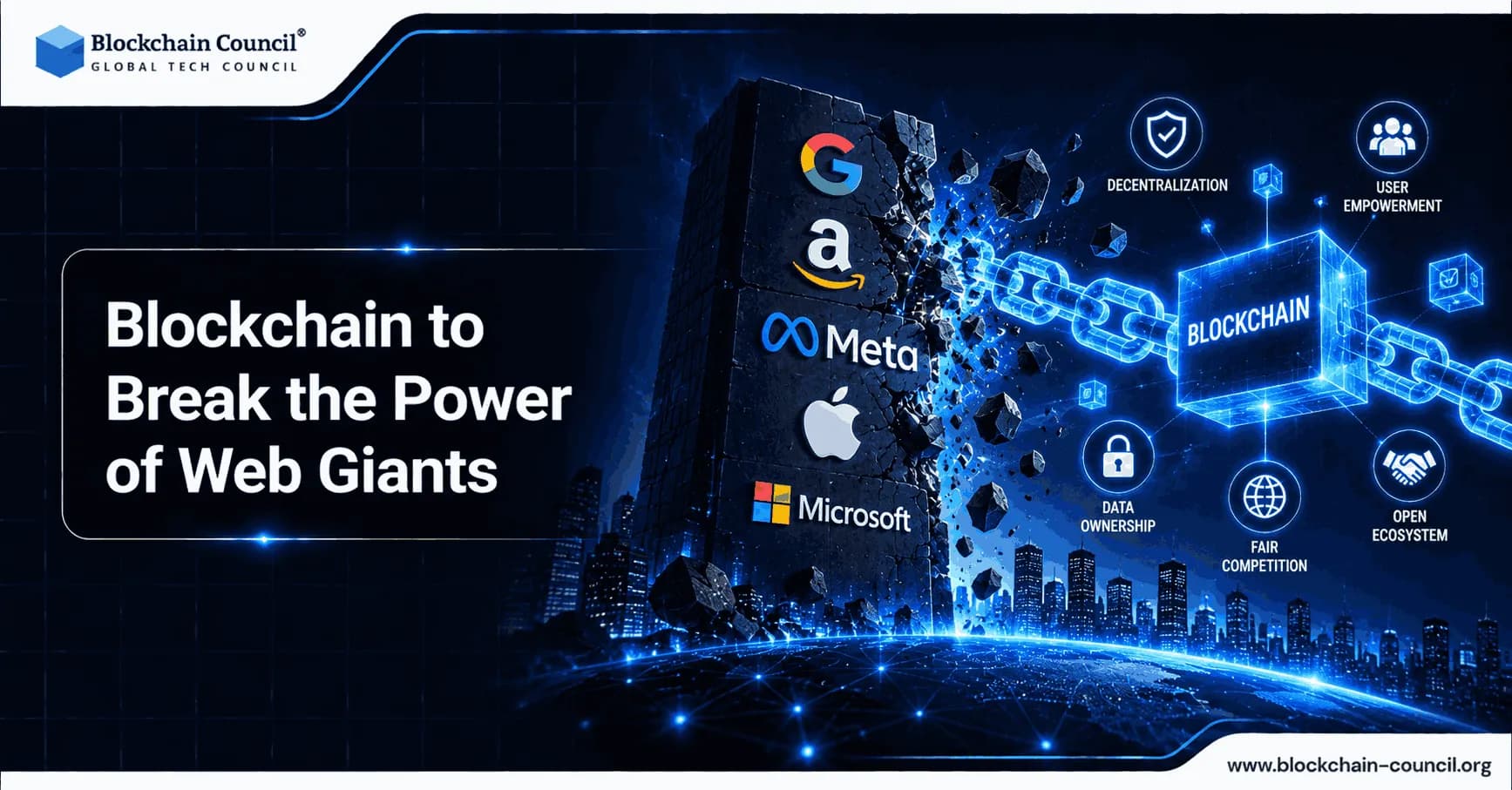
A handful of companies now control the infrastructure most of the internet runs on, the cloud servers hosting a significant share of global websites, the app stores determining which software billions of people can install, the advertising networks deciding what content gets seen, and the data centers storing the personal information nearly every online interaction generates. Blockchain proposes a genuinely different architecture, one where no single company controls the infrastructure, the data, or the rules governing how people interact online. Many people studying whether this proposal holds up in practice start with a Certified Blockchain Expert credential to understand exactly where decentralized infrastructure can realistically challenge concentrated web power, and where that challenge remains genuinely unproven.
In this article, we will look at the specific forms of concentrated power blockchain is being built to challenge, the real infrastructure already competing with centralized web giants, and the genuine obstacles standing between blockchain's promise and any meaningful redistribution of power online.

The Specific Concentrations of Power Blockchain Targets
Web giants hold power across several genuinely distinct layers of internet infrastructure, and understanding blockchain's challenge requires separating these layers rather than treating "big tech power" as a single, undifferentiated target. Cloud computing infrastructure remains highly concentrated among a small number of providers, giving those companies enormous influence over which websites and applications can even function reliably. App store gatekeeping lets platform owners control which software reaches users and what commission developers must pay for that access. Advertising networks concentrate enormous data and decision making power over what content gets shown to whom. And centralized data storage means personal information collected across countless services often sits within the same small set of corporate infrastructure providers, regardless of which specific company a person believes they are interacting with.
Blockchain based alternatives propose addressing each of these layers directly, decentralized cloud storage and computing, decentralized app distribution that removes a single gatekeeper's commission and approval power, blockchain based advertising models that give users more control over their own data, and storage architectures where no single company holds a complete copy of a user's information.
How Blockchain Infrastructure Is Actually Challenging Web Giants
Decentralized Cloud Storage and Computing
Blockchain based storage networks distribute data across thousands of independent node operators rather than concentrating it within a handful of corporate data centers, meaning no single company holds complete control over where data lives or who can access the infrastructure hosting it. Similarly, decentralized computing networks let developers rent processing power from a distributed network of contributors rather than relying entirely on a small number of centralized cloud providers, offering a genuine alternative pricing and control structure for the infrastructure modern applications depend on.
Decentralized App Distribution
Blockchain based app distribution models propose letting developers reach users directly, without a single app store controlling approval, discovery, and commission on every transaction. This directly targets one of the most consistently criticized aspects of platform gatekeeping, commission structures that have drawn regulatory scrutiny in multiple countries specifically because of how much control a single company holds over software distribution to its own device ecosystem.
Building the infrastructure capable of genuinely replacing centralized app distribution and cloud services requires serious, specialized engineering work, spanning consensus mechanisms, distributed storage architecture, and secure smart contract design. This is why developers building decentralized alternatives to centralized web infrastructure increasingly pursue a Certified Blockchain Developer credential, developing the specific technical skills needed to build systems capable of actually competing on performance and reliability, not just philosophical appeal alone.
User Owned Data and Identity
Blockchain based identity systems let individuals control their own personal data directly, choosing what to share with which services rather than having that data collected, stored, and monetized by default across dozens of platforms owned or dependent on the same small set of web giants. This model directly challenges the advertising driven business structure that has made user data one of the most valuable and closely guarded assets these companies hold.
Decentralized Social and Content Platforms
Beyond infrastructure specifically, blockchain based social platforms propose letting users own their content, audience relationships, and even monetization directly, rather than having a centralized platform control distribution and advertising revenue entirely. Several of these platforms have launched with genuine technical innovation in this space, though none have yet approached the scale needed to seriously challenge established social platforms.
Future-Ready Skills
As technology becomes increasingly important across industries, students need opportunities to develop future-ready skills early in their education. A World Tech Olympiad can introduce students to areas such as artificial intelligence, coding, cybersecurity, robotics, and computational thinking while encouraging curiosity and continuous learning.
Building this kind of early technical foundation gives students a genuine head start toward eventually understanding the decentralized technologies increasingly positioned to challenge concentrated power across the internet's core infrastructure.
Why Web Giants Remain Genuinely Difficult to Displace
Network Effects Built Over Decades
Web giants benefit from network effects that took considerable time and resources to build, users stay because other users, developers, and content are already there, and this dynamic is extraordinarily difficult for any decentralized alternative to overcome quickly, regardless of how compelling the underlying technology might be.
Performance and Reliability Expectations
Centralized infrastructure has been refined over decades to deliver consistently fast, reliable performance at massive scale. Decentralized alternatives, while improving steadily, still generally face genuine performance and reliability tradeoffs compared to infrastructure that has had years of concentrated investment and optimization behind it.
User Experience Gaps
Managing blockchain based identity, decentralized storage, and cryptocurrency payments still generally requires more technical understanding than most users are willing to invest for a marginal improvement in data control or a modest reduction in fees, particularly when a simpler, centralized alternative already meets their needs adequately.
Genuinely closing these gaps requires more than promising technology alone. It requires organizations building decentralized infrastructure to develop the same level of engineering rigor and user experience polish that has taken web giants years to achieve. This is why development teams working on this kind of large scale decentralized infrastructure increasingly pursue a formal Tech Certification, building the broad, applied technical literacy needed to close these performance and usability gaps rather than relying purely on decentralization's philosophical appeal to attract users away from established platforms.
What Realistic Disruption Actually Looks Like
The most credible path forward likely involves gradual, targeted erosion of specific concentrated power, rather than a sudden, wholesale replacement of established infrastructure. Decentralized storage and computing may first gain traction among developers and organizations specifically prioritizing censorship resistance or data sovereignty, rather than mainstream consumers seeking the cheapest or most convenient option. App distribution pressure may continue building through a combination of decentralized alternatives and direct regulatory action, similar to policy changes already forcing greater openness in existing app ecosystems. Broader disruption of core cloud infrastructure and advertising dominance remains a considerably longer term, uncertain proposition, one that depends heavily on decentralized alternatives closing genuine gaps in performance, reliability, and usability first.
Communicating This Genuine but Gradual Shift
Organizations building decentralized alternatives to web giant infrastructure need to communicate their value honestly, avoiding the temptation to oversell decentralization as an imminent, wholesale replacement for centralized infrastructure that continues to work reliably for most users today. Overpromising risks genuine disillusionment once users encounter real, current limitations in performance or usability. This is why many organizations building decentralized infrastructure increasingly pair their technical development with a Marketing Certification, learning to communicate blockchain's genuine, specific advantages honestly to users who are comfortable with the centralized platforms they already know and depend on daily.
Final Thoughts
Blockchain genuinely challenges specific, well defined layers of concentrated power that web giants currently hold, cloud infrastructure control, app distribution gatekeeping, centralized data ownership, and advertising driven business models built on collecting user information by default. Whether this amounts to a genuine breaking of that power depends considerably less on blockchain's theoretical potential and more on whether decentralized alternatives can close real, substantial gaps in scale, performance, and usability that currently favor established infrastructure by a wide and genuine margin.
Blockchain has not broken the power of web giants yet, and given the scale of the network effects and infrastructure investment involved, it may not do so completely for a considerable time. But the technology has laid out a credible, technically grounded blueprint for exactly where that power remains genuinely vulnerable, and that pressure alone is already shaping how competitive and regulatory dynamics around web infrastructure continue to evolve.
FAQs
1. How can blockchain challenge the power of web giants?
Blockchain can challenge centralized internet platforms by enabling decentralized applications, user-controlled digital assets, portable identities, and peer-to-peer transactions. Instead of relying entirely on one company's database or platform, users can interact through distributed networks and shared protocols.
2. What are web giants?
Web giants are large technology companies that operate major internet platforms, search engines, social networks, marketplaces, cloud services, advertising systems, or digital ecosystems. Their scale can give them substantial control over user data, online distribution, advertising, and digital services.
3. Why is centralization a concern on the internet?
Centralized platforms can create strong dependencies because users, businesses, and developers may rely on a single company for access, data storage, identity, payments, or distribution. This can also create concerns around data ownership, censorship, privacy, competition, and single points of control.
4. How does blockchain decentralize online services?
Blockchain distributes transaction records and decision-making across multiple network participants rather than keeping everything under one central database. Depending on the architecture, this can reduce reliance on a single organization for maintaining records or executing certain digital transactions.
5. Can blockchain give users ownership of their data?
Blockchain can support systems designed around user-controlled data and decentralized identity, but blockchain itself does not automatically give users ownership of all their personal information. Web3 architectures can combine blockchain with decentralized storage, verifiable credentials, and access-control systems to give individuals greater control over how information is shared.
6. Can blockchain reduce the power of social media companies?
Potentially. Decentralized social networks can allow users to control identities, relationships, content, or digital assets across multiple applications instead of keeping everything inside one company's ecosystem. However, blockchain does not automatically solve content moderation, discovery, user experience, or network-effect advantages enjoyed by established social platforms.
7. How can blockchain help content creators?
Blockchain can enable creators to establish verifiable ownership of digital assets and receive payments directly from users. Tokenized assets, smart contracts, and decentralized marketplaces can potentially reduce dependence on centralized intermediaries.
8. Can blockchain help creators earn more money?
It can create alternative monetization models by enabling direct payments, tokenized assets, memberships, and programmable revenue distribution. However, blockchain does not guarantee higher income because creators still need audiences, useful content, sustainable business models, and effective distribution.
9. How can blockchain change online advertising?
Blockchain could make advertising transactions more transparent by recording selected events and enabling automated payments through smart contracts. Decentralized identity and privacy-preserving technologies could also reduce the need for platforms to collect excessive personal information, although advertising ecosystems still face significant technical and business challenges.
10. Can blockchain reduce dependence on Google, Facebook, and other large platforms?
Blockchain-based alternatives can reduce dependence in specific areas such as identity, payments, digital ownership, and decentralized applications. However, blockchain is unlikely to eliminate major technology companies by itself because centralized platforms continue to provide highly scalable infrastructure, search, cloud computing, content discovery, and convenient user experiences.
11. What is Web3's role in challenging web giants?
Web3 is a broader vision of a more user-centric internet in which decentralized systems, blockchain, digital assets, and user-controlled data play important roles. NIST describes Web3 as a proposed restructuring of the internet toward user ownership and decentralized systems.
12. Can blockchain eliminate centralized intermediaries?
Blockchain can reduce the need for intermediaries in certain transactions, particularly where participants can interact through smart contracts and decentralized protocols. It cannot eliminate every intermediary because users may still need exchanges, wallets, cloud infrastructure, interfaces, legal services, or other centralized services.
13. How can decentralized identity reduce the power of web giants?
Traditional internet services often require users to maintain separate accounts and provide personal information to individual platforms. Decentralized identity can allow users to maintain portable credentials and selectively provide information to applications, reducing dependence on a single company's identity system.
14. Can blockchain make digital payments more independent?
Yes. Blockchain networks can enable peer-to-peer digital value transfers without requiring every transaction to pass through traditional payment intermediaries. Web3 systems can also incorporate native digital assets and programmable payments, although regulatory, usability, volatility, and compliance issues remain important considerations.
15. Can blockchain prevent censorship by large technology platforms?
Blockchain can make some forms of censorship more difficult when applications and transactions operate on sufficiently decentralized networks. However, censorship can still occur at other layers, including internet access providers, centralized interfaces, wallets, infrastructure providers, validators, or application operators.
16. Can blockchain create decentralized alternatives to app stores?
Potentially. Decentralized applications can be distributed through blockchain-based ecosystems rather than relying entirely on centralized app-store operators. Smart contracts can provide application logic and ownership mechanisms, although users may still depend on centralized devices, operating systems, interfaces, and infrastructure.
17. What role do smart contracts play in reducing centralized control?
Smart contracts allow predefined rules to execute automatically on blockchain networks. This can reduce the need for an intermediary to manually enforce certain agreements, such as payments, asset transfers, membership rules, or decentralized marketplace transactions.
18. What are the biggest challenges to blockchain replacing web giants?
Major challenges include scalability, user experience, governance, interoperability, regulatory compliance, security, decentralized storage, and infrastructure reliability. Research on blockchain-enabled data ecosystems also identifies data sovereignty, governance, security, and cross-system interoperability as important unresolved challenges.
19. Does blockchain automatically make the internet decentralized?
No. A blockchain-based application can still depend on centralized hosting, cloud providers, RPC services, wallets, frontends, exchanges, or other infrastructure. Research has also questioned whether some Web3 systems achieve meaningful decentralization in practice, showing that decentralization must be evaluated across the entire technology stack rather than simply assumed because blockchain is involved.
20. Can blockchain really break the power of web giants?
Blockchain could weaken centralized control in specific areas by giving users more control over identity, digital assets, payments, and data-sharing relationships. However, it is more accurate to say blockchain can redistribute some forms of digital power rather than completely eliminate web giants. The long-term outcome will depend on adoption, usability, interoperability, regulation, governance, and whether decentralized alternatives can compete with the convenience of established platforms.
Related Articles
View All
Blockchain
Beyond Cryptocurrency: How Blockchain Is Transforming Real-World Industries
Explore how blockchain works beyond cryptocurrency in banking, supply chains, healthcare, tokenisation, CBDCs, and government, plus key challenges and career paths.

Blockchain
Smart Contracts & dApps: How Blockchain Becomes Programmable
Learn how smart contracts and dApps make blockchain programmable, from Ethereum and tokens to DeFi, NFTs, real use cases, benefits, and key risks.

Blockchain
Behind the Blocks: How Blockchain Transactions Actually Work
Go behind the blocks to see how a blockchain transaction really works: wallets and keys, digital signatures, verification, hashing, blocks, consensus, proof of work vs proof of stake, and how miners and validators secure the network.
Trending Articles
How Blockchain Secures AI Data
Understand how blockchain technology is being applied to protect the integrity and security of AI training data.
How to Install Claude Code
Learn how to install Claude Code on macOS, Linux, and Windows using the native installer, plus verification, authentication, and troubleshooting tips.
How to Create Claude Skills?
Claude Skills are one of the most important features Anthropic has introduced for users who want automation that is structured, consistent and reusable. Instead of giving Claude long instructions ever