

Can Blockchain Build Balance to the Work Industry?
 Toshendra Kumar Sharma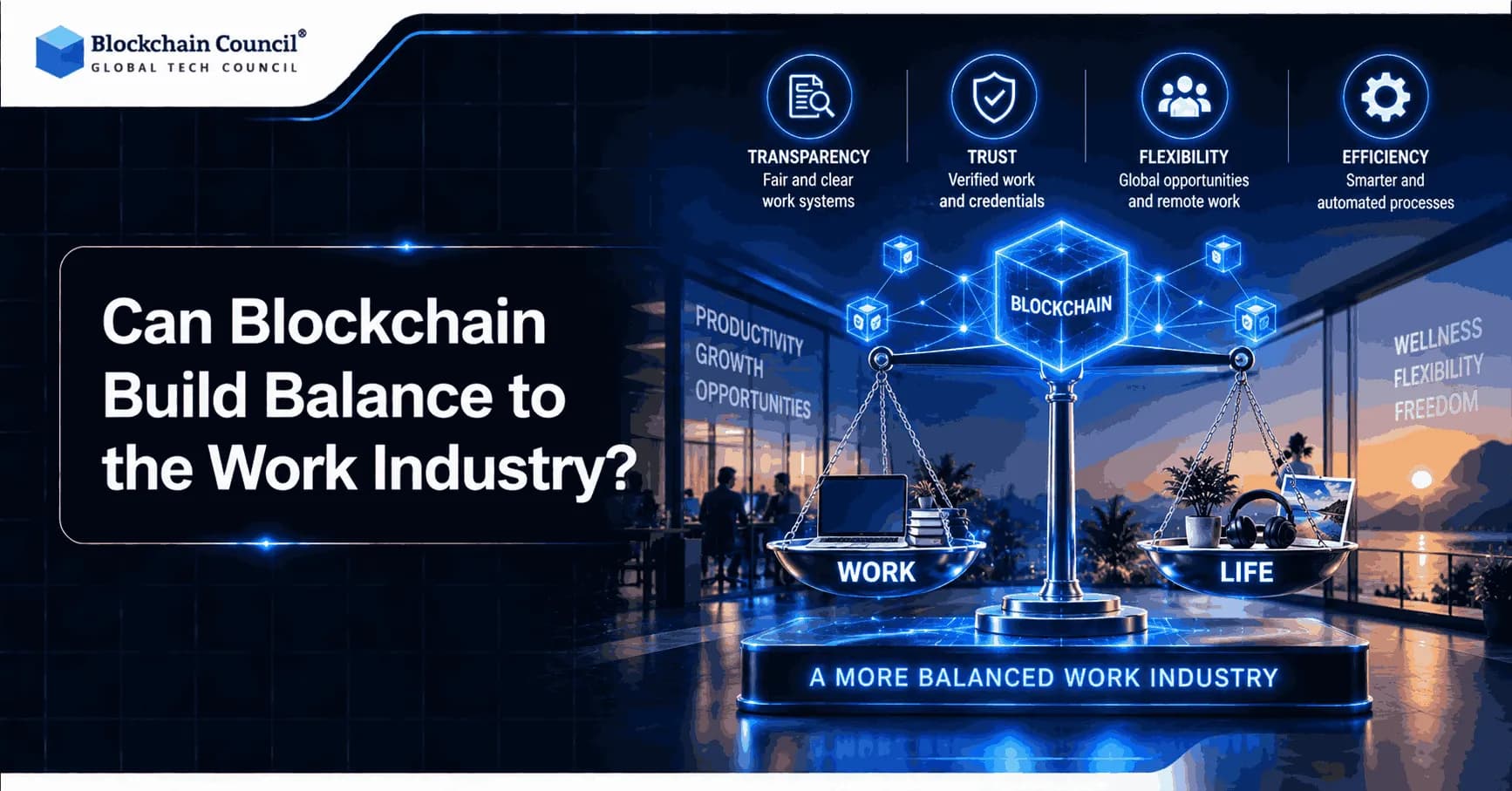
The modern work industry runs on a genuine imbalance. Platforms controlling gig work, freelance marketplaces, and even traditional employment records hold disproportionate power over the people actually doing the work, setting fees, controlling reputation data, and often taking a substantial cut of every transaction without giving workers meaningful say in how the system operates. Blockchain proposes a genuinely different model, one where workers hold more direct control over their earnings, their professional reputation, and the platforms they depend on. Many professionals studying this potential shift start with a Certified Blockchain Expert credential to understand exactly where blockchain can realistically rebalance power in the work industry, and where that promise remains genuinely unproven.
In this article, we will look at the specific imbalances blockchain is being applied to address across the modern work industry, the real platforms and models already testing this approach, and the genuine limits standing between blockchain's promise and truly balanced work arrangements.

The Genuine Imbalance Blockchain Is Responding To
Today's dominant work platforms, from gig economy apps to freelance marketplaces, generally hold three kinds of power that workers themselves do not. They control the algorithm determining who gets matched with which job. They control the reputation and review data a worker spends years building, data that typically cannot be transferred if a worker wants to leave the platform. And they set commission rates and payment terms largely without worker input, often changing these terms unilaterally with limited recourse for the people actually affected.
This concentration of control has produced genuinely well documented frustrations, delayed payments, opaque rating systems, sudden policy changes that affect a worker's livelihood overnight, and reputation data that evaporates the moment a worker tries to move to a different platform. Blockchain's core properties, decentralization, transparency, and portable, verifiable records, directly target each of these specific pain points rather than offering a vague, general purpose fix.
How Blockchain Is Being Applied to Rebalance Work
Portable, Verifiable Professional Reputation
One of blockchain's more genuinely promising applications involves letting workers own a portable record of their completed work, client ratings, and verified skills, one that travels with them across platforms rather than remaining locked inside a single company's proprietary database. This addresses a genuine, long standing frustration, since workers currently lose years of accumulated reputation the moment they switch platforms or a platform shuts down entirely.
Direct, Disintermediated Payment Structures
Blockchain based payment systems allow clients and freelancers to transact directly, with smart contracts automatically releasing payment once agreed upon conditions are verified as met. This removes much of the commission a traditional platform would otherwise take, and it can also resolve payment disputes more transparently, since the conditions for release are encoded directly into the contract rather than left to a platform's internal, often opaque resolution process.
Building the infrastructure capable of handling this kind of automated, trustworthy payment release at scale requires genuine, specialized technical skill. This is why developers building decentralized work platforms increasingly pursue a Certified Blockchain Developer credential, developing the smart contract expertise needed to build payment systems that workers and clients alike can genuinely trust without a centralized platform arbitrating every transaction.
Worker Owned Governance Through DAOs
Decentralized autonomous organizations, or DAOs, offer a genuinely novel model for worker governance, letting contributors hold tokens that grant them a direct vote in decisions about platform fees, policies, and priorities. This represents a meaningful structural shift from the traditional model, where workers have essentially no formal input into decisions a platform makes unilaterally, toward one where workers hold genuine, tokenized decision making power alongside the platform's other stakeholders.
Transparent, Auditable Labor Supply Chains
Beyond individual freelance work, blockchain is also being applied to bring transparency to broader labor supply chains, verifying working conditions, fair wage compliance, and ethical sourcing claims that have historically been difficult for consumers and regulators to independently confirm. This application extends blockchain's balancing potential beyond gig platforms into manufacturing and global supply chains, where labor conditions have often remained genuinely opaque to everyone outside the immediate employer.
Real World Examples Worth Understanding
Several platforms have already tested elements of this model in practice. Decentralized freelance marketplaces have launched specifically to let workers keep a larger share of their earnings by removing traditional platform commissions, using blockchain based escrow and smart contracts to handle payment release automatically. Some supply chain transparency initiatives have used blockchain specifically to verify fair labor practices across garment manufacturing, giving brands and consumers a genuinely verifiable way to confirm ethical sourcing claims rather than relying on a company's own, self reported assurances.
Future-Ready Skills
As technology becomes increasingly important across industries, students need opportunities to develop future-ready skills early in their education. A World Tech Olympiad can introduce students to areas such as artificial intelligence, coding, cybersecurity, robotics, and computational thinking while encouraging curiosity and continuous learning.
Building this kind of early technical foundation gives students a genuine head start toward eventually understanding how emerging technologies like blockchain are being applied to reshape fairness and balance across entire industries, including the future of work itself.
The Genuine Limits Standing in the Way
Blockchain's balancing potential in the work industry faces real, unresolved obstacles. Decentralized platforms still need to achieve the same scale and liquidity, enough workers and enough clients simultaneously active, that established centralized platforms have spent years building, and network effects remain genuinely difficult for any new entrant to overcome quickly. Many workers, particularly those in industries with limited technical exposure, still find managing digital wallets and understanding blockchain based systems a genuine barrier to entry compared to a simple, familiar app. And DAO governance, while conceptually appealing, still faces real practical questions around voter participation, decision making speed, and whether token based voting genuinely represents the interests of the broader worker base or concentrates influence among the most technically engaged, token heavy participants.
Understanding both the genuine promise and these real constraints requires careful, honest analysis rather than uncritical enthusiasm for the technology's theoretical potential. This is precisely why organizations and platforms building decentralized work solutions need to communicate both sides clearly to the workers and clients they are trying to attract. This is why teams working on these platforms increasingly pursue a formal Tech Certification, building the well rounded technical literacy needed to design systems that genuinely deliver on blockchain's balancing promise rather than simply adding decentralized branding to the same underlying power imbalances.
What Genuine Balance Would Actually Require
Real, lasting balance in the work industry likely requires more than blockchain technology alone. It requires genuine worker adoption at meaningful scale, regulatory frameworks that recognize and protect blockchain based work arrangements the way traditional employment law protects conventional workers, and platforms genuinely committed to worker governance rather than using decentralized language as a marketing layer over an otherwise unchanged, centrally controlled system. Blockchain provides the technical infrastructure capable of supporting this shift, but the shift itself depends on choices made by the people and organizations actually building and adopting these systems.
Communicating This Shift Honestly
As decentralized work platforms continue developing, clearly and honestly explaining both their genuine benefits and their real, current limitations matters enormously for building lasting trust with the workers these systems are meant to serve. Overpromising blockchain's ability to instantly fix deep, structural imbalances risks genuine disillusionment once workers encounter the technology's real, current constraints. This is why organizations building these platforms increasingly pair their technical development with a Marketing Certification, learning to communicate blockchain's genuine, specific benefits honestly rather than overselling a complete, instant solution to problems that have persisted across the work industry for decades.
Final Thoughts
Blockchain genuinely offers meaningful tools for rebalancing specific, well documented imbalances in the modern work industry, portable reputation data, direct and transparent payment structures, worker governance through DAOs, and verifiable labor supply chain transparency. Whether this translates into genuine, industry wide balance depends less on the technology itself and more on whether decentralized platforms can achieve real adoption at scale, whether regulation evolves to support these new work arrangements, and whether the organizations building these systems remain genuinely committed to worker empowerment rather than treating decentralization as a marketing narrative alone.
Blockchain has not yet built lasting balance to the work industry, but it has laid out a credible, technically grounded path toward exactly that outcome, one that will depend as much on adoption and intention as it does on the underlying technology itself.
FAQs
1. Can blockchain create more balance in the work industry?
Blockchain could help create greater balance by improving transparency in payments, employment records, contracts, and worker credentials. However, it cannot create workplace fairness on its own because labor laws, employer policies, worker representation, and social protections remain essential.
2. How can blockchain improve fairness in the workplace?
Blockchain can create tamper-evident records of employment agreements, payments, credentials, and completed work. This can make it easier for workers and employers to verify information and resolve certain disputes based on shared records. Research on blockchain-enabled HR systems highlights transparency and auditability as potential benefits.
3. Can blockchain help workers receive fair payments?
Yes, blockchain and smart contracts can potentially automate payments when predefined work conditions are fulfilled. For example, a contract could release payment after a verified task or milestone is completed, reducing manual payment delays.
4. How can blockchain help freelancers and gig workers?
Blockchain can support freelancers through transparent payments, portable professional credentials, digital identities, and potentially decentralized marketplaces. Research suggests smart contracts could reduce transaction costs and change traditional employer-worker relationships, although this may also create new labor-law challenges.
5. Can blockchain reduce payment disputes between workers and employers?
It can help reduce some disputes by maintaining verifiable records of agreements, completed tasks, and payment transactions. Smart contracts can also automate payments according to predefined conditions, although disputes involving subjective performance or contractual interpretation may still require human intervention.
6. How can blockchain improve employee records?
Blockchain can provide tamper-evident records of employment history, qualifications, certifications, and other professional credentials. This can make it easier for workers to prove their experience when changing employers or working across different organizations.
7. Can blockchain make professional qualifications easier to verify?
Yes. Educational institutions, certification providers, and employers can use blockchain-based credentials to create verifiable records of qualifications. Workers could then share evidence of their skills without repeatedly relying on manual verification processes.
8. Can blockchain give workers greater control over their professional identity?
Blockchain-based digital identity systems can potentially allow workers to control and selectively share verified credentials. This can reduce dependence on centralized organizations for proving employment history, qualifications, or professional experience.
9. How can blockchain improve transparency in wages?
A blockchain-based payroll or labor system could create auditable records of agreed wages, completed work, and payments. This could help identify discrepancies and improve accountability, although wage transparency also requires appropriate privacy controls so that sensitive employee information is not unnecessarily exposed.
10. Can blockchain help prevent workplace exploitation?
Blockchain may help document contracts, working hours, wages, and other employment information, making certain violations easier to identify. Research has proposed blockchain-based worker-management systems that use tamper-proof records and smart contracts for areas such as worker safety and employment management.
11. Can smart contracts replace traditional employment contracts?
Not completely. Smart contracts can automate specific contractual conditions, such as releasing payment after a verified milestone, but employment relationships involve human judgment, labor rights, benefits, dispute resolution, and legal obligations that cannot always be reduced to code.
12. Can blockchain make the gig economy fairer?
Blockchain could address some problems in gig work by supporting transparent payments, portable reputations, digital identity, and decentralized marketplaces. However, research also warns that decentralizing work can weaken traditional employment protections if legal and social safeguards do not evolve alongside technology.
13. Can blockchain help workers move between companies more easily?
Potentially, yes. A worker could maintain a portable collection of verified qualifications, employment records, certifications, and professional achievements. This could reduce the friction involved in proving experience when applying for new opportunities.
14. Can blockchain support decentralized organizations and worker ownership?
Yes. Decentralized Autonomous Organizations (DAOs) use blockchain-based systems and smart contracts to coordinate participants without relying entirely on a traditional centralized organization. Some researchers are exploring DAOs as potential models for worker participation, collective decision-making, and employment generation.
15. Can blockchain give workers more bargaining power?
It potentially can by enabling workers to maintain portable reputations, coordinate collectively, participate in decentralized organizations, and access global marketplaces. However, technology does not automatically create bargaining power, and worker representation, labor organizations, and legal protections remain important.
16. Can blockchain improve workplace safety?
Blockchain can provide an auditable record of safety procedures, inspections, certifications, and incidents. A proposed blockchain-based construction-worker management system, for example, uses tamper-proof timestamps and smart contracts to support worker safety management.
17. Does blockchain guarantee fair treatment of workers?
No. Blockchain can make records more transparent and difficult to alter, but it cannot determine whether wages are fair, working conditions are ethical, or an employer is treating workers appropriately. Those outcomes depend on laws, governance, organizational policies, and human decision-making.
18. What are the risks of using blockchain in the workplace?
Potential risks include privacy concerns, excessive monitoring, technical complexity, regulatory uncertainty, scalability limitations, and the possibility of encoding unfair rules into smart contracts. Blockchain should therefore be implemented with strong privacy, governance, and worker-protection measures.
19. Can blockchain replace human resource departments?
No. Blockchain can automate specific HR activities such as credential verification, recordkeeping, contract execution, and certain payroll processes, but HR departments still perform functions involving recruitment, employee relations, conflict resolution, workplace culture, development, and strategic decision-making. A 2026 study describes blockchain-enabled HR as a framework for enhancing HR processes rather than eliminating human management.
20. What is the future of blockchain in the work industry?
Blockchain could become a useful infrastructure layer for portable worker identities, verifiable credentials, transparent payments, smart contracts, decentralized work platforms, and worker-owned organizations. Its ability to create a genuinely more balanced work industry will depend on combining technological innovation with labor protections, privacy, regulation, and meaningful worker participation. Recent research into blockchain-based labor systems and DAOs shows that this area remains promising but still developing.
Related Articles
View All
Blockchain
Behind the Blocks: How Blockchain Transactions Actually Work
Go behind the blocks to see how a blockchain transaction really works: wallets and keys, digital signatures, verification, hashing, blocks, consensus, proof of work vs proof of stake, and how miners and validators secure the network.

Blockchain
Blockchain vs IoT: How Decentralized Networks and Connected Devices Work Together
Blockchain vs IoT explained: how connected devices, smart contracts, device identity, and decentralized ledgers work together in real systems.

Blockchain
Blockchain Wallets Explained: How They Work, Types, and Security Best Practices
Blockchain wallets manage keys, sign transactions, and secure digital assets. Learn wallet types, risks, best practices, and how to choose the right setup.
Trending Articles

Top 5 DeFi Platforms
Explore the leading decentralized finance platforms and what makes each one unique in the evolving DeFi landscape.
What is AWS? A Beginner's Guide to Cloud Computing
Everything you need to know about Amazon Web Services, cloud computing fundamentals, and career opportunities.

Can DeFi 2.0 Bridge the Gap Between Traditional and Decentralized Finance?
The next generation of DeFi protocols aims to connect traditional banking with decentralized finance ecosystems.