

CeDefi
 Suyash Raizada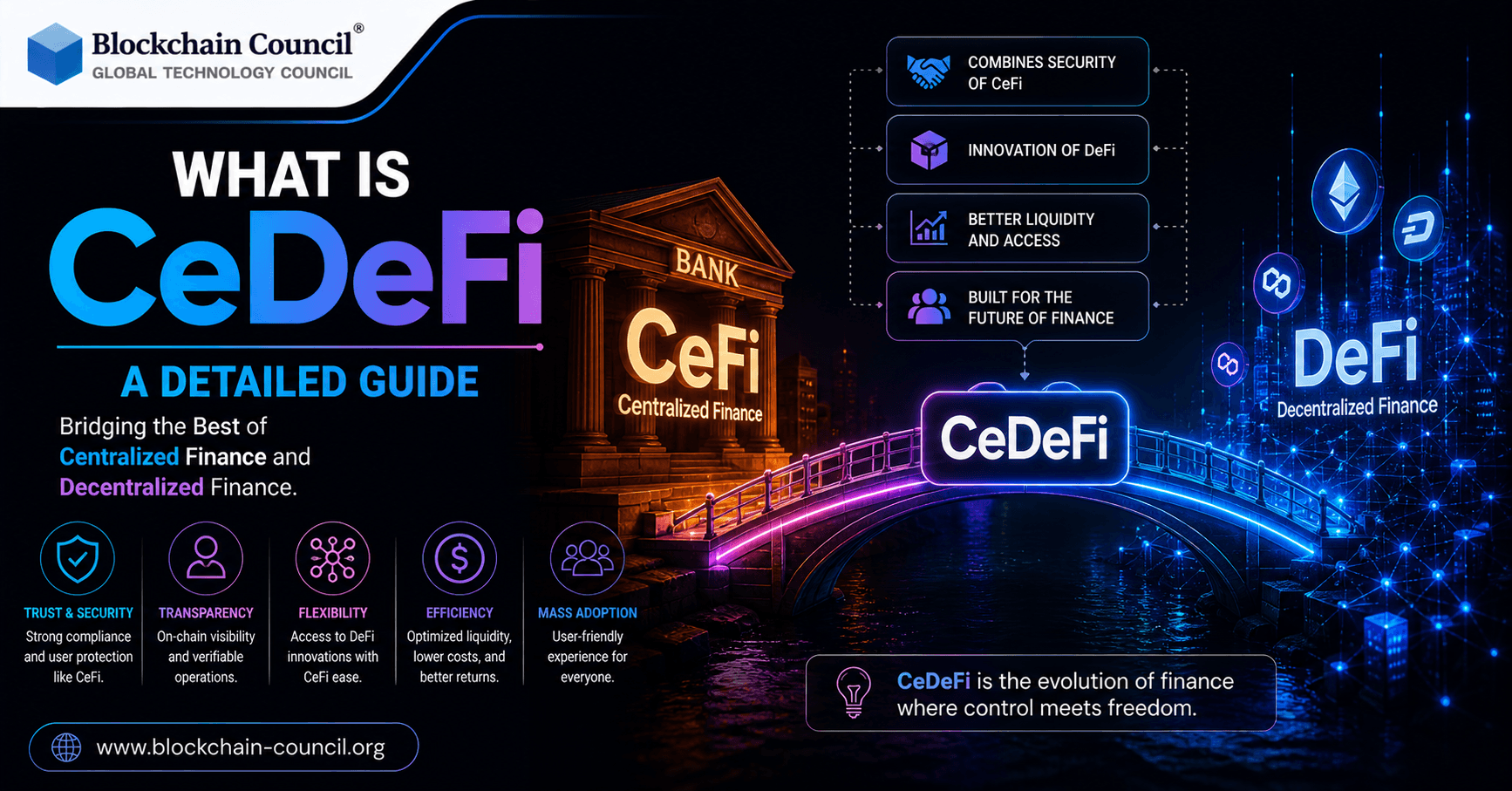
DeFi has been unquestionably garnering attention since its inception. Dapp transaction volumes topped $270 billion, with Ethereum’s DeFi ecosystem accounting for 95%. Decentralized finance protocols ushered in a transparent, trustless financial revolution on various fronts, including lending and borrowing, derivatives, insurance, stablecoins and decentralized exchanges. With almost $250 billion in value locked up in the DeFi ecosystem, it’s evident that the sector is here to stay. Even though DeFi’s naturally decentralized structure contrasts with its centralized equivalents, traditional financial institutions have been seeking to find a way to participate in the developing DeFi ecosystem. Understand how CeDeFi combines the efficiency of centralized platforms with the transparency and automation of DeFi protocols to create hybrid financial systems that improve liquidity, compliance, and user experience by building expertise through a Cryptocurrency Expert, analyzing DeFi protocols and on-chain data using a Python certification, and scaling CeDeFi platforms or products with a Digital marketing course.
CeDeFi, or centralized, decentralized finance, is a solution to this problem. Binance CEO Changpeng “CZ” Zhao invented the acronym CeDeFi when the company debuted its Binance Smart Chain in September 2020. Their BSC chain aimed to bridge the gap between centralized and decentralized finance, launching a USD 100 million seed fund to encourage CeFi and DeFi collaboration. Users can stake BNB, Binance’s native token, and gain farmed tokens from other prospective Finance initiatives. This allows users to reap some benefits of being exposed to DeFi without directly dealing with the protocols. Since then, other chains have been looking into how to structure their networks to keep the best of DeFi but still allow centralized parties access.

Defining CeDefi
The word “CeDeFi” is relatively new in the cryptocurrency realm. CeDeFi, or centralized, decentralized finance, is the ideal combination of centralized and decentralized finance, combining the greatest features of each. Corporations can use CeDeFi to experiment with novel and modern financial products while still adhering to traditional financial regulatory rules.
CeDeFi lets you experiment with DeFi products like decentralized exchanges (DEX), liquidity aggregators, yield farming tools, lending protocols, and much more for a cheap transaction fee. Businesses can use CeDeFi to develop custom smart contracts and add many products and services to a single platform, resulting in faster transactions and lower risk.
Traders can use CeDeFi to find and filter the best possibilities based on liquidity depth, transaction fees, network fees, KYC stipulations, and withdrawal fees, resulting in less slippage, more asset availability, and improved security.
CeDeFi also addresses the emerging regulatory and compliance problems around cryptocurrencies. CeDeFi lays the way for institutional custodianship of DeFi protocols by combining centralized and decentralized financial aspects.
Furthermore, it promotes regulated security tokens for activities such as bond issuance and DeFi stablecoin settlement, integrating many advantages of crypto assets, whether moving or storing value. This is in addition to its potential to transform global payments with protocols that are faster, cheaper, and easier to use.
CeDeFi’s concept is gaining traction since it promises a definite means for crypto fans, both novice and experienced, to operate on safe exchanges while having access to handpicked and validated projects with high liquidity.
Basics of CeDeFi’s Rise
With clear regulatory guidelines, it is expected that decentralized financing using DeFi technology would be acceptable for enterprise deployment in 2022. Traditional centralized financial institutions would embrace mature DeFi applications, which they would then integrate with hybrid CeDeFi services.
The main goal of introducing centralized, decentralized finance is to combine the greatest features of both centralized and decentralized finance systems. As a result, decentralized finance can combine traditional regulatory safeguards with cutting-edge financial products and infrastructure. Binance’s recent experiment merging DeFi (Decentralized Finance) with its centralized platform, known as Binance Smart Chain, could herald new beginnings for DeFi and crypto adoption. In the first half of September, Binance announced the launch of its smart chain, a decentralized public blockchain variation.
Many industry observers see Binance’s entry into the DeFi field as an aggressive move aimed at suffocating Ethereum. CeDeFi, on the other hand, does not attempt to compete with other blockchain projects in the financial sector. On Binance, a thorough examination of the many components of centralized DeFi could aid in learning more.
Role of Binance in the Introduction of CeDeFi
The foremost thing you should understand about Binance is that it is currently the world’s largest cryptocurrency exchange. Binance, on the other hand, has evolved from a simple exchange to a massive ecosystem. Binance introduced the Binance Chain to provide a foundation for achieving its aim of a decentralized exchange (DEX) in place of the current Binance Exchange.
Binance has long been one of the most popular exchanges, with a significant market share regarding the 24-hour trading volume. CZ, Binance’s pseudonymous founder and CEO, and the company found their way into the Decentralized Finance sector via Binance Chain. Binance Chain was designed to make it simple to perform DeFi transactions, accelerating the emergence of a new financial trend.
Following that, Binance created the Binance smart chain to assist users in designing and developing decentralized applications, or dApps. Binance launched the Binance Chain in April 2019, and the smart chain will launch in September 2020.
As a result, it’s easy to overlook that Smart Chain is still relatively new, especially in the DeFi sector. As a result, it’s tough to find all of the smart chain’s interesting ideas. Both the Binance Chain and the Smart Chain, on the other hand, are attracting the interest of scholars, developers, investors, and traders.
Both the Binance Chain and the Smart Chain operate in tandem, having autonomous and compatible capabilities. Binance Chain seeks to match the transaction speeds of centralized exchanges in general. On the other hand, Binance Smart Chain may provide a benefit in terms of network congestion mitigation. The smart chain also eliminates the concerns about increasing fees with Ethereum.
CeDeFi’s Advantages
So now you know what CeDeFi is, where it came from, and its numerous features. As a result, it’s critical to learn about the benefits of Smart Chain on Binance and the reasons for its popularity. Here are some of the most significant benefits of Binance CeDeFi, which have the potential to propel the innovative concept to new heights in the modern financial environment.
Binance is funding the Protocols
The funding of protocols is the most significant benefit of centralized DeFi on Binance. Binance’s Smart Chain provides funding for several protocols. Binance’s team is hard at work finding current and future projects to support through Binance Accelerator Funds.
Binance awards candidates with diverse resources throughout the ecosystem as part of the due diligence process, including extensive security assessments. Binance offers various services, including media access, a large client base with millions of users, financial management, and educational platforms.
Yield Farming’s Advantages
Binance CeDeFi’s popularity is mostly based on yield farming. Yield farming is a method of increasing token income by integrating the processes of borrowing, lending, and trading. Different DeFi protocols must be used to lock the tokens. Annual percentage yields were insanely high in the early days of DeFi.
Users may have the possibility to earn APYs of over 1000 percent in some circumstances. However, such profits cannot be sustained, and as a result, they have dwindled. Binance Smart Chain, on the other hand, appears to have a good chance of launching its centralized-DeFi campaign. On Binance CeDeFi, some protocols have shown higher APYs than conventional DeFi protocols.
Ethereum is being supported
Support for Ethereum is another possible cause for CeDeFi’s gaining popularity, thanks to Binance’s efforts. Because of Ethereum’s extremely high prices, DEX transactions can cost hundreds of dollars. Furthermore, Ethereum causes network congestion, resulting in increased time consumption.
The Top 5 Emerging CeDeFi Exchanges to Keep an Eye on
Traditional finance and cryptocurrency are sometimes considered conflicting ecosystems, which is incorrect. Crypto is a more advanced version of today’s markets, with a decentralized architecture as its key distinguishing feature.
Legacy financial ecosystems are centralized, implying they are managed from a single location. For example, central banks, including the Federal Reserve, keep the money supply under control. This is not the situation with crypto because operations are pre-programmed on decentralized smart contracts with no major parties.
Despite their differences, crypto and traditional banking are mutually beneficial ecosystems that are more likely to prosper through integrated solutions. The crypto sector currently includes both centralized and decentralized projects, such as exchanges, yield platforms, and financial instruments, among other things.
That creates a co-dependent ecosystem; innovators are now working on solutions to merge Centralized Finance (CeFi) and Decentralized Finance (DeFi). Several crypto projects have already released integration solutions, while others are exploring embracing DeFi advances while keeping a CeFi architecture.
This year, we’ll highlight five of the most promising CeDeFi projects to keep an eye on.
Unizen
Unizen is a smart exchange ecosystem that bridges the gap between centralized (CEX) and decentralized (DEX) infrastructure. This smart exchange, a first of its kind, aims to alleviate the crypto ecosystem’s liquidity, slippage, and KYC issues.
The project has unveiled a smart exchange that combines multiple crypto products and exchanges into a single platform. Unizen’s smart exchange is one of the most recent CeDeFi ventures to gain popularity with investors and traders. For liquidity-compliant solutions in the DeFi market, the initiative has worked with important businesses such as AllianceBlock.
Unizen, smart exchange users, should be able to browse for a wide choice of crypto items while maintaining their desired KYC tolerance. Unizen is also preparing to create a multi-dynamic staking program in which users can stake ZCX, the platform’s governance token, on Binance Smart Chain (BSC).
Followers will be rewarded with the ZCX governance token and other digital assets used as liquidity provision pairings. Unizen’s incubator ZenX laboratories, node hostings, and listings on the hybrid smart exchange will be used to fund this endeavor.
Unizen modules, third-party modules, and Unizen custom logic form the foundation of the Unizen hybrid exchange. Unizen modules will include built-in features like the platform’s centralized exchange (CEX), while third-party modules will include DeFi integrations. Additional trading capabilities, such as a cross-chain trade aggregation algorithm and social sentiment indicators, are available in the Custom logic.
CoinZoom
CoinZoom is a crypto exchange established in the United States that aims to provide a one-stop shop for crypto trading and real-world application of digital assets. Users can invest in over 30 listed tokens on the regulated exchange, offering a Visa debit card for crypto spending.
CoinZoom users may send cryptocurrency to family, friends, and business contacts worldwide within minutes. Todd Crosland, the company’s CEO, has previously stated that CoinZoom is a “full experience.”
CoinZoom’s Ethereum-based coin, ZOOM, also bridges the gap between traditional finance and crypto. CoinZoom’s decentralized ecosystem revolves around these tokens, allowing users to gain various DeFi rewards.
CoinZoom’s centralized exchange is complemented by this decentralized infrastructure, which provides more chances to merge CeFi and DeFi.
Nexo
Nexo is a CeFi company that offers various services, including an exchange, a card, borrowing services, and the NEXO utility crypto-token.
The regulatory scope is crucial to the platform’s approach to CeDeFi integration. Regulating the crypto economy, particularly in the young DeFi sector, remains a major concern today. While the case for decentralization may be legitimate, some components of the DeFi market are not ‘fully’ decentralized.
Decentralized Autonomous Organizations (DAO) fuel this ecosystem, allowing token holders to vote on the future growth of a DeFi project. Developers can sometimes influence the distribution of governance tokens to benefit specific stakeholders. The decentralized aspect of a DeFi project could be undermined if this happens.
Nexo aims to close this gap by providing infrastructure for DeFi developers to create regulatory-compliant products. The Nexo CeFi business delivers DeFi technologies with a regulated building ecosystem through its knowledge, industry relationships, and licenses worldwide. Nexo’s CeDeFi solutions can allow controlled DeFi developments while the project is centralized, protecting CeFi and DeFi users.
Bybit
Bybit is a cryptocurrency derivatives market that sells Bitcoin and Ether futures, among other financial instruments. The exchange has a diverse user base, with most of its customers being from Asia. Bybit is also exploring making its centralized products available in a more decentralized format.
It’s worth noting that existing derivative exchanges have two options: the first is to adhere to legacy financial standards, and the second is to develop decentralized products.
Although the exchange is exploring releasing decentralized products, Bybit wishes to remain regulatory compliant. Bybit will eventually take the decentralized route, giving centralized products in a more decentralized manner.
Binance Smart Chain (BSC)
Binance is quite a prominent cryptocurrency exchange globally and is ahead of the curve with its CeDeFi solution. The exchange launched Binance Smart Chain (BSC) to allow DeFi developers to integrate their decentralized projects. Many DeFi initiatives now call BSC home, and they benefit from both centralized and decentralized ecosystems. The centralized crypto market has become a hotspot for DeFi locals, with daily volumes vying with Ethereum. However, certain crypto community members remain unconvinced of the BSC CeDeFi architecture’s novelty.
Final Takeaway
Crypto ecosystems have a long way before conventional institutions and investors accept native products. One strategy to encourage usage and introduce regulatory-compliant goods is to create a CeDeFi ecosystem.
Finally, you can see how CeDeFi is poised to change the financial world. Financial services face numerous challenges due to the growing scope of digitalization, particularly in terms of security, control, and transparency. As a result, users desiring democratic control over financial transactions began to pay attention to DeFi or decentralized finance projects. Build CeDeFi applications that integrate centralized controls like KYC and compliance with decentralized smart contract execution for lending, staking, and trading by mastering blockchain ecosystems through a Certified Blockchain Expert, developing hybrid financial platforms using a Node JS Course, and promoting innovative fintech solutions with an AI powered marketing course.
If you want to keep up with the trends of blockchain industry, join our communities on Discord, Reddit and Telegram.
FAQs
1. What is CeDeFi?
CeDeFi stands for Centralized Decentralized Finance, a hybrid model that combines the efficiency of centralized platforms with the transparency of decentralized finance. It allows users to access DeFi services through structured, compliant systems. This approach aims to reduce risks while maintaining flexibility. CeDeFi is designed to bridge the gap between traditional finance and blockchain-based ecosystems.
2. How does CeDeFi differ from DeFi?
DeFi operates without intermediaries, relying entirely on smart contracts and decentralized protocols. CeDeFi, on the other hand, introduces a layer of centralized oversight for better compliance and usability. This helps reduce risks like hacks or user errors. It offers a more controlled environment compared to fully decentralized systems.
3. How is CeDeFi different from traditional finance (CeFi)?
Traditional finance (CeFi) is fully centralized and controlled by institutions. CeDeFi integrates decentralized technologies like blockchain while retaining some centralized governance. This allows for transparency and automation without losing regulatory compliance. It creates a balance between innovation and control.
4. Why is CeDeFi gaining popularity in 2026?
CeDeFi is gaining traction because it addresses the limitations of both DeFi and CeFi. It offers improved security, regulatory alignment, and user-friendly interfaces. Institutions are more comfortable adopting CeDeFi due to its structured approach. It also attracts users who want DeFi benefits without high risk.
5. What are the main benefits of CeDeFi?
CeDeFi offers enhanced security, better compliance, and easier user experience. It reduces risks associated with smart contract vulnerabilities and user mistakes. It also provides access to advanced financial tools. This makes it appealing to both beginners and experienced users.
6. What are the risks associated with CeDeFi?
While CeDeFi reduces some risks, it introduces others such as centralization concerns. Users may need to trust platform operators. Regulatory changes can also impact operations. Balancing decentralization and control remains a challenge.
7. How does CeDeFi improve security?
CeDeFi platforms often implement audits, compliance checks, and monitoring systems. These measures help prevent hacks and fraud. Centralized oversight adds an extra layer of protection. This makes CeDeFi safer compared to purely decentralized platforms.
8. What role do smart contracts play in CeDeFi?
Smart contracts automate transactions and financial processes in CeDeFi systems. They ensure transparency and reduce manual intervention. However, centralized systems may oversee or manage these contracts. This combination improves reliability and efficiency.
9. Can institutions adopt CeDeFi easily?
Yes, CeDeFi is designed to be more accessible for institutions compared to DeFi. It includes compliance features like KYC and AML. This makes it easier for banks and financial firms to participate. Institutional adoption is a key driver of CeDeFi growth.
10. What are common use cases of CeDeFi?
CeDeFi is used in lending, borrowing, staking, and yield farming. It also supports asset management and trading. These use cases combine decentralized protocols with centralized management. This improves efficiency and reduces risks.
11. How does CeDeFi support regulatory compliance?
CeDeFi platforms integrate compliance mechanisms such as identity verification and transaction monitoring. This aligns them with global financial regulations. It helps build trust among users and institutions. Compliance is a major advantage of CeDeFi.
12. What technologies power CeDeFi?
CeDeFi relies on blockchain, smart contracts, and centralized management systems. It may also use AI and analytics for risk assessment. These technologies work together to create a hybrid financial ecosystem. Innovation continues to drive its evolution.
13. Is CeDeFi suitable for beginners?
Yes, CeDeFi platforms are generally more user-friendly than DeFi. They provide guided interfaces and customer support. This makes it easier for beginners to participate. It lowers the barrier to entry in blockchain finance.
14. How does CeDeFi impact liquidity?
CeDeFi improves liquidity by attracting both retail and institutional investors. Centralized platforms can manage liquidity pools more efficiently. This ensures smoother transactions. Increased liquidity benefits the entire ecosystem.
15. What is the role of governance in CeDeFi?
Governance in CeDeFi can be a mix of centralized decision-making and decentralized voting. This allows for flexibility and control. It helps maintain stability while enabling innovation. Governance models vary across platforms.
16. Can CeDeFi coexist with DeFi?
Yes, CeDeFi complements DeFi rather than replacing it. It provides an alternative for users who prefer more security and compliance. Both models serve different needs. Together, they expand the financial ecosystem.
17. What are examples of CeDeFi platforms?
Some platforms integrate CeDeFi features by combining centralized exchanges with DeFi services. These platforms offer staking, lending, and yield farming with added security. They aim to provide the best of both worlds. The ecosystem is growing rapidly.
18. How does CeDeFi enhance user experience?
CeDeFi platforms simplify complex DeFi processes. They offer intuitive interfaces and customer support. This makes financial services more accessible. Improved UX is a key factor in adoption.
19. What is the future of CeDeFi?
The future of CeDeFi looks promising with increasing adoption by institutions and retail users. Integration with AI and advanced analytics will enhance capabilities. It is expected to play a major role in digital finance. Continuous innovation will drive growth.
20. Why should you learn about CeDeFi?
Understanding CeDeFi helps you stay ahead in the evolving financial landscape. It offers insights into the future of finance. Professionals can leverage this knowledge for career growth. It is a valuable skill in the blockchain ecosystem.
Related Articles
View All
DeFi
CeDeFi Vs DeFi – Key Differences
The shifting dynamics of the financial ecosystem are the most serious challenge for most people worldwide. At its launch, DeFi (Decentralized Finance) seemed to offer a lot of promise for better openness in the global financial landscape. On the other side, the deployment of centralized-DeFi could…

DeFi
DeFi Lending and Borrowing: Overcollateralization, Liquidations, and Interest Rate Models
Learn how DeFi lending and borrowing works, including overcollateralization, liquidation incentives, and utilization-based interest rate models that shape risk and returns.

DeFi
The Future of DeFi Regulation: Compliance Challenges, KYC/AML Trends, and What Builders Should Prepare For
Explore the future of DeFi regulation, emerging KYC/AML and sanctions trends, and the compliance architecture builders need to prepare for enforcement and growth.
Trending Articles

Top 5 DeFi Platforms
Explore the leading decentralized finance platforms and what makes each one unique in the evolving DeFi landscape.
How Blockchain Secures AI Data
Understand how blockchain technology is being applied to protect the integrity and security of AI training data.
What is AWS? A Beginner's Guide to Cloud Computing
Everything you need to know about Amazon Web Services, cloud computing fundamentals, and career opportunities.