

DeFi Lending
 Toshendra Kumar Sharma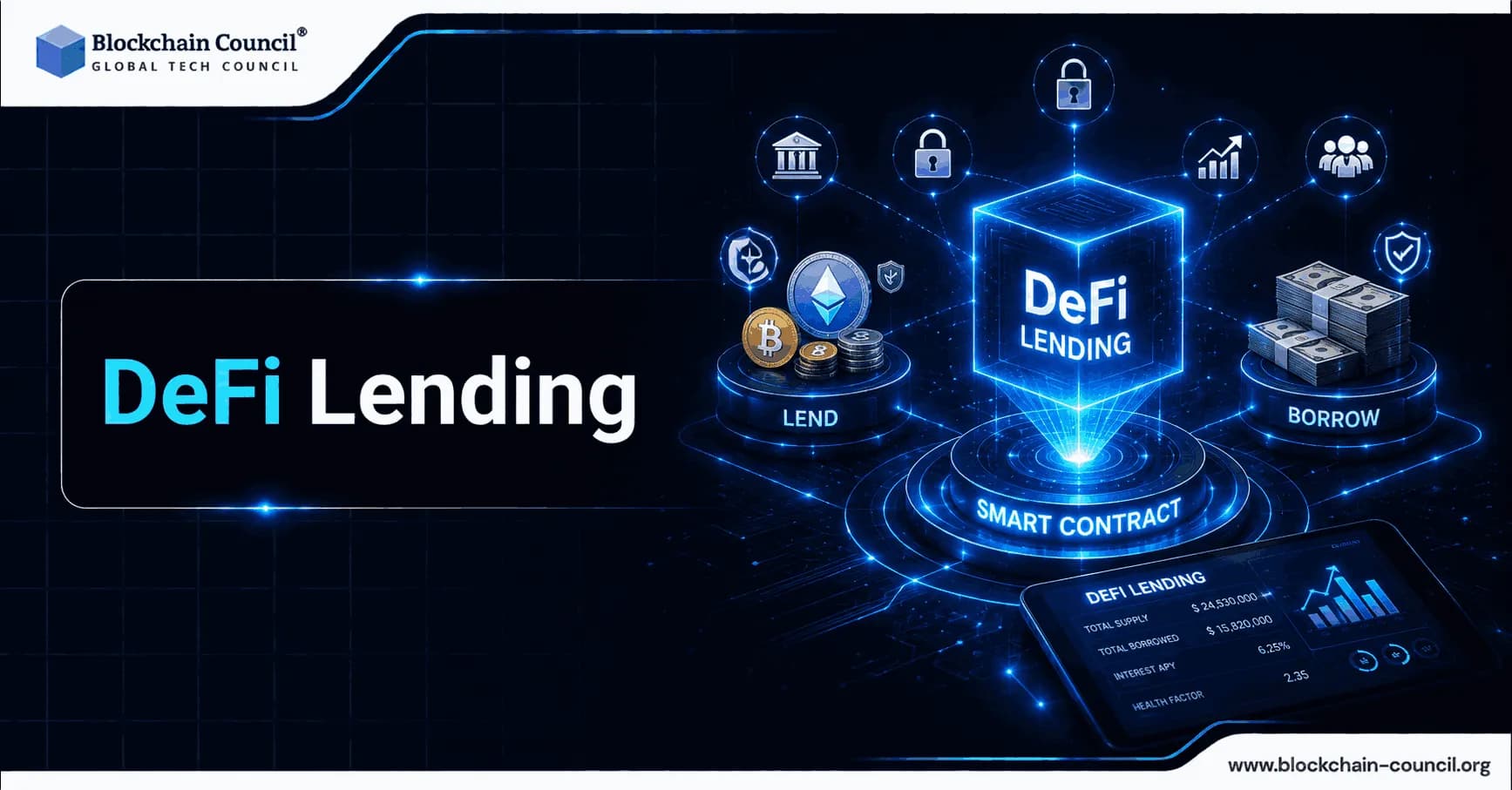
Decentralized finance lending has grown from an experimental corner of crypto into one of the largest and most institutionally credible categories in the entire industry. By 2026, DeFi lending protocols collectively hold tens of billions of dollars in deposits, spread across hundreds of active platforms, with major asset managers now building formal partnerships directly into the space rather than watching from the sidelines. This guide breaks down what DeFi lending actually is, how it works, the protocols that dominate the space, and the risks anyone considering it should understand before depositing a single dollar. Building genuine expertise in this space, rather than relying on scattered forum advice, is exactly what a Certified DeFi Expert credential is designed to provide.
What Is DeFi Lending?
DeFi lending lets people borrow and lend cryptocurrency directly through blockchain based smart contracts, without a bank, credit union, or brokerage acting as an intermediary. Lenders deposit crypto assets, commonly stablecoins like USDC or USDT, into a liquidity pool and earn interest paid automatically by borrowers. Borrowers, in turn, lock up collateral, typically worth more than the amount they want to borrow, and receive a loan against that collateral without going through a credit check or approval process. Interest rates on most platforms adjust automatically based on real time supply and demand within each pool, rather than being set by a loan officer or centralized rate committee. Understanding the deeper mechanics behind these automated rate models and collateral systems is where a Certified Cryptocurrency Expert credential becomes genuinely useful, since DeFi lending sits at the intersection of traditional lending concepts and blockchain specific mechanics that don't have a direct equivalent in conventional finance.

How DeFi Lending Actually Works
The core mechanics of DeFi lending follow a fairly consistent pattern across most major protocols. A lender deposits an asset into a shared liquidity pool and receives a token representing their deposit, which accrues interest automatically over time. A borrower deposits collateral, usually a different crypto asset, and can then borrow up to a set percentage of that collateral's value, a practice known as overcollateralization since the loan amount is always smaller than the value backing it. If the value of the borrower's collateral falls too close to the value of their outstanding loan, an automated liquidation process kicks in, selling enough collateral to repay the loan and protect the lenders' deposits, all without any human intervention. This overcollateralization requirement is the single biggest structural difference between DeFi lending and traditional bank lending, and it exists specifically because DeFi protocols have no way to verify a borrower's identity, credit history, or ability to repay through legal means.
The Major DeFi Lending Protocols in 2026
The lending landscape has consolidated around a handful of dominant platforms, though the specific rankings shift regularly as capital moves between them. Aave remains the largest protocol by total value locked, operating across more than a dozen blockchain networks and having originated well over a trillion dollars in cumulative loans since its 2017 launch as ETHLend. Morpho has emerged as one of the fastest growing entrants, built as a minimal lending primitive rather than a single managed pool, allowing curated vaults to allocate deposits across isolated markets, an architecture that has attracted serious institutional capital, including a widely reported partnership with asset manager Apollo Global Management. Compound, one of the original pioneers of pooled DeFi lending, has taken a more conservative path with its V3 architecture, isolating each market around a single base asset to tighten risk parameters, while Spark has built a significant lending base around its own stablecoin ecosystem. Stablecoin supply yields across these platforms commonly range from roughly 3 to 8 percent annually depending on the protocol and current market utilization, consistently outperforming traditional savings accounts, though that yield always comes bundled with smart contract and market risk that a savings account simply doesn't carry.
The Real Risks of DeFi Lending
DeFi lending's risks are structurally different from traditional lending risk, and understanding them matters just as much as understanding the yield. Smart contract risk sits at the top of the list, since a bug or exploit in a protocol's code can result in a complete loss of deposited funds, regardless of how sound the underlying economic design is. Oracle risk is closely related, since most lending protocols rely on external price feeds to determine when a loan should be liquidated, and a manipulated or delayed price feed has been the root cause of several major DeFi exploits. Liquidation risk affects borrowers directly, since a sudden drop in collateral value during volatile markets can trigger automatic liquidation at unfavorable prices, sometimes compounded by network congestion that delays a borrower's ability to add collateral in time. Governance risk is a subtler concern, particularly on protocols like Morpho where curated vaults introduce a layer of trust in the curator's risk management decisions, separate from the underlying smart contract code itself. Evaluating all of these risk layers properly, rather than chasing the highest advertised yield on a dashboard, requires real technical fluency. That kind of applied risk literacy is exactly what a solid Tech Certification in blockchain and DeFi infrastructure is built to provide, going well beyond surface level comparisons of advertised interest rates.
Regulatory Considerations and Institutional Adoption
DeFi lending has increasingly caught the attention of regulators and institutional finance alike. In the United States, the GENIUS Act's stablecoin framework has brought clearer rules to the assets that underpin most DeFi lending activity, since the majority of lending pool deposits and borrows are now concentrated in stablecoins rather than volatile crypto assets. Institutional participation has grown alongside this regulatory clarity, with asset managers, on-chain treasury allocators, and protocol backed funds increasingly treating DeFi lending as legitimate yield generating infrastructure rather than a speculative sideline. Real world asset tokenization is also reshaping the space, with analysts projecting that tokenized, real world asset backed lending could represent a meaningfully larger share of total DeFi lending activity within the next few years as protocols experiment with reducing the strict overcollateralization requirements that currently limit capital efficiency.
Getting Started Responsibly
Anyone considering DeFi lending should start small, stick to well audited, established protocols, and understand exactly what happens to their funds if a smart contract fails or a collateral position gets liquidated. As institutional interest in this space grows, so does demand for professionals who can explain these mechanics clearly to less technical audiences, including investors, compliance teams, and everyday users trying to understand where an advertised yield is actually coming from. That combination of technical understanding and clear communication is exactly where pairing DeFi expertise with a Marketing Certification becomes genuinely valuable, helping professionals translate complex lending mechanics into content and guidance that a broader audience can actually use to make informed decisions.
Conclusion
DeFi lending has evolved from an experimental alternative to traditional finance into genuine, institutional grade infrastructure, with tens of billions of dollars now flowing through protocols like Aave, Morpho, Compound, and Spark. The core value proposition, permissionless, automated lending and borrowing without a bank in the middle, remains as compelling as ever, but it comes with a fundamentally different risk profile built around smart contracts, oracles, and collateral mechanics rather than credit scores and regulatory deposit insurance. Anyone approaching DeFi lending in 2026 should weigh the genuinely attractive yields against those risks with real technical understanding, not just the numbers advertised on a protocol's dashboard.
FAQs
1. What is DeFi lending?
DeFi lending is a blockchain-based system that allows users to lend and borrow digital assets through decentralized finance protocols. Instead of a traditional bank approving and managing the loan, smart contracts execute predefined lending rules. Lenders can supply assets to liquidity markets and potentially earn interest, while borrowers typically provide cryptocurrency collateral before borrowing another asset.
2. How does DeFi lending work?
DeFi lending protocols generally create liquidity pools into which users deposit supported digital assets. Borrowers provide collateral and borrow available assets according to the protocol's rules. Smart contracts calculate interest, monitor collateral values, process repayments, and trigger liquidations when necessary. Transactions are recorded on blockchain networks, allowing users to interact directly through compatible wallets.
3. What is a DeFi lending protocol?
A DeFi lending protocol is a collection of smart contracts that facilitates decentralized borrowing and lending. It defines which assets users can supply or borrow, collateral requirements, interest-rate mechanisms, liquidation rules, and other risk parameters. Depending on the protocol, governance processes may determine which markets and parameters are supported.
4. How do lenders make money from DeFi lending?
Users can supply supported assets to a DeFi lending market and may receive interest generated by borrowers using that liquidity. Returns generally vary according to supply, borrowing demand, asset type, market conditions, and protocol design. Some protocols may provide additional incentives. Advertised yields should never be interpreted as guaranteed returns because smart-contract, market, liquidity, and asset risks remain.
5. How can I borrow money through DeFi?
A user typically connects a compatible self-custody wallet to a DeFi lending application, deposits an accepted asset as collateral, and chooses an asset to borrow. The protocol determines the maximum borrowing capacity based on collateral value and risk parameters. Borrowers must monitor their positions carefully because falling collateral values can lead to automatic liquidation.
6. Why does DeFi lending require collateral?
Most DeFi lending is pseudonymous and does not rely on conventional credit checks, salaries, or credit scores. Protocols therefore commonly require borrowers to deposit crypto assets worth more than the amount being borrowed. This overcollateralization protects lenders by allowing the protocol to liquidate collateral if the borrower's position becomes insufficiently secured.
7. What is overcollateralization in DeFi lending?
Overcollateralization means providing collateral worth more than the value of the loan. For example, a protocol might require a borrower to deposit $150 worth of an eligible asset to borrow substantially less than $150. Exact requirements vary by protocol and asset. Overcollateralization helps compensate for cryptocurrency volatility and the absence of conventional borrower credit assessments.
8. What is DeFi liquidation?
Liquidation occurs when a borrower's collateral position falls below the protocol's required safety threshold. Smart contracts can allow part or all of the collateral to be sold or claimed according to predetermined rules to repay outstanding debt. Liquidation can happen quickly during volatile markets, so borrowers need to understand collateral ratios and liquidation thresholds before taking a loan.
9. What is a health factor in DeFi lending?
A health factor is a risk indicator used by some lending protocols to show how close a borrowing position is to liquidation. A healthier position generally has collateral comfortably above the required threshold. As collateral loses value or borrowed assets increase in value relative to it, the health factor can deteriorate. The exact calculation and liquidation level depend on the protocol.
10. How are DeFi lending interest rates determined?
Many DeFi lending protocols use algorithmic interest-rate models based on liquidity utilization. When borrowing demand is high relative to available liquidity, borrowing rates may increase to attract additional deposits and discourage excessive borrowing. When liquidity is abundant, rates may decrease. Different protocols use different models, so both lending and borrowing rates can change substantially over time.
11. What are the benefits of DeFi lending?
DeFi lending can provide open access, programmable transactions, transparent market rules, global availability, and self-custodial interaction. Users can often lend or borrow without going through a conventional bank's application process. Smart contracts can automate much of the infrastructure. However, easier access does not mean lower risk, particularly when users borrow against volatile collateral.
12. What are the major risks of DeFi lending?
Major risks include smart-contract vulnerabilities, liquidation, oracle failures, governance attacks, stablecoin depegging, liquidity problems, blockchain congestion, malicious interfaces, compromised wallets, and regulatory uncertainty. Users may also lose money because of simple operational mistakes. DeFi removes some traditional intermediaries, but financial risk does not disappear merely because the paperwork has been replaced by Solidity.
13. Is DeFi lending safe?
DeFi lending can involve significant financial and technical risk. Established protocols may have audits, extensive operating histories, risk controls, and large liquidity pools, but none of these guarantees safety. Users should investigate protocol security, smart-contract risks, supported collateral, oracle design, governance, liquidity, and historical incidents before committing funds they cannot afford to lose.
14. What is the difference between DeFi lending and traditional bank lending?
Traditional banks typically assess borrowers using identity, income, credit history, and other financial information. DeFi protocols generally use blockchain-based collateral and smart contracts instead. Banks operate through regulated institutions and legal agreements, while DeFi can enable direct wallet-based access to programmable markets. The two systems therefore differ significantly in credit assessment, custody, regulation, and consumer protection.
15. What is the difference between DeFi lending and centralized crypto lending?
DeFi lending generally allows users to interact with smart contracts through self-custody wallets, while centralized crypto lenders take a more traditional intermediary role and may hold customer assets. Centralized services can offer simpler interfaces but introduce counterparty and custody risk. DeFi reduces reliance on a centralized operator while introducing smart-contract, wallet, oracle, and protocol-governance risks.
16. What are flash loans in DeFi?
Flash loans are blockchain-native loans that allow users to borrow assets without conventional collateral as long as the borrowing, use of funds, and repayment occur within the same atomic transaction. They can support arbitrage, refinancing, collateral swaps, and other advanced strategies. If repayment conditions are not satisfied, the entire transaction is reversed. Flash loans are powerful but generally intended for technically sophisticated users.
17. What role do stablecoins play in DeFi lending?
Stablecoins are important to DeFi lending because they provide blockchain-based assets designed to maintain relatively stable values, commonly against currencies such as the US dollar. Users may borrow stablecoins against volatile crypto collateral or supply them to lending markets. Stablecoins still carry risks involving reserves, issuers, smart contracts, liquidity, regulation, and loss of their intended peg.
18. Can DeFi lending generate passive income?
Supplying assets to DeFi lending protocols can generate yield, but describing it simply as “passive income” can conceal substantial risk. Interest rates fluctuate, asset values can change, stablecoins can lose their pegs, and protocols can suffer security failures. Users should evaluate expected returns against smart-contract, liquidity, market, custody, and regulatory risks rather than focusing exclusively on the displayed APY.
19. Is DeFi lending taxable?
DeFi lending can create tax obligations depending on the user's jurisdiction and the specific transaction. Interest or token rewards may be taxable, while depositing collateral, exchanging assets, liquidations, and receiving protocol tokens can have separate tax consequences. Because tax treatment varies considerably between countries and continues to evolve, users should maintain detailed transaction records and consult applicable local guidance or a qualified tax professional.
20. What is the future of DeFi lending?
The future of DeFi lending is likely to involve closer integration between decentralized finance, stablecoins, tokenized Real-World Assets, institutional finance, improved identity systems, and automated risk management.
Traditional DeFi lending has relied heavily on overcollateralized cryptocurrency loans. Future markets could expand the range of collateral to include tokenized financial assets such as government securities, funds, private credit, and other legally structured Real-World Assets.
Stablecoins can continue providing an important borrowing and settlement layer, while improved blockchain scalability can make lending applications cheaper and easier to use.
Zero-Knowledge Proofs and Verifiable Credentials could also allow users to demonstrate selected financial or compliance information without publicly revealing complete identities or sensitive records. This may eventually support more sophisticated forms of blockchain-based credit.
AI could contribute through risk monitoring, fraud detection, market analysis, and automated position management. At the same time, AI-driven automation creates additional security and governance questions that protocols will need to address.
The user experience should also become considerably simpler. Account abstraction, embedded wallets, passkeys, and automated transaction management can hide much of today's blockchain complexity.
The long-term objective is not merely to reproduce traditional lending with tokens.
It is to create programmable credit markets in which assets, collateral, payments, and financial rules can interact through shared digital infrastructure.
DeFi lending has already demonstrated that smart contracts can coordinate borrowing and lending without a conventional bank managing every transaction.
The harder task is making those markets secure, legally workable, understandable, and useful beyond crypto-native users.
That part requires rather more engineering than adding the word “decentralized” to finance and waiting for civilization to reorganize itself.
Related Articles
View All
DeFi
DeFi Lending and Borrowing: Overcollateralization, Liquidations, and Interest Rate Models
Learn how DeFi lending and borrowing works, including overcollateralization, liquidation incentives, and utilization-based interest rate models that shape risk and returns.

DeFi
The Future of DeFi Regulation: Compliance Challenges, KYC/AML Trends, and What Builders Should Prepare For
Explore the future of DeFi regulation, emerging KYC/AML and sanctions trends, and the compliance architecture builders need to prepare for enforcement and growth.

DeFi
Can DeFi 2.0 Bridge the Gap Between Traditional and Decentralized Finance?
The short answer is yes—at least partly. DeFi 2.0, the second generation of decentralized finance protocols, is designed to fix the flaws of DeFi 1.0 and make it easier for institutions to step in. By adding better incentives, improved security, and real-world asset tokenization, DeFi 2.0 is…
Trending Articles
The Role of Blockchain in Ethical AI Development
How blockchain technology is being used to promote transparency and accountability in artificial intelligence systems.

Top 5 DeFi Platforms
Explore the leading decentralized finance platforms and what makes each one unique in the evolving DeFi landscape.
How Blockchain Secures AI Data
Understand how blockchain technology is being applied to protect the integrity and security of AI training data.