

What are Review Sites, and how Blockchain can help?
 Toshendra Kumar Sharma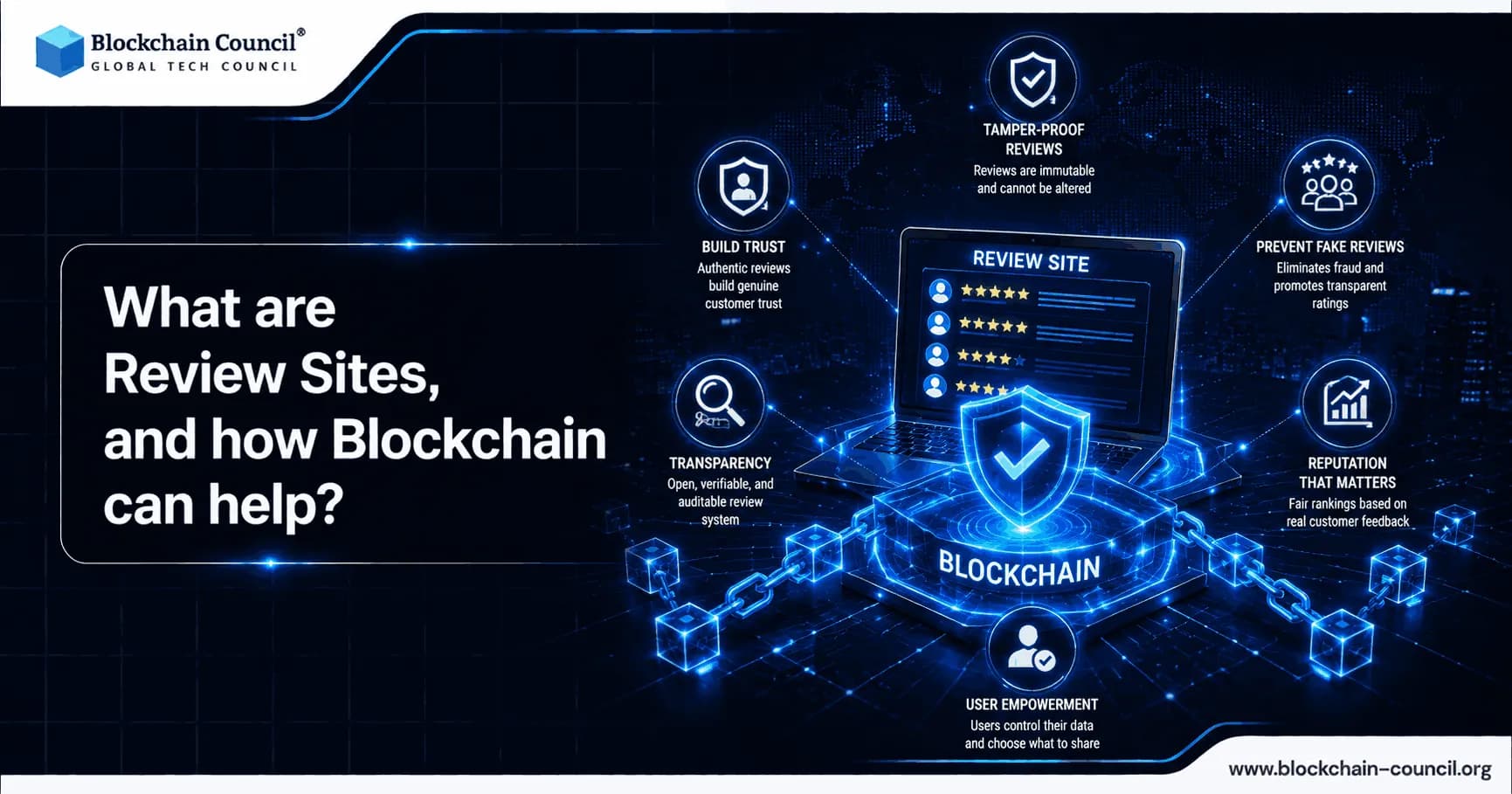
Review sites have quietly become one of the most influential forces in modern purchasing decisions, shaping everything from which restaurant a family chooses on a Friday night to which enterprise software a company commits to for the next five years. The problem is that the trust these platforms depend on has been badly eroded. Fake reviews are now estimated to cost the global economy around 770.7 billion dollars, and research from Capital One Shopping suggests roughly 30 percent of online reviews in circulation today are not genuine. That is not a minor nuisance sitting at the edges of a few shady platforms. It is a structural trust problem sitting at the center of how billions of people make everyday purchasing decisions. For anyone looking to understand how blockchain technology fits into solving this, the Certified Blockchain Expert credential offers a structured way to build real technical grounding before evaluating the specific claims being made about blockchain-based review systems.
Review sites and blockchain might seem like an unlikely pairing at first glance, one built around consumer opinion and the other built around cryptography and distributed ledgers. Once you look closely at where review platforms actually break down, though, the connection becomes clear.

What Review Sites Actually Do
Before evaluating any proposed fix, it helps to be precise about what a review site is actually trying to accomplish and where that model tends to fail.
Aggregating Opinion Into a Trust Signal
A review site collects individual experiences, ratings, and written feedback from customers and compiles them into a single, aggregated signal that future customers can use to make faster, more confident decisions. Platforms spanning e-commerce, hospitality, software, and local business directories all operate on the same basic premise: enough honest, independent voices sharing genuine experience should produce a reasonably accurate picture of a product or service's real quality.
Why That Model Breaks Down at Scale
The trust this model depends on collapses the moment a meaningful share of reviews stop being genuine. Amazon's own 2024 Brand Protection Report noted that the company's machine learning systems blocked more than 275 million suspected fake reviews in a single year, and even with that scale of enforcement, more than 99 percent of viewed product pages were reported to display only authentic reviews, a number that still implies a real, ongoing volume of fraud slipping through even the most heavily resourced detection systems. Smaller platforms without Amazon's detection infrastructure face an even steeper challenge.
The Fake Review Problem Review Sites Cannot Solve Alone
Understanding why blockchain has entered this conversation requires understanding exactly how fake reviews get created and why traditional platform moderation struggles to keep pace.
Review Farms and Manufactured Credibility
Fake review farms and coordinated manipulation schemes can generate large volumes of seemingly credible reviews in a short window, sometimes leaving a legitimate small business with a fraction of the review volume a fraudulent competitor accumulates in months rather than years. A 2025 NBER and Wharton study found that fake reviews measurably reduce consumer welfare and shift sales away from honest sellers toward dishonest ones, directly rewarding the businesses willing to manipulate the system over those competing fairly.
Deletion and Suppression Add a Second Layer of Distrust
Beyond fabricated positive reviews, businesses under pressure from a negative but genuine review sometimes push platforms to quietly remove it, whether through direct requests, legal threats, or exploiting a platform's moderation policies. This creates a second, related trust problem: even a review that was written honestly is not guaranteed to stay visible if the business it criticizes has enough leverage over the platform hosting it.
How Blockchain Technology Can Strengthen Review Systems
This is where blockchain's specific technical properties, immutability, transparency, and decentralized verification, map directly onto the exact failure points review platforms currently struggle with.
Immutable Records Prevent Silent Deletion
Once a review is recorded on a blockchain, no single party, not the platform, not the business being reviewed, and not a bad actor with legal leverage, can quietly alter or delete it. This directly addresses the suppression problem, since a genuine negative review becomes permanently part of the public record the moment it gets confirmed on-chain, regardless of how much pressure gets applied afterward. Understanding how this kind of decentralized, tamper-resistant infrastructure actually gets designed and deployed is exactly the kind of applied knowledge covered by a credential like the Certified Web3 Expert, which goes beyond blockchain theory into how real decentralized applications get built and maintained.
Linking Reviews to Verified Purchases
Blockchain-based review systems can tie a review directly to proof of an actual transaction recorded on the same ledger, making it significantly harder to post a fabricated review for a product or service that was never actually purchased. Some proposed systems scale this verification to the value of the purchase itself, requiring a reviewer to have genuinely paid for and held a higher-value item for a meaningful period before their review carries full weight, making large-scale manipulation considerably more expensive and logistically difficult to pull off.
Reputation Systems and Token-Based Incentives
Beyond individual review verification, blockchain enables persistent reputation systems where a reviewer's track record of accurate, helpful feedback becomes part of a verifiable, portable history rather than being locked inside a single platform's private database. Some models pair this with token-based incentives that reward consistent, genuine participation while making coordinated manipulation economically unattractive, shifting the incentive structure away from the volume-based fraud that plagues traditional review platforms today.
Building the Technical Infrastructure Behind These Systems
None of these benefits materialize automatically simply by attaching the word blockchain to a review platform. Getting the implementation right requires genuine engineering discipline.
Combining blockchain-based verification with off-chain systems like AI-driven fraud detection, secure identity verification, and reliable purchase-data integration is where real, functioning review platforms are actually being built, rather than relying on blockchain's properties in isolation. Recent academic research specifically combining blockchain with AI-driven fraud detection for tourism review platforms found this hybrid approach meaningfully outperformed blockchain-only models that emphasized decentralization but overlooked deeper content verification. Programs under Tech Certification help engineers and product teams build exactly this kind of applied technical skill, covering the broader systems and security discipline needed to combine blockchain verification with the surrounding infrastructure a genuinely trustworthy review platform actually requires.
Future-Ready Skills
As technology becomes increasingly important across industries, students need opportunities to develop future-ready skills early in their education. A World Tech Olympiad can introduce students to areas such as artificial intelligence, coding, cybersecurity, robotics, and computational thinking while encouraging curiosity and continuous learning.
The kind of systems-level thinking these students build early, understanding how different technologies need to work together to solve a real problem rather than relying on any single tool in isolation, mirrors exactly what makes blockchain-based review systems succeed where blockchain alone would fall short.
Where Blockchain Alone Still Falls Short
Blockchain strengthens review systems considerably, but it is worth being honest about what it does not fix on its own.
A blockchain can verify that a review is tied to a real purchase and that it has not been silently deleted, but it cannot, by itself, determine whether the written content of a review is honest, well-considered, or written in good faith. A genuinely dishonest reviewer who did make a real purchase can still write a misleading review, and that review becomes just as permanent on the blockchain as an honest one. This is precisely why the strongest emerging systems pair blockchain verification with additional layers, AI-driven content analysis, human moderation, and reputation scoring, rather than treating blockchain as a complete, standalone solution to review fraud.
Communicating This Shift to Businesses and Consumers
Getting a business or platform to actually adopt blockchain-based review verification requires more than solid engineering. It requires helping both businesses and everyday consumers understand what this technology genuinely changes, without overselling it as a magic fix for a problem that will still require ongoing effort to manage.
Major e-commerce platforms are expected to adopt blockchain-based review verification gradually, likely starting with high-value categories like electronics or luxury goods where fraud incentives are strongest, before expanding more broadly once the approach proves itself in practice. Clearly explaining that rollout, and the real tradeoffs involved, to businesses evaluating whether to adopt these systems requires genuine communication skill alongside the underlying technical work. A Marketing Certification can help professionals in this space build that communication ability, translating blockchain's real but bounded benefits into language businesses and consumers can actually evaluate and trust.
The Bottom Line on Review Sites and Blockchain
Review sites remain a genuinely valuable tool for consumer decision-making, but the fake review problem undermining them has grown into a measurable, economy-wide issue that traditional moderation alone has struggled to contain. Blockchain offers real, specific improvements: immutable records that resist silent deletion, purchase-linked verification that raises the cost of fabricating reviews, and portable reputation systems that reward genuine participation. It does not, on its own, guarantee that every review is honest or well-reasoned, which is why the platforms most likely to succeed are combining blockchain verification with AI-driven detection and thoughtful moderation rather than treating the technology as a complete fix. Understood with that nuance, blockchain represents a genuine, meaningful step toward restoring trust in online reviews, not a silver bullet that eliminates the problem entirely.
FAQs
1. What are review sites?
Review sites are online platforms where customers share opinions, ratings, and experiences about products, services, businesses, hotels, restaurants, professionals, or other providers. They help potential customers compare options and make more informed purchasing decisions.
2. Why are review sites important for businesses?
Review sites can influence customer trust, brand reputation, purchasing decisions, and online visibility. Positive and authentic reviews can provide social proof, while negative reviews can highlight areas where a business needs to improve.
3. What are the common problems with online review sites?
Common problems include fake reviews, manipulated ratings, paid reviews, review suppression, duplicate reviews, and misleading reviewer identities. These issues can make it difficult for consumers to determine whether the feedback they see represents genuine customer experiences.
4. What is a fake review?
A fake review is a review that does not accurately represent a genuine customer's experience. It can involve fabricated identities, purchased reviews, false experiences, or reviews generated and published without the reviewer actually using the product or service.
5. How can blockchain help review sites?
Blockchain can create a tamper-evident record of review-related information. Once properly recorded on a blockchain, relevant data can be made more difficult to secretly alter or delete, potentially improving transparency and trust in the review ecosystem.
6. Can blockchain prevent fake reviews?
Blockchain alone cannot completely prevent fake reviews. However, it can support verification systems in which information such as proof of purchase, reviewer credentials, or review timestamps can be linked to a verifiable record, making certain types of manipulation harder.
7. How can blockchain verify a customer review?
A review platform could connect a review to a verified transaction or service interaction and record a cryptographic proof on a blockchain. The blockchain would not necessarily store the customer's private information or the entire review, but could store evidence that a particular review event occurred.
8. Can blockchain make online reviews more trustworthy?
Blockchain can contribute to greater trust by providing a transparent and tamper-evident record of selected review events. However, trust also depends on how the platform verifies users, collects information, handles disputes, and prevents fraudulent activity.
9. Can blockchain stop businesses from deleting negative reviews?
Blockchain could make records more resistant to unauthorized alteration or deletion if review records are properly anchored to a decentralized network. However, a blockchain-based system still needs rules for moderation, illegal content, privacy, and dispute resolution.
10. How can blockchain help with review transparency?
Blockchain can provide an auditable record of events such as when a review was submitted, whether it was associated with a verified transaction, and whether specific information has been changed. This can help platforms provide greater transparency about how reviews are collected and managed.
11. What is a blockchain-based review system?
A blockchain-based review system is a review platform that uses blockchain technology to record or verify information associated with customer feedback. Depending on its design, it could use smart contracts, decentralized identities, transaction verification, and tamper-evident records.
12. Can blockchain verify that someone actually purchased a product?
Potentially, yes. A retailer, marketplace, or service provider could provide a verifiable digital proof of purchase that a review platform uses to establish that a transaction occurred. Personal information does not necessarily need to be placed directly on the blockchain.
13. How can blockchain improve reviewer identity verification?
Blockchain can support decentralized identity or verifiable credential systems that allow users to prove certain claims without repeatedly revealing unnecessary personal information. This could help review platforms distinguish between verified participants and anonymous or suspicious accounts.
14. Can blockchain prevent review manipulation?
Blockchain can make certain forms of manipulation more difficult by creating immutable or tamper-evident records. However, it cannot determine whether a person's opinion is truthful, so additional fraud detection, identity verification, moderation, and governance mechanisms remain necessary.
15. How can smart contracts be used in review platforms?
Smart contracts could automate predefined processes such as recording verified transactions, managing review submissions, distributing reputation points, or handling review-related incentives. Their rules would need to be carefully designed to avoid creating new opportunities for manipulation.
16. Does blockchain eliminate the need for review moderation?
No. Blockchain does not replace human or automated moderation. Review platforms still need processes for identifying spam, harassment, illegal content, privacy violations, fraudulent activity, and other content that should not be published.
17. What are the benefits of blockchain for review sites?
Potential benefits include improved data integrity, greater transparency, verifiable review histories, stronger transaction verification, better auditability, and reduced opportunities for unauthorized modification. These benefits depend heavily on the platform's technical architecture and governance.
18. What are the limitations of using blockchain for online reviews?
Blockchain can introduce challenges involving scalability, transaction costs, privacy, data storage, user experience, regulatory requirements, and integration with existing platforms. It also cannot guarantee that the original information entered into the system is truthful.
19. Is blockchain a complete solution for fake online reviews?
No. Blockchain should be viewed as one component of a broader review-integrity system. Effective platforms may need verified transactions, identity or credential systems, AI-assisted fraud detection, transparent moderation policies, user reporting, and appropriate legal compliance alongside blockchain.
20. What is the future of blockchain-powered review sites?
The future could involve review platforms where transaction history, reviewer credentials, reputation, and review timestamps can be independently verified. As concerns about fake and manipulated reviews continue, blockchain may become useful for creating more transparent and auditable review ecosystems, although adoption will depend on privacy, usability, cost, and regulatory considerations. The need for trustworthy reviews is significant, with regulators continuing to address deceptive review practices.
Related Articles
View All
Blockchain
How Certification Can Help You Become a Blockchain Product Manager
Learn how certification builds blockchain knowledge, credibility, and practical product skills for aspiring blockchain product managers.

Blockchain
Blockchain Certification Programs You Can Join Online
Discover the best blockchain certification programs you can join online. Learn blockchain fundamentals, smart contracts, enterprise blockchain, and career opportunities with globally recognized certifications.

Blockchain
Agile for Blockchain Teams: Managing Sprints, Smart Contracts, and Decentralized Roadmaps
Learn how agile for blockchain teams works when sprints, smart contracts, audits, governance, and decentralized roadmaps are planned around risk.
Trending Articles
How Blockchain Secures AI Data
Understand how blockchain technology is being applied to protect the integrity and security of AI training data.

Can DeFi 2.0 Bridge the Gap Between Traditional and Decentralized Finance?
The next generation of DeFi protocols aims to connect traditional banking with decentralized finance ecosystems.
How to Install Claude Code
Learn how to install Claude Code on macOS, Linux, and Windows using the native installer, plus verification, authentication, and troubleshooting tips.