

Is Bitcoin a Hoax?
 Toshendra Kumar Sharma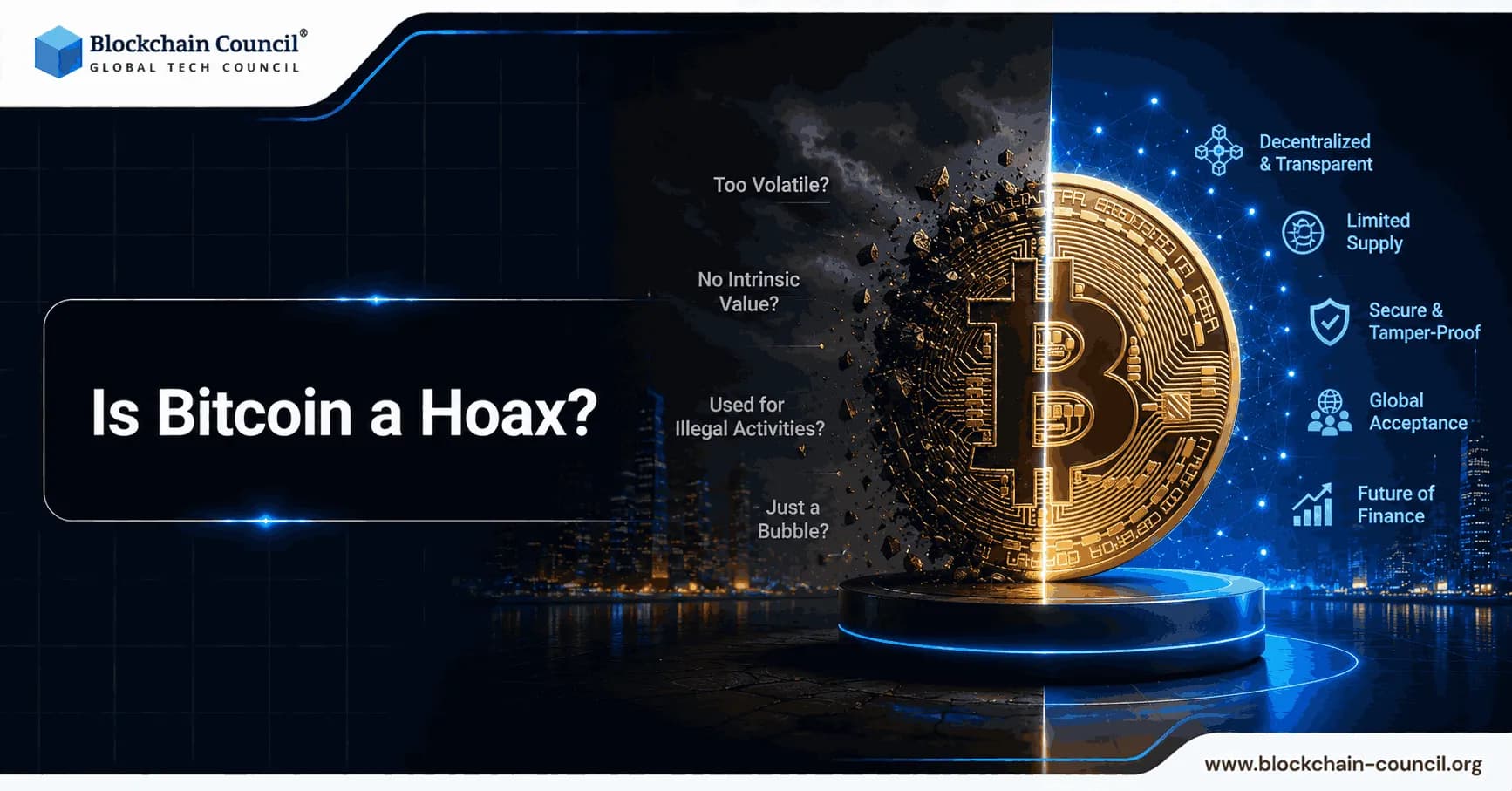
Bitcoin has spent 2025 and 2026 living through the same emotional whiplash it always has. After setting a record high above $126,000 in October 2025, the price has since pulled back sharply, trading in the low-$60,000s through the summer of 2026 a drawdown of roughly 50% from the peak. Anyone watching that kind of swing for the first time understandably starts asking whether the whole thing is built on nothing. It's a question worth taking seriously rather than dismissing outright, and understanding the answer starts with the same foundation a Certified Bitcoin Expert learns early: separating Bitcoin's price behavior from the technology that actually underlies it.
What Would Actually Make Bitcoin a Hoax?
A hoax, in the classic sense, is a deliberate fabrication designed to look legitimate pyramid schemes and Ponzi structures are the textbook examples. A pyramid scheme pays existing participants using money from new recruits rather than from any real product or investment. A Ponzi scheme works the same way in spirit: organizers promise high returns with little risk, then quietly use new investors' money to pay off earlier ones instead of generating any actual return. BitConnect, which collapsed in early 2018 after operating exactly this way, remains one of the clearest examples of a genuine crypto hoax and it's worth remembering that BitConnect was a scheme built on top of crypto's popularity, not Bitcoin itself.

Bitcoin doesn't share a single structural feature with schemes like that. There's no central operator collecting funds from new participants to pay old ones Bitcoin is a decentralized, open-source protocol that anyone can inspect, audit, and verify independently. It doesn't promise guaranteed returns, and it doesn't rely on recruiting new investors to stay solvent. Its entire design goal is preventing anyone from tampering with or counterfeiting transactions, and in more than fifteen years of continuous operation, the core Bitcoin protocol itself has never been successfully hacked. That track record is a direct result of its security model, not luck: rewriting Bitcoin's transaction history would require controlling more than half of the entire network's computing power, an undertaking so expensive it's effectively irrational at Bitcoin's current scale. Understanding exactly how that security model holds up under real-world pressure is a core part of what a Certified Cryptocurrency Expert curriculum covers, since it's the piece most skeptics never actually examine before forming an opinion.
Examining Bitcoin's Technology and Adoption
The technology itself hasn't wavered even as the price has. Bitcoin's blockchain remains a public, tamper-evident ledger secured by thousands of independently operated nodes worldwide, with no single company or government able to alter it unilaterally. That resilience is precisely why institutions kept building on top of it even through painful corrections. The approval of eleven spot Bitcoin ETFs in the United States in January 2024 opened the door for mainstream investment vehicles to hold Bitcoin directly, and inflows into those funds have remained a structural source of demand ever since a form of adoption that simply didn't exist during Bitcoin's earlier boom-and-bust cycles. In March 2025, the U.S. government went a step further, signing an executive order establishing a Strategic Bitcoin Reserve, formally treating Bitcoin as a reserve asset at the federal level. Corporate treasuries have followed a similar path, with public companies holding Bitcoin on their balance sheets as a long-term store of value rather than a short-term trade.
None of this proves Bitcoin's price will always go up it doesn't, and it never has in a straight line. But growing institutional adoption, regulatory engagement, and continuous technical operation are the opposite of what you'd expect from a fabricated scheme quietly circling the drain.
Understanding the Risks Without Confusing Them for Fraud
It's fair to say Bitcoin carries real risks, and none of them need to be minimized to make the case that it isn't a hoax. Price volatility is the most obvious one: Bitcoin has fallen 50% or more from its highs multiple times across its history, including the 2021-2022 collapse from roughly $69,000 to under $16,000, and the more recent pullback from October 2025's peak. Regulatory uncertainty in various countries, custody risk when using exchanges instead of self-custody, and the irreversible nature of transactions if a user makes a mistake are all legitimate concerns. Security incidents involving exchanges like the historic Mt. Gox collapse in 2014 have caused real harm to real users, even though the underlying Bitcoin protocol itself was never compromised in that event. These are genuine risks that any serious investor should weigh carefully, but they describe an early-stage, volatile asset class not a fabricated con.
Common Misconceptions
A few misunderstandings keep the "Bitcoin is a hoax" narrative alive even as the evidence points the other way:
"The price crashed, so it must be fake." Price volatility is a feature of a young, speculative asset finding its footing, not evidence of fraud. Gold, tech stocks, and countless legitimate assets have suffered comparable or worse drawdowns in their early history.
"No one controls it, so it can't be trusted." This gets the logic backward Bitcoin's decentralization is precisely what prevents any single entity from manipulating it for personal gain, the defining trait of every real hoax.
"It has no real-world use." Institutional custody products, corporate treasury holdings, and a government reserve are all real-world uses that didn't exist a few years ago and continue to grow regardless of short-term price action.
The Evidence Behind the World's Leading Cryptocurrency
Weighing everything together, the evidence points clearly away from "hoax" and toward "volatile but functioning technology." Bitcoin has operated continuously and securely since 2009, survived multiple 80%+ corrections without the network itself ever failing, attracted regulated ETF products and government-level reserve status, and continues to run on a protocol that anyone with the technical knowledge can independently verify. None of that requires blind faith it's observable, auditable, and has held up under sustained public and institutional scrutiny for well over a decade.
Grasping all of this well enough to explain it to others, or to build something on top of it, takes more than following headlines. Rounding out that foundation with a broader Tech Certification helps put Bitcoin's technical design in context alongside the wider technology landscape it now sits within, rather than treating it as an isolated curiosity.
And for anyone working to help others understand this distinction educators, advisors, or businesses building products around Bitcoin clear communication matters just as much as technical accuracy. A Marketing Certification rounds out that skill set, turning a solid technical understanding of Bitcoin into messaging that actually helps a skeptical audience separate the technology from the price chart.
Bitcoin isn't a hoax. It's a volatile, still-maturing asset built on genuinely resilient technology and those two facts have coexisted since the very beginning.
FAQs
1. Is Bitcoin a hoax?
No. Bitcoin itself is not a hoax. It is an open-source decentralized digital currency that has operated continuously since 2009. However, scams, fraudulent investment schemes, and fake cryptocurrency projects sometimes misuse Bitcoin's popularity, which can lead people to mistakenly associate Bitcoin with those scams.
2. Why do some people think Bitcoin is a scam?
Some people associate Bitcoin with scams because of its price volatility, fraudulent investment schemes, phishing attacks, exchange failures, and misleading promises of guaranteed profits. These activities involve bad actors rather than the Bitcoin protocol itself.
3. Is Bitcoin legitimate?
Bitcoin is a legitimate blockchain network used by millions of individuals, businesses, financial institutions, developers, and investors worldwide. It operates through open-source software maintained by a global community, and every transaction is recorded on its public blockchain.
4. Who created Bitcoin?
Bitcoin was introduced in 2008 through a whitepaper published under the pseudonym Satoshi Nakamoto. The network officially launched in January 2009. The true identity of Satoshi Nakamoto remains unknown.
5. Is Bitcoin regulated?
Bitcoin regulation varies by country. Many jurisdictions regulate cryptocurrency exchanges, taxation, anti-money laundering (AML), and know-your-customer (KYC) requirements, while Bitcoin itself remains a decentralized network that is not controlled by any single government or organization.
6. Is Bitcoin backed by anything?
Bitcoin is not backed by a government or physical commodity such as gold. Its value is determined by market supply and demand, network security, scarcity, utility, and investor confidence, similar to many freely traded financial assets.
7. Why does Bitcoin have value?
Many people attribute Bitcoin's value to its limited supply of 21 million coins, decentralized design, network security, global accessibility, and ability to transfer value without relying on a central authority. As with any asset, market participants ultimately determine its price.
8. Can Bitcoin disappear?
While Bitcoin has operated continuously for many years, no technology or financial asset is guaranteed to exist forever. Its future depends on continued user adoption, network security, developer support, regulatory developments, and overall market demand.
9. Is Bitcoin a Ponzi scheme?
Most economists and regulators do not classify Bitcoin itself as a Ponzi scheme because it does not promise guaranteed returns or require payments from new participants to existing ones through a centralized operator. However, fraudulent schemes built around Bitcoin may operate as Ponzi or pyramid schemes.
10. Can people lose money investing in Bitcoin?
Yes. Bitcoin is highly volatile, and investors can experience significant gains or losses depending on market conditions. Investing in Bitcoin involves substantial financial risk, and there are no guaranteed returns.
11. Why is Bitcoin so volatile?
Bitcoin's price can change rapidly due to investor sentiment, supply and demand, macroeconomic conditions, regulatory developments, institutional activity, technological updates, and overall cryptocurrency market trends.
12. Is Bitcoin used for real-world transactions?
Yes. Bitcoin is used for peer-to-peer transfers, cross-border payments, investment, treasury holdings, charitable donations, and purchases with merchants that accept it. Adoption varies by country, industry, and payment provider.
13. How secure is Bitcoin?
The Bitcoin blockchain is considered one of the most secure public blockchain networks because of its decentralized architecture and Proof of Work consensus mechanism. However, users remain responsible for protecting their wallets, private keys, and recovery phrases.
14. What are the biggest risks of Bitcoin?
Major risks include price volatility, cybersecurity threats, phishing attacks, private key loss, exchange failures, changing regulations, tax obligations, fraud, and market uncertainty.
15. How can investors avoid Bitcoin scams?
Investors should use reputable exchanges, verify website addresses, enable two-factor authentication (2FA), never share private keys or recovery phrases, avoid guaranteed-return schemes, research projects carefully, and remain skeptical of unsolicited investment offers.
16. What common misconceptions exist about Bitcoin?
Common misconceptions include that Bitcoin is anonymous, illegal everywhere, controlled by a single company, guaranteed to make investors rich, backed by gold, or used only for criminal activity. In reality, Bitcoin is a transparent public blockchain with diverse legal uses around the world.
17. What are best practices before investing in Bitcoin?
Best practices include learning how Bitcoin works, understanding its risks, investing only money you can afford to lose, diversifying investments, securing digital assets properly, maintaining long-term financial discipline, and keeping accurate records for tax purposes.
18. How has Bitcoin influenced global finance?
Bitcoin introduced decentralized digital money and inspired the growth of blockchain technology, cryptocurrencies, decentralized finance (DeFi), digital asset custody, tokenization, and broader discussions about the future of money and financial infrastructure.
19. What trends are shaping Bitcoin in 2025-2026?
Key trends include institutional adoption, Bitcoin ETFs in eligible markets, Lightning Network growth, tokenization of real-world assets (RWAs), improved custody solutions, AI-assisted blockchain analytics, renewable energy mining initiatives, and evolving global cryptocurrency regulations.
20. Is Bitcoin a hoax or a legitimate innovation?
Bitcoin is widely regarded as a legitimate technological innovation, although opinions differ regarding its long-term investment value and role in the global financial system. Like any emerging technology, it has both opportunities and risks. While scams continue to exploit Bitcoin's popularity, those schemes should not be confused with the Bitcoin protocol itself. Careful research, realistic expectations, and sound risk management remain essential for anyone considering involvement with digital assets. If history has taught anything, it's that humans are remarkably capable of building revolutionary technologies and equally remarkable at inventing scams that borrow their names.
Related Articles
View All
Blockchain
How Blockchain Was Introduced: Bitcoin and the Birth of Decentralized Ledgers
Learn how blockchain was introduced through Bitcoin, from timestamping research and digital cash to proof-of-work, mining, and decentralized ledgers.

Blockchain
The History of Blockchain: From Bitcoin to Web3 Innovation
A clear history of blockchain, from cryptographic research and Bitcoin to Ethereum, Web3, DeFi, NFTs, enterprise adoption, and future skills.

Blockchain
Beyond Cryptocurrency: How Blockchain Is Transforming Real-World Industries
Explore how blockchain works beyond cryptocurrency in banking, supply chains, healthcare, tokenisation, CBDCs, and government, plus key challenges and career paths.
Trending Articles
AWS Career Roadmap
A step-by-step guide to building a successful career in Amazon Web Services cloud computing.

Top 5 DeFi Platforms
Explore the leading decentralized finance platforms and what makes each one unique in the evolving DeFi landscape.
How Blockchain Secures AI Data
Understand how blockchain technology is being applied to protect the integrity and security of AI training data.