

Top 5 Challenges with Public Blockchain
 Toshendra Kumar Sharma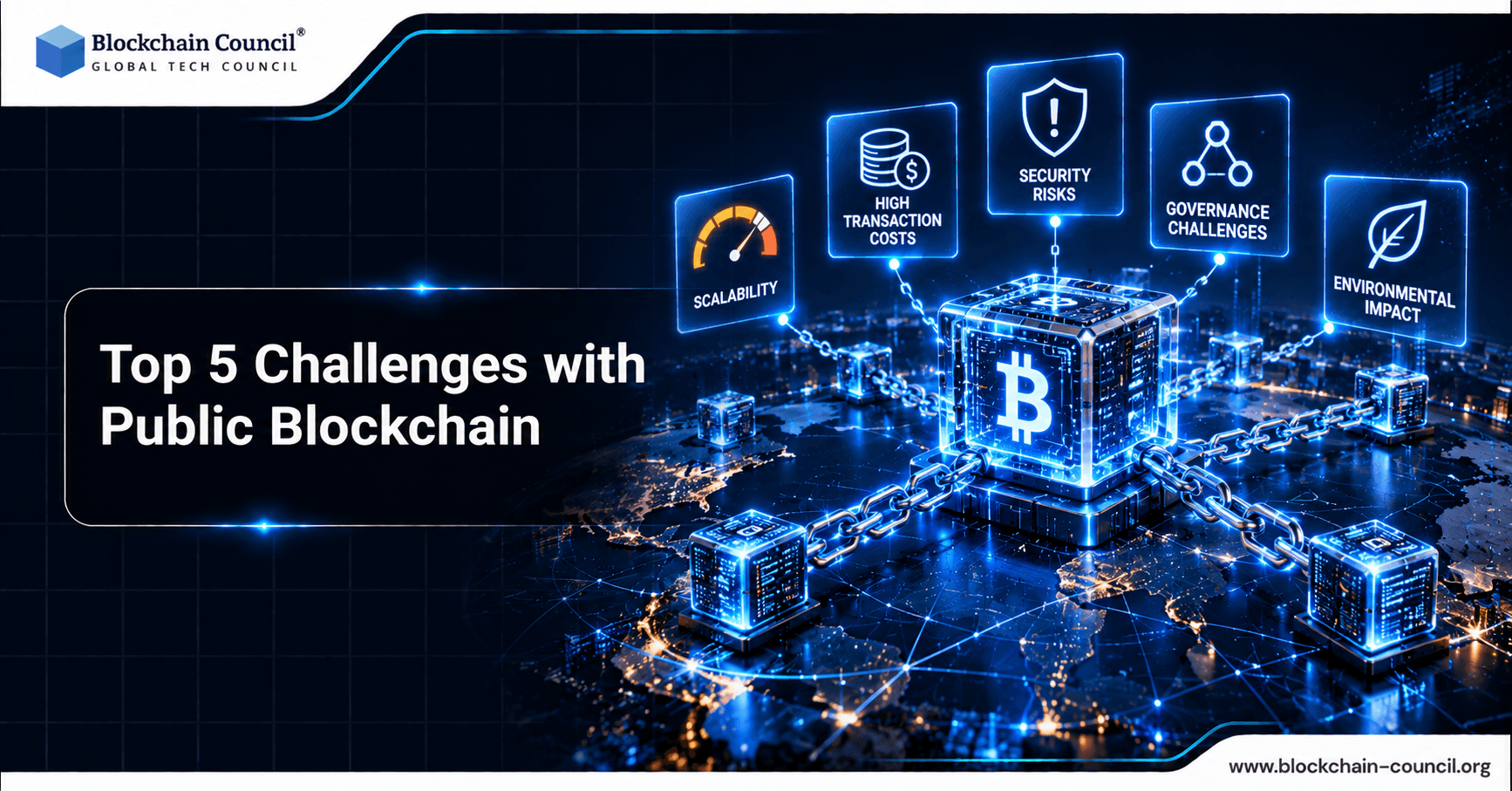
A public blockchain is open to anyone, but being open does not make it easy or risk-free. It brings real problems for developers, businesses, and everyday users. Slow speeds, rising fees, security gaps, heavy energy use, unclear regulation, and weak connections between networks all hold back wider adoption. If you want to build a career in this space, earning a credential such as the Certified Blockchain Expert can help you understand these trade-offs before you invest time or money in a project.
This guide explains the five biggest challenges in plain language. Beginners will get clear definitions, and professionals will find the technical context they need.

What Is a Public Blockchain?
A public blockchain is a shared digital ledger that anyone can read, join, and verify. Bitcoin and Ethereum are the best-known examples. No single company owns them. Thousands of computers, called nodes, keep copies of the ledger and agree on which transactions are valid.
Three features define it:
Open access: Anyone can create a wallet, send transactions, or run a node.
Transparency: Every confirmed transaction can be inspected by anyone.
Decentralization: Control is spread across many participants instead of sitting with one authority.
These strengths also create the challenges below. The more open and decentralized a network is, the harder it becomes to make it fast, cheap, and easy to govern.
Why Understanding Public Blockchain Limits Matters
Many newcomers hear only about the upside, such as borderless payments, tokenized assets, and smart contracts. Real projects, however, succeed or fail on how well their teams handle limits. A founder who ignores transaction fees can build an app nobody can afford to use. A developer who ignores security can lose user funds in minutes.
That is why practical training matters. A course like the Certified Blockchain Developer program teaches how to write and test smart contracts with these risks in mind. Knowing the weak points is the first step toward designing around them.
The Top 5 Challenges with Public Blockchain
1. Scalability and High Transaction Fees
Scalability is the ability to handle more users and more transactions without slowing down. It is the most talked-about weakness of any public blockchain.
Bitcoin processes roughly 7 transactions per second. Ethereum's base layer handles around 15 to 30. Traditional card networks such as Visa can process tens of thousands per second. The gap exists because every node must verify and store each transaction, and that shared checking keeps the network honest but limits its speed.
When demand rises, users compete for limited block space, and fees climb. The CryptoKitties craze of 2017 is a well-known case where Ethereum fees spiked because of a single popular app. For small payments, a high fee can cost more than the purchase itself.
Developers describe the underlying tension as the blockchain trilemma. A network can struggle to deliver decentralization, security, and scalability all at once. Common fixes include:
Layer 2 networks: Rollups bundle many transactions off the main chain and post a compact proof back to it.
Sharding: The network splits its workload into smaller parallel pieces.
Faster base layers: Some newer chains raise throughput by using more demanding hardware.
Each fix improves speed, but each also brings new trade-offs, such as added complexity, reliance on a few operators, or higher hardware costs for validators.
2. Security Risks and Irreversible Mistakes
A common belief is that blockchains cannot be hacked. The ledger itself is very hard to alter, but the systems built around it are another story.
Chainalysis reported more than $3.4 billion in stolen crypto in 2025. The Bybit exchange breach alone accounted for about $1.5 billion, and North Korea-linked groups were responsible for at least $2.02 billion. Analysts noted that attackers increasingly target infrastructure and private keys rather than the core blockchain code. TRM Labs, for instance, found that code exploits made up a small share of stolen value compared with infrastructure attacks.
Several risks stand out:
Smart contract bugs: Once a faulty contract is deployed, fixing it can be hard, and attackers can drain funds quickly.
Stolen keys: Whoever holds the private key controls the funds. There is no password reset.
Phishing and scams: Fake websites and wallet drainers trick users into signing harmful transactions.
51 percent attacks: In theory, a group controlling most of a network's power could rewrite recent history. This is far more realistic on small networks than on large ones.
Because transactions are final, a wrong address or a signed scam cannot be undone. Good habits help: use hardware wallets, verify contract addresses, never share seed phrases, and prefer audited code.
3. High Energy Use and Sustainability Concerns
Proof-of-work networks such as Bitcoin secure the ledger by having miners solve difficult puzzles. This protects the network, but it burns large amounts of electricity. Some researchers have compared Bitcoin's yearly consumption with that of entire countries, which has drawn criticism from regulators, investors, and environmental groups.
Ethereum showed that change is possible. Its move to proof-of-stake, known as the Merge, cut its energy use by about 99.95 percent. Validators now lock up coins instead of racing with hardware. Many newer chains also use proof-of-stake or similar designs.
Still, sustainability questions remain. Bitcoin continues to rely on proof-of-work, and the debate over its environmental cost is far from settled. Companies that want to use blockchain in their reporting or supply chains must also consider their carbon footprint. This is why professionals who work with emerging technology often broaden their skills through a general Tech Certification, which covers adjacent topics such as cloud, data, and AI that affect how responsibly a blockchain solution can run.
4. Regulatory Uncertainty and Privacy Conflicts
Rules for digital assets differ widely from country to country. Some governments welcome innovation with clear licensing. Others restrict trading or ban certain activities. A business that operates across borders may need to follow many different rulebooks at once.
Privacy creates a second problem. Data on a public blockchain is visible to everyone and extremely hard to delete. That conflicts with laws such as the European Union's GDPR, which gives people the right to have personal data erased. Even when wallet addresses look anonymous, analysts can often link them to real identities by studying transaction patterns.
Practical ways to reduce this risk include:
Keep personal data off-chain and store only hashes or proofs on the blockchain.
Use zero-knowledge proofs, which verify a fact without revealing the underlying data.
Get legal advice early, especially for token sales, lending, or payments products.
Regulation is moving quickly, so teams should check current rules in each market they serve before launching.
5. Interoperability and Poor User Experience
Most blockchains cannot talk to each other natively. A token on one network cannot simply move to another. Bridges try to solve this by locking assets on one chain and issuing a copy on another, but bridges have become a favorite target for attackers. The 2021 Poly Network exploit, in which more than $600 million was taken, is a famous example.
User experience is also a barrier. New users must manage seed phrases, understand gas fees, pick the right network, and avoid fake tokens. One small error can mean permanent loss. Compared with a banking app, the process feels risky and confusing.
Improvements are under way:
Account abstraction: Wallets that offer recovery options and simpler sign-ins.
Cross-chain standards: Shared messaging protocols that reduce reliance on risky bridges.
Better interfaces: Clearer warnings that explain what a transaction will actually do.
Adoption grows when technology fades into the background, so usability is as important as raw performance.
How to Prepare for These Challenges
Whether you are a student, a founder, or a seasoned engineer, a few steps will help:
Match the tool to the problem. Not every use case needs a public blockchain. Sometimes a private or hybrid network is a better fit.
Plan for costs and speed. Test your app under heavy demand and consider Layer 2 options early.
Treat security as a habit. Use audits, bug bounties, and careful key management from day one.
Stay informed on regulation. Review local rules before you launch.
Keep learning. The field changes fast, and structured study keeps your skills current.
Blockchain is also reshaping business communication and growth. Professionals who explain these products to customers can benefit from a Marketing Certification, since clear messaging is often what turns a technical idea into real adoption.
Conclusion
The public blockchain model delivers openness, transparency, and shared control, but it comes with five clear challenges: limited scalability, security risks, energy concerns, regulatory and privacy conflicts, and weak interoperability and usability. None of them is a dead end. Layer 2 networks, proof-of-stake, zero-knowledge proofs, and better wallets are all reducing the pain points. Teams that understand the limits and plan around them are the ones most likely to build products people trust and use.
FAQs
1. What are the top 5 challenges with public blockchain?
The five major challenges are scalability, security, privacy, decentralization, and regulatory uncertainty. These challenges can affect transaction performance, user safety, data protection, network participation, and real-world adoption.
2. What is the biggest challenge of public blockchain?
Scalability is one of the most important challenges for public blockchains. As network usage increases, limited transaction capacity can result in congestion, slower processing, and higher transaction fees.
3. Why is scalability a challenge for public blockchain?
Public blockchains must process transactions while maintaining security and decentralization. Increasing capacity without creating excessive hardware or infrastructure requirements can be difficult because high-performance requirements may reduce the number of participants able to operate nodes.
4. How does blockchain congestion affect users?
Network congestion can increase transaction confirmation times and transaction fees. During periods of high demand, users may have to pay higher fees or wait longer for transactions to be processed.
5. How does public blockchain security create challenges?
Public blockchains can face risks involving smart contracts, wallets, infrastructure, bridges, applications, and private keys. A secure underlying blockchain does not automatically make every application built on it secure.
6. Why are smart contract vulnerabilities a challenge?
Smart contracts can contain programming errors or security vulnerabilities that attackers may exploit. Because blockchain transactions are generally difficult or impossible to reverse after confirmation, mistakes can result in permanent financial losses.
7. Is public blockchain completely private?
No. Many public blockchains are transparent by design, meaning on-chain transactions and addresses can be publicly inspected. Although addresses may not directly reveal a person's legal identity, transaction patterns and other information can sometimes be analyzed to infer sensitive details.
8. Why is privacy a challenge for public blockchain?
Transparency can conflict with applications that require confidentiality. Businesses and individuals may not want transaction history, financial activity, or other sensitive information to be publicly observable.
9. How does decentralization create challenges for blockchain networks?
Decentralization requires distributing control and allowing many independent participants to verify and maintain the network. However, hardware, bandwidth, storage, and operational requirements can make participation more difficult and potentially concentrate activity among larger operators.
10. Why is running a blockchain node sometimes difficult?
Blockchain nodes may require substantial storage, processing resources, bandwidth, and technical knowledge. High infrastructure requirements can make it harder for ordinary users to independently verify the network, which can create concerns about decentralization.
11. What is the blockchain scalability trilemma?
The blockchain scalability trilemma describes the difficulty of simultaneously maximizing scalability, security, and decentralization. Increasing transaction capacity through larger blocks or more demanding infrastructure can potentially make independent participation harder.
12. How does regulation affect public blockchain adoption?
Public blockchains operate across jurisdictions, while regulations are generally created by individual governments or regulatory bodies. Differences in rules concerning digital assets, taxation, privacy, securities, and financial services can create uncertainty for blockchain projects and businesses.
13. Why is interoperability a challenge for public blockchains?
Different blockchain networks can use different protocols, consensus mechanisms, smart contract environments, and security assumptions. Connecting these networks often requires bridges or interoperability protocols, which can introduce additional technical and security risks.
14. Are blockchain bridges a security risk?
Bridges can introduce additional attack surfaces because assets and information may depend on multiple contracts, validators, or verification mechanisms. The Ethereum security community has highlighted the importance of clearly communicating the trust assumptions behind interoperability systems.
15. How can public blockchain transaction fees become expensive?
Transaction fees can rise when demand for block space exceeds available network capacity. Users may compete for limited block space by offering higher fees, particularly during periods of heavy network activity.
16. Can public blockchains solve scalability problems?
Public blockchains are developing different approaches to improve scalability, including Layer 2 networks and data-scaling technologies. These solutions aim to increase transaction capacity and reduce costs while preserving important security and decentralization properties.
17. How does blockchain complexity affect security?
As blockchain ecosystems become more complex, they can involve multiple layers, applications, bridges, wallets, infrastructure providers, and external services. Each additional component can introduce new dependencies and potential attack surfaces.
18. What challenge does irreversible blockchain transactions create?
Irreversibility provides strong guarantees because confirmed transactions generally cannot simply be reversed. However, it also means that sending assets to the wrong address, approving a malicious transaction, or losing a private key can result in permanent losses.
19. How can businesses overcome public blockchain challenges?
Businesses can reduce risks by selecting appropriate blockchain infrastructure, conducting smart contract audits, implementing strong key-management practices, evaluating interoperability assumptions, protecting sensitive information, and monitoring regulatory requirements. Technical and operational security should be treated as an ongoing process rather than a one-time task.
20. What is the future of public blockchain despite these challenges?
Public blockchain technology continues to evolve through improvements in scalability, privacy, security, interoperability, and node accessibility. The long-term challenge is to increase usability and capacity without sacrificing the security and decentralized properties that make public blockchains valuable.
Related Articles
View All
Blockchain
Top Blockchain Use Cases in Banks and Financial Services
Explore the top blockchain use cases in banks, from payments and trade finance to tokenization, settlement, lending, KYC, and digital asset services.

Blockchain
Blockchain Careers in Europe: Top Jobs, Skills, Salaries, and Certification Paths
A practical guide to blockchain careers in Europe, covering top roles, salary benchmarks, key skills, remote work trends, and certification paths.

Blockchain
Top Blockchain Intelligence Tools for Tracking Wallets, Transactions, and DeFi Activity
Explore the top blockchain intelligence tools for wallet tracking, transaction tracing, DeFi analytics, compliance screening, and market research.
Trending Articles

Top 5 DeFi Platforms
Explore the leading decentralized finance platforms and what makes each one unique in the evolving DeFi landscape.
How Blockchain Secures AI Data
Understand how blockchain technology is being applied to protect the integrity and security of AI training data.
What is AWS? A Beginner's Guide to Cloud Computing
Everything you need to know about Amazon Web Services, cloud computing fundamentals, and career opportunities.