

IBM’s Patent For a Peer-to-Peer Blockchain Web Browser
 Toshendra Kumar Sharma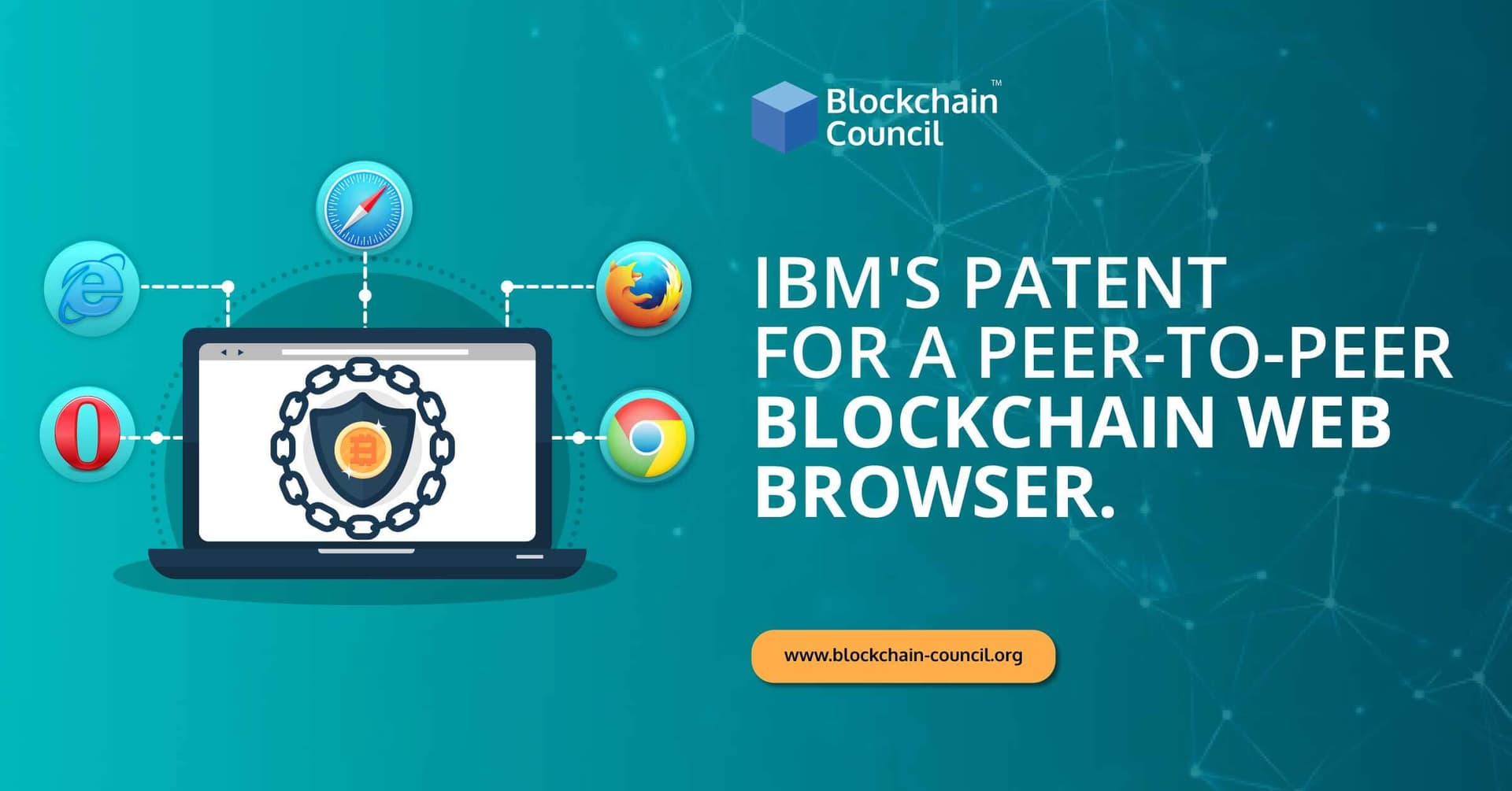
Last week, American tech giant IBM filed a patent for a web browser with the United States Patent and Trademark Office. A peer-to-peer network backs this web browser. According to the filing, the system “records and maintains a record of browser events in a blockchain using a peer-to-peer network.”

As mentioned in the patent, this web browser will collect pre-specified information from web browsing sessions. This information which is collected is then transferred to a network which consists of peer-to-peer network nodes for the purposes of collection and storage. The type of information collected depends upon the type of browsing experience which has been selected. This is done for on-chain storage of the in-browser events.
The web browser will demand different settings based on the type of browsing: work computer browsing or a personal browser. The data which can be stored on-chain include bookmarks, search terms, cookies, visited websites, browser security patch records, and geolocations. As commented by IBM, the patented blockchain-based browser “affords a system for storing information such that privacy is preserved and places privacy ‘in the hands of a user’ rather than a third party.”
Currently, IBM is spearheading enterprise-level blockchain solutions through services such as blockchain-as-a-service, supply chain management, and a program termed as Oracle, which makes use of third party information for executing smart contracts. The patent registered recently reveals that browser refers to a system which transmits client information to a global network for storage and processing.
The patent report includes one potential use case, which is an attack on a computer’s browser. Since it is verified using blockchain technology, a viable backup of all client data is available. IBM has also incorporated tokens into their model which will help check the activities of a client’s browser session as they are packaged into blocks for the peer-to-peer framework. These browsing session activities include generated queries, user cohort and context, program or service execution results, risk assessment, and forecast.
IBM, headquartered in New York, is the world’s largest technology company, which is a computer, technology, and IT consulting corporation. In terms of a global brand, IBM is the second most valuable company. IBM offers services such as infrastructure, consulting, and hosting in areas ranging from mainframe computers to nanotechnology. IBM is involved in the manufacture and sales of computer hardware and software.
Within a year, IBM has tripled the number of blockchain licenses verified in the United States, significantly. IBM, at present displays more than 100 dynamic patent families. This makes IBM’s development in the US licenses the biggest of a year ago. Seagate, the American data storage company, has recently entered the pilot stage of its blockchain project for tracking the supply chain of hard disk drives. Apart from tracking products to customers, this blockchain system will also help track the products which are returned to the company.
IBM certainly has the edge when it comes to employment offers in the blockchain domain. According to recent research reports, IBM is in the lead with 335 employment propositions until May 2019, trailed by Oracle and PwC. One organization which is ahead of IBM in terms of the number of patents worldwide is Alibaba, the Chinese Amazon rival.
Related Articles
View All
Blockchain
Beyond Cryptocurrency: How Blockchain Is Transforming Real-World Industries
Explore how blockchain works beyond cryptocurrency in banking, supply chains, healthcare, tokenisation, CBDCs, and government, plus key challenges and career paths.
Blockchain
Smart Contracts & dApps: How Blockchain Becomes Programmable
Learn how smart contracts and dApps make blockchain programmable, from Ethereum and tokens to DeFi, NFTs, real use cases, benefits, and key risks.

Blockchain
Behind the Blocks: How Blockchain Transactions Actually Work
Go behind the blocks to see how a blockchain transaction really works: wallets and keys, digital signatures, verification, hashing, blocks, consensus, proof of work vs proof of stake, and how miners and validators secure the network.
Trending Articles
AWS Career Roadmap
A step-by-step guide to building a successful career in Amazon Web Services cloud computing.
How Blockchain Secures AI Data
Understand how blockchain technology is being applied to protect the integrity and security of AI training data.
What is AWS? A Beginner's Guide to Cloud Computing
Everything you need to know about Amazon Web Services, cloud computing fundamentals, and career opportunities.