

Are Blockchains Better than Patents?
 Toshendra Kumar Sharma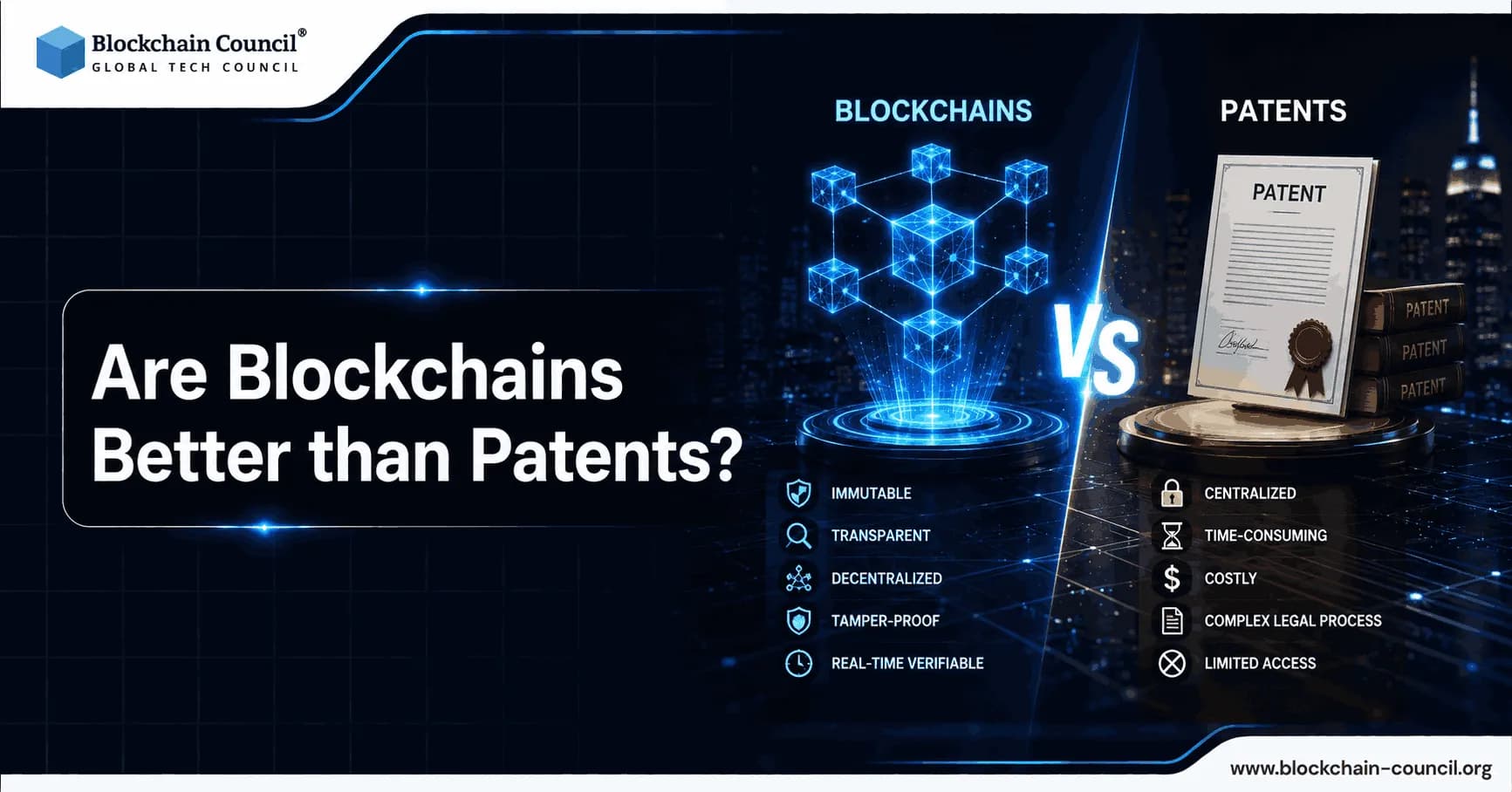
Innovators and businesses have long relied on patents to protect their ideas, but blockchain technology has introduced a new question into that conversation, whether a decentralized, timestamped ledger can offer some of the same protection, or even improve on it, without the cost and complexity of the traditional patent process. The comparison is not entirely fair on its surface, since patents and blockchains solve different problems, but understanding where each one genuinely helps innovators is increasingly relevant as more inventors explore digital tools to document and protect their work. Professionals building expertise in this space, including those pursuing a Certified Blockchain Expert credential, are trained to evaluate exactly this kind of question, understanding what blockchain technology can and cannot substitute for in areas like intellectual property protection. This article breaks down what patents actually do, what blockchain can offer instead, and where the two approaches genuinely differ.
What Does a Patent Actually Protect?
A patent is a legal right granted by a government that gives an inventor exclusive control over their invention for a set period, typically twenty years from the filing date. This exclusivity allows the patent holder to prevent others from making, using, selling, or importing the invention without permission, and it comes with the ability to pursue legal action against infringement.

Patents require:
A formal application process, reviewed and approved by a patent office.
Public disclosure, since the invention details become publicly available once granted.
Legal enforceability, backed by courts and government authority.
Jurisdictional limits, meaning protection generally applies only within the country or region where the patent was filed.
This legal backing is precisely what makes patents valuable, and it is also what blockchain technology cannot fully replicate on its own.
What Blockchain Actually Offers Innovators
Blockchain does not grant legal exclusivity the way a patent does, but it does something patents cannot do quickly or cheaply, create an immutable, timestamped record proving that a specific idea, document, or piece of work existed at a specific point in time. Once information is recorded on a properly configured blockchain, that timestamp becomes extremely difficult to alter or dispute, which can serve as valuable supporting evidence in intellectual property disputes.
This capability has led some inventors and creators to use blockchain for:
Proof of creation, establishing a verifiable timestamp for an idea or piece of work.
Supplementary evidence, supporting a broader intellectual property claim alongside formal protection.
Rapid, low cost documentation, without the months long process patents typically require.
Global accessibility, since a blockchain record is not limited by the jurisdictional boundaries that apply to patents.
Understanding how to actually build and configure these systems, including the smart contracts often used to timestamp and manage this kind of record, is a core skill developed through a Certified Blockchain Developer credential, which covers the technical foundation needed to implement blockchain based documentation systems correctly rather than relying on it as a vague concept.
Are Blockchains Better Than Patents: A Direct Comparison
The honest answer is that blockchain and patents are not direct substitutes, they serve different functions and offer different types of protection.
Factor | Patents | Blockchain |
|---|---|---|
Legal enforceability | Strong, backed by courts and government | Limited, not inherently legally binding |
Cost | High, often thousands of dollars | Low, minimal transaction costs |
Time to establish | Months to years for approval | Immediate, often within minutes |
Exclusivity granted | Yes, exclusive rights to the invention | No, only proof of timestamp or record |
Jurisdiction | Limited to filed countries or regions | Global, not bound by jurisdiction |
Public disclosure | Required as part of the process | Optional, depending on implementation |
Patents remain the stronger choice when an inventor needs enforceable exclusivity and the legal standing to stop competitors from using an invention. Blockchain becomes valuable as a faster, cheaper way to document creation and support broader intellectual property claims, particularly in fast moving fields where waiting years for patent approval is simply not practical.
Where Blockchain Genuinely Adds Value Alongside Patents
Rather than replacing patents outright, blockchain tends to work best as a complementary tool. Several use cases illustrate this well:
Provisional documentation before a full patent application is filed, establishing an early timestamp.
Trade secret protection, where formal patent disclosure is undesirable but proof of existence still matters.
Cross border collaboration, where multiple parties need a shared, tamper resistant record of contributions.
Licensing and royalty tracking, using smart contracts to automate and verify usage agreements tied to an invention.
In each of these cases, blockchain supports the broader intellectual property strategy rather than standing in as a full legal replacement for a patent.
Future-Ready Skills
As technology becomes increasingly important across industries, students need opportunities to develop future-ready skills early in their education. A Tech Olympiad can introduce students to areas such as artificial intelligence, coding, cybersecurity, robotics, and computational thinking while encouraging curiosity and continuous learning. This same foundation matters for the next generation of inventors and entrepreneurs, who will increasingly need to understand both the legal frameworks behind intellectual property and the emerging digital tools, like blockchain, that are reshaping how ideas get documented and protected. Building this kind of broad technical literacy early makes it easier for innovators to make informed decisions later about which protection methods actually fit their situation.
How Innovators Can Decide Between the Two
Choosing how to protect an idea usually comes down to a few practical questions:
Does the invention need enforceable legal exclusivity, or simply proof of existence?
How quickly does protection need to be established?
What is the available budget for legal and filing costs?
Does the idea need protection across multiple countries?
Is the goal to prevent competitors from using the invention, or to support a broader documentation strategy?
For most serious inventions with significant commercial value, patents remain the stronger foundation, with blockchain serving as a useful supplementary layer rather than a replacement. Staying current on how these technologies and legal frameworks continue to evolve is part of why professionals in this space often pursue a broad Tech Certification, ensuring their understanding of both the technical and practical sides of intellectual property protection stays up to date as new tools emerge.
Communicating IP Strategy to Stakeholders
Deciding between patents, blockchain documentation, or a combination of both is only part of the equation. Inventors and businesses also need to communicate their intellectual property strategy clearly to investors, partners, and customers who may not understand the technical or legal nuances involved. This is where a Marketing Certification can genuinely help, giving professionals the communication skills needed to explain complex protection strategies in a way that builds confidence with stakeholders rather than confusion.
Blockchain is not better than patents in any absolute sense, and treating it as a full replacement misunderstands what each tool actually does. Patents offer enforceable legal exclusivity that blockchain cannot replicate on its own, while blockchain offers speed, low cost, and global accessibility that traditional patent processes cannot match. The strongest intellectual property strategies tend to combine both, using blockchain to document and support claims while relying on patents for the legal protection that ultimately matters most when a dispute actually arises.
FAQs
1. Are Blockchains Better Than Patents?
Blockchain technology is not necessarily better than patents because the two serve different purposes. A patent can provide legally recognized exclusive rights over a qualifying invention, while blockchain can create a tamper-resistant, time-stamped record that may help establish when information or an invention existed.
2. What Is the Difference Between Blockchain and a Patent?
A blockchain is a technology for recording and verifying information across a distributed ledger, while a patent is a legal intellectual property right granted for an eligible invention. Blockchain can support evidence and IP management, but simply recording an invention on a blockchain does not automatically grant patent rights.
3. Can Blockchain Replace Patents?
Blockchain generally cannot replace the legal protection provided by a patent. It can complement the patent system by helping document the existence, development, ownership, or transfer of intellectual assets. WIPO has identified blockchain-based timestamping and evidence as potential tools within broader IP ecosystems.
4. Can Blockchain Prove Who Created an Invention First?
A blockchain record can provide time-stamped evidence that particular information or a digital file existed at a certain point in time. However, proving creation or ownership in a legal dispute can involve additional evidence and applicable national laws, so a blockchain record should not automatically be treated as proof of legal ownership.
5. Does Blockchain Give You Intellectual Property Rights?
No. Recording an invention, design, or document on a blockchain does not by itself create a patent or another intellectual property right. WIPO notes that digital timestamping can establish the existence of a file at a particular time, while substantive IP rights generally arise through the applicable legal framework.
6. How Can Blockchain Help Protect Intellectual Property?
Blockchain can create tamper-resistant records showing the existence and history of digital assets. Potential applications include documenting creation dates, tracking ownership changes, managing licenses, recording transactions, and providing evidence related to IP disputes.
7. Can Blockchain Be Used as Evidence in Patent Disputes?
Blockchain records may potentially be used as supporting evidence, depending on the jurisdiction, circumstances, and how the record was created and maintained. WIPO has highlighted blockchain's potential to provide time-stamped evidence relating to patents and other intellectual property rights, but legal acceptance depends on applicable rules.
8. What Are the Advantages of Using Blockchain Instead of a Patent?
Blockchain can provide fast, digital, and potentially global timestamping of information without requiring the same registration process as a patent. It can also support continuous records of development, ownership, licensing, and transactions, making it useful as a complementary IP-management tool.
9. What Are the Advantages of Patents Over Blockchain?
Patents can provide legally enforceable exclusive rights for qualifying inventions under applicable patent laws. They also establish a formal public record containing information such as the invention's description, inventor information, and claims defining the scope of protection sought.
10. Is Blockchain Cheaper Than Getting a Patent?
Creating a blockchain timestamp or record can potentially be less expensive than pursuing a patent application. However, cost should not be the only consideration because blockchain records and patents provide different forms of protection and have different legal effects.
11. Can Blockchain Prevent Someone From Patenting Your Invention?
Blockchain can potentially support a defensive publication strategy by recording or publishing technical information in a way that establishes its existence and date. If the information is publicly accessible and meets the applicable requirements for prior art, it may help prevent others from obtaining a patent on the same invention. The legal requirements vary by jurisdiction.
12. What Is a Blockchain Timestamp in Intellectual Property?
A blockchain timestamp is a record associated with digital information that helps establish when that information existed or was recorded. It can provide useful evidence for inventions, designs, software, research data, trade secrets, and other intellectual assets.
13. Can Blockchain Protect Trade Secrets?
Blockchain can help document the existence and handling of trade-secret-related information, particularly through timestamping and controlled records. However, trade-secret protection also depends on maintaining confidentiality and taking reasonable measures to prevent unauthorized disclosure.
14. Can Blockchain Protect Copyright?
Blockchain can help creators document the existence and creation of digital works through time-stamped records. It may therefore provide supporting evidence in copyright-related matters, although the blockchain record itself does not replace the copyright protection provided by applicable law.
15. Can Blockchain Help With Patent Management?
Yes. Blockchain could support activities such as recording IP ownership, tracking assignments and licenses, documenting development milestones, and maintaining evidence associated with patent-related assets. WIPO has specifically explored blockchain applications across the IP value chain.
16. What Are the Limitations of Using Blockchain for Intellectual Property?
Blockchain does not automatically verify whether the information originally entered is truthful or whether the person submitting it actually owns the intellectual property. Other challenges include legal recognition, privacy, governance, interoperability, scalability, and ensuring that off-chain events are accurately reflected on the ledger.
17. Is a Blockchain Record Legally Valid Everywhere?
Not necessarily. The evidentiary value and legal treatment of blockchain records can vary between jurisdictions and specific legal proceedings. WIPO has identified regulatory frameworks, standards, governance, and interoperability as important considerations for blockchain-based IP systems.
18. Should Inventors Use Blockchain or Apply for a Patent?
The appropriate choice depends on the invention, business strategy, jurisdiction, costs, confidentiality requirements, and desired protection. For an invention that may qualify for patent protection, blockchain can potentially be used as a complementary recordkeeping or evidence tool rather than as a substitute for professional patent advice and the formal patent process.
19. Can Blockchain and Patents Work Together?
Yes. Blockchain and patents can complement one another by combining formal legal protection with digital records of invention development, ownership, licensing, and other IP-related events. This combination could create a more comprehensive approach to intellectual property management.
20. Which Is Better for Protecting an Invention: Blockchain or a Patent?
For obtaining formal patent rights, a patent is the appropriate legal mechanism where the invention qualifies and patent protection is desired. Blockchain is better viewed as a complementary technology that can help document evidence, provenance, and IP-related transactions rather than replace the patent system.
Related Articles
View All
Blockchain
Public, Private & Consortium Blockchains: Which Network Fits the Use Case?
Compare public, private, and consortium blockchains by security, speed, privacy, and control, with real examples and a simple guide to choosing the right network.

Blockchain
Blockchain Digital Identity Management Patents: Key Innovations and Market Trends
A practitioner-focused look at blockchain digital identity management patents, from biometric wallets and DIDs to KYC, EU wallets, IoT, and market growth.

Blockchain
Blockchain State Machine Replication: How Blockchains Agree on State
Blockchain State Machine Replication explains how nodes agree on transaction order and state, even with faults, forks, and malicious behavior.
Trending Articles
The Role of Blockchain in Ethical AI Development
How blockchain technology is being used to promote transparency and accountability in artificial intelligence systems.
How Blockchain Secures AI Data
Understand how blockchain technology is being applied to protect the integrity and security of AI training data.
What is AWS? A Beginner's Guide to Cloud Computing
Everything you need to know about Amazon Web Services, cloud computing fundamentals, and career opportunities.