

Why Banks are Looking for Blockchain Based Payment Systems
 Toshendra Kumar Sharma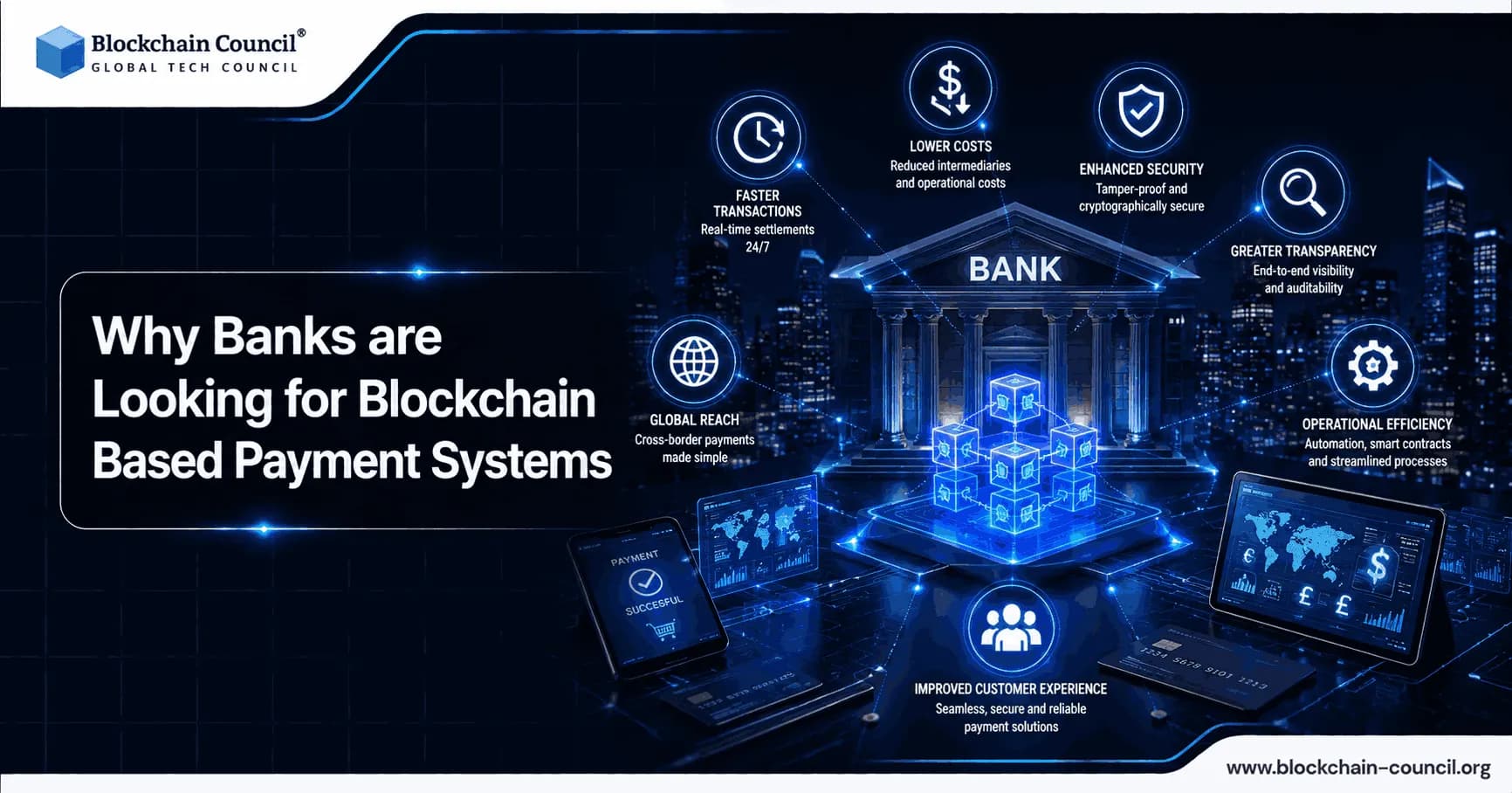
The financial industry is undergoing a major transformation as banks look for faster, more secure, and more transparent ways to process payments. Traditional payment infrastructure often involves multiple intermediaries, lengthy settlement procedures, operational costs, and limited visibility into transactions. Blockchain technology offers an alternative approach by enabling transactions to be recorded and verified through a decentralized and tamper-resistant digital ledger.
For professionals exploring how blockchain is changing financial services, pursuing a Certified Blockchain Expert can provide valuable knowledge about blockchain architecture, applications, and real-world use cases.

Why Are Banks Exploring Blockchain-Based Payment Systems?
Banks are increasingly examining blockchain-based payment systems because they can address several limitations associated with conventional payment networks. Blockchain can enable participating institutions to share synchronized transaction records, reducing the need for repeated reconciliation between different databases.
Instead of relying entirely on centralized systems and several intermediaries, blockchain-based networks can facilitate direct and programmable transactions between authorized participants.
This can be particularly valuable for international payments, where transactions may pass through correspondent banks and multiple settlement systems before reaching the recipient.
Key Reasons Banks Are Adopting Blockchain for Payments
Faster Transaction Settlement
Traditional cross-border payments can take hours or even several business days to complete. Blockchain networks can potentially reduce settlement times by allowing transactions and their associated records to be processed on a shared digital infrastructure.
Faster settlement can improve cash flow for businesses, reduce waiting periods for customers, and help financial institutions manage liquidity more efficiently.
Lower Operational Costs
Payment processing involves infrastructure, intermediaries, compliance procedures, reconciliation, and administrative activities. These processes can create significant operational expenses.
Blockchain can automate certain processes through smart contracts and shared transaction records. By reducing manual reconciliation and unnecessary intermediaries, banks may be able to lower the cost of processing specific types of transactions.
Professionals who want to understand the intersection of financial services and distributed ledger technology can explore a Certified Blockchain & Finance Professional program to build relevant knowledge in this emerging area.
Improved Transparency and Traceability
Blockchain records transactions in a way that can provide authorized participants with a consistent view of transaction history. Depending on the network design, participants can trace transactions from initiation through settlement.
This can make reconciliation easier and improve visibility across financial processes while supporting stronger auditing and monitoring capabilities.
Enhanced Payment Security
Security is a major consideration for banks handling large volumes of financial transactions. Blockchain uses cryptographic techniques and consensus mechanisms to protect transaction records against unauthorized changes.
A properly designed permissioned blockchain network can also restrict participation and access to approved institutions, allowing banks to maintain greater control over who can interact with the payment infrastructure.
How Blockchain Can Improve Cross-Border Payments
Cross-border payments are one of the areas where blockchain could have a significant impact. Conventional international transfers can involve correspondent banking relationships, different currencies, separate payment systems, and multiple compliance checks.
Blockchain-based payment infrastructure can connect participating financial institutions through a shared network. This can help reduce fragmentation and improve the movement of transaction information.
For example, a blockchain network could allow authorized institutions in different countries to access a synchronized record of payment activity. Smart contracts could also automate specific conditions associated with payment processing, reducing manual intervention.
However, blockchain does not automatically eliminate every challenge associated with international payments. Regulations, currency conversion, network interoperability, privacy requirements, and compliance standards still need to be addressed.
The Role of Blockchain in Modern Banking
Blockchain is not simply about replacing existing banking infrastructure. Its larger potential lies in creating more efficient systems for exchanging and verifying financial information.
Banks can potentially use blockchain for areas such as:
Cross-border payments
Interbank settlements
Trade finance
Digital assets
Transaction reconciliation
Identity verification
Automated financial agreements
Central bank digital currency infrastructure
As these applications develop, financial professionals will increasingly need a combination of banking knowledge and emerging technology expertise.
Challenges Banks Need to Consider
Despite its potential, blockchain-based payment systems also present several challenges.
Regulatory Compliance
Banks operate within strict regulatory frameworks. Any blockchain payment network must comply with requirements related to anti-money laundering, know-your-customer procedures, data protection, and financial reporting.
Scalability
A payment system used by major financial institutions needs to process large transaction volumes reliably. Blockchain networks must therefore demonstrate sufficient speed, scalability, and availability before they can support widespread adoption.
Interoperability
Different banks and payment networks may use different technologies and standards. Connecting these systems remains an important consideration for blockchain adoption.
Privacy
Financial transactions contain sensitive information. Banks need blockchain architectures that provide transparency to authorized participants while protecting confidential customer and business data.
Blockchain Skills Are Becoming More Valuable in Finance
The development of blockchain-based payment systems is creating demand for professionals who understand both technology and financial applications. Banks need people who can evaluate blockchain infrastructure, understand digital transactions, assess risks, and identify practical business applications.
A broader Tech Certification can also help learners build technology-oriented knowledge that complements specialized blockchain expertise.
Future-Ready Skills
As technology becomes increasingly important across industries, students need opportunities to develop future-ready skills early in their education. A World Tech Olympiad can introduce students to areas such as artificial intelligence, coding, cybersecurity, robotics, and computational thinking while encouraging curiosity and continuous learning.
What Does the Future Hold for Blockchain Payments?
The future of blockchain in banking is likely to focus on practical integration rather than technology adoption for its own sake. Financial institutions will continue evaluating whether blockchain can deliver measurable improvements in settlement speed, transparency, security, cost efficiency, and automation.
Greater interoperability between blockchain networks and existing financial infrastructure could also make adoption easier. As regulatory frameworks mature and institutions gain more experience with distributed ledger technology, blockchain-based payment solutions may become an increasingly important component of modern financial infrastructure.
For banks, the objective is not simply to adopt a new technology. It is to build payment systems that can meet the growing expectations of customers and businesses in a digital economy.
Conclusion
Banks are looking toward blockchain-based payment systems because the technology has the potential to make certain financial transactions faster, more transparent, secure, and efficient. Cross-border payments, settlement, reconciliation, and automated financial processes are among the areas where blockchain can provide meaningful benefits.
Although challenges such as regulation, scalability, interoperability, and privacy remain, continued innovation could make blockchain an important part of the future payment ecosystem. At the same time, professionals and students who develop technology, finance, and digital business skills will be better positioned to participate in this evolving financial landscape.
Building complementary business knowledge can further strengthen career readiness. A Marketing Certification can support professionals who want to understand how emerging technologies influence business strategy, customer engagement, and digital transformation.
FAQs
1. Why Are Banks Looking for Blockchain-Based Payment Systems?
Banks are exploring blockchain-based payment systems because distributed ledgers can potentially make payments faster, programmable, continuously available, and easier to reconcile, particularly for wholesale and cross-border transactions.
Traditional international payments may pass through several correspondent banks and separate databases before final settlement. Blockchain-based infrastructure can potentially place payment instructions, transaction records, and settlement processes on shared programmable platforms.
This is no longer purely experimental. In May 2026, BIS Project Agorá reported that its prototype successfully demonstrated atomic wholesale cross-border settlement using tokenized commercial-bank deposits and tokenized central-bank reserves across multiple currencies and jurisdictions.
The attraction for banks is therefore fairly straightforward:
Faster Payments + Programmability + 24/7 Settlement + Better Reconciliation + Improved Liquidity Management
2. What Is a Blockchain-Based Payment System in Banking?
A blockchain-based banking payment system uses distributed-ledger or blockchain infrastructure to record, transfer, and settle monetary value between authorized participants.
The value being transferred does not necessarily have to be cryptocurrency. Banks can use blockchain infrastructure with:
Tokenized Deposits → Central-Bank Money → Deposit Tokens → Regulated Digital Assets
For example, tokenized deposits are conventional commercial-bank deposits represented on programmable ledgers. They remain liabilities of the issuing bank and are intended to maintain parity with ordinary deposits.
So:
Blockchain Payment ≠ Necessarily Cryptocurrency Payment
That distinction saves everyone several meetings.
3. Why Are Traditional Cross-Border Payments a Problem for Banks?
Cross-border payments often involve correspondent banks, multiple currencies, different operating hours, separate messaging systems, reconciliation, compliance checks, and sequential settlement processes.
The BIS describes today's cross-border payment system as burdened by structural inefficiencies that can make transactions slow, costly, opaque, and liquidity-intensive.
A simplified traditional process can look like:
Sender → Sender's Bank → Correspondent Bank → Another Correspondent → Recipient's Bank → Recipient
Each additional intermediary can introduce processing time, operational complexity, reconciliation, and cost.
4. How Can Blockchain Make Bank Payments Faster?
Blockchain can enable participants to transact through shared or interoperable ledgers rather than repeatedly updating and reconciling separate databases.
A simplified blockchain-based model could look like:
Bank A → Shared Programmable Ledger → Bank B
The payment, transaction record, and settlement process can potentially occur much closer together.
Project Agorá demonstrated that tokenized deposits and central-bank reserves could support secure, final, multi-currency wholesale settlement on programmable infrastructure.
This does not mean every blockchain payment is automatically instantaneous. Network architecture, regulation, compliance, liquidity, and integration still matter.
5. Can Blockchain Enable 24/7 Banking Payments?
Yes. Always-on settlement is one of the strongest attractions of blockchain-based payment infrastructure.
Traditional payment and settlement systems frequently operate according to banking hours, business days, or scheduled processing windows.
Programmable ledgers can potentially operate:
24 Hours × 7 Days × 365 Days
The BIS says a Project Agorá-type platform could support around-the-clock wholesale cross-border payments if implemented.
Commercial implementations already demonstrate the concept. J.P. Morgan's Kinexys offers blockchain deposit infrastructure designed for continuous payments and near-real-time settlement across multiple currencies.
6. How Can Blockchain Reduce Payment Costs for Banks?
Blockchain can potentially reduce costs by decreasing manual intervention, reconciliation, intermediary processing, settlement delays, and operational duplication.
Banks currently maintain enormous infrastructure to ensure that separate systems agree about who sent what, to whom, in which currency, and whether settlement actually occurred.
Shared programmable infrastructure can potentially combine:
Payment Instructions + Transaction Records + Settlement + Reconciliation
The BIS says smart-contract-enabled tokenized platforms could reduce reconciliation burdens, manual intervention, and operational frictions that contribute to payment delays and failures.
The savings depend on implementation. Blockchain is infrastructure, not a magical coupon code for banking.
7. What Is Atomic Settlement in Blockchain Payments?
Atomic settlement means linked parts of a financial transaction either complete together or do not complete at all.
Suppose Bank A exchanges dollars for euros with Bank B.
Instead of:
Bank A Sends USD → Wait → Bank B Sends EUR
an atomic transaction could operate more like:
USD Transfer ↔ EUR Transfer
Both sides settle together.
Project Agorá demonstrated that atomic wholesale cross-border settlement could be achieved securely across currencies and jurisdictions using tokenized commercial-bank deposits and central-bank reserves.
Atomic settlement can potentially reduce settlement and counterparty risk.
8. What Are Tokenized Bank Deposits?
Tokenized deposits are digital representations of conventional commercial-bank deposits recorded on programmable or tokenized ledgers.
They remain liabilities of the issuing commercial bank rather than becoming independent cryptocurrencies.
The basic structure is:
Customer Bank Deposit → Tokenized Representation → Blockchain/Programmable Ledger → Payment or Settlement
Banks are particularly interested in tokenized deposits for wholesale payments, treasury management, securities settlement, cross-border transactions, and programmable finance.
9. Are Banks Already Using Blockchain for Real Payments?
Yes. Some blockchain-based banking systems have progressed from proofs of concept to production use.
J.P. Morgan reported in August 2026 that its Kinexys blockchain business had processed more than $4 trillion in transactions since inception and was averaging approximately $7 billion daily.
Its blockchain infrastructure supports applications including payments, tokenization, collateral management, delivery-versus-payment settlement, and asset lifecycle management.
This does not mean blockchain has replaced conventional payment rails. It means institutional blockchain payments are now an operating financial technology rather than merely a conference-slide hypothesis.
10. What Is JPM Coin and Why Is It Important for Blockchain Banking?
JPM Coin is a bank-issued deposit token from J.P. Morgan designed to move and settle value using blockchain infrastructure.
J.P. Morgan explicitly distinguishes JPM Coin from both cryptocurrency and stablecoins. It represents USD deposits within the bank's regulated infrastructure and can support payments, collateral movement, transaction settlement, and on-chain financial activity.
JPM Coin became available for institutional clients on Base, an Ethereum Layer 2 network, following earlier proof-of-concept work.
This is significant because it demonstrates how banks can adopt public blockchain technology without abandoning regulated commercial-bank money.
11. Why Are Banks Interested in Programmable Payments?
Programmable payments allow money to move automatically when predefined conditions are satisfied.
For example:
Invoice Approved → Payment Released
Goods Delivered → Supplier Paid
Collateral Required → Funds Transferred
Loan Condition Met → Payment Executed
Smart contracts can embed workflow logic, compliance requirements, and conditional payment triggers directly into transactions. Project Agorá demonstrated these capabilities within wholesale cross-border payment infrastructure.
Programmability could therefore turn payments from isolated transactions into components of automated business processes.
12. How Can Blockchain Improve Bank Reconciliation?
Reconciliation occurs when financial institutions compare different records to verify that transactions match.
Traditional architecture can involve:
Bank A Database ↔ Payment Network ↔ Correspondent Bank ↔ Bank B Database
Each participant maintains its own records, creating potential discrepancies.
With shared distributed-ledger infrastructure:
Bank A + Bank B + Authorized Participants → Shared Transaction Record
This can reduce repetitive reconciliation.
J.P. Morgan describes its deposit-token infrastructure as combining payment, settlement, and reconciliation into a single on-chain action, illustrating why this architecture appeals to banks.
13. How Can Blockchain Improve Liquidity Management for Banks?
Banks and corporations maintain liquidity across countries, currencies, accounts, and financial institutions.
Traditional settlement windows can leave capital sitting idle while organizations wait for markets or payment systems to reopen.
Blockchain-based systems can potentially support:
24/7 Liquidity Movement → Near-Real-Time Settlement → Just-in-Time Funding → On-Chain FX → Automated Treasury Management
J.P. Morgan's blockchain deposit infrastructure, for example, supports continuous access across currencies including USD, EUR, GBP, SGD, JPY, HKD, RMB, and AUD.
For multinational companies, moving money when needed rather than when a batch-processing system permits it can reduce trapped liquidity.
14. Can Blockchain Improve Foreign Exchange Payments?
Yes. Tokenized payment systems can potentially combine foreign exchange and settlement more closely.
Consider a conventional cross-border transaction:
Currency A → FX Conversion → Correspondent Banking → Currency B → Settlement
A programmable system could potentially coordinate:
Tokenized Currency A ↔ FX ↔ Tokenized Currency B
with linked or atomic settlement.
J.P. Morgan expanded its blockchain deposit infrastructure in 2026 to additional Asia-Pacific currencies and supports on-chain foreign exchange and continuous cross-border settlement.
The BIS is similarly exploring multi-currency settlement through Project Agorá.
15. Why Are Banks Interested in Public Blockchains Such as Ethereum?
Public blockchains offer shared infrastructure, interoperability, smart contracts, token standards, and access to emerging tokenized financial markets.
However, banks cannot simply place every financial transaction onto an unrestricted public network. They must address:
Privacy → Identity → AML/KYC → Cybersecurity → Transaction Finality → Governance → Regulatory Compliance
Financial institutions are therefore experimenting with ways to combine public blockchain infrastructure with controlled participation and regulatory safeguards.
J.P. Morgan and MIT's Digital Currency Initiative have specifically studied the structural and operational challenges financial institutions face when adopting public blockchains.
16. What Is the Difference Between Blockchain Bank Payments and Stablecoin Payments?
They can overlap technologically, but they are not necessarily the same financial instrument.
A tokenized bank deposit represents a liability of a commercial bank.
A stablecoin is generally issued by a separate entity and attempts to maintain a stable value through reserves or another stabilization mechanism.
Simplified:
Tokenized Deposit → Commercial Bank Liability
Stablecoin → Token Issuer Liability/Claim Structure
The BIS currently views tokenized deposits as potentially better aligned with the traditional two-tier monetary system, while warning that stablecoins can create risks involving monetary singleness, financial stability, and sovereignty.
17. Can Blockchain Replace SWIFT and Correspondent Banking?
Blockchain could reduce reliance on some traditional correspondent-banking processes, but wholesale replacement is neither immediate nor guaranteed.
Existing networks have enormous advantages:
Global Reach → Regulatory Integration → Established Trust → Banking Relationships → Operational Standards
Blockchain instead offers potential improvements around:
Settlement → Programmability → Transparency → Reconciliation → Liquidity
The BIS specifically identifies correspondent banking as a promising area for tokenization and programmable-ledger infrastructure.
The likely future is therefore integration and gradual infrastructure modernization, rather than every bank ceremonially deleting its existing payment systems on Friday afternoon.
18. What Are the Risks of Blockchain-Based Payment Systems for Banks?
Blockchain payments introduce several technical and financial risks.
Cybersecurity Risk: wallets, keys, nodes, and applications can be attacked.
Smart Contract Risk: programming errors can trigger incorrect transactions.
Privacy Risk: sensitive financial information must remain protected.
Liquidity Risk: faster settlement can require liquidity to be available sooner.
Interoperability Risk: different blockchain networks may not communicate effectively.
Legal Risk: tokenized money and transactions require clear legal treatment.
Operational Risk: banks must integrate blockchain systems with existing infrastructure.
Regulatory Risk: AML, sanctions, privacy, and payment rules remain applicable.
The BIS emphasizes that interoperability with both other DLT networks and traditional payment rails is essential if blockchain-based payment systems are to achieve meaningful efficiency.
19. Will Blockchain-Based Payments Replace Traditional Banking Systems?
Probably not completely.
A more plausible evolution is:
Traditional Banking + Blockchain + Tokenized Deposits + Smart Contracts + Existing Payment Rails
Banks are interested in the technology precisely because they can potentially preserve regulated commercial-bank money while improving the infrastructure through which it moves.
The BIS's emerging model similarly combines tokenized central-bank reserves, commercial-bank deposits, and other financial assets on programmable infrastructure, rather than proposing that conventional banking money simply disappear.
Blockchain may therefore become another layer of banking infrastructure, much as APIs and cloud computing became important without making bank accounts obsolete.
20. What Is the Future of Blockchain-Based Payment Systems in Banking?
The future of blockchain payments is likely to center on institutional rather than purely speculative applications.
Promising areas include:
24/7 Payments → Cross-Border Settlement → Tokenized Deposits → Programmable Payments → On-Chain FX → Securities Settlement → Collateral Management → Corporate Treasury → Tokenized Assets
The strongest evidence comes from systems moving beyond laboratory experiments. Project Agorá has demonstrated multi-currency atomic settlement using tokenized commercial-bank deposits and central-bank reserves and plans to advance toward real-value testing. Meanwhile, J.P. Morgan reports trillions of dollars of cumulative transaction activity through its blockchain infrastructure.
The evolution can be summarized as:
Traditional Payments → Digital Payments → Real-Time Payments → Tokenized Payments → Programmable Payments
Banks are therefore not necessarily adopting blockchain because they suddenly developed an ideological attachment to decentralization. They are interested because money that can move continuously, settle quickly, interact with tokenized assets, and execute programmable instructions could make parts of banking infrastructure more efficient.
That is the wonderfully unromantic endgame of a technology once advertised as the mechanism for eliminating banks: the banks inspected it, kept the useful parts, added compliance controls, and put their logo on the dashboard.
Related Articles
View All
Blockchain
Blockchain in Banks: Use Cases, Benefits, Risks, and the AI Connection
Explore how blockchain in banks is reshaping payments, trade finance, tokenized deposits, KYC, AML, and AI-driven risk workflows.
Blockchain
Top Blockchain Use Cases in Banks and Financial Services
Explore the top blockchain use cases in banks, from payments and trade finance to tokenization, settlement, lending, KYC, and digital asset services.

Blockchain
Blockchain Infrastructure for Global Financial Systems: Payments, Settlement, CBDCs, and Standards
Blockchain infrastructure is entering core finance through CBDCs, stablecoins, tokenised securities, and regulated settlement systems.
Trending Articles
The Role of Blockchain in Ethical AI Development
How blockchain technology is being used to promote transparency and accountability in artificial intelligence systems.
Top 5 DeFi Platforms
Explore the leading decentralized finance platforms and what makes each one unique in the evolving DeFi landscape.
Claude AI Tools for Productivity
Discover Claude AI tools for productivity to streamline tasks, manage workflows, and improve efficiency.