

Blockchain To Be Next Frontier for Logistics
 Toshendra Kumar Sharma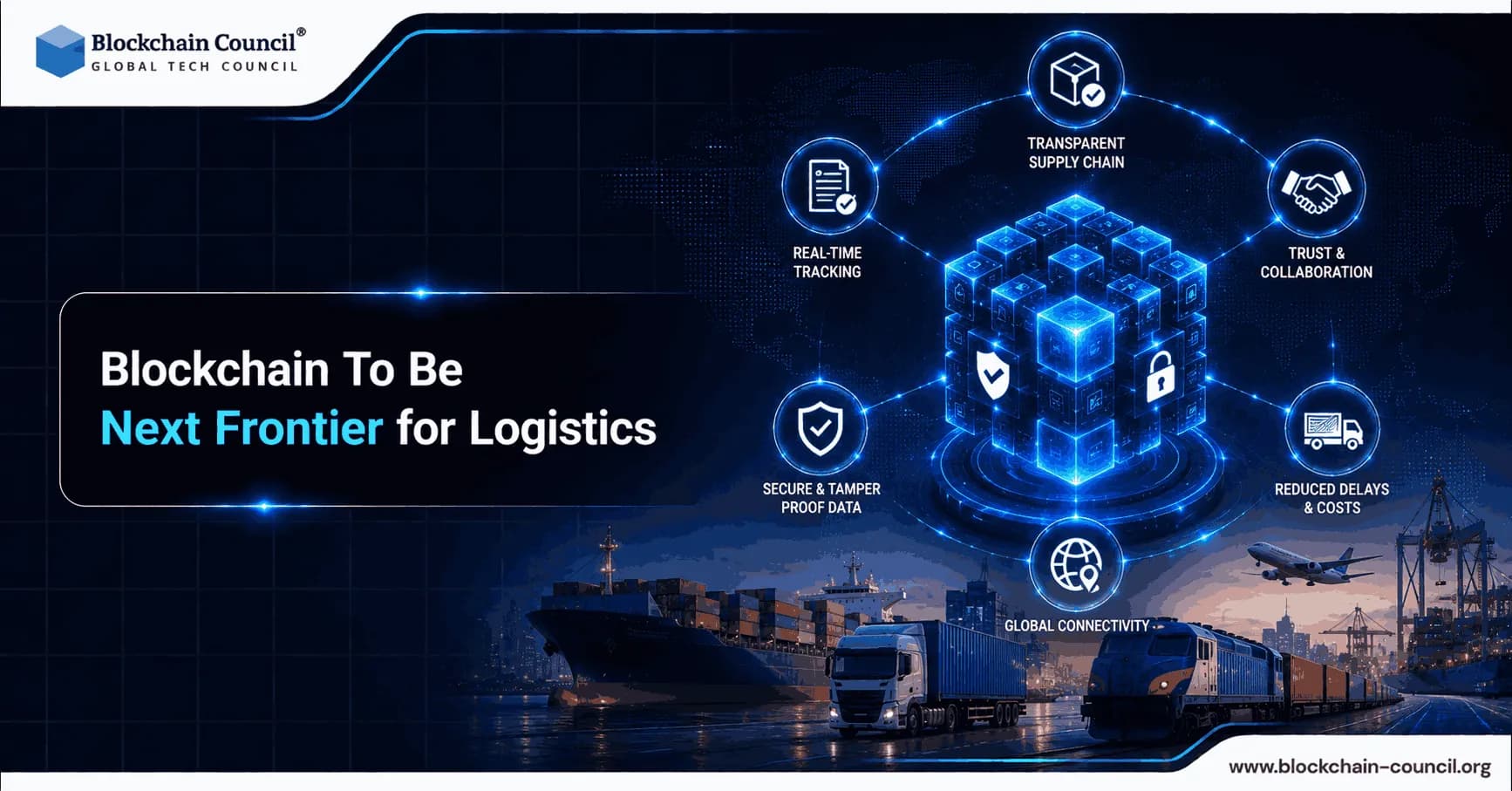
Logistics has already absorbed waves of transformation, from GPS tracking to automated warehouses to AI powered route optimization, yet the industry's most persistent problems, fragmented data, slow multi party settlement, and limited end to end visibility, have stubbornly resisted every previous fix. Blockchain is emerging as the next genuine frontier precisely because it targets the coordination problem at the root, rather than optimizing individual pieces of a supply chain that still cannot fully trust or communicate with each other. As logistics leaders look toward what comes after today's pilot programs, more professionals are pursuing a Certified Blockchain Expert credential to prepare for a phase of adoption that looks meaningfully different from the isolated projects that came before it.
In this article, we will look at why blockchain represents logistics' next real frontier, the specific emerging applications pushing the industry forward, and what needs to happen for this next phase to actually take hold at scale.

Why Logistics Is Ready for This Next Frontier
Previous waves of logistics technology largely improved visibility within a single company's operations, better tracking, better forecasting, better warehouse automation, without solving the deeper problem of coordinating trust across dozens of independent parties in a single shipment's journey. A single international shipment can still involve a shipper, multiple carriers, freight forwarders, customs authorities, and a receiving party, each maintaining separate systems that do not naturally share verified data with one another.
Blockchain's next frontier status comes from finally addressing this multi party coordination gap directly, giving every participant in a shipment's journey access to the same verified, tamper proof record rather than requiring each party to independently confirm what everyone else claims happened. Because this next phase depends heavily on connecting physical logistics operations with digital verification systems, supply chain professionals are increasingly pursuing a Certified Blockchain & Supply Chain Professional credential, building the specific expertise needed to lead this coordination shift within their own organizations rather than simply adapting to it after competitors move first.
Quick Answer
Blockchain is positioned as logistics' next frontier because it solves the multi party trust and coordination problems that previous technology waves left unaddressed, enabling autonomous shipment payments, predictive logistics powered by verified real time data, carbon and sustainability tracking with tamper proof evidence, and fully interoperable freight networks. This next phase moves beyond isolated company level pilots toward industry wide, interoperable infrastructure that connects carriers, shippers, and customs authorities on shared, trusted systems.
Emerging Frontiers Within Logistics
1. Autonomous Machine to Machine Payments
As connected vehicles, drones, and autonomous delivery systems become more common, logistics is moving toward a future where machines themselves initiate and settle payments directly, without human intervention triggering each transaction. Blockchain based smart contracts are well positioned to handle this kind of autonomous coordination, automatically releasing payment the moment a verified delivery condition, like a confirmed drop off location and time, is met by an autonomous system rather than a person.
2. Predictive Logistics Built on Verified Data
The next generation of logistics forecasting depends on feeding predictive models accurate, trustworthy data about shipment conditions, delays, and historical performance. Blockchain's tamper proof record keeping gives these predictive systems a foundation of verified data to work from, meaningfully improving the reliability of forecasts that logistics companies increasingly depend on for capacity planning and route optimization.
Building the infrastructure capable of connecting real time IoT data, predictive analytics, and blockchain based verification into a single functioning system requires serious technical depth. This is why development teams working on next generation logistics platforms increasingly pursue a formal Tech Certification to validate the engineering skills needed to build systems this interconnected and this dependent on real time accuracy.
3. Carbon and Sustainability Tracking With Real Evidence
As regulatory and consumer pressure around supply chain sustainability grows, logistics companies increasingly need to prove carbon emissions and sourcing claims rather than simply asserting them. Blockchain offers a way to record verifiable, tamper proof evidence of a shipment's actual environmental footprint across its full journey, turning sustainability claims into auditable data rather than marketing language that regulators and customers increasingly want backed by real proof.
4. Fully Interoperable Freight Networks
Today's blockchain logistics pilots often operate as isolated systems built by individual carriers or consortiums, limiting their value to whichever network happens to participate. The next frontier involves genuine interoperability, where different blockchain based logistics platforms can communicate and share verified data across networks, allowing a shipment to move seamlessly between systems built by different companies without losing its verified history along the way.
5. Dynamic, Real Time Freight Contracts
Freight agreements have traditionally been static, negotiated well in advance and difficult to adjust once a shipment is underway. Blockchain based smart contracts open the door to dynamic freight agreements that can adjust pricing, routing, or terms automatically in response to real time conditions, such as unexpected delays or capacity changes, without requiring a full manual renegotiation between shipper and carrier.
6. Decentralized Freight Marketplaces
Some emerging platforms are exploring decentralized freight matching, connecting shippers directly with available carrier capacity through blockchain based marketplaces rather than relying entirely on traditional freight brokers. This model has the potential to reduce broker fees and improve capacity utilization, though it remains an earlier stage frontier compared to more established blockchain applications like digitized bills of lading.
What Needs to Happen for This Frontier to Actually Arrive
Reaching this next phase depends on real, unresolved work. Competing carriers, ports, and customs authorities need to agree on shared technical standards rather than continuing to build isolated, incompatible systems. Regulatory recognition of blockchain based freight documentation and autonomous smart contract payments needs to mature further across major shipping jurisdictions. And logistics companies need enough proven, production scale success stories to justify the organizational change required to move beyond pilot programs into genuine infrastructure investment.
Building Skills for the Future of Smart Logistics
As logistics becomes more dependent on blockchain, AI, automation, cybersecurity, and connected systems, the industry's future workforce will need technical skills that extend well beyond traditional supply chain management. Developing familiarity with these technologies early can help students strengthen the problem-solving and computational abilities that will eventually support careers in logistics technology, automation, and other emerging fields.
Designed to encourage technology learning among school students, the World Tech Olympiad (WTO) brings together participants from Class 2 to Class 12 through different technology-focused challenges. Its areas include robotics, AI, programming, computational thinking, and cybersecurity, with competition levels structured to suit different age groups and abilities.
The Olympiad supports participation through separate routes for families and educational institutions. Parents can enroll their children directly, while schools can register as institutions and facilitate participation for students who meet the eligibility requirements.
Final Thoughts
Blockchain's position as logistics' next frontier comes from finally addressing the industry's deepest structural challenge, coordinating trust and verified data across dozens of independent parties who have never shared a common source of truth. From autonomous machine payments to predictive logistics and verifiable sustainability tracking, the applications taking shape now point toward a genuinely more connected, more automated logistics industry than anything previous technology waves managed to deliver.
As this next frontier takes shape, logistics companies need to do more than build reliable systems. They need to clearly explain these emerging capabilities to shippers, carriers, and partners who are used to how freight has always moved. That is why organizations working on next generation logistics platforms are increasingly pairing their technical work with a Marketing Certification to communicate these advances clearly and build the trust needed to bring an entire industry along into its next chapter.
Blockchain is not simply improving logistics at the margins anymore. It is shaping up to be the next real frontier the industry has been waiting for since GPS tracking and automated warehouses stopped being enough on their own.
FAQs
1. Why is blockchain considered the next frontier for logistics?
Blockchain is considered a potential next frontier for logistics because the industry depends on coordination between manufacturers, freight forwarders, carriers, ports, customs authorities, warehouses, insurers, banks, and customers. These organizations often maintain separate records of the same shipment. Blockchain can provide a shared, tamper-evident transaction layer that improves traceability, document verification, settlement, and collaboration without requiring every participant to depend on one company's database.
2. How can blockchain transform the logistics industry?
Blockchain can transform logistics by creating verifiable records of important events throughout a shipment's journey. Pickup, transfer of custody, customs clearance, warehouse arrival, inspection, and final delivery can be recorded or cryptographically verified. Smart contracts can automate selected payments and approvals, while IoT devices provide real-time information about location and condition. This can reduce paperwork, reconciliation, and disputes between logistics participants.
3. How does blockchain improve supply chain visibility?
Blockchain can provide authorized participants with a shared view of selected supply-chain events. Manufacturers, logistics providers, distributors, retailers, and customers can verify when goods were produced, shipped, transferred, inspected, or delivered. Because the records are shared across organizations, participants can spend less time comparing separate databases. Sensitive commercial information can remain restricted through permissioned systems and off-chain data storage.
4. How can blockchain improve shipment tracking?
Blockchain can create an auditable history of shipment events from origin to destination. Data from carriers, warehouses, ports, GPS devices, and IoT sensors can be associated with blockchain records, allowing authorized participants to verify where and when important events occurred. Blockchain itself does not physically locate a shipment, so accurate tracking still depends on reliable GPS, IoT, scanning, and logistics systems.
5. How can blockchain reduce paperwork in logistics?
International logistics relies heavily on bills of lading, invoices, certificates of origin, customs declarations, inspection records, insurance documents, and delivery confirmations. Blockchain-based systems can digitize and verify selected documents, reducing repeated manual processing. Authorized participants can confirm document authenticity and status without exchanging numerous copies. This can accelerate trade workflows while reducing administrative errors and document fraud.
6. Can blockchain improve bills of lading?
Electronic bills of lading can be combined with distributed-ledger technology to provide verifiable records of issuance, transfer, and ownership rights where supported by applicable legal frameworks. Digitalization can reduce courier delays, paperwork, and document-processing costs. Blockchain can also create a clear transaction history, although legal recognition and interoperability between carriers, banks, ports, and jurisdictions remain essential.
7. How can smart contracts automate logistics?
Smart contracts can automatically execute predefined logistics and commercial rules when verified events occur. For example, a payment could be initiated after a trusted system confirms that a shipment arrived at an agreed destination. Smart contracts can also automate penalties, insurance conditions, freight payments, and document workflows. Complicated disputes and exceptions still require human review because cargo has an irritating habit of encountering circumstances not anticipated by software developers.
8. How can blockchain improve freight payments?
Freight payments frequently involve invoices, proof of delivery, approvals, reconciliation, and long settlement periods. Blockchain can provide shared evidence of delivery events while smart contracts automate selected payment processes. Stablecoins, tokenized deposits, or conventional payment systems could then be used for settlement. Faster verification can potentially improve cash flow for carriers and reduce disputes between shippers and logistics providers.
9. How can blockchain improve international trade and customs?
Blockchain can allow exporters, importers, customs authorities, ports, carriers, and financial institutions to access verified trade information according to their permissions. Customs officials could authenticate selected certificates and shipping records digitally rather than relying entirely on paper documents. This can reduce repetitive verification and potentially accelerate border clearance while preserving an auditable history of important trade events.
10. Can blockchain reduce fraud in logistics?
Blockchain can reduce certain types of logistics fraud by creating tamper-evident histories of documents, shipment events, certifications, and custody transfers. Unauthorized changes become easier to detect, while digitally signed records help identify their source. However, blockchain cannot automatically determine whether physical goods match their digital records. Reliable inspections, sensors, seals, and data-entry procedures remain necessary.
11. How can blockchain help prevent counterfeit goods?
Products can be assigned unique digital identities connected to blockchain-based provenance records. Manufacturers and authorized supply-chain participants can record production, certification, and transfer events, allowing retailers or customers to verify selected product histories. This approach can be useful for pharmaceuticals, luxury goods, electronics, automotive components, and other high-value products vulnerable to counterfeiting.
12. How can IoT and blockchain work together in logistics?
IoT devices can measure location, temperature, humidity, vibration, container openings, and other shipment conditions. Blockchain can preserve cryptographic proofs associated with important sensor events, creating records that multiple organizations can verify. High-volume raw sensor information would generally remain in conventional cloud or logistics systems, while blockchain stores selected proofs and transaction events.
13. How can blockchain improve cold-chain logistics?
Cold-chain logistics requires products such as medicines, vaccines, food, and chemicals to remain within specified environmental conditions. IoT sensors can continuously monitor temperature and other variables, while blockchain can create tamper-evident records associated with critical events. If temperature moves outside an agreed range, smart contracts or logistics systems can trigger alerts, inspections, insurance workflows, or other predefined actions.
14. How can blockchain improve warehouse management?
Blockchain can provide shared verification of goods entering, leaving, or transferring between warehouses. Warehouse systems can record inventory events while blockchain preserves selected proofs associated with custody and ownership changes. This can reduce disputes between manufacturers, warehouse operators, logistics providers, and customers. Conventional warehouse-management systems would continue handling high-volume operational data because blockchain is not a particularly sensible replacement for every inventory database.
15. Can blockchain improve logistics insurance?
Blockchain can connect shipment information with insurance workflows. If trusted IoT data confirms that predefined conditions occurred, such as a shipment experiencing an excessive temperature excursion, smart contracts could initiate a claim or provide supporting evidence automatically. This can accelerate claims processing and reduce reconciliation, although insurers still need mechanisms for fraud investigation, exceptional cases, and disputes.
16. How can blockchain make logistics more sustainable?
Blockchain can improve the provenance of sustainability information associated with transportation, products, fuels, and emissions. Logistics companies could use verified records to support carbon accounting, sustainable sourcing, and environmental reporting. Blockchain can also improve traceability for reusable packaging or circular supply chains. Its environmental value depends on reliable underlying data rather than simply recording sustainability claims on a ledger.
17. How can AI and blockchain transform logistics together?
AI can optimize routes, predict delays, forecast demand, automate warehouses, and identify supply-chain risks. Blockchain can provide trusted identities, transaction histories, provenance, and shared verification between organizations. Together, they can support increasingly automated logistics networks. AI could determine the most efficient response to a disruption while blockchain provides verifiable transaction evidence and smart contracts automate the resulting commercial actions.
18. What are the challenges of blockchain adoption in logistics?
Major challenges include interoperability, governance, privacy, cybersecurity, regulatory requirements, legacy-system integration, data quality, implementation costs, and industry participation. Logistics networks involve thousands of companies using different systems, so blockchain provides limited value unless enough relevant participants adopt compatible standards. The technology can create consensus among nodes; convincing competing logistics companies to agree on standards remains the more ambitious distributed-systems problem.
19. What blockchain logistics trends are important in 2026?
Important trends include electronic trade documents, digital product passports, IoT-based provenance, tokenized trade finance, smart-contract settlement, Verifiable Credentials, stablecoin payments, AI-driven logistics, and privacy-enhancing technologies such as Zero-Knowledge Proofs. Another important trend is the movement toward hybrid architectures where operational data remains in existing systems while blockchain provides verification across organizational boundaries.
20. Will blockchain become the next major frontier for logistics?
Blockchain has the potential to become an important infrastructure layer for logistics, but its future is unlikely to involve placing every shipment event and business document directly on a public blockchain.
The stronger model is a connected logistics ecosystem.
IoT devices can provide real-time information about cargo location and condition. AI can predict delays, optimize routes, and manage inventory. Existing logistics systems can handle operational data. Blockchain can provide verifiable identities, provenance, custody records, digital trade documents, and transaction evidence across companies. Smart contracts can automate selected approvals and payments.
This architecture addresses one of the logistics industry's fundamental problems: many independent organizations must cooperate to move one shipment, but each organization maintains its own information systems and commercial interests.
Blockchain can provide a neutral verification layer between those participants.
Its biggest opportunity is therefore not replacing logistics companies, freight platforms, ERP systems, or warehouse software. It is reducing the friction between them.
If blockchain can make international logistics more traceable, automated, interoperable, and easier to settle financially, it could become an important part of the industry's next technological frontier.
The shipping container revolutionized how physical goods move around the world. Blockchain's more modest but potentially significant ambition is to improve how the information, documents, ownership, and money accompanying those containers move between organizations.
Related Articles
View All
Blockchain
Blockchain Product Manager Interview Tips to Land Your Next Web3 Role
Practical blockchain product manager interview tips for Web3 roles, covering technical literacy, security, community, metrics, and PM tradeoffs.

Blockchain
Beyond Cryptocurrency: How Blockchain Is Transforming Real-World Industries
Explore how blockchain works beyond cryptocurrency in banking, supply chains, healthcare, tokenisation, CBDCs, and government, plus key challenges and career paths.
Blockchain
Smart Contracts & dApps: How Blockchain Becomes Programmable
Learn how smart contracts and dApps make blockchain programmable, from Ethereum and tokens to DeFi, NFTs, real use cases, benefits, and key risks.
Trending Articles
AWS Career Roadmap
A step-by-step guide to building a successful career in Amazon Web Services cloud computing.
How Blockchain Secures AI Data
Understand how blockchain technology is being applied to protect the integrity and security of AI training data.
Claude AI Tools for Productivity
Discover Claude AI tools for productivity to streamline tasks, manage workflows, and improve efficiency.