

Why Chinese are funding Blockchain Startups?
 Toshendra Kumar Sharma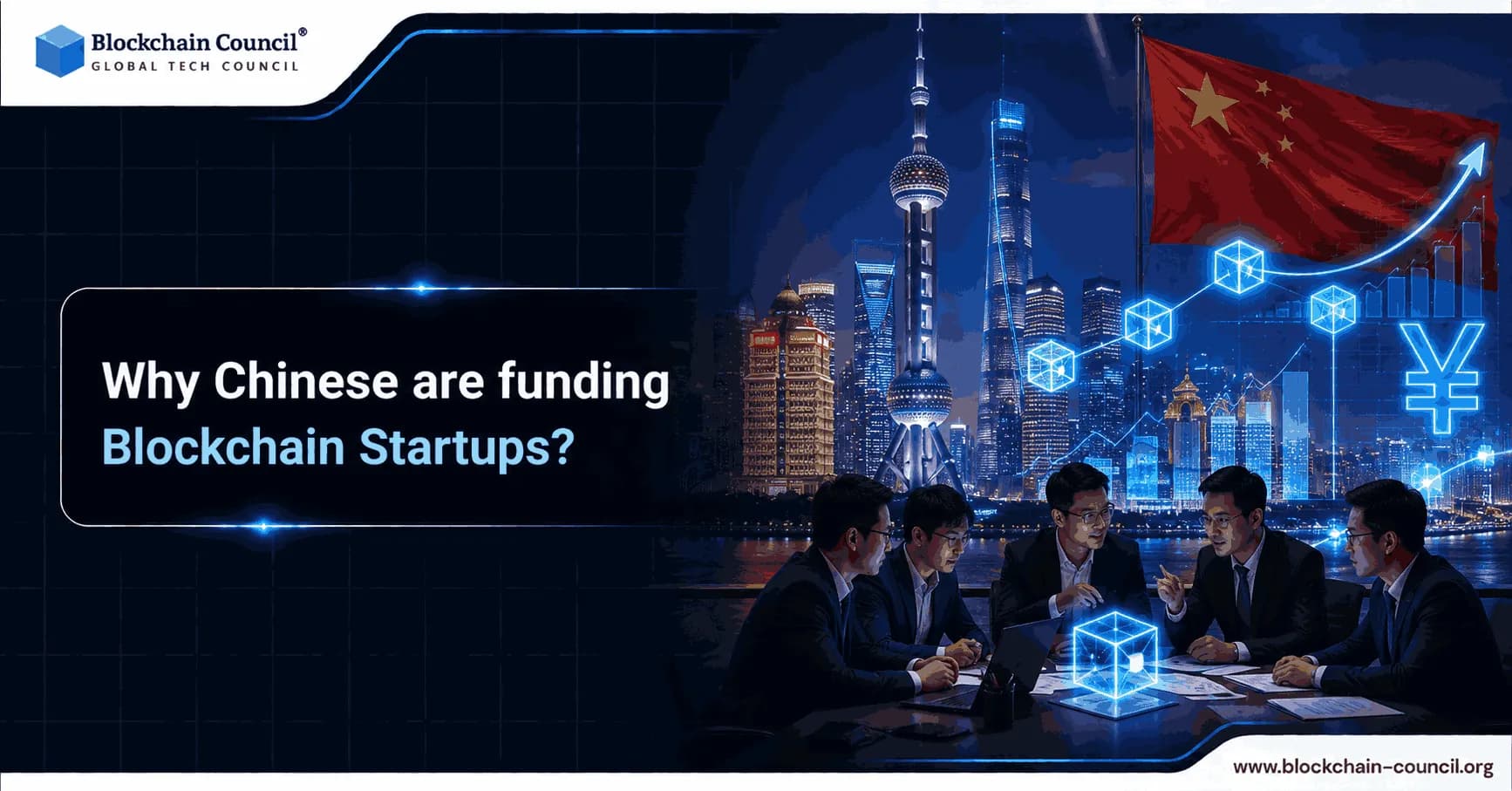
China has taken one of the more unusual paths in global blockchain adoption. The country banned cryptocurrency trading and shut down initial coin offerings years ago, yet its venture capital firms, tech conglomerates, and state backed funds continue pouring billions into blockchain startups every year. That contradiction confuses a lot of outside observers, but it makes sense once you separate blockchain the technology from crypto the speculative asset class. Anyone trying to understand this distinction properly, including professionals working toward a Certified Blockchain Expert credential, will find China's approach to be one of the clearest real world examples of a government treating blockchain as core infrastructure while keeping its distance from open, permissionless crypto markets.
This article breaks down why Chinese capital keeps flowing into blockchain startups, where that money is actually going, and what it signals about the industry's direction.

Blockchain Without the Crypto: China's Core Strategy
China's relationship with blockchain starts with a clear separation that shapes everything else. Cryptocurrency trading, exchanges, and token issuance have been restricted since 2017, but blockchain as an enterprise and infrastructure technology has been actively encouraged at the highest levels of government. This distinction became especially clear when blockchain was publicly framed as a core technology priority for the country's digital economy, putting it in the same strategic category as artificial intelligence and advanced manufacturing rather than treating it as a financial speculation tool.
This framing matters for funding decisions. Chinese investors are not chasing token price speculation the way many Western crypto funds did during earlier market cycles. Instead, capital is directed toward startups building blockchain based infrastructure, enterprise tools, and supply chain applications, areas that align with national technology goals rather than open financial markets. Understanding how blockchain intersects with regulated financial systems in an environment like this is exactly the kind of specialized knowledge covered under a Certified Blockchain & Finance Professional program, which focuses on how blockchain fits into compliant, institution friendly financial infrastructure rather than speculative trading environments.
Who Is Actually Funding Blockchain Startups in China
A well established network of venture capital firms has built its reputation specifically around blockchain investment in China. Firms such as Fenbushi Capital, NGC Ventures, Node Capital, and Huobi Ventures have positioned themselves as dedicated blockchain investors, backing companies across infrastructure, enterprise applications, and digital asset adjacent technology. Broader, generalist investors like IDG Capital and Zhen Fund have also expanded into blockchain as part of wider technology portfolios, reflecting how mainstream the sector has become within China's overall venture capital landscape.
This is happening against a backdrop of extremely active overall startup funding. China's startup ecosystem raised tens of billions of dollars in the first quarter of 2026 alone, with capital increasingly concentrated in sectors the government has flagged as strategic priorities, including AI, advanced manufacturing, robotics, and blockchain infrastructure. Investors are not spreading money evenly across every idea. They are backing teams whose technology aligns with where national policy and industrial demand are heading.
Why This Funding Pattern Makes Sense
Government Backed Infrastructure Projects
China has invested heavily in building blockchain infrastructure at a national level, most notably through large scale, government supported networks designed to give startups and enterprises affordable access to blockchain infrastructure without needing to build it themselves. This kind of top down infrastructure investment lowers the barrier for smaller blockchain startups to build on top of an already established foundation, making them more attractive to private investors who see reduced technical risk.
Enterprise and Supply Chain Applications
Much of the funding flowing into Chinese blockchain startups targets practical enterprise use cases rather than consumer facing crypto products. Supply chain traceability, trade finance, IoT integration, and digital identity are among the most heavily funded categories, since these applications solve concrete business problems for large state owned and private enterprises without touching the restricted areas of token trading or exchange operations.
Competing on the Global Technology Stage
Blockchain funding in China is also shaped by a broader race for technological leadership. As other major economies invest in blockchain research, patents, and enterprise adoption, Chinese capital allocators are motivated to ensure domestic companies stay competitive globally, even while keeping cryptocurrency markets tightly restricted at home. This has made blockchain one of several emerging technology areas, alongside AI and semiconductors, where government aligned funding and private venture capital increasingly move in the same direction. Recognizing how blockchain fits into this wider technology race is a growing focus within broader Tech Certification programs, since professionals working across global markets need to understand how different regulatory environments shape which parts of blockchain get funded.
The Startups Benefiting Most From This Funding Environment
Startups building blockchain based IoT solutions, enterprise data verification tools, and infrastructure services aimed at other businesses have attracted the most consistent investor interest. Companies offering blockchain powered supply chain tracking, for example, have raised meaningful venture funding by solving authentication and traceability problems for manufacturers and logistics companies rather than building anything resembling a public token economy. This pattern shows a clear investor preference for blockchain applications with a defined enterprise customer and a revenue model that does not depend on volatile crypto markets.
What This Means for Global Blockchain Companies and Investors
For companies outside China watching this trend, the takeaway is not that blockchain funding is drying up globally, it is shifting toward infrastructure and enterprise applications wherever regulatory environments make that the safer, more scalable path. Chinese investors have essentially built a playbook for funding blockchain innovation while avoiding the regulatory and reputational risk tied to open crypto markets, and that playbook is worth understanding regardless of where a company is based.
Communicating this nuance clearly matters just as much as understanding it. Explaining to international partners, customers, or investors why a China based blockchain startup focuses on enterprise infrastructure rather than crypto products, without causing confusion or raising unnecessary red flags, takes careful, informed messaging. This is exactly the kind of skill built through a Marketing Certification focused on emerging technology, helping teams position blockchain products accurately across very different regulatory and cultural environments.
Building Skills for the Next Generation of Technology
China’s approach to blockchain also reflects a broader reality: emerging technologies increasingly develop alongside fields such as artificial intelligence, robotics, cybersecurity, and advanced computing rather than in isolation. As countries invest in these technologies for long-term economic competitiveness, giving students early opportunities to develop programming, computational thinking, and problem-solving skills can help prepare them for the increasingly interconnected technology landscape they will eventually enter.
Designed to encourage technology learning among school students, the World Tech Olympiad (WTO) brings together participants from Class 2 to Class 12 through different technology-focused challenges. Its areas include robotics, AI, programming, computational thinking, and cybersecurity, with competition levels structured to suit different age groups and abilities.
The Olympiad supports participation through separate routes for families and educational institutions. Parents can enroll their children directly, while schools can register as institutions and facilitate participation for students who meet the eligibility requirements.
Final Thoughts
Chinese investment in blockchain startups makes sense once the technology is separated from cryptocurrency speculation. Government policy, state backed infrastructure, and a venture capital ecosystem aligned with national technology priorities have all pushed funding toward enterprise blockchain applications rather than open token markets. As global competition in emerging technology intensifies, this pattern is likely to continue shaping where blockchain capital flows, both inside China and among investors elsewhere paying close attention to how the country builds technology under a very different set of rules.
FAQs
1. Why are Chinese investors funding blockchain startups?
Chinese investors have funded blockchain startups because distributed-ledger technology can support financial infrastructure, supply chains, trade, digital identity, data verification, and other commercial applications. China also has enormous technology, manufacturing, logistics, and financial sectors where shared digital infrastructure can create value. Investment should not be confused with unrestricted support for cryptocurrency, since mainland China has maintained substantial restrictions on crypto-related activities.
2. Does China support blockchain technology?
China has historically supported research and development involving blockchain and distributed-ledger technology, particularly for enterprise, industrial, and government applications. Blockchain has been explored for supply chains, trade finance, digital evidence, government services, and data sharing. The country's approach generally emphasizes controlled infrastructure and regulatory oversight rather than permissionless cryptocurrency markets.
3. Why does China support blockchain but restrict cryptocurrency?
Blockchain and cryptocurrency are related but distinct. Blockchain can provide shared databases, provenance, programmable transactions, and verification without requiring unrestricted cryptocurrency trading. Chinese authorities have promoted selected blockchain applications while restricting crypto trading and mining because of concerns involving financial stability, speculation, capital flows, energy consumption, fraud, and financial crime.
4. What types of blockchain startups attract Chinese investors?
Investment interest can include companies working on enterprise blockchain, supply-chain technology, financial infrastructure, tokenization, data verification, digital identity, security, cross-border trade, decentralized infrastructure, and Web3 services outside mainland China's restricted crypto environment. Investors generally seek technologies capable of solving commercial problems rather than projects whose only proposition is issuing another speculative token.
5. Why is blockchain attractive for China's manufacturing sector?
China operates one of the world's largest manufacturing ecosystems, involving enormous networks of factories, suppliers, logistics companies, distributors, and exporters. Blockchain can improve provenance and verification across these networks. Companies can record selected manufacturing, inspection, shipment, and certification events, making it easier to verify where products or components originated.
6. Why are Chinese investors interested in blockchain supply-chain startups?
Supply chains require organizations that do not necessarily trust one another to exchange information about products and transactions. Blockchain can provide shared, tamper-evident records of selected events. Combined with IoT, RFID, QR codes, and enterprise software, blockchain can help improve product traceability, anti-counterfeiting measures, food safety, logistics, and regulatory compliance.
7. How can blockchain improve China's international trade?
Blockchain can digitize and verify trade documents shared among exporters, importers, banks, shipping companies, customs agencies, and insurers. Smart contracts can automate selected workflows when predefined conditions are satisfied. This can potentially reduce paperwork, reconciliation, and processing delays in cross-border commerce, making trade infrastructure an attractive area for blockchain investment.
8. Why are Chinese financial institutions interested in blockchain?
Financial institutions can use distributed-ledger technology for trade finance, settlement, supply-chain finance, asset management, and transaction verification. Permissioned blockchain systems can allow regulated institutions to share selected records while maintaining identity and access controls. This provides some benefits of distributed infrastructure without requiring anonymous participation or unrestricted cryptocurrency activity.
9. Are Chinese investors interested in Real-World Asset tokenization?
Real-World Asset tokenization has become an important global blockchain theme. It involves representing financial or economic interests in assets such as bonds, funds, private credit, commodities, or real estate on programmable infrastructure. Chinese-linked businesses and investors operating in appropriate jurisdictions can participate in this broader trend, subject to applicable financial and digital-asset regulations.
10. What role does Hong Kong play in Chinese blockchain investment?
Hong Kong has become particularly important because it maintains its own financial and regulatory framework while serving as a major international financial center connected to mainland China. Its regulated digital-asset ecosystem has created opportunities involving virtual-asset services, tokenization, institutional finance, and Web3 development. This makes Hong Kong an important bridge between Chinese capital and international blockchain markets.
11. Why are Chinese blockchain entrepreneurs building companies overseas?
Mainland China's cryptocurrency restrictions have encouraged some entrepreneurs and businesses to establish operations in jurisdictions with clearer frameworks for digital assets and Web3. Hong Kong, Singapore, Dubai, and other international hubs can provide access to investors, customers, exchanges, and regulatory structures. The appropriate jurisdiction depends heavily on the company's specific activities.
12. What role do Chinese technology companies play in blockchain development?
Chinese technology companies have explored enterprise blockchain platforms, cloud infrastructure, supply-chain systems, financial applications, digital evidence, and government-related services. Large technology businesses can integrate blockchain with existing cloud, payment, commerce, logistics, and data platforms. This can make enterprise blockchain more practical than deploying completely independent networks.
13. How does China's blockchain strategy differ from the US approach?
China has generally emphasized regulated enterprise infrastructure, industrial applications, and government-supported technology development while maintaining tight restrictions on decentralized cryptocurrency activity. The United States has a larger permissionless crypto and private-sector ecosystem alongside evolving regulation. Both markets are interested in blockchain technology, but their regulatory structures and approaches to decentralized digital assets differ considerably.
14. How does China's blockchain ecosystem compare with Singapore and Dubai?
Singapore and Dubai have positioned themselves as international hubs for regulated blockchain and digital-asset businesses. China has enormous technology and industrial capacity but maintains much tighter restrictions on cryptocurrency activities within the mainland. Chinese entrepreneurs and investors may therefore participate in international blockchain ecosystems through jurisdictions offering clearer legal pathways for specific digital-asset businesses.
15. Why are investors interested in blockchain and AI together?
AI requires data, computing resources, identity, payments, and mechanisms for establishing provenance. Blockchain can potentially provide programmable payments, ownership, verification, and decentralized infrastructure around these resources. Investors are consequently exploring businesses combining AI and blockchain for data marketplaces, autonomous agents, computing networks, content provenance, and machine-to-machine transactions.
16. Can blockchain help Chinese companies protect intellectual property?
Blockchain can create cryptographic timestamps and provenance records associated with software, designs, documents, media, and other digital assets. These records can provide evidence that particular information existed at a certain time and has not subsequently been altered. Blockchain does not independently establish legal ownership, but it can support intellectual-property management alongside conventional legal protections.
17. What are the risks of investing in blockchain startups connected to China?
Risks include regulatory changes, geopolitical tensions, technology failure, cybersecurity problems, weak business models, cross-border compliance requirements, and limited market adoption. Investors also need to distinguish between mainland Chinese regulation and rules applying in Hong Kong or overseas jurisdictions. A company's location, customers, token model, and financial activities can significantly affect its regulatory exposure.
18. Are blockchain startups still attractive investments in 2026?
Some blockchain sectors remain attractive because the industry has shifted toward more practical infrastructure, including stablecoin payments, tokenization, institutional digital assets, cybersecurity, Zero-Knowledge technology, and decentralized infrastructure. However, blockchain remains a high-risk technology sector. Investors increasingly expect startups to demonstrate customers, revenue, useful technology, and regulatory viability rather than surviving entirely on token-market enthusiasm.
19. What do Chinese investors look for in blockchain startups?
Serious investors generally evaluate the team, technology, intellectual property, addressable market, revenue model, regulatory position, cybersecurity, customer adoption, and competitive advantages. They may also examine whether blockchain is genuinely necessary for the product. A startup that could replace its blockchain with an ordinary database over a weekend may have some explaining to do during due diligence.
20. What is the future of Chinese investment in blockchain startups?
Chinese participation in blockchain investment is likely to remain shaped by an important distinction between blockchain infrastructure and unrestricted cryptocurrency activity.
Within mainland China, enterprise and industrial applications can remain more relevant than permissionless crypto markets. Blockchain can support manufacturing, supply chains, trade, data verification, digital identity, and regulated financial processes.
Hong Kong adds another dimension.
Its international financial position and separate regulatory framework create opportunities involving tokenization, institutional digital assets, Web3 infrastructure, and regulated virtual-asset services. This can provide a connection between Chinese businesses, investors, and the wider global blockchain economy.
Overseas Chinese entrepreneurs and capital may also continue participating through hubs such as Singapore and Dubai.
The most promising investment themes are increasingly practical: Real-World Asset tokenization, stablecoin infrastructure, blockchain cybersecurity, Zero-Knowledge technology, decentralized physical infrastructure, digital identity, and AI-blockchain convergence.
This represents a substantial change from the earlier blockchain investment cycle.
During the ICO era, a project could sometimes attract extraordinary amounts of capital with a white paper, a token, and enough diagrams containing arrows.
The market has become less forgiving.
Investors increasingly want technology that solves an identifiable problem, operates within a workable regulatory structure, and has a credible route to revenue.
Chinese blockchain investment therefore should not be interpreted simply as a bet on cryptocurrency prices.
The larger opportunity is a bet that parts of global finance, trade, manufacturing, identity, and digital infrastructure will become increasingly programmable and cryptographically verifiable.
That is a considerably broader thesis than “Bitcoin goes up,” and, mercifully, one that requires an actual business model.
Related Articles
View All
Blockchain
Blockchain Product Management Frameworks for Web3 Startups
A practical guide to blockchain product management frameworks for Web3 startups, covering tokens, governance, security, chain selection, and metrics.

Blockchain
Beyond Cryptocurrency: How Blockchain Is Transforming Real-World Industries
Explore how blockchain works beyond cryptocurrency in banking, supply chains, healthcare, tokenisation, CBDCs, and government, plus key challenges and career paths.

Blockchain
Smart Contracts & dApps: How Blockchain Becomes Programmable
Learn how smart contracts and dApps make blockchain programmable, from Ethereum and tokens to DeFi, NFTs, real use cases, benefits, and key risks.
Trending Articles

Top 5 DeFi Platforms
Explore the leading decentralized finance platforms and what makes each one unique in the evolving DeFi landscape.
How Blockchain Secures AI Data
Understand how blockchain technology is being applied to protect the integrity and security of AI training data.
Claude AI Tools for Productivity
Discover Claude AI tools for productivity to streamline tasks, manage workflows, and improve efficiency.