

What type of applications are emerging in Blockchain?
 Toshendra Kumar Sharma
Blockchain has moved far beyond its early reputation as the technology behind Bitcoin. Today it powers real business systems across finance, healthcare, supply chains, real estate, and government services, with a growing number of industries adopting it to solve problems that traditional databases and centralized systems struggle with. Understanding this shift is a core part of any serious blockchain education, and it is exactly the kind of foundational knowledge covered in a Certified Blockchain Expert program, since these applications represent where the technology is actually being used rather than just where it started.
This article breaks down the major categories of blockchain applications that are gaining traction right now and why each one matters.

Decentralized Finance and Digital Payments
Decentralized finance, commonly called DeFi, has matured from an experimental corner of crypto into a genuine layer of financial infrastructure. Platforms built on smart contracts now allow people to lend, borrow, and trade assets without relying on a traditional bank as an intermediary. Well established DeFi protocols are increasingly used by both retail users and institutions, and mainstream banks are exploring similar blockchain based systems for trade finance and settlement.
Alongside DeFi, stablecoins and blockchain based payment rails are helping move money across borders faster and more cheaply than legacy banking systems. This kind of practical financial application is one reason blockchain now ranks alongside cloud computing and AI as a priority investment area for many organizations, a trend that shows up clearly across broader Tech Certification programs, which increasingly pair blockchain fundamentals with fintech specific modules to reflect how closely these fields now overlap.
Smart Contracts Automating Agreements
Smart contracts are self executing agreements that carry out actions automatically once predefined conditions are met. They are being used to automate trade settlements, insurance claims, and royalty payments, cutting processing times that used to take days or weeks down to minutes, while removing much of the manual paperwork that traditionally slowed these processes down.
Supply Chain Transparency and Provenance
Supply chain tracking is one of the clearest examples of blockchain solving a problem that existed long before crypto did. By recording every step of a product's journey on a shared, tamper resistant ledger, companies can trace goods from origin to shelf in a matter of seconds rather than days. Retailers and logistics providers use this to confirm certifications, verify quality checks, and quickly identify the source of contamination or counterfeit goods when problems arise.
Large enterprises have already put this into practice, using blockchain based tracking systems to trace food products and reduce fraud across complex, multi party supply chains where trust between vendors has traditionally been difficult to verify.
Healthcare Data Management
Healthcare is emerging as one of the more sensitive but high value areas for blockchain adoption. Hospitals and health networks are exploring blockchain to protect patient data while still allowing secure, permissioned sharing between providers. Instead of medical records sitting isolated inside a single hospital's system, blockchain based approaches let patients maintain more control over their own health data and share it selectively with doctors or specialists as needed, without relying on a single centralized database that could become a target for large scale breaches.
Pharmaceutical tracking is another growing use case, where blockchain helps verify that medications are authentic and have moved through a legitimate, unbroken supply chain from manufacturer to patient.
Digital Identity and Government Services
Governments are beginning to explore blockchain as a way to secure citizen identity and streamline public services. Estonia is often cited as an early example, having built government infrastructure that anchors citizen records, health data, and business registries to a blockchain based system, allowing residents and officials to trust that records have not been altered.
Digital identity systems built on blockchain also have applications outside government, including financial inclusion projects that give people without traditional banking access a verifiable transaction history, which can then be used to qualify for microloans or other financial services they previously could not access.
Asset Tokenization and Real Estate
Tokenization, the process of converting a real world asset like property, art, or commodities into a digital token on a blockchain, is one of the fastest growing categories in the space. Real estate tokenization in particular is opening up fractional ownership, allowing investors to buy a small share of a property rather than needing enough capital to purchase it outright, with rental income distributed automatically through smart contracts.
Beyond real estate, tokenized bonds, securities, and commodity backed tokens are being explored as ways to reduce settlement delays and improve price transparency in markets that have traditionally relied on slower, paper heavy processes.
Why This Matters for Businesses and Professionals
As blockchain applications spread across so many different industries, explaining their value clearly to customers, investors, and regulators has become just as important as building the technology itself. Businesses adopting blockchain for supply chains, healthcare, or tokenized assets still need to communicate what these systems actually do in language that non technical stakeholders can understand and trust. This is why a structured Marketing Certification focused on blockchain and emerging technology has become increasingly relevant, helping professionals translate complex, permissioned ledger systems and tokenization models into messaging that builds genuine confidence rather than confusion.
Final Thoughts
Blockchain's next chapter is being written far outside the world of cryptocurrency trading. Decentralized finance, supply chain transparency, healthcare data management, digital identity, and asset tokenization are all maturing into practical, revenue generating applications rather than experimental pilots. As regulatory clarity improves and scalability challenges continue to be resolved, these use cases are likely to become standard infrastructure across industries rather than emerging trends, reshaping how businesses operate and how trust is established in digital systems.
FAQs
1. What types of blockchain applications are emerging?
Blockchain applications are rapidly expanding beyond cryptocurrencies into finance, healthcare, supply chain management, digital identity, gaming, artificial intelligence (AI), telecommunications, government services, and enterprise automation. Modern blockchain applications focus on improving transparency, security, automation, and trust across industries.
2. Why are blockchain applications growing?
Organizations are adopting blockchain because it enables secure data sharing, decentralized trust, smart contract automation, digital ownership, and tamper-evident record-keeping. These capabilities help reduce fraud, improve efficiency, and streamline collaboration among multiple parties.
3. What are the major categories of blockchain applications?
Emerging blockchain applications include:
Decentralized Finance (DeFi)
Digital Identity (DID)
Tokenization of Real-World Assets (RWAs)
Supply Chain Management
Blockchain Gaming
Healthcare
Enterprise Blockchain
Government Services
Internet of Things (IoT)
Artificial Intelligence (AI)
4. How is blockchain transforming finance?
Financial applications include:
Cross-border payments
Stablecoins
Digital wallets
Lending platforms
Decentralized exchanges (DEXs)
Asset tokenization
Securities settlement
Trade finance
Insurance automation
5. How is blockchain used in healthcare?
Healthcare applications include:
Electronic medical record verification
Pharmaceutical supply chain tracking
Clinical trial management
Healthcare credential verification
Insurance claims processing
Medical identity management
6. How is blockchain improving supply chains?
Blockchain enables:
Product traceability
Inventory management
Supplier verification
Food safety monitoring
Carbon footprint tracking
Digital Product Passports (DPPs)
Logistics automation
Anti-counterfeiting systems
7. What role does blockchain play in digital identity?
Blockchain supports:
Decentralized Identity (DID)
Verifiable Credentials (VCs)
Digital wallets
Secure authentication
Reusable KYC
Access management
Privacy-preserving identity verification
8. How is blockchain being used in gaming?
Blockchain gaming enables:
Digital asset ownership
NFT collectibles
In-game marketplaces
Player-controlled economies
Play-and-earn models
Interoperable digital assets
Community governance
9. How is blockchain integrating with AI?
Blockchain and AI work together by supporting:
AI model provenance
Data verification
Decentralized AI marketplaces
Automated payments
Machine learning governance
Trusted data sharing
Audit trails
10. How is blockchain transforming government services?
Governments are exploring blockchain for:
Digital identity
Land registries
Public procurement
Voting systems
Tax administration
Business registration
Healthcare records
Educational credentials
11. How is blockchain used in the Internet of Things (IoT)?
Blockchain secures IoT ecosystems by enabling:
Device authentication
Machine-to-machine (M2M) payments
Secure firmware verification
Data integrity
Supply chain monitoring
Smart city infrastructure
12. Which blockchain platforms support modern applications?
Popular platforms include:
Ethereum
Polygon
Solana
Avalanche
Hedera
Hyperledger Fabric
Hyperledger Besu
BNB Smart Chain
Cosmos
Sui
The best platform depends on scalability, security, privacy, governance, and application requirements.
13. What are the advantages of blockchain applications?
Benefits include:
Greater transparency
Improved security
Smart contract automation
Reduced fraud
Digital ownership
Better traceability
Faster settlements
Stronger data integrity
Lower reconciliation costs
Enhanced collaboration
14. What challenges remain?
Challenges include:
Scalability
Interoperability
Regulatory uncertainty
Privacy protection
Cybersecurity
User adoption
Governance
Integration with legacy systems
Transaction costs
Energy consumption for some networks
15. Are blockchain applications replacing traditional software?
No. Blockchain is typically integrated with cloud computing, databases, mobile applications, APIs, and enterprise software. Most successful applications use a hybrid architecture where blockchain handles shared trust and verification while traditional systems manage high-speed processing and data storage.
16. What common mistakes should organizations avoid?
Common mistakes include adopting blockchain without solving a real business problem, storing sensitive information directly on public blockchains, neglecting smart contract security audits, ignoring governance, overlooking regulatory requirements, and assuming decentralization automatically improves every application.
17. What are best practices for building blockchain applications?
Best practices include identifying a clear business use case, selecting the appropriate blockchain platform, storing confidential data off-chain where appropriate, integrating with existing enterprise systems, auditing smart contracts, implementing decentralized identity (DID), ensuring regulatory compliance, and designing for scalability.
18. How does blockchain fit into digital transformation?
Blockchain complements artificial intelligence (AI), cloud computing, Internet of Things (IoT), robotic process automation (RPA), cybersecurity, digital identity, edge computing, advanced analytics, and enterprise resource planning (ERP) systems to modernize business operations.
19. What trends are shaping blockchain applications in 2025-2026?
Major trends include:
Tokenization of real-world assets (RWAs)
Decentralized identity (DID)
Stablecoin adoption
Zero-knowledge proofs (ZKPs)
AI-powered blockchain applications
Decentralized Physical Infrastructure Networks (DePIN)
Digital Product Passports (DPPs)
Enterprise blockchain interoperability
Account abstraction
Programmable finance
20. What is the future of blockchain applications?
Blockchain applications are expected to become increasingly integrated into everyday digital services rather than existing as standalone technologies. Future innovation will likely focus on combining blockchain with AI, cloud computing, IoT, and digital identity to create secure, automated, and interoperable systems across industries. The most successful applications will not be those that simply add blockchain as a marketing feature, but those that solve real-world problems in ways traditional systems cannot. As with many technologies, the greatest sign of success may be when users stop noticing the blockchain entirely and simply enjoy software that works more securely, transparently, and efficiently.
Related Articles
View All
Blockchain
Blockchain vs Smart Contracts: Key Differences, Benefits, and Real-World Applications
Blockchain vs smart contracts explained: learn how distributed ledgers and self-executing code differ, work together, and power DeFi, NFTs, DAOs, and enterprise workflows.
Blockchain
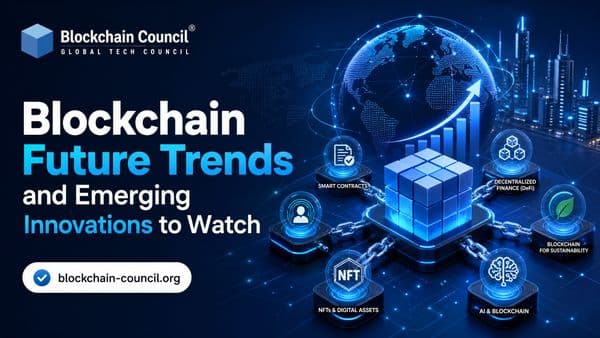
Blockchain Future Trends and Emerging Innovations to Watch
Explore blockchain future trends and emerging innovations, including DeFi, CBDCs, Web3, tokenized assets, gaming, interoperability, and enterprise adoption.

Blockchain
Beyond Cryptocurrency: How Blockchain Is Transforming Real-World Industries
Explore how blockchain works beyond cryptocurrency in banking, supply chains, healthcare, tokenisation, CBDCs, and government, plus key challenges and career paths.
Trending Articles
The Role of Blockchain in Ethical AI Development
How blockchain technology is being used to promote transparency and accountability in artificial intelligence systems.

Can DeFi 2.0 Bridge the Gap Between Traditional and Decentralized Finance?
The next generation of DeFi protocols aims to connect traditional banking with decentralized finance ecosystems.
Claude AI Tools for Productivity
Discover Claude AI tools for productivity to streamline tasks, manage workflows, and improve efficiency.