

How Is Blockchain different from Cryptocurrencies?
 Toshendra Kumar Sharma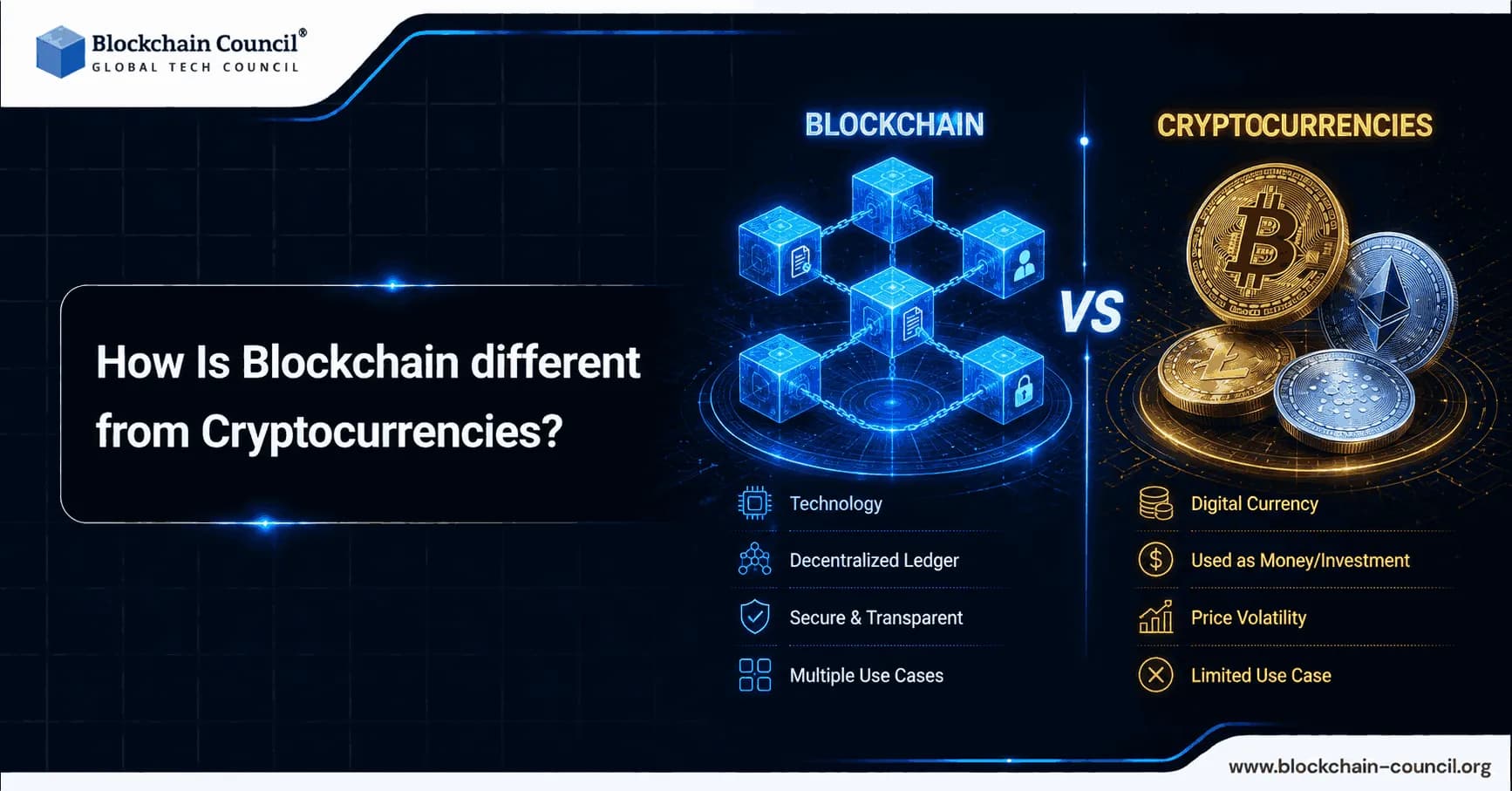
The Confusion Everyone Runs Into
Blockchain and cryptocurrency get used interchangeably so often that many people assume they are the same thing. They are not, and the gap between them has become more obvious in 2026 than ever before. Enterprise blockchain spending grew 28% year over year in early 2026 while cryptocurrency markets stayed largely flat, a clear sign that businesses are adopting blockchain as infrastructure regardless of what crypto prices are doing that week. Nearly 90% of surveyed businesses now report deploying blockchain in some capacity, while the technology continues powering an entirely separate, highly volatile asset class made up of nearly 20,000 individual cryptocurrencies. Untangling this distinction matters for anyone making career or investment decisions in the space, which is why a Certified Blockchain Expert credential and a cryptocurrency-focused credential now exist as genuinely separate learning paths rather than one combined course.
What Blockchain Actually Is
Blockchain is a distributed, tamper-resistant record-keeping system. It stores information across a network of independent computers rather than one central server, links each new entry cryptographically to the one before it, and requires network-wide agreement before any record can be added or changed. That structure alone has nothing to do with money. It can just as easily record a shipment's location, a patient's verified medical history, or a vote, which is exactly why the technology has spread so far beyond its original use case.

What Cryptocurrency Actually Is
Cryptocurrency is a digital asset that uses blockchain as its underlying settlement layer. Bitcoin, the first cryptocurrency, still represents roughly 57% of total crypto market capitalization, while Ethereum introduced programmable smart contracts that now support the majority of global decentralized finance activity. A cryptocurrency needs blockchain to function, since the ledger is what proves who owns what and prevents the same unit of currency from being spent twice. But blockchain does not need cryptocurrency to function. Many enterprise blockchain deployments run on permissioned networks with no native coin or token involved at all. Making sense of that asset-specific layer, price behavior, market structure, regulation, is a different discipline from understanding distributed ledger architecture, which is why professionals focused specifically on digital assets pursue a Certified Cryptocurrency Expert credential rather than treating crypto literacy as a byproduct of general blockchain knowledge.
Where The Two Genuinely Diverge
Purpose And Design Intent
Blockchain's purpose is trust and verification. It gives multiple parties who don't necessarily trust each other a shared, auditable record they can all rely on without a middleman. Cryptocurrency's purpose is value exchange and, in many cases, speculative investment. One is infrastructure, the other is an application built on top of that infrastructure, and conflating the two leads to a common but mistaken belief that a crash in crypto prices means blockchain itself is failing. It does not. The two now move independently enough that enterprise blockchain investment has kept climbing through periods of flat or declining crypto prices.
Volatility And Risk Profile
Cryptocurrency prices can swing dramatically within a single day, driven by sentiment, regulation, and speculation. Blockchain infrastructure spending, by contrast, behaves far more like conventional enterprise technology investment, growing steadily as adoption widens across finance, healthcare, logistics, and government services. The global blockchain market is projected to reach roughly $32 billion in 2026 on the back of that steady enterprise demand, a very different growth story from the day-to-day price charts most people associate with crypto.
Regulation
Regulators increasingly treat these as separate categories requiring separate rules. Frameworks like the EU's MiCA regulation specifically govern crypto-assets, exchanges, and stablecoins, while enterprise blockchain deployments used for supply chain tracking or identity verification typically fall under entirely different data protection and industry-specific compliance rules. That regulatory split reflects the practical reality that a bank using blockchain to settle trades faster faces a very different compliance burden than a crypto exchange listing new tokens.
Adoption Patterns
More than 600 million people now hold or use cryptocurrency worldwide, a figure driven largely by retail investment and payments. Enterprise blockchain adoption tells a different story, with a large majority of Fortune 500 companies now actively pursuing blockchain initiatives, most of them for reasons entirely unrelated to holding or trading digital currency, supply chain traceability, identity verification, and secure data sharing between business partners are consistently the leading use cases.
Why This Distinction Matters Beyond Semantics
For Businesses Evaluating Blockchain
A company exploring blockchain for supply chain traceability or secure record-keeping does not need to touch cryptocurrency at all. Many production deployments run on permissioned networks like Hyperledger Fabric, which powers the majority of enterprise blockchain systems today, specifically because they don't require a public token or exposure to crypto market volatility. Understanding this upfront saves businesses from either avoiding blockchain unnecessarily out of crypto-related caution, or overcomplicating a project by introducing token mechanics a use case never actually needed. Building that technical judgment is exactly the kind of cross-cutting skill a broader Tech Certification is designed to develop, since evaluating blockchain projects well requires comfort with the infrastructure layer independent of whatever is happening in crypto markets that quarter.
For Investors And Professionals
Treating blockchain and cryptocurrency as the same investment thesis leads to real mistakes, buying into a blockchain-branded project because crypto prices are rising, or dismissing genuinely useful enterprise blockchain applications because a specific cryptocurrency crashed. The two deserve separate due diligence, separate risk assessment, and in many cases separate expertise entirely.
Explaining The Difference Clearly Is Its Own Skill
Even once the technical distinction is understood, translating it for a non-technical audience, a customer, a board member, an investor, remains genuinely difficult. Blockchain and cryptocurrency get conflated constantly in mainstream coverage, and businesses launching blockchain-based products often have to actively correct that assumption before customers will engage with what they've actually built. That kind of clear, credible communication is a distinct skill from either the engineering or the financial side, which is why teams bringing blockchain products to market increasingly round out their expertise with a Marketing Certification, recognizing that a technically sound, non-crypto blockchain product still needs to be explained in terms an audience conditioned to think "blockchain equals crypto" can actually follow.
Technology & Problem Solving
Technology education is not only about learning tools or programming languages. It also involves understanding problems, analysing information, identifying patterns, and developing logical solutions. A Tech Olympiad gives students an opportunity to develop these problem-solving abilities while exploring different areas of technology.
Students interested in technology can explore the World Tech Olympiad, a global Tech Olympiad covering AI, coding, robotics, cybersecurity, and computational thinking.
The Bottom Line
Blockchain is the underlying technology, a shared, tamper-resistant ledger built for trust and verification across many industries. Cryptocurrency is one specific, high-profile application of that technology, a volatile, speculative digital asset class that happens to rely on blockchain for its core functionality. The 2026 data makes the split unmistakable: enterprise blockchain spending keeps climbing steadily on real operational returns, while cryptocurrency continues to move on its own separate cycle of price swings and market sentiment. Understanding both halves of that picture, and knowing which one actually applies to the problem in front of you, is what separates a well-informed blockchain decision from one driven by headlines about crypto prices.
FAQs
1. What is the difference between blockchain and cryptocurrency?
Blockchain is a technology for recording and verifying data across a distributed network, while cryptocurrency is a digital asset that can operate using blockchain technology.
Bitcoin, Ether, and many other cryptocurrencies rely on blockchains to record transactions and establish ownership. However, blockchain can also be used without creating a cryptocurrency, including applications in supply chains, digital identity, healthcare, financial settlement, and credential verification.
2. What is blockchain technology?
Blockchain is a type of distributed ledger in which transactions or records are grouped and cryptographically linked so that historical information becomes difficult to alter without detection.
Depending on its design, a blockchain can be public or permissioned and may be maintained by many independent participants or a controlled group of organizations.
Its purpose is to create a shared and verifiable record among participants.
3. What is cryptocurrency?
Cryptocurrency is a digital asset secured using cryptography and generally transferred through a blockchain or similar distributed network.
Examples include Bitcoin (BTC), Ether (ETH), and Solana (SOL). Depending on the network, cryptocurrencies can be used for payments, transaction fees, staking, decentralized applications, governance, or other economic functions.
4. Is blockchain the same as Bitcoin?
No. Bitcoin is an application of blockchain technology, not another name for blockchain itself.
Bitcoin uses a blockchain to maintain a decentralized record of BTC transactions. Blockchain concepts can also be applied to many other systems that have nothing to do with Bitcoin.
Bitcoin is therefore one blockchain-based network among many.
5. Can blockchain exist without cryptocurrency?
Yes.
A blockchain can be designed for enterprise or institutional applications without a publicly traded cryptocurrency.
For example, permissioned blockchain networks can be used for supply-chain records, financial settlements, document verification, trade finance, or shared business processes.
Some blockchain architectures still use internal digital assets or fees, but a speculative public cryptocurrency is not a universal requirement.
6. Can cryptocurrency exist without blockchain?
Most major cryptocurrencies rely on blockchain technology, but blockchain is not the only possible form of distributed ledger.
Some digital-asset systems can use alternative distributed data structures and consensus mechanisms.
Therefore, cryptocurrency and blockchain are closely associated, but cryptocurrency is the asset or application, while blockchain describes an underlying technological architecture.
7. Why does Bitcoin need blockchain?
Bitcoin needs a mechanism for thousands of independent participants to agree on which transactions are valid without relying on a central bank or payment company.
Its blockchain provides a chronological transaction history, while Proof of Work helps participants agree on the state of that ledger.
Together, these mechanisms help prevent problems such as double-spending.
8. What information can a blockchain store besides cryptocurrency transactions?
Blockchain can record or verify many forms of information, including asset ownership, product provenance, credentials, identities, agreements, certifications, financial transactions, and digital rights.
In practice, large or sensitive information is often kept off-chain, while blockchain stores hashes, proofs, identifiers, permissions, or transaction records.
This avoids treating an immutable ledger as an unusually expensive cloud-storage service.
9. What are the major uses of blockchain outside cryptocurrency?
Blockchain applications outside cryptocurrency include supply-chain traceability, trade finance, digital identity, educational credentials, healthcare consent, aircraft maintenance records, insurance, product authentication, and asset tokenization.
The strongest use cases generally involve multiple organizations that need to verify the same information but do not want to rely entirely on one participant's database.
10. What role does cryptocurrency play in a blockchain network?
Cryptocurrency can provide economic incentives that help a public blockchain operate securely.
A network's native cryptocurrency may be used to pay transaction fees, reward miners or validators, participate in staking, execute smart contracts, or discourage malicious behavior.
For example, BTC plays an economic role in Bitcoin, while ETH is used for transaction fees and staking within Ethereum.
11. What is the difference between blockchain, coins, and tokens?
Blockchain is the underlying ledger or network infrastructure. A coin is generally the native digital asset of a blockchain, while a token is typically created using an existing blockchain or smart-contract platform.
For example, Bitcoin is the blockchain network and BTC is its native coin. Ethereum is a blockchain platform and ETH is its native asset, while many stablecoins and other tokens operate through smart contracts on Ethereum.
12. Are all blockchains decentralized?
No.
Public blockchains such as Bitcoin are designed around highly decentralized participation, but other blockchains can be permissioned and controlled by a limited group of organizations.
Decentralization exists on a spectrum and can involve different aspects of a network, including validators, software development, governance, infrastructure, and ownership.
Simply calling a database a blockchain does not automatically make it decentralized.
13. Are all cryptocurrencies decentralized?
No.
Cryptocurrencies and tokens vary significantly in decentralization. Some networks have thousands of independent participants, while others depend heavily on a foundation, company, small validator group, or token issuer.
Stablecoins, for example, may operate on decentralized blockchain networks while still having centralized issuers that manage reserves and token issuance.
Users should therefore evaluate decentralization at both the blockchain and asset level.
14. What is the difference between blockchain and a cryptocurrency exchange?
A blockchain is the underlying network that records transactions, while a cryptocurrency exchange is a platform that facilitates buying, selling, or trading digital assets.
Centralized exchanges may also hold cryptocurrency on behalf of customers.
If an exchange fails, that does not mean the underlying blockchain has failed. The distinction became painfully clear during several crypto-industry collapses.
15. Does using blockchain mean using Bitcoin?
No.
Organizations can use Ethereum, Solana, Hyperledger-based technologies, permissioned distributed ledgers, or other blockchain systems depending on their requirements.
Businesses can also create private or consortium networks where participation is restricted to authorized organizations.
Bitcoin is particularly designed around decentralized digital money rather than every possible enterprise blockchain application.
16. What are the advantages of blockchain compared with traditional databases?
Blockchain can provide advantages when several independent parties need a shared record with strong auditability and resistance to unauthorized modification.
Potential benefits include transparency, traceability, distributed verification, programmable transactions, and reduced reconciliation.
Traditional databases are generally faster and simpler when one trusted organization controls the system. Blockchain should therefore be used where shared trust or verification creates genuine value, rather than because somebody wants the architecture diagram to look more futuristic.
17. What are the risks of cryptocurrencies compared with blockchain technology?
Cryptocurrencies introduce financial risks that blockchain technology itself does not necessarily create.
These can include price volatility, market manipulation, scams, custody failures, private-key loss, regulatory changes, and liquidity risks.
Blockchain implementations have their own risks, including smart-contract vulnerabilities, poor governance, privacy problems, consensus attacks, and incorrect data.
Separating technological risk from investment risk is essential when evaluating blockchain projects.
18. How do smart contracts connect blockchain and cryptocurrency?
Smart contracts are programs deployed on programmable blockchains that automatically execute predefined logic.
They can manage cryptocurrencies and tokens, but they can also support non-financial applications such as digital identity, supply-chain verification, voting mechanisms, and credential management.
Cryptocurrency is often used to pay the network fees required to execute these contracts, creating an economic connection between the blockchain and its native asset.
19. What blockchain and cryptocurrency trends are important in 2026?
Important developments include Real-World Asset (RWA) tokenization, stablecoin payments, Layer 2 networks, decentralized identity, zero-knowledge proofs, institutional blockchain adoption, tokenized deposits, AI-agent payments, DePIN, and improved blockchain interoperability.
One important shift is that blockchain adoption is increasingly discussed in terms of financial infrastructure, tokenization, verification, and programmable transactions, rather than cryptocurrency speculation alone.
20. What is the easiest way to understand blockchain vs cryptocurrency?
The simplest distinction is that blockchain is the infrastructure, while cryptocurrency is one type of digital asset that can use that infrastructure.
A useful comparison is the internet and email. The internet is an underlying communications infrastructure, while email is one application built using it. Similarly, blockchain provides infrastructure for recording, verifying, and transferring information, while cryptocurrencies use that infrastructure to represent and transfer digital value.
Bitcoin demonstrated one of blockchain's most influential applications: decentralized digital money. But blockchain technology has since expanded into payments, tokenized assets, identity, supply chains, credentials, financial markets, and other applications.
So while blockchain and cryptocurrency are deeply connected, they are not interchangeable terms. Cryptocurrency is an application of blockchain technology; blockchain is the broader technological foundation.
Related Articles
View All
Blockchain
Blockchain Certification Programs You Can Join Online
Discover the best blockchain certification programs you can join online. Learn blockchain fundamentals, smart contracts, enterprise blockchain, and career opportunities with globally recognized certifications.

Blockchain
Agile for Blockchain Teams: Managing Sprints, Smart Contracts, and Decentralized Roadmaps
Learn how agile for blockchain teams works when sprints, smart contracts, audits, governance, and decentralized roadmaps are planned around risk.

Blockchain
How to Write a PRD for Blockchain Products: Key Sections, Examples, and Best Practices
Learn how to write a PRD for blockchain products with key sections, practical examples, tokenomics, security, governance, and success metrics.
Trending Articles
The Role of Blockchain in Ethical AI Development
How blockchain technology is being used to promote transparency and accountability in artificial intelligence systems.
AWS Career Roadmap
A step-by-step guide to building a successful career in Amazon Web Services cloud computing.

Top 5 DeFi Platforms
Explore the leading decentralized finance platforms and what makes each one unique in the evolving DeFi landscape.