

What is Ripple?
 Toshendra Kumar Sharma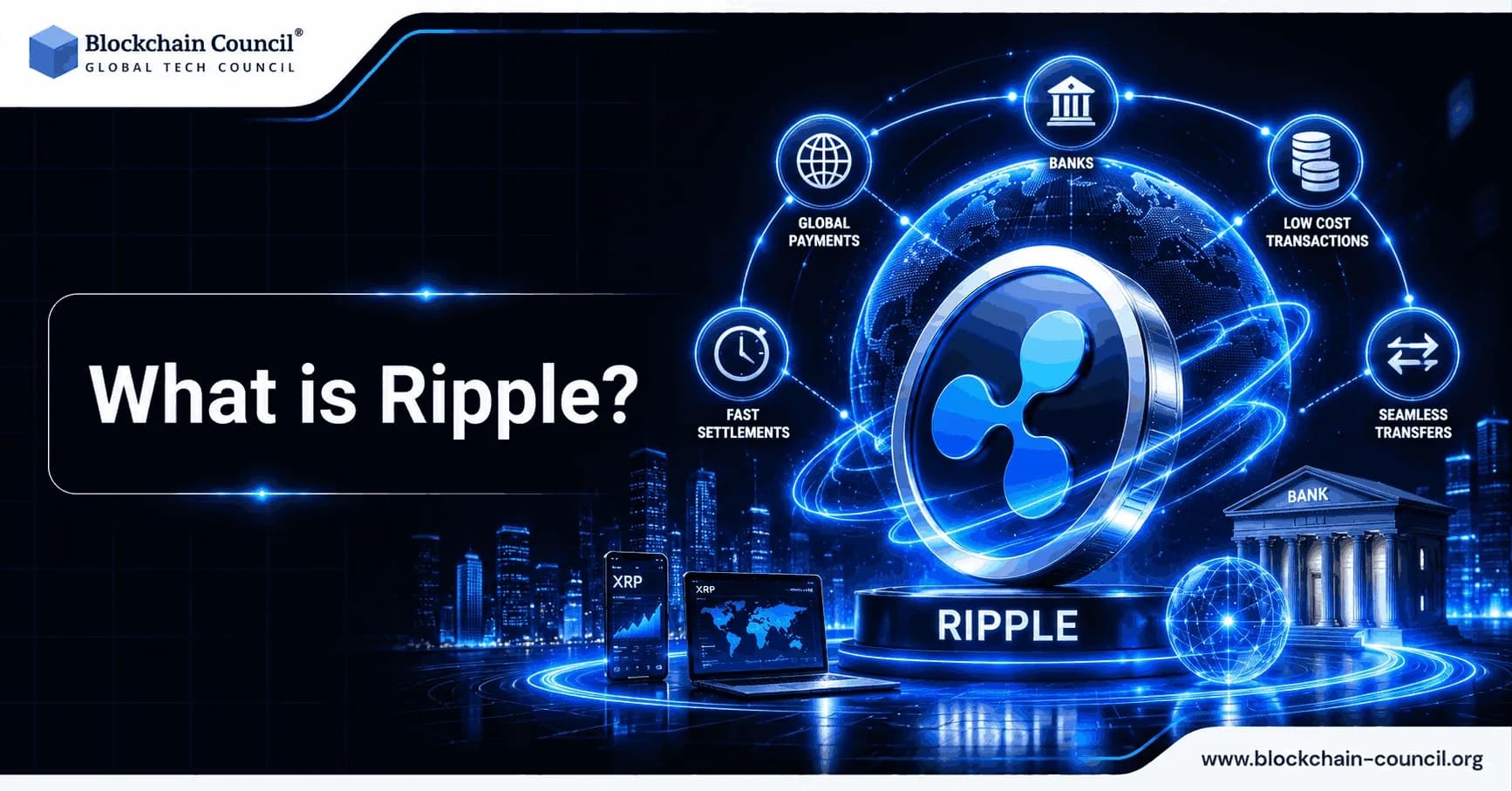
As of the time of writing, the market cap of Ripple is approximately $66.6 billion
Cryptocurrency conversations almost always start with Bitcoin, but it's far from the only digital asset that matters. Ripple and its native token, XRP has spent over a decade building a genuinely different use case: fast, low-cost cross-border payments for banks and financial institutions, rather than competing directly as a store of value. By 2026, Ripple has also cleared one of the biggest overhangs in its history, with its long-running legal battle against the U.S. Securities and Exchange Commission (SEC) formally resolved. If you're trying to make sense of where Ripple actually fits in the broader crypto landscape, building a foundation as a Cryptocurrency Expert is a practical way to understand how payment-focused tokens like XRP differ from assets like Bitcoin.

What Is Ripple?
Ripple refers to both the company and the payment protocol behind XRP, one of the largest cryptocurrencies by market capitalization. Unlike Bitcoin, which was designed as a peer-to-peer digital currency free of institutional involvement, Ripple was built specifically to solve a banking problem: cross-border transactions that are traditionally slow, expensive, and dependent on a chain of correspondent banks. Ripple's core pitch has stayed consistent since launch settle international payments in seconds rather than days, at a fraction of the cost of traditional wire transfers. For readers who want to understand the technical fundamentals that separate a payments-focused network like Ripple from the original blockchain model, earning a Certified Bitcoin Expert credential offers useful comparative grounding, even though Ripple itself doesn't use a traditional public blockchain.
Who's Behind Ripple?
Ripple's predecessor concept dates back to the mid-2000s, but the modern company was founded as OpenCoin in 2012 by Chris Larsen and Jed McCaleb, later rebranding to Ripple Labs. Brad Garlinghouse has served as Ripple's CEO for years and has been a prominent public voice for the company throughout its regulatory battles and expansion into institutional payments.
What Ripple Set Out to Build
Ripple's founding objective was to create a faster, more transparent alternative to traditional cross-border money movement one that doesn't route through the layers of correspondent banks, card networks, or remittance services that typically add cost and delay to international transfers. XRP, the network's native digital asset, is designed to act as a bridge currency, allowing near-instant conversion between different fiat currencies without requiring institutions to pre-fund accounts in every market they operate in.
Key Features of XRP
Can be transferred directly between accounts without routing through a central intermediary
Settlement typically completes in a few seconds, dramatically faster than traditional cross-border wires
Uses cryptographic security to protect transactions from tampering or counterfeiting
Operates on the XRP Ledger, which today also supports tokenized real-world assets alongside payments
How Is Ripple Different From Bitcoin?
Ripple and Bitcoin share some surface-level similarities both use cryptography to secure transactions and both can move value directly between accounts but the underlying architecture is quite different. Bitcoin runs on an open, permissionless public blockchain secured by proof-of-work mining. XRP instead runs on the XRP Ledger, validated by a network of trusted nodes rather than anonymous miners, which enables much faster transaction finality typically a matter of seconds, compared to Bitcoin's longer confirmation times. This is also where a deeper Tech Certification in blockchain and distributed ledger fundamentals becomes genuinely useful: understanding why XRP Ledger's consensus model works differently from Bitcoin's proof-of-work system explains most of the practical differences between the two networks, from settlement speed to energy usage.
Bitcoin has a fixed maximum supply of 21 million coins, released gradually through mining. XRP, by contrast, had its full supply of 100 billion tokens created at launch, with a large portion held by Ripple itself and released on a controlled schedule to partners, users, and the broader market a structural difference that has fueled ongoing debate about XRP's classification as a security versus a commodity.
Ripple's Legal Status: The SEC Lawsuit Is Resolved
For years, Ripple operated under the shadow of a landmark SEC lawsuit, filed in December 2020, alleging that Ripple's XRP sales amounted to an unregistered securities offering. A pivotal 2023 court ruling found that XRP sold to retail investors on public exchanges did not constitute a securities transaction, while certain institutional sales did a split decision that shaped years of subsequent negotiation. That legal uncertainty formally came to a close in 2025, when the case concluded with Ripple paying a civil penalty and both sides dropping further appeals, closing one of the most closely watched legal battles in crypto history. The resolution has removed a major obstacle for XRP's presence on U.S. exchanges and cleared the way for regulated investment products, including spot XRP exchange-traded funds (ETFs), to launch in the years since.
Real-World Adoption in 2026
Ripple's core selling point being one of the few cryptocurrency projects with genuine enterprise clients continues to hold up. Banks and financial institutions including UBS, Santander, and other global payment partners have used Ripple's technology as settlement infrastructure for cross-border transfers. Ripple has also expanded its product lineup with RLUSD, its own U.S. dollar-pegged stablecoin backed by cash and short-term Treasuries, aimed at giving institutional partners price stability for settlement while XRP itself continues to serve as a bridge asset for cross-currency liquidity. The XRP Ledger has additionally become a notable platform for tokenizing real-world assets, reflecting Ripple's broader shift toward positioning itself as infrastructure for institutional finance rather than a purely retail cryptocurrency.
Final Thoughts
Ripple has spent over a decade carving out a distinct lane in the crypto industry: rather than competing head-on with Bitcoin or Ethereum, it has focused on becoming genuine payment infrastructure for banks and financial institutions. With its SEC lawsuit resolved and products like RLUSD and XRP-based tokenized assets gaining traction, Ripple's institutional pitch looks more credible today than it has in years even as XRP's token price has, at times, lagged behind the pace of these business developments. As more banks and fintech companies explore blockchain-based settlement, there's also growing demand for professionals who can clearly communicate what Ripple actually does to non-technical audiences, which is exactly where combining crypto fundamentals with a Marketing Certification becomes a genuinely useful skill set for anyone working in fintech communications or investor relations.
Future-Ready Skills
As technology becomes increasingly important across industries, students need opportunities to develop future-ready skills early in their education. A World Tech Olympiad can introduce students to areas such as artificial intelligence, coding, cybersecurity, robotics, and computational thinking while encouraging curiosity and continuous learning.
FAQs
1. What is Ripple?
Ripple is a financial technology company that develops blockchain-based payment solutions for banks, payment providers, financial institutions, and businesses. It focuses on making cross-border payments faster, more transparent, and more cost-efficient using blockchain technology and digital assets.
2. What is XRP?
XRP is the native cryptocurrency of the XRP Ledger (XRPL), an open-source blockchain designed for fast and low-cost transactions. XRP can be used as a bridge asset for transferring value between different currencies and payment systems.
3. What is the difference between Ripple and XRP?
Ripple is the company that develops payment technologies and enterprise financial solutions, while XRP is the cryptocurrency that operates on the independent XRP Ledger. Although Ripple uses XRP in some products, the company and the cryptocurrency are not the same thing.
4. What is the XRP Ledger (XRPL)?
The XRP Ledger is a decentralized, open-source blockchain network optimized for fast transaction settlement, low fees, and high throughput. It supports payments, token issuance, decentralized exchange functionality, and other blockchain applications.
5. How does Ripple work?
Ripple develops payment infrastructure that helps financial institutions transfer money internationally. Some Ripple products can use XRP as a bridge asset to facilitate liquidity, while others may operate without XRP depending on customer requirements.
6. How does XRP work?
XRP transactions are processed through the XRP Ledger using a consensus protocol rather than traditional Proof of Work mining. This allows transactions to settle within seconds while consuming relatively little energy compared to many proof-of-work blockchains.
7. What is Ripple Payments?
Ripple Payments (formerly known as On-Demand Liquidity for certain services) is Ripple's payment solution designed to facilitate cross-border transfers. Depending on the implementation, it can use XRP to reduce the need for pre-funded accounts in international payments.
8. Why is Ripple important?
Ripple aims to improve global payment infrastructure by enabling faster settlement, lower transaction costs, greater transparency, and more efficient liquidity management for financial institutions and payment providers.
9. What are the main features of XRP?
Key features include fast transaction settlement, low transaction fees, energy-efficient consensus, support for tokenization, decentralized exchange functionality, high transaction throughput, and global accessibility.
10. What are the advantages of Ripple and XRP?
Potential advantages include rapid international payments, efficient settlement, low network fees, scalability, enterprise payment solutions, interoperability, and growing interest in blockchain-based financial infrastructure.
11. What are the limitations of Ripple and XRP?
Challenges include regulatory uncertainty in some jurisdictions, competition from other blockchain networks and payment systems, evolving adoption by financial institutions, and the broader volatility associated with cryptocurrency markets.
12. Which industries use Ripple technology?
Ripple's technology has applications in banking, international payments, remittances, financial services, fintech, treasury management, digital asset infrastructure, and cross-border business settlements.
13. Can XRP be used for everyday payments?
Yes. XRP can be transferred between compatible wallets and supported payment services. However, acceptance by merchants depends on whether they choose to support XRP as a payment method.
14. How does Ripple compare with SWIFT?
SWIFT is a global financial messaging network used by banks to communicate payment instructions. Ripple develops blockchain-based payment solutions that seek to improve settlement speed and efficiency. The two serve related but distinct roles, and some institutions may use both depending on their operational needs.
15. How does XRP compare with Bitcoin?
Bitcoin was primarily designed as a decentralized digital currency and store of value, while XRP was designed to facilitate fast, low-cost value transfers on the XRP Ledger. They differ in consensus mechanisms, transaction speed, energy consumption, and intended use cases.
16. What common mistakes should beginners avoid?
Common mistakes include confusing Ripple with XRP, investing without understanding regulatory developments, ignoring wallet security, failing to protect recovery phrases, relying solely on market hype, and investing more than they can afford to lose.
17. What are best practices for investing in or using XRP?
Best practices include researching the XRP Ledger ecosystem, using reputable exchanges and wallets, enabling two-factor authentication (2FA), securing private keys offline, following regulatory developments, diversifying investments, and understanding both the opportunities and risks associated with digital assets.
18. How does Ripple fit into the blockchain ecosystem?
Ripple contributes to blockchain adoption by developing payment infrastructure for financial institutions, while the XRP Ledger supports payments, tokenization, decentralized finance (DeFi), digital asset issuance, and other blockchain applications through its open-source network.
19. What trends are shaping Ripple and XRP in 2025-2026?
Key trends include institutional blockchain adoption, cross-border payment modernization, tokenization of real-world assets (RWAs), stablecoin integration, central bank digital currency (CBDC) research, decentralized identity, regulatory developments, and growing enterprise use of blockchain infrastructure.
20. What is the future of Ripple and XRP?
The future of Ripple and XRP will depend on factors such as regulatory developments, adoption by financial institutions, technological innovation, ecosystem growth, and broader acceptance of blockchain-based payment solutions. As demand for faster and more efficient international payments continues to grow, Ripple's enterprise focus and the XRP Ledger's capabilities may continue to play a role in the evolving global financial system. Whether that role becomes transformative or simply complementary will depend less on marketing slogans and more on real-world adoption by businesses and financial institutions.
Related Articles
View All
Blockchain
Beyond Cryptocurrency: How Blockchain Is Transforming Real-World Industries
Explore how blockchain works beyond cryptocurrency in banking, supply chains, healthcare, tokenisation, CBDCs, and government, plus key challenges and career paths.

Blockchain
Smart Contracts & dApps: How Blockchain Becomes Programmable
Learn how smart contracts and dApps make blockchain programmable, from Ethereum and tokens to DeFi, NFTs, real use cases, benefits, and key risks.

Blockchain
Public, Private & Consortium Blockchains: Which Network Fits the Use Case?
Compare public, private, and consortium blockchains by security, speed, privacy, and control, with real examples and a simple guide to choosing the right network.
Trending Articles

Can DeFi 2.0 Bridge the Gap Between Traditional and Decentralized Finance?
The next generation of DeFi protocols aims to connect traditional banking with decentralized finance ecosystems.
Claude AI Tools for Productivity
Discover Claude AI tools for productivity to streamline tasks, manage workflows, and improve efficiency.
How to Install Claude Code
Learn how to install Claude Code on macOS, Linux, and Windows using the native installer, plus verification, authentication, and troubleshooting tips.