

What is Quorum Blockchain?
 Toshendra Kumar Sharma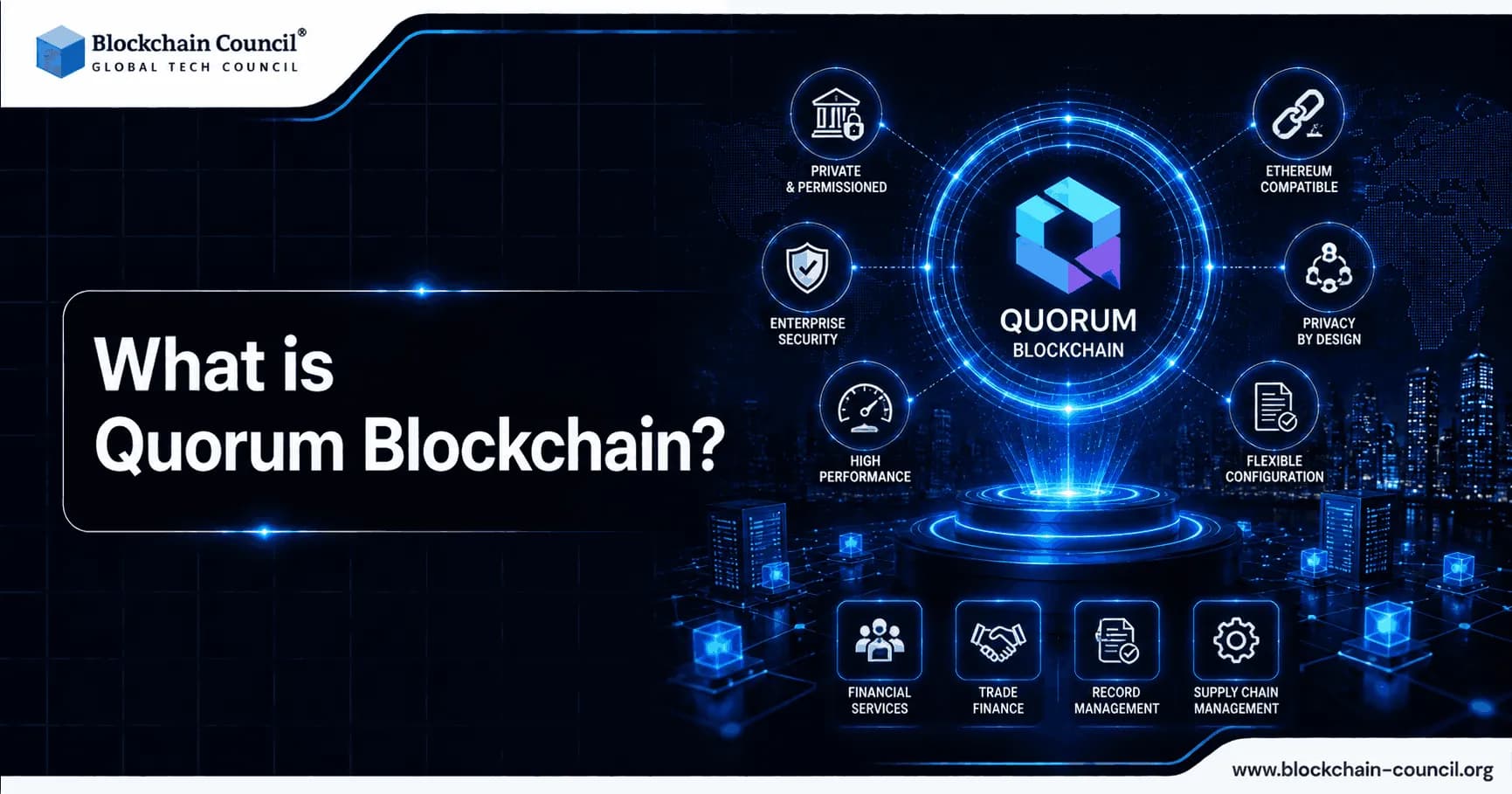
Enterprise blockchain has produced several notable platforms over the years, but few have the origin story of Quorum, a permissioned blockchain built by JPMorgan Chase specifically to bring the security and programmability of Ethereum into the highly regulated world of institutional finance. What began as an internal JPMorgan project has since evolved into a widely used enterprise platform now maintained under ConsenSys, powering everything from interbank payment networks to trade finance consortiums. Understanding how Quorum works, and why a major bank built its own blockchain rather than using a public network, is exactly the kind of practical knowledge covered by a Certified Quorum Expert credential, which focuses specifically on this platform's architecture and enterprise applications. This article breaks down what Quorum actually is, how it works, and why it has become a significant player in enterprise blockchain adoption.
The Origins of Quorum
Quorum was developed internally by JPMorgan starting in 2016, built as a fork of Ethereum designed to meet the specific needs of financial institutions, namely privacy, high transaction throughput, and permissioned participation. Unlike public Ethereum, where anyone can join the network and every transaction is visible to all participants, Quorum was designed from the ground up to restrict access to known, approved participants while still preserving the core benefits of blockchain technology.

In 2020, JPMorgan transferred Quorum to ConsenSys, a leading Ethereum software company, in a deal that also included a strategic investment from JPMorgan into ConsenSys. Since then, Quorum has continued to operate as open source software under the ConsenSys Quorum brand, remaining interoperable with other Ethereum based enterprise tools while JPMorgan continues using it as a customer of ConsenSys's broader platform and services.
How Quorum Blockchain Actually Works
Quorum retains much of Ethereum's underlying architecture, including support for smart contracts written in Solidity, but modifies key components to make the platform suitable for enterprise and regulatory environments. Broader knowledge of blockchain architecture, the kind developed through a Certified Blockchain Expert credential, provides useful context for understanding exactly how Quorum's modifications differ from a standard public Ethereum deployment.
Several features define how Quorum operates:
Permissioned network access, where only approved participants can join and validate transactions.
Private transactions, allowing certain data to remain visible only to the parties involved rather than the entire network.
Alternative consensus mechanisms, such as Raft and Istanbul BFT, replacing Ethereum's original proof of work model with faster, enterprise appropriate alternatives.
High transaction throughput, supporting the volume and speed institutional finance applications require.
Ethereum compatibility, allowing existing Ethereum tools, smart contracts, and developer expertise to transfer with minimal friction.
This combination gives enterprises the programmability and transparency benefits of blockchain, without exposing sensitive financial data to a fully public network.
Private Transactions and Data Privacy
One of Quorum's most distinctive features is its approach to transaction privacy. While all participants in the network can verify that a transaction occurred, the actual contents of certain private transactions remain visible only to the specific parties involved, using a private transaction manager to handle this selective visibility. This matters enormously for financial institutions that need blockchain's verification benefits without exposing proprietary deal terms, trade details, or customer information to every other network participant.
Consensus Mechanisms Built for Enterprise Needs
Quorum supports multiple consensus mechanisms rather than relying on energy intensive proof of work mining used by public Ethereum. Raft consensus offers fast finality suited to smaller, trusted networks, while Istanbul BFT (Byzantine Fault Tolerant) consensus supports larger networks that need resilience against malicious or faulty participants. This flexibility lets organizations choose the consensus model that best fits their specific network size and trust requirements.
Real World Applications of Quorum Blockchain
Quorum has been deployed across several significant enterprise use cases since its creation, demonstrating practical value well beyond a theoretical proof of concept.
Notable applications include:
Interbank Information Network, a payments network involving hundreds of banks, built to speed up cross border payment processing and reduce friction in compliance checks.
JPM Coin, JPMorgan's institutional stablecoin, which runs on Quorum to enable instant payments between institutional accounts.
Komgo, a trade finance platform built on Quorum, connecting banks, trading companies, and other participants in commodity trade finance.
Covantis, a blockchain based platform for agricultural commodity trading, streamlining documentation and settlement processes among global trading houses.
These deployments illustrate why Quorum has become a genuine reference point for enterprise blockchain adoption rather than a purely experimental technology.
Future-Ready Skills
As technology becomes increasingly important across industries, students need opportunities to develop future-ready skills early in their education. A Tech Olympiad can introduce students to areas such as artificial intelligence, coding, cybersecurity, robotics, and computational thinking while encouraging curiosity and continuous learning. This kind of early, structured exposure to technical problem solving lays the groundwork for the next generation of blockchain developers and financial technologists who will eventually work with platforms like Quorum, where success depends on understanding both distributed systems and the regulatory realities of institutional finance.
Quorum Compared to Other Enterprise Blockchain Platforms
Quorum is often compared to other permissioned blockchain frameworks, such as Hyperledger Fabric, since both target enterprise use cases rather than open public participation.
Factor | Quorum | Hyperledger Fabric |
|---|---|---|
Base technology | Fork of Ethereum | Built independently, modular architecture |
Smart contracts | Solidity | Chaincode in Go, Java, or Node.js |
Consensus options | Raft, Istanbul BFT | Pluggable, including Raft |
Origin | Developed by JPMorgan | Developed under the Linux Foundation |
Ecosystem | Ethereum tooling and developer community | Independent Hyperledger ecosystem |
Choosing between the two generally comes down to whether an organization values Ethereum compatibility and its existing developer ecosystem, which favors Quorum, or prefers a framework built independently from the ground up for enterprise flexibility, which often favors Fabric.
Why Quorum Matters for the Future of Enterprise Blockchain
Quorum represents a practical middle ground between the openness of public blockchains and the control enterprises need for regulated, sensitive financial operations. Its continued use by major financial institutions, combined with ongoing development under ConsenSys, suggests it will remain a significant platform as more banks and enterprises explore blockchain based infrastructure for payments, trade finance, and settlement systems.
Professionals looking to build careers around platforms like Quorum benefit from developing broad technical literacy alongside platform specific knowledge. A general Tech Certification can help build this well rounded foundation, giving professionals the flexibility to work across multiple enterprise blockchain platforms rather than being narrowly specialized in just one.
Beyond the technical side, organizations adopting Quorum or similar platforms also need to communicate the value of these systems clearly to stakeholders, partners, and clients who may not have a technical background. Explaining why a bank chose to build its own blockchain, and what that decision actually delivers in practice, requires genuine communication skill. A Marketing Certification can help professionals working at this intersection present complex blockchain initiatives in terms that build confidence rather than confusion among non technical audiences.
Quorum stands as one of the clearest examples of enterprise blockchain moving from concept to genuine production use, built by a major financial institution to solve real problems around privacy, throughput, and regulatory compliance that public blockchains were never designed to address. As adoption continues to grow across payments, trade finance, and beyond, understanding platforms like Quorum has become genuinely valuable knowledge for anyone working at the intersection of finance and blockchain technology.
FAQs
1. What Is Quorum Blockchain?
Quorum is an Ethereum-based blockchain protocol originally developed for enterprise use, with features designed for permissioned networks, transaction privacy, and alternative consensus mechanisms. It was designed to help businesses build blockchain networks where participants are known and sensitive transactions can remain private.
2. Who Developed Quorum Blockchain?
Quorum was originally developed by J.P. Morgan as an enterprise-focused variant of Ethereum. In 2020, J.P. Morgan announced the transfer of the Quorum platform to ConsenSys, which subsequently developed the ConsenSys Quorum offering.
3. Is Quorum a Public or Private Blockchain?
Quorum was primarily designed to support private and permissioned blockchain networks. This means organizations can control which participants are allowed to join the network and can implement privacy controls for transactions.
4. How Does Quorum Blockchain Work?
Quorum extends Ethereum-based blockchain technology with features such as permissioned participation, privacy mechanisms, and enterprise-oriented consensus options. Network participants can maintain synchronized ledgers while restricting certain transaction information to authorized parties.
5. What Makes Quorum Different From Ethereum?
Quorum was built from Ethereum technology but introduced enterprise-focused capabilities such as permissioning and private transactions. This makes it suitable for business networks where organizations may need greater control over participation and confidentiality than a public blockchain normally provides.
6. What Is GoQuorum?
GoQuorum is the Go-based Ethereum client associated with the original Quorum technology. It supports permissioned networks, private transactions, and alternative consensus mechanisms, but ConsenSys' GoQuorum repository was archived in June 2026 and is no longer actively maintained or supported.
7. Does Quorum Support Private Transactions?
Yes. Quorum was designed to support private transactions in which transaction information is shared only with authorized participants. GoQuorum uses a private transaction manager to encrypt and distribute private transaction data to the relevant network participants.
8. What Is the Role of Tessera in Quorum?
Tessera is a private transaction manager used with GoQuorum to support confidential transactions. It handles encrypted private transaction data and distributes it to the parties authorized to access that information.
9. What Consensus Mechanisms Does Quorum Use?
Quorum was designed to use consensus mechanisms suitable for permissioned networks rather than relying exclusively on public Ethereum's consensus model. Historical GoQuorum implementations supported mechanisms such as QBFT, Istanbul BFT, Clique Proof of Authority, and Raft.
10. What Is QBFT in Quorum?
QBFT is a Byzantine fault-tolerant consensus mechanism used for permissioned blockchain networks. It is designed to provide transaction finality while allowing a known group of validators to reach agreement on the state of the network. GoQuorum documentation identifies QBFT as an improved version of IBFT that is interoperable with Besu.
11. What Are the Main Features of Quorum Blockchain?
Key features include permissioned network participation, private transactions, Ethereum compatibility, smart contract support, and enterprise-oriented consensus mechanisms. These capabilities were intended to help organizations build customized blockchain networks for business applications.
12. Can Quorum Run Smart Contracts?
Yes. Quorum is based on Ethereum technology and supports Ethereum Virtual Machine smart contracts. This allows developers familiar with Ethereum development to build applications and business logic for compatible Quorum networks.
13. What Are the Benefits of Quorum Blockchain for Businesses?
Quorum can provide controlled network participation, transaction privacy, programmable smart contracts, and enterprise-oriented infrastructure. These features can be useful when multiple organizations need to coordinate processes while keeping certain business information confidential.
14. What Industries Can Use Quorum Blockchain?
Enterprise blockchain technologies such as Quorum have been considered for financial services, supply chains, healthcare, asset management, and other multi-party business processes. These use cases are particularly relevant when several organizations need shared records, automation, and controlled data access.
15. How Does Quorum Provide Privacy?
Quorum can separate public and private transaction states. In GoQuorum, private transaction information is encrypted and handled through a private transaction manager, while participants without permission cannot access the underlying private transaction payload.
16. Is Quorum Faster Than Public Ethereum?
Permissioned Quorum networks can achieve different performance characteristics because they operate with a known set of participants and enterprise-oriented consensus mechanisms. However, actual performance depends on network architecture, consensus configuration, infrastructure, transaction complexity, and workload.
17. What Is the Difference Between Quorum and Hyperledger Fabric?
Quorum is based on Ethereum and supports Ethereum-compatible smart contracts and tooling, while Hyperledger Fabric uses a different permissioned blockchain architecture centered around organizations, peers, channels, and chaincode. The better option depends on requirements such as application compatibility, privacy architecture, governance, and existing technical expertise.
18. Is Quorum Still Used Today?
The terminology can be confusing because "Quorum" has referred to several related products and technologies over time. The original GoQuorum repository was archived in June 2026 and is no longer actively maintained by ConsenSys, so organizations considering a new enterprise blockchain deployment should evaluate currently maintained alternatives rather than assuming the historical GoQuorum project is actively supported.
19. Is Quorum Blockchain Open Source?
The original Quorum technology was released as open-source software, and ConsenSys continued the open-source approach after acquiring the platform from J.P. Morgan. However, the GoQuorum repository is now archived, so the current maintenance status of a particular Quorum-related component should be checked before using it for a new project.
20. What Is the Future of Quorum Blockchain?
The original GoQuorum implementation is no longer actively maintained, making its future as a standalone platform limited. The broader enterprise Ethereum ecosystem continues to evolve through technologies such as Hyperledger Besu and other maintained blockchain infrastructure, so businesses should evaluate current support, security, interoperability, and development activity before selecting a platform.
Related Articles
View All
Blockchain
Beyond Cryptocurrency: How Blockchain Is Transforming Real-World Industries
Explore how blockchain works beyond cryptocurrency in banking, supply chains, healthcare, tokenisation, CBDCs, and government, plus key challenges and career paths.

Blockchain
Smart Contracts & dApps: How Blockchain Becomes Programmable
Learn how smart contracts and dApps make blockchain programmable, from Ethereum and tokens to DeFi, NFTs, real use cases, benefits, and key risks.

Blockchain
Behind the Blocks: How Blockchain Transactions Actually Work
Go behind the blocks to see how a blockchain transaction really works: wallets and keys, digital signatures, verification, hashing, blocks, consensus, proof of work vs proof of stake, and how miners and validators secure the network.
Trending Articles
The Role of Blockchain in Ethical AI Development
How blockchain technology is being used to promote transparency and accountability in artificial intelligence systems.
AWS Career Roadmap
A step-by-step guide to building a successful career in Amazon Web Services cloud computing.

Can DeFi 2.0 Bridge the Gap Between Traditional and Decentralized Finance?
The next generation of DeFi protocols aims to connect traditional banking with decentralized finance ecosystems.