

What Is NEM?
 Toshendra Kumar Sharma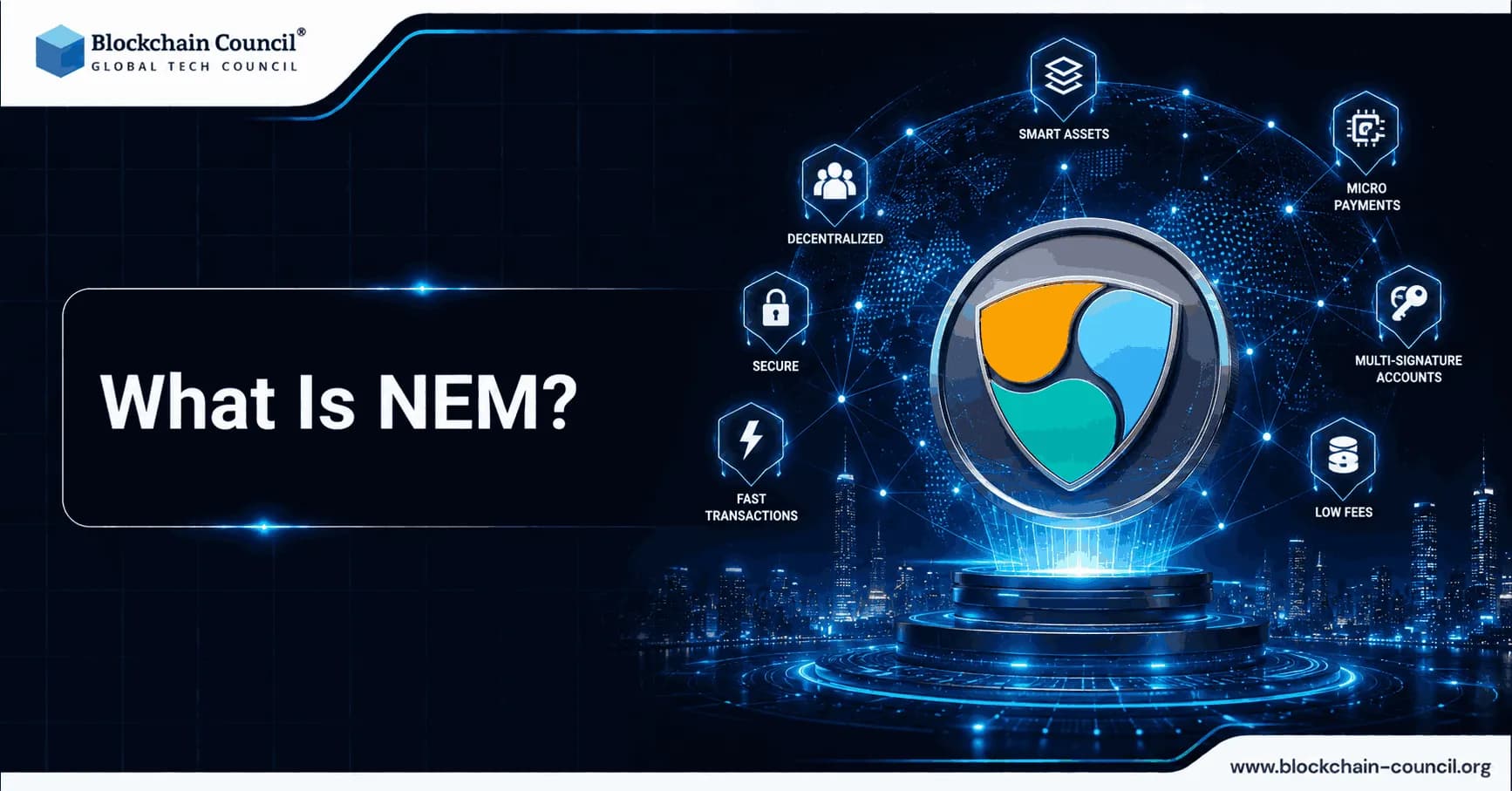
The 10th largest cryptocurrency by market cap, NEM, just had a significant bull run which more than doubled its price in less than a day. But until now NEM and its underlying digital asset, XEM, have remained slightly confusing to investors. Here’s a more in-depth look at what NEM is and aims to achieve in the future.
As enterprise blockchain platforms continue to evolve beyond digital payments, understanding their underlying technology has become increasingly important for developers, investors, and business professionals. A Certified Cryptocurrency Expert credential helps build practical knowledge of cryptocurrency ecosystems, blockchain networks, digital assets, and decentralized technologies, making it easier to evaluate projects such as NEM.

New Economy Movement
NEM, which stands for New Economy Movement is among a new generation of cryptocurrencies which aim to improve upon Bitcoin’s technical prowess. NEM’s is entirely original and has been written from scratch which already separates it from the plethora of Bitcoin copycats. Launched in 2015, it’s not only a digital currency but also a digital exchange and storage platform. In the future, it can be used to store stock information, medical records, mortgages, votes and any other file that can be stored on a computer. By saving these data on NEM’s blockchain, they become impervious to tampering and forever secured because of the underlying blockchain.
Beyond understanding digital currencies, it is equally valuable to explore the blockchain infrastructure that powers these innovations. A Certified Blockchain Expert credential equips professionals with practical knowledge of distributed ledger technology, consensus mechanisms, enterprise blockchain architecture, and real-world blockchain applications, providing deeper insight into platforms like NEM.
Vested Balance and Proof of Importance
NEM uses a Proof of Signature algorithm to select how a block is appended to the blockchain, and it is here where its first significant advantage over Bitcoin lies. Unlike Proof of Work and Proof of Stake, in Proof of Signature, there are no miners. Instead, some harvesters earn rewards based on not only how large their XEM stack is but also how many transactions they perform on the network. Harvesters collect fees based on their importance in the network which is determined by their “trust score” which can be increased by using the network more. Proof of Signature makes sure that people who use the network the most are the ones that get rewarded for it and in the process makes XEM transactions about 100x more energy efficient than those of Bitcoin.
One of the ways to become more critical to the network is by having what’s called a vested balance. If a user lets their XEM sit at an address for a long time, it becomes vested as it gets old. When a user has enough money vested, they start becoming important to the group. To gain importance, users need at least 10,000 XEM to have become vested by staying at the same address. It usually only takes a few weeks for a person’s balance to become vested. The process of becoming vested becomes significantly faster if a user has more than 100,000 XEM in their possession.
Namespaces and Mosaics
Namespaces and Mosaics are some of the unique features of NEM and could have interesting real-world applications. The simplest way to think about Namespaces is with an analogy to the domain names on the internet. So, a domain has to be at the lowest level of a derivation tree, also called the root. This where NEM comes in handy, as when a user creates a domain name on NEM, it becomes a unique domain in the NEM ecosystem. For example, if we create a unique Namespace “tosh,” we can create the unique identifier, “tosh.website” and no other user can create the same Namespace. Namespaces can have up to 3 levels, a Namespace, and its two sub-Namespaces.
Mosaics are also an exciting part of this domain service. A mosaic is like a file hosted on a domain and could represent an underlying asset like a stock or a mortgage. This is significant because Namespaces and mosaics can combine to create assets on the blockchain.
Upcoming Catapult Upgrade
NEM developers have been working for the past several months on a protocol upgrade for NEM which will shift NEM’s technology from JAVA to C++ for increased scalability and speed. It is currently being tested on a test network and is expected to hit the leading network in Q1 2018. Catapult has shown tremendous results so far with a maximum of over 4000 transactions per second and averaging over 3000 transactions per second.
With benchmarks like this, NEM blows its competition out of the water as Ethereum and Bitcoin are both struggling to perform over 15-20 transactions per second. This is why NEM is a viable solution for the long term because developers have focused on creating a highly customizable blockchain that can be used by enterprises and financial institutions for asset management. Because of NEM’s RESTful JSON API gateway, connection to other existing centralized or decentralized solutions like smart contract systems or payment gateways is much more accessible making its integration with existing software convenient which is crucial for mainstream adoption.
As blockchain platforms become increasingly integrated with enterprise software, cloud infrastructure, and digital ecosystems, professionals benefit from strengthening their broader technical capabilities. A Tech Certification helps develop expertise across emerging technologies, software systems, cybersecurity, and digital infrastructure, complementing blockchain knowledge in today's technology-driven environment.
NEM and the Evolution to Symbol
The NEM ecosystem has undergone significant changes since the introduction of the Catapult project. What began as a major protocol upgrade eventually evolved into Symbol, a next-generation blockchain designed to provide improved performance, enterprise-grade features, and greater flexibility for developers and businesses.
Symbol introduces a modern blockchain architecture with faster transaction processing, enhanced security, and advanced functionality such as multi-signature accounts, metadata support, and tokenization capabilities. These features make it suitable for business applications, supply chain management, digital identity, and asset tokenization.
One of Symbol's key strengths is its focus on interoperability and ease of integration. Through developer-friendly APIs and software development kits (SDKs), organizations can connect blockchain technology with existing business systems without rebuilding their infrastructure from scratch.
Rather than competing solely on transaction speed, the NEM ecosystem now emphasizes reliability, security, and practical enterprise use cases. Ongoing development and community support continue to improve the platform, making it a viable option for organizations exploring blockchain adoption.
As blockchain technology continues to mature, the NEM ecosystem remains focused on delivering scalable and efficient solutions that support real-world applications across multiple industries.
As enterprise blockchain adoption continues to grow, organizations also require professionals who can effectively communicate the value of blockchain solutions to customers, investors, and stakeholders. A Marketing Certification helps strengthen strategic communication, product positioning, and market outreach skills, supporting the successful adoption of innovative blockchain technologies.
Future-Ready Skills
As technology becomes increasingly important across industries, students need opportunities to develop future-ready skills early in their education. A World Tech Olympiad can introduce students to areas such as artificial intelligence, coding, cybersecurity, robotics, and computational thinking while encouraging curiosity and continuous learning.
FAQs
1. What is NEM?
NEM (New Economy Movement) is an open-source blockchain platform launched in 2015 to provide a scalable, secure, and customizable infrastructure for digital assets, business applications, and enterprise blockchain solutions. It was designed to simplify blockchain adoption through built-in features and developer-friendly tools.
2. Why is NEM important?
NEM introduced several innovative blockchain concepts, including its Proof-of-Importance (PoI) consensus mechanism, multisignature accounts, namespaces, mosaics, and a flexible API-driven architecture. These features helped position NEM as one of the early enterprise-focused blockchain platforms.
3. How does NEM work?
NEM operates as a decentralized blockchain where network participants validate transactions and maintain the ledger using the Proof-of-Importance consensus algorithm. The platform also supports customizable digital assets, account permissions, encrypted messaging, and smart asset functionality.
4. What is the XEM cryptocurrency?
XEM is the native cryptocurrency of the original NEM blockchain. It is used to pay transaction fees, facilitate transfers, and support various activities within the NEM ecosystem.
5. What is Proof-of-Importance (PoI)?
Proof-of-Importance (PoI) is NEM's consensus mechanism that considers factors beyond token ownership when determining who can participate in block creation. It evaluates elements such as account activity and network participation, aiming to encourage active ecosystem engagement rather than rewarding only large token holders.
6. What are namespaces in NEM?
Namespaces function similarly to internet domain names within the NEM blockchain. They allow users and organizations to create unique blockchain identities under which digital assets and services can be organized.
7. What are mosaics in NEM?
Mosaics are customizable digital assets created on the NEM blockchain. They can represent cryptocurrencies, loyalty points, utility tokens, digital certificates, stable-value assets, or other tokenized resources.
8. What is Catapult (Symbol)?
Catapult, later released as Symbol (XYM), is a next-generation blockchain platform developed from NEM technology. Symbol introduced enhanced scalability, improved security, hybrid public-private blockchain support, and enterprise-focused features while operating as a separate blockchain from the original NEM network.
9. What is Symbol (XYM)?
Symbol is an enterprise-oriented blockchain platform launched by the NEM Group. It builds upon ideas introduced by NEM while adding new capabilities such as aggregated transactions, metadata support, cross-chain functionality, and improved performance for business applications.
10. What are the main features of NEM?
Key features include Proof-of-Importance consensus, multisignature accounts, encrypted messaging, namespaces, mosaics, delegated harvesting, API-first architecture, role-based permissions, and enterprise-friendly blockchain tools.
11. What are the advantages of NEM?
NEM offers flexible asset creation, strong security features, customizable blockchain components, efficient consensus, easy API integration, enterprise functionality, and developer-friendly infrastructure that supports a wide variety of blockchain applications.
12. What are the limitations of NEM?
Like many blockchain platforms, NEM faces challenges including competition from newer ecosystems, changing developer activity, evolving market demand, ecosystem growth, and broader adoption within the blockchain industry.
13. What industries can use NEM?
NEM technology can support finance, supply chain management, healthcare, government services, digital identity, asset tokenization, real estate, loyalty programs, document verification, and enterprise record management.
14. Which developer tools support NEM?
Developers can use SDKs, REST APIs, command-line tools, blockchain explorers, wallet software, Symbol development tools, and official documentation to build applications within the NEM and Symbol ecosystems.
15. How does NEM compare with Ethereum?
Ethereum is a general-purpose smart contract platform supporting decentralized applications through programmable smart contracts. NEM focuses more on built-in blockchain functionality, customizable digital assets, API-based development, and enterprise solutions. The best platform depends on project requirements and ecosystem preferences.
16. What common mistakes should beginners avoid?
Common mistakes include confusing NEM with Symbol, misunderstanding Proof-of-Importance, failing to secure wallet recovery information, overlooking official documentation, and investing without researching the technology and ecosystem.
17. What are best practices for using NEM?
Best practices include securing wallet credentials, understanding blockchain architecture, testing applications before production deployment, reviewing platform documentation, monitoring ecosystem updates, and using trusted wallets and exchanges.
18. How does NEM fit into the blockchain ecosystem?
NEM remains an important part of blockchain history because it introduced several innovative concepts that influenced enterprise blockchain development. Its evolution into Symbol also demonstrates how blockchain projects continue adapting to changing technical and business requirements.
19. What trends are shaping NEM and Symbol in 2025-2026?
Key trends include enterprise blockchain adoption, tokenization of real-world assets (RWAs), decentralized identity, interoperability, hybrid public-private blockchain deployments, improved compliance tools, digital asset infrastructure, and increasing institutional exploration of blockchain technology.
20. What is the future of NEM?
NEM's long-term significance lies in its contributions to blockchain innovation, while ongoing development has largely shifted toward the Symbol ecosystem. As blockchain adoption expands across enterprise and government sectors, technologies emphasizing interoperability, security, digital asset management, and business integration may continue finding specialized use cases. In blockchain, pioneering an idea is only the beginning. Staying relevant requires evolving just as quickly as the technology itself.
Related Articles
View All
Blockchain
Beyond Cryptocurrency: How Blockchain Is Transforming Real-World Industries
Explore how blockchain works beyond cryptocurrency in banking, supply chains, healthcare, tokenisation, CBDCs, and government, plus key challenges and career paths.

Blockchain
Smart Contracts & dApps: How Blockchain Becomes Programmable
Learn how smart contracts and dApps make blockchain programmable, from Ethereum and tokens to DeFi, NFTs, real use cases, benefits, and key risks.

Blockchain
Public, Private & Consortium Blockchains: Which Network Fits the Use Case?
Compare public, private, and consortium blockchains by security, speed, privacy, and control, with real examples and a simple guide to choosing the right network.
Trending Articles
The Role of Blockchain in Ethical AI Development
How blockchain technology is being used to promote transparency and accountability in artificial intelligence systems.
AWS Career Roadmap
A step-by-step guide to building a successful career in Amazon Web Services cloud computing.
What is AWS? A Beginner's Guide to Cloud Computing
Everything you need to know about Amazon Web Services, cloud computing fundamentals, and career opportunities.