

What is KYC & How KYC on Blockchain Can Help?
 Toshendra Kumar Sharma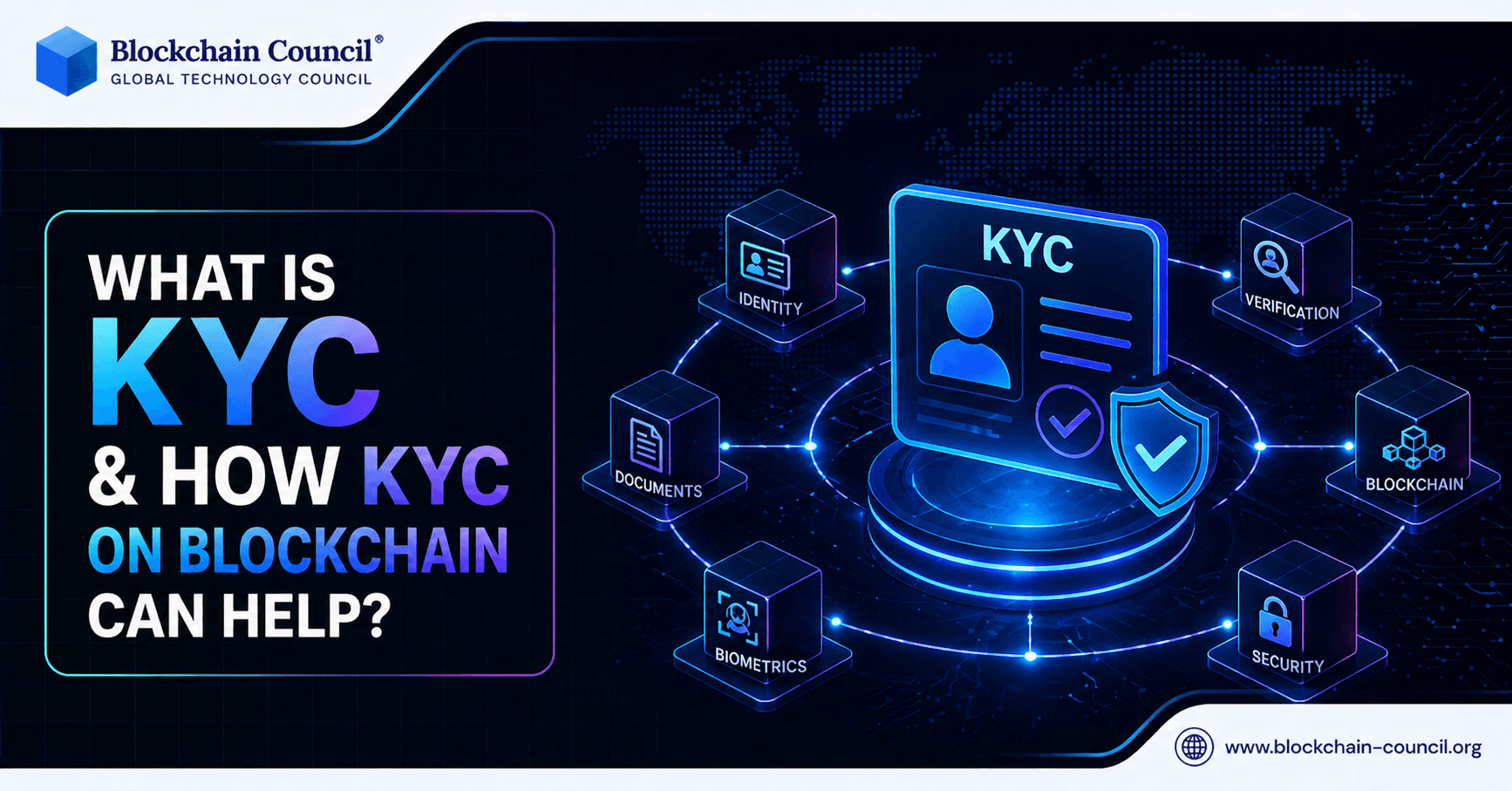
Know Your Customer (KYC) is a mandatory process used by businesses to verify the identity of their customers. It is a critical part of regulatory compliance, especially in industries such as banking, fintech, telecommunications, and cryptocurrency.
KYC is closely related to Anti-Money Laundering (AML) regulations, but they are not the same. KYC focuses on identity verification, while AML involves monitoring transactions to detect suspicious activity.

As digital services expand globally, traditional KYC processes have become inefficient, repetitive, and costly. Blockchain-based KYC offers a more streamlined, secure, and user-controlled approach to identity verification. Understand how blockchain-based KYC improves identity verification, reduces fraud, and enhances compliance across financial systems by building expertise through a Cyber Security Expert, implementing identity verification systems using a Python certification, and scaling compliance solutions via a Digital marketing course.
What Is KYC?
KYC is the process of collecting and verifying customer information to confirm their identity. This typically includes:
Government-issued identification
Proof of address
Biometric verification (such as facial recognition)
Financial or employment details
Organizations use KYC to prevent fraud, identity theft, and financial crimes. It is a legal requirement in many jurisdictions.
Challenges with Traditional KYC
Traditional KYC systems are often centralized and fragmented, leading to several issues.
Repetition
Users must submit the same documents repeatedly to different service providers.
Time-Consuming
Verification can take hours or even days, especially when manual review is involved.
High Costs
Businesses spend significant resources on compliance, document storage, and verification processes.
Data Security Risks
Centralized databases are vulnerable to data breaches and unauthorized access.
What Is Blockchain-Based KYC?
Blockchain-based KYC is a decentralized approach where users store their identity data securely and share it with service providers when needed.
Instead of uploading documents repeatedly, users verify their identity once and reuse it across multiple platforms. Access to this data is controlled by the user, not the service provider.
Blockchain ensures that records are tamper-resistant, transparent, and securely shared.
How Blockchain Improves KYC
Blockchain introduces several improvements to traditional KYC systems.
User-Controlled Identity
Users own and control their identity data. They decide who can access it and for how long.
Data Integrity
Once verified, records stored on blockchain systems cannot be altered without detection.
Reduced Duplication
KYC verification can be reused across multiple services, reducing redundancy.
Enhanced Security
Data is encrypted and often stored off-chain with secure references on-chain, minimizing exposure.
Faster Verification
Automated processes and shared access reduce onboarding time for businesses.
How Blockchain KYC Works: Step-by-Step
To understand the process, consider a simplified real-world scenario.
Step 1: User Registration and Document Upload
A user registers on a blockchain-based identity platform and uploads documents such as ID proof and address verification. These documents are encrypted and stored securely, often off-chain, with a hash recorded on the blockchain.
Step 2: Identity Verification
A trusted entity, such as a bank or KYC provider, verifies the documents. Once verified, the user receives a digital identity credential.
Step 3: Service Request
The user applies for a service, such as opening a bank account or subscribing to a telecom provider.
Step 4: Access Request
The service provider requests access to the user’s verified KYC data through an API or interface.
Step 5: User Authorization
The user reviews the request and grants permission. This consent is recorded on the blockchain for transparency.
Step 6: Data Sharing
The service provider receives access to the required data. Only authorized information is shared, not the entire dataset.
Step 7: Verification Completion
The provider verifies the data instantly using the blockchain record and proceeds with onboarding.
Step 8: Reuse of KYC
For future services, the user can reuse the same verified identity, eliminating the need to repeat the process.
Key Technologies Behind Blockchain KYC
Modern blockchain KYC systems rely on several advanced technologies.
Decentralized Identity (DID)
DIDs allow users to create and control their digital identity without relying on a central authority.
Verifiable Credentials
These are digitally signed credentials issued by trusted entities and stored by users.
Zero-Knowledge Proofs
This technology allows users to prove certain information, such as age or residency, without revealing full details.
Encryption and Off-Chain Storage
Sensitive data is stored securely off-chain, while blockchain stores proofs and access logs.
Benefits of Blockchain KYC
Blockchain-based KYC offers clear advantages for both users and organizations.
Reduced onboarding time and operational costs
Improved user experience with fewer repeated submissions
Enhanced data privacy and control
Increased transparency and auditability
Lower risk of fraud and identity theft
These benefits make blockchain KYC particularly valuable in global digital ecosystems.
Challenges and Limitations
Despite its potential, blockchain KYC faces several challenges.
Regulatory Compliance
Different countries have varying requirements, making standardization difficult.
Adoption Barriers
Widespread adoption requires collaboration between governments, banks, and technology providers.
Privacy Concerns
Improper implementation can still expose sensitive data if not handled correctly.
Technical Complexity
Implementing decentralized identity systems requires advanced infrastructure and expertise.
Real-World Use Cases
Blockchain KYC is already being explored and implemented across industries.
Banks and fintech companies streamline customer onboarding
Telecom providers verify user identity quickly
Crypto exchanges comply with regulations while improving user experience
Governments explore digital identity systems
As digital identity becomes more important, blockchain-based KYC is expected to grow significantly.
The Future of KYC on Blockchain
The future of KYC lies in self-sovereign identity, where individuals fully control their personal data.
Emerging trends include:
Integration with digital wallets
Cross-border identity verification systems
AI-powered fraud detection combined with blockchain
Government-backed digital identity frameworks
As standards mature, blockchain KYC could become a global solution for secure and efficient identity verification. Build secure and decentralized KYC systems using blockchain identity frameworks and encryption techniques by mastering cybersecurity and blockchain integration through a Cyber Security Expert, developing backend integrations using a Node JS Course, and promoting compliance solutions using an AI powered marketing course.
Frequently Asked Questions (FAQs)
1. What is KYC in simple terms?
KYC is the process businesses use to verify a customer’s identity. It helps prevent fraud and ensures regulatory compliance.
2. What is the difference between KYC and AML?
KYC focuses on identity verification, while AML involves monitoring transactions to detect illegal activities.
3. Why is KYC important?
KYC helps prevent financial crimes such as money laundering and identity theft. It is required by law in many industries.
4. What is blockchain KYC?
Blockchain KYC is a decentralized system where users store and share verified identity data securely using blockchain technology.
5. How does blockchain improve KYC?
It reduces duplication, improves security, and allows users to control their data while enabling faster verification.
6. What is decentralized identity (DID)?
DID is a system that allows users to create and manage their digital identity without relying on a central authority.
7. What are verifiable credentials?
These are digital documents issued by trusted entities that confirm a user’s identity or attributes.
8. Is blockchain KYC secure?
Yes, it uses encryption and decentralized systems to enhance security, though proper implementation is essential.
9. Can KYC be reused across platforms?
Yes, blockchain KYC allows users to reuse verified credentials across multiple services.
10. What industries use blockchain KYC?
Banking, fintech, telecom, healthcare, and cryptocurrency platforms are adopting blockchain-based KYC solutions.
11. What is user consent in blockchain KYC?
User consent means individuals control who can access their data and must approve each request.
12. What is zero-knowledge proof in KYC?
It allows users to prove specific information without revealing full personal data.
13. Is blockchain KYC legally accepted?
Acceptance varies by country, but many regions are exploring or adopting blockchain-based identity systems.
14. What are the risks of blockchain KYC?
Risks include regulatory uncertainty, technical complexity, and potential privacy issues if poorly implemented.
15. How does blockchain reduce KYC costs?
It eliminates repeated verification processes and reduces manual work, lowering operational expenses.
16. Can blockchain KYC prevent identity theft?
It reduces the risk by securing data and giving users control, but it does not eliminate all threats.
17. What is off-chain storage in KYC?
Sensitive data is stored outside the blockchain, while the blockchain stores proofs and access records.
18. How do companies access blockchain KYC data?
They request access through APIs, and users grant permission before any data is shared.
19. What is self-sovereign identity?
It is a model where individuals fully control their identity data without relying on centralized systems.
20. What is the future of blockchain KYC?
It is expected to become a global standard for digital identity, improving efficiency, security, and user control.
Related Articles
View All
Blockchain
How Certification Can Help You Become a Blockchain Product Manager
Learn how certification builds blockchain knowledge, credibility, and practical product skills for aspiring blockchain product managers.

Blockchain
Blockchain Certification Programs You Can Join Online
Discover the best blockchain certification programs you can join online. Learn blockchain fundamentals, smart contracts, enterprise blockchain, and career opportunities with globally recognized certifications.

Blockchain
Agile for Blockchain Teams: Managing Sprints, Smart Contracts, and Decentralized Roadmaps
Learn how agile for blockchain teams works when sprints, smart contracts, audits, governance, and decentralized roadmaps are planned around risk.
Trending Articles
The Role of Blockchain in Ethical AI Development
How blockchain technology is being used to promote transparency and accountability in artificial intelligence systems.

Can DeFi 2.0 Bridge the Gap Between Traditional and Decentralized Finance?
The next generation of DeFi protocols aims to connect traditional banking with decentralized finance ecosystems.
Blockchain in Supply Chain Provenance Tracking
Supply chains are under pressure to prove not just efficiency, but also authenticity, sustainability, and fairness. Customers want to know if their coffee really is fair trade, if the diamonds are con