

What is JP Morgan doing in Blockchain space?
 Toshendra Kumar Sharma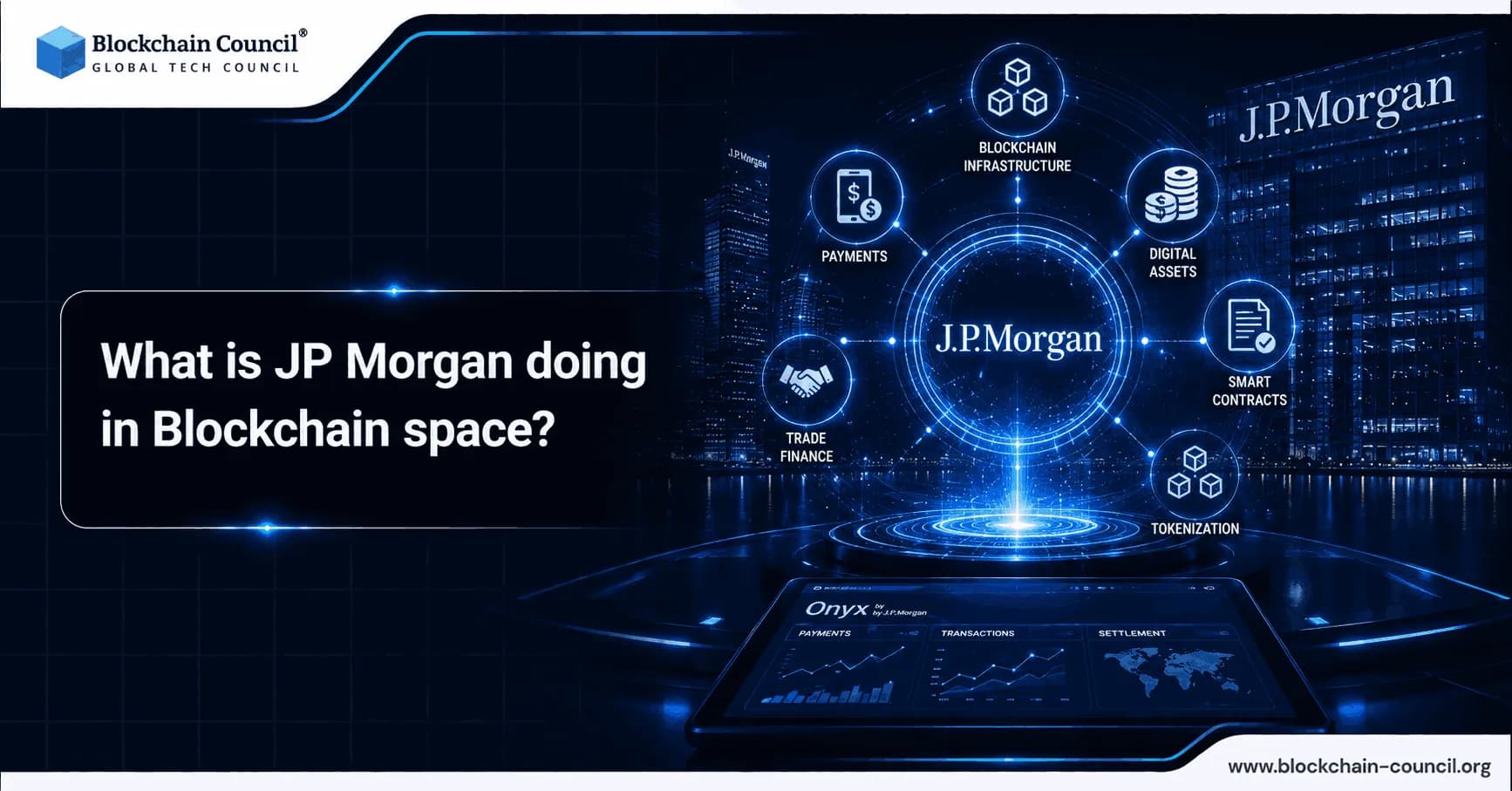
JPMorgan Chase has quietly become one of Wall Street's most active builders in blockchain infrastructure, and the numbers back that up. Its blockchain unit has processed more than $3 trillion in transactions since it first launched in 2015, now averaging over $5 billion in daily volume. This is not a bank running small pilots on the side. It is a bank whose own CEO, Jamie Dimon, has publicly warned that tokenization and blockchain-based settlement are direct competitors to traditional banking functions, and that JPMorgan must move faster to keep up with the shift it is helping create. Understanding exactly what the bank is building reveals a lot about where institutional finance is actually headed in 2026.
Making sense of a strategy this technical, spanning deposit tokens, public blockchain integrations, and asset tokenization, starts with a solid grounding in the underlying technology. A recognized Certified Blockchain Expert credential gives finance professionals and analysts the foundation needed to evaluate JPMorgan's moves on their real technical substance rather than headline summaries alone.

From Quorum To Kinexys: A Decade Of Building In Public
The Early Years: Quorum And Onyx
JPMorgan's blockchain journey began in 2015 with the development of Quorum, an enterprise version of Ethereum built specifically for permissioned, institutional use. That early work laid the technical groundwork for Onyx, the blockchain business unit JPMorgan formally launched to house its digital asset ambitions, making it one of the first major global banks to operate its own dedicated blockchain division rather than treating the technology as an experimental side project.
The Rebrand To Kinexys
Onyx was rebranded as Kinexys, with its payment settlement system renamed Kinexys Digital Payments. The rebrand was not cosmetic. It signaled a shift from an internal research unit toward a commercialized product suite aimed at driving broader adoption of blockchain payments and tokenization across mainstream financial services. Leadership has continued evolving alongside the platform, with Oliver Harris, previously head of Digital Assets Americas at Goldman Sachs, joining in 2026 to lead Kinexys with a specific focus on deepening commercial engagement with institutional clients.
Building and evaluating infrastructure at this scale, spanning permissioned networks, public blockchain integrations, and regulated deposit tokens, requires genuine technical depth. A structured Tech Certification in blockchain development gives finance and technology professionals the practical grounding needed to understand how systems like Kinexys are actually architected, rather than relying on surface-level summaries of what the platform does.
JPM Coin: The Bank's Flagship Deposit Token
JPM Coin, also known by its ticker JPMD, represents a digital token backed directly by U.S. dollar deposits held at JPMorgan. It lets institutional clients move money, post collateral, and settle transactions using a digital representation of commercial bank money, carrying the same credit risk profile and balance sheet certainty as traditional bank deposits while operating around the clock on blockchain rails.
Expanding Beyond Private Infrastructure
For years, JPM Coin operated primarily on JPMorgan's own private, permissioned blockchain. That has changed significantly in 2026. The bank made JPMD available to institutional clients on Base, a public Layer 2 Ethereum network affiliated with Coinbase, marking a genuine shift toward public blockchain infrastructure rather than infrastructure the bank alone controls. Kinexys also announced a collaboration with Digital Asset to bring JPM Coin natively to the Canton Network, a privacy-enabled public blockchain built specifically for synchronized financial markets, with the integration rolling out in phases throughout the year, covering issuance, transfer, and near-instant redemption.
On-Chain Foreign Exchange Settlement
JPM Coin now supports on-chain foreign exchange settlement, initially covering U.S. dollar to euro conversions with additional currency pairs planned. This lets institutional clients settle currency conversions directly on-chain rather than routing through traditional correspondent banking channels, cutting out layers of intermediaries and reducing settlement time significantly.
Tokenizing Traditional Financial Assets
Beyond payments, JPMorgan has pushed aggressively into asset tokenization, running pilots that convert traditional financial instruments like government bonds and money market funds into blockchain-based tokens that can be transferred and used as collateral in near real time. The bank filed to launch a tokenized Treasury fund built on its Kinexys infrastructure, structured specifically to satisfy reserve asset requirements under the GENIUS Act for stablecoin issuers seeking compliant exposure to tokenized government securities.
Blockchain Deposit Accounts And Programmable Payments
Kinexys has also built out a Blockchain Deposit Account framework, letting clients convert between traditional cash holdings and JPM Coin seamlessly, alongside programmable payment logic that automates payout conditions directly within the settlement process. This collapses what used to be separate payment, settlement, and reconciliation steps into a single on-chain action, keeping institutional capital liquid and productive without the delays traditional multi-step processing typically introduces.
Real Enterprise Clients Already Using The System
This is not purely theoretical infrastructure. Enterprise clients including Siemens and BlackRock already use JPMorgan's blockchain-based systems for treasury management and cross-border liquidity, giving the bank concrete, named examples of institutional adoption rather than relying solely on projected future demand.
Communicating a strategy this layered, spanning deposit tokens, public network integrations, and asset tokenization, to institutional clients and stakeholders who may not follow blockchain closely takes real skill in its own right. A well-rounded Marketing Certification becomes genuinely valuable here, helping teams translate a complex, multi-part blockchain strategy into messaging that treasury managers, compliance teams, and institutional partners can actually understand and act on.
Why Jamie Dimon Says JPMorgan Must Move Faster
JPMorgan's urgency around blockchain is not just a product strategy. It comes directly from the top. In his annual letter to shareholders, Dimon warned that blockchain-based technologies including tokenization, stablecoins, and smart contracts are emerging as direct competitors to traditional banking, with the potential to fundamentally change core functions like payments, trading, and asset management. He specifically cautioned that faster, tokenized systems threaten both fee income and traditional bank deposits by enabling near-instant settlement and direct asset transfers that bypass banks entirely.
That warning frames JPMorgan's blockchain buildout not as an optional innovation project but as a defensive and offensive necessity at once. The bank is positioning Kinexys to compete directly with the same tokenized infrastructure that could otherwise erode its traditional revenue streams, rather than waiting for competitors or crypto-native platforms to capture that shift first.
Trade Finance And Real-World Commercial Applications
JPMorgan's blockchain work extends into trade finance as well, where the bank has applied the technology to processes like issuing Standby Letters of Credit. Blockchain-based approaches to this process have compressed timelines that traditionally took three to five weeks down to just three to five days, giving corporate clients a concrete, measurable efficiency gain rather than an abstract technological upgrade.
Where JPMorgan's Blockchain Strategy Is Headed Next
A few clear patterns define where the bank's blockchain ambitions are pointed going forward:
Deeper integration with public blockchain networks, moving beyond JPMorgan's own private infrastructure toward networks like Base and Canton that connect the bank's systems with the broader digital asset ecosystem.
Expanding institutional adoption of JPM Coin, with the explicit goal of scaling beyond the current fraction of the bank's total payment volume that runs through blockchain rails today.
Growing exposure to Bitcoin-linked products, reflected in the bank's own filings showing a substantial increase in its holdings of a major Bitcoin ETF, worth several hundred million dollars.
Attracting other banks as partners, with Kinexys positioning itself as infrastructure other financial institutions can build on top of, rather than a tool exclusive to JPMorgan's own internal operations.
Future-Ready Skills
As technology becomes increasingly important across industries, students need opportunities to develop future-ready skills early in their education. A Tech Olympiad can introduce students to areas such as artificial intelligence, coding, cybersecurity, robotics, and computational thinking while encouraging curiosity and continuous learning.
Final Thoughts
JPMorgan's blockchain strategy in 2026 looks nothing like a cautious bank dipping a toe into an experimental technology. It looks like a bank racing to build the infrastructure it believes will define the next era of institutional finance, from deposit tokens moving across public blockchains to tokenized Treasury funds and programmable payment systems already handling trillions of dollars in real transaction volume. Jamie Dimon's own warning that blockchain-based competitors threaten the bank's core business only reinforces how seriously JPMorgan is treating this shift, not as a side project, but as a central pillar of its long-term strategy.
For professionals trying to keep pace with a strategy evolving this quickly, across new network integrations, regulatory filings, and product rebrands, building real technical fluency remains the best way to separate genuine developments from surface-level headlines. Revisiting the fundamentals through a Certified Blockchain Expert credential gives finance and technology professionals alike the grounding needed to follow JPMorgan's next moves with real understanding, rather than just reacting to the next announcement.
FAQs
1. What is JPMorgan doing with blockchain technology?
JPMorgan Chase has become one of the most active major global banks in institutional blockchain and digital-asset infrastructure.
Its blockchain activities have included Kinexys by J.P. Morgan, formerly known as Onyx, as well as blockchain-based payments, tokenized deposits, programmable payments, collateral settlement, asset tokenization, and research into public and permissioned blockchain infrastructure.
Rather than focusing primarily on speculative cryptocurrencies, JPMorgan has concentrated on using blockchain to improve institutional financial transactions.
2. What is Kinexys by J.P. Morgan?
Kinexys by J.P. Morgan is the bank's blockchain and digital-assets business, created by rebranding its former Onyx business.
Kinexys focuses on areas such as:
Digital payments
Tokenized financial assets
Programmable transactions
Blockchain settlement
Institutional digital finance
Digital identity and information exchange
The platform is designed primarily for financial institutions, corporations, and institutional markets.
3. What happened to JPMorgan's Onyx platform?
JPMorgan launched Onyx in 2020 to develop blockchain-based financial infrastructure.
In 2024, the bank renamed the business Kinexys by J.P. Morgan, reflecting its evolution from experimental blockchain projects toward broader commercial digital-asset and tokenization services.
The underlying strategy continued, but under the Kinexys brand.
4. What is JPM Coin?
JPM Coin was introduced as a blockchain-based representation of money held in JPMorgan accounts for eligible institutional clients.
It was designed to facilitate faster transfers and settlement between participating institutional customers.
JPM Coin should not be confused with a public cryptocurrency such as Bitcoin. It operates within regulated banking infrastructure and represents commercial bank money rather than a decentralized monetary asset.
5. Does JPMorgan have its own cryptocurrency?
Not in the conventional Bitcoin-like sense.
JPMorgan has developed blockchain-based representations of bank deposits and payment infrastructure, but these are not decentralized public cryptocurrencies.
The distinction matters:
Bitcoin: decentralized cryptocurrency
Stablecoin: blockchain token designed to maintain a reference value
Tokenized deposit: digital representation of a commercial bank deposit
CBDC: digital central bank money
JPMorgan's primary focus has historically been regulated institutional digital money and tokenized deposits.
6. What is JPMorgan's blockchain payment network?
JPMorgan's blockchain payment infrastructure enables participating institutional clients to transfer value using blockchain-based representations of deposits.
Potential benefits include:
Near-real-time settlement
24/7 availability
Cross-border transfers
Programmable payments
Improved liquidity management
Automated treasury operations
This can allow corporations to move funds outside traditional banking operating windows in supported environments.
7. What are programmable payments at JPMorgan?
Programmable payments allow organizations to establish rules that automatically initiate transactions when predefined conditions occur.
Examples include:
Automated supplier payments
Treasury transfers
Margin payments
Conditional settlements
Account funding
Event-triggered payments
This combines commercial bank money with smart-contract-style automation.
8. How is JPMorgan using blockchain for cross-border payments?
Blockchain can reduce some of the delays associated with correspondent banking by providing shared settlement infrastructure between participating institutions.
JPMorgan has explored blockchain-based cross-border transactions to provide:
Faster settlement
Greater transaction visibility
24/7 payment capabilities
Automated processing
Improved liquidity management
Traditional banking regulations, sanctions requirements, AML controls, and foreign-exchange rules still apply.
9. How is JPMorgan involved in asset tokenization?
JPMorgan has been actively developing infrastructure for tokenized financial assets.
Tokenization can represent assets such as:
Bonds
Money-market instruments
Fund interests
Collateral
Cash
Other securities
Blockchain can enable these assets to be transferred, settled, and used as collateral through programmable infrastructure.
10. What is JPMorgan's Tokenized Collateral Network?
JPMorgan has developed blockchain-based infrastructure for representing and transferring collateral digitally.
Tokenized collateral can allow financial institutions to transfer economic control of eligible assets without necessarily moving the underlying assets through slow conventional processes each time.
Potential advantages include:
Faster collateral movement
Improved capital efficiency
Reduced settlement friction
Better liquidity management
Automated collateral operations
11. How does blockchain help JPMorgan's institutional clients?
Institutional clients can potentially use blockchain infrastructure for:
Treasury management
Cross-border payments
Collateral transfers
Securities settlement
Liquidity management
Programmable transactions
Tokenized assets
Automated financial workflows
For large corporations, even modest improvements in settlement speed and liquidity efficiency can have significant financial value.
12. Is JPMorgan working with public blockchains?
JPMorgan's blockchain strategy began primarily with permissioned enterprise networks, but the broader organization has increasingly explored connections between regulated finance and public blockchain ecosystems.
Public blockchains can provide interoperability, liquidity, and access to tokenized markets, while permissioned infrastructure provides institutions with greater control over privacy, identity, and compliance.
The long-term financial architecture may combine both approaches.
13. What happened to Quorum, JPMorgan's blockchain platform?
Quorum was an enterprise blockchain platform originally developed by JPMorgan using Ethereum technology.
In 2020, Consensys acquired Quorum's enterprise technology from JPMorgan.
Quorum subsequently became part of the broader enterprise Ethereum ecosystem, while JPMorgan continued developing its own institutional blockchain services through Onyx and later Kinexys.
14. Is JPMorgan involved in decentralized finance (DeFi)?
JPMorgan has explored institutional applications involving technologies associated with DeFi, particularly tokenization, smart contracts, and blockchain-based settlement.
The bank's approach differs from permissionless retail DeFi because regulated financial institutions must satisfy requirements involving:
KYC
AML
Sanctions compliance
Custody
Risk management
Investor protection
Financial regulation
This emerging area is often described as institutional DeFi or regulated on-chain finance.
15. What are the benefits of blockchain for JPMorgan?
Potential benefits include:
Faster settlement
24/7 transactions
Programmable money
Reduced reconciliation
Improved collateral efficiency
Tokenized financial assets
Better treasury management
Automated financial workflows
Cross-border payment efficiency
New institutional financial products
JPMorgan's strategy demonstrates that blockchain's institutional value may have considerably less to do with cryptocurrency speculation than with making financial plumbing less prehistoric.
16. What challenges does JPMorgan face with blockchain adoption?
Major challenges include:
Financial regulation
Blockchain interoperability
Privacy
Cybersecurity
Institutional adoption
Legal enforceability
Digital asset custody
Legacy-system integration
Liquidity fragmentation
Cross-border regulation
Operational resilience
Blockchain infrastructure becomes substantially more useful when many financial institutions participate, which means technical interoperability and industry coordination matter enormously.
17. Does JPMorgan support Bitcoin and cryptocurrencies?
JPMorgan's relationship with cryptocurrency has evolved considerably.
The bank has historically expressed skepticism about certain cryptocurrencies while simultaneously developing blockchain infrastructure and providing selected digital-asset-related services to institutional clients.
This is not necessarily contradictory. A bank can question the investment characteristics of a cryptocurrency while believing that blockchain, tokenization, and digital-asset infrastructure have valuable financial applications.
18. How does JPMorgan's blockchain strategy differ from traditional banking?
Traditional banking infrastructure generally relies on centralized databases, messaging networks, clearing systems, and scheduled settlement processes.
JPMorgan's blockchain strategy introduces:
Shared ledgers
Tokenized money
Tokenized assets
Programmable transactions
Near-real-time settlement
24/7 financial infrastructure
The objective is not necessarily to eliminate banks but to modernize how regulated financial institutions exchange value and information.
19. What JPMorgan blockchain trends are important in 2026?
Important areas include:
Kinexys expansion
Tokenized deposits
Programmable payments
Institutional asset tokenization
Tokenized collateral
Cross-border blockchain settlement
24/7 treasury management
Institutional DeFi
Public-private blockchain interoperability
Digital identity
Real-World Asset (RWA) tokenization
AI-driven treasury automation
On-chain financial markets
Stablecoin and tokenized-money interoperability
One of the most significant trends is the convergence of tokenized assets and tokenized money, allowing both sides of a financial transaction to potentially settle on programmable digital infrastructure.
20. What is the future of JPMorgan in blockchain?
JPMorgan's blockchain strategy points toward a financial system where money, securities, collateral, and other assets can increasingly exist in tokenized form and move through programmable infrastructure.
A future institutional transaction could involve a tokenized security being purchased with tokenized commercial-bank money, with smart contracts coordinating compliance, ownership transfer, collateral, and settlement almost immediately.
JPMorgan is therefore not simply experimenting with whether blockchain "works." Its more consequential effort is determining how blockchain can be integrated into regulated global finance at institutional scale.
The irony is fairly satisfying: blockchain began partly as an attempt to create financial systems that did not require banks, and some of the world's largest banks are now using its underlying ideas to rebuild banking infrastructure. Technology has a peculiar sense of humor.
Related Articles
View All
Blockchain
Blockchain Certification Programs You Can Join Online
Discover the best blockchain certification programs you can join online. Learn blockchain fundamentals, smart contracts, enterprise blockchain, and career opportunities with globally recognized certifications.

Blockchain
Agile for Blockchain Teams: Managing Sprints, Smart Contracts, and Decentralized Roadmaps
Learn how agile for blockchain teams works when sprints, smart contracts, audits, governance, and decentralized roadmaps are planned around risk.

Blockchain
How to Write a PRD for Blockchain Products: Key Sections, Examples, and Best Practices
Learn how to write a PRD for blockchain products with key sections, practical examples, tokenomics, security, governance, and success metrics.
Trending Articles
AWS Career Roadmap
A step-by-step guide to building a successful career in Amazon Web Services cloud computing.

Top 5 DeFi Platforms
Explore the leading decentralized finance platforms and what makes each one unique in the evolving DeFi landscape.
How Blockchain Secures AI Data
Understand how blockchain technology is being applied to protect the integrity and security of AI training data.