

What is Ethereum and why is it important?
 Suyash Raizada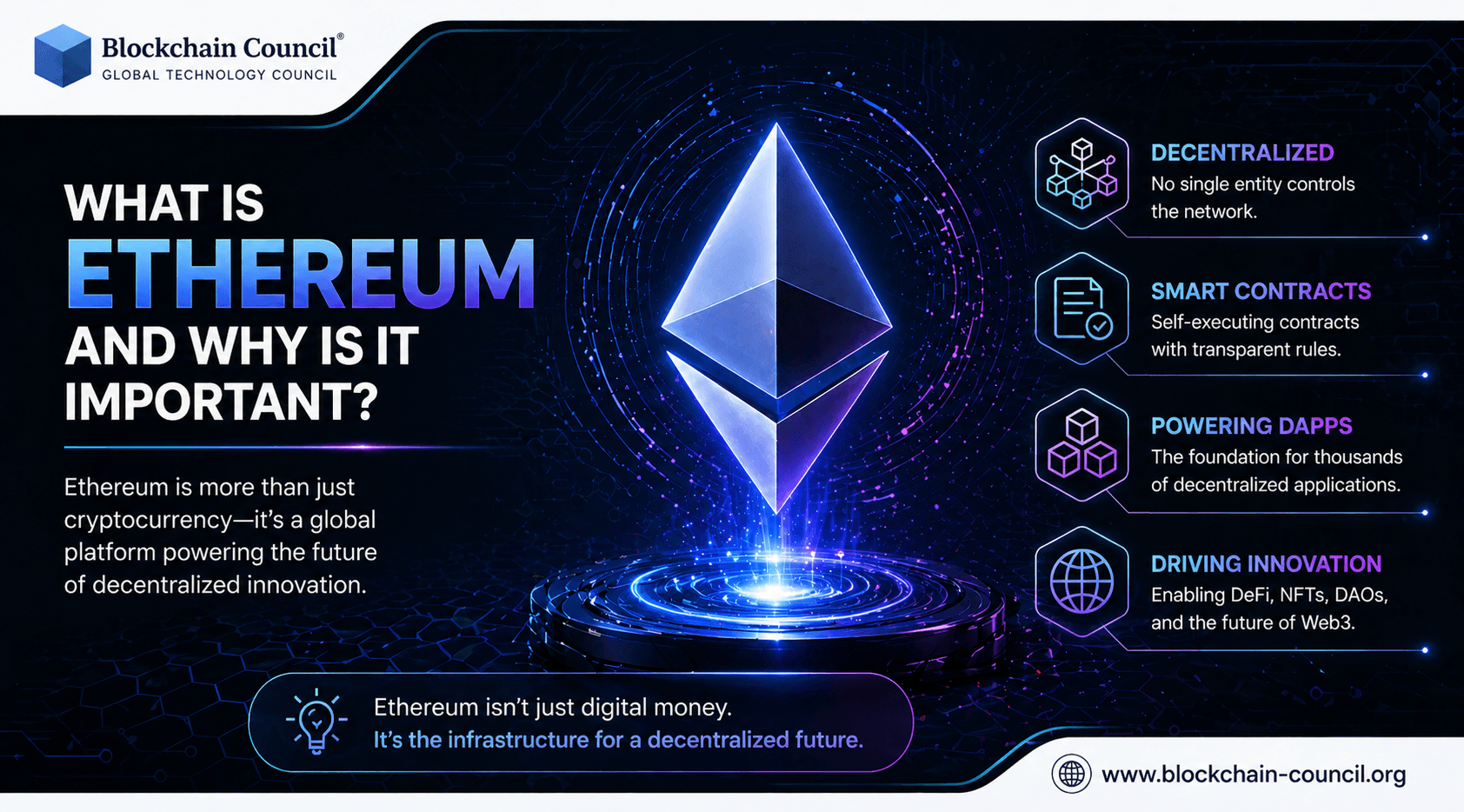
Ethereum is one of the most influential technologies in the blockchain ecosystem, but explaining it as “just another cryptocurrency” is like calling the internet “a place for emails.” Technically true, deeply misleading.
At its core, Ethereum is a decentralized, open-source blockchain platform that allows developers to build and run applications without relying on centralized authorities. These applications, known as decentralized applications (dApps), operate using smart contracts, which are self-executing programs stored on the blockchain.

Since its launch in 2015, Ethereum has evolved significantly. It is no longer just a concept attracting curiosity from tech enthusiasts. It now powers a large portion of the decentralized web, including finance, gaming, identity systems, and digital ownership. Understand how Ethereum powers smart contracts, DeFi, NFTs, and decentralized applications by building deep expertise through a Certified Blockchain Expert, analyzing Ethereum transactions and on-chain data using a Python certification, and turning your Web3 knowledge into real opportunities with a Digital marketing course.
What Is Ethereum?
Ethereum is a blockchain network designed to execute code in a decentralized way. Instead of relying on a central server, Ethereum uses a global network of computers (nodes) to validate and run applications.
The native cryptocurrency of the Ethereum network is Ether (ETH). ETH is used to pay for transactions and computational services on the network.
What makes Ethereum unique is its ability to support programmable transactions. These are not just simple transfers of value, like Bitcoin transactions, but complex operations defined by code.
How Ethereum Works
Ethereum operates using a distributed ledger, where every transaction and piece of code is recorded across thousands of computers worldwide. This ensures transparency, security, and resistance to tampering.
Smart Contracts
Smart contracts are the backbone of Ethereum. They are programs that automatically execute when predefined conditions are met. For example, a smart contract can release payment once a service is completed, without needing a third party.
Ethereum Virtual Machine (EVM)
The Ethereum Virtual Machine is the environment where smart contracts run. It ensures that code executes exactly as written, without downtime or interference.
Proof of Stake (PoS)
Ethereum transitioned from Proof of Work (PoW) to Proof of Stake (PoS) in 2022. This upgrade, known as “The Merge,” significantly reduced energy consumption and improved scalability. Validators now secure the network by staking ETH instead of mining.
Ethereum vs Bitcoin: Key Differences
Comparing Ethereum to Bitcoin is common, but they serve different purposes.
Bitcoin is primarily a digital currency designed for peer-to-peer payments and value storage. Ethereum, on the other hand, is a programmable platform.
Bitcoin focuses on being secure and decentralized money. Ethereum focuses on enabling decentralized applications and smart contracts.
In simple terms, Bitcoin is digital gold, while Ethereum is a decentralized computing platform.
Why Ethereum Is Important
1. Enables Decentralized Applications (dApps)
Ethereum allows developers to build applications that run without centralized control. These apps are transparent, censorship-resistant, and globally accessible.
This has opened the door to industries like decentralized finance (DeFi), blockchain gaming, and digital identity.
2. Powers Smart Contracts
Smart contracts eliminate the need for intermediaries such as banks, brokers, or legal authorities. They reduce costs, improve efficiency, and minimize human error.
This is especially useful in sectors like finance, supply chain, insurance, and real estate.
3. Foundation of Decentralized Finance (DeFi)
Ethereum is the backbone of DeFi, which aims to recreate traditional financial systems using blockchain technology.
Users can lend, borrow, trade, and earn interest on digital assets without relying on banks. Platforms like Uniswap, Aave, and MakerDAO are built on Ethereum.
4. Supports NFTs and Digital Ownership
Ethereum popularized non-fungible tokens (NFTs), which represent ownership of digital assets such as art, music, and virtual real estate.
NFTs have expanded into gaming, entertainment, and brand engagement, creating new business models.
5. Backed by Major Enterprises
Ethereum has strong support from major organizations and enterprise groups such as the Enterprise Ethereum Alliance. Companies like Microsoft, JPMorgan, and ConsenSys have explored or implemented Ethereum-based solutions.
This institutional interest adds credibility and drives adoption.
6. Continuous Upgrades and Innovation
Ethereum is actively evolving. Upgrades like sharding and layer-2 scaling solutions (such as Arbitrum and Optimism) aim to improve speed and reduce transaction costs.
Unlike many static systems, Ethereum adapts to meet growing demand.
7. Global Financial Inclusion
Ethereum provides access to financial services for people without traditional banking access. Anyone with an internet connection can interact with Ethereum-based applications.
This has significant implications for developing economies.
Real-World Use Cases of Ethereum
Ethereum is not just theoretical. It is actively used in multiple industries.
Finance
Decentralized exchanges, lending platforms, and stablecoins operate on Ethereum, offering alternatives to traditional banking.
Supply Chain
Companies use Ethereum to track goods and verify authenticity in supply chains.
Gaming
Blockchain-based games allow players to own and trade in-game assets as NFTs.
Identity Management
Ethereum can store secure digital identities, reducing fraud and improving privacy.
Explore Ethereum’s ecosystem including gas fees, EVM, and token standards like ERC-20 and ERC-721 by mastering blockchain development through a Certified Blockchain Expert, building dApps and integrations using a Node JS Course, and positioning Ethereum-based solutions effectively using an AI powered marketing course.
Challenges Facing Ethereum
Despite its advantages, Ethereum is not perfect.
High Transaction Fees
Network congestion can lead to high gas fees, making small transactions expensive.
Scalability Issues
Although improvements are underway, Ethereum still faces limitations in processing large volumes of transactions.
Regulatory Uncertainty
Governments worldwide are still figuring out how to regulate blockchain technologies, which creates uncertainty.
Is Ethereum a Good Investment?
Ethereum remains one of the most widely adopted blockchain platforms. Its long-term value depends on continued adoption, technological improvements, and regulatory clarity.
However, like all cryptocurrencies, ETH is volatile. Prices can fluctuate significantly based on market conditions.
It is generally considered a long-term investment rather than a short-term speculative asset.
FAQs
1. What is Ethereum in simple terms?
Ethereum is a blockchain platform that allows developers to build decentralized applications using smart contracts. It also has its own cryptocurrency called Ether.
2. How is Ethereum different from Bitcoin?
Bitcoin is mainly used as digital money, while Ethereum is designed to run applications and smart contracts on its network.
3. What is Ether (ETH)?
Ether is the native cryptocurrency of Ethereum. It is used to pay for transactions and computational services on the network.
4. What are smart contracts?
Smart contracts are self-executing programs that run on Ethereum. They automatically perform actions when specific conditions are met.
5. What are decentralized applications (dApps)?
dApps are applications that run on a blockchain instead of a central server. They are transparent and resistant to censorship.
6. What is Ethereum 2.0?
Ethereum 2.0 refers to the network’s upgrade to Proof of Stake, improving energy efficiency and scalability.
7. What is Proof of Stake?
Proof of Stake is a system where validators secure the network by staking ETH instead of using energy-intensive mining.
8. Why are Ethereum gas fees high?
Gas fees increase when network demand is high. Users compete to have their transactions processed quickly.
9. What are NFTs on Ethereum?
NFTs are unique digital assets stored on the Ethereum blockchain. They represent ownership of items like art or collectibles.
10. What is DeFi?
DeFi stands for decentralized finance. It allows users to access financial services without banks using blockchain technology.
11. Is Ethereum secure?
Ethereum is highly secure due to its decentralized structure, but smart contract vulnerabilities can still pose risks.
12. Can Ethereum be hacked?
The network itself is very secure, but poorly written smart contracts or user errors can lead to losses.
13. What are layer-2 solutions?
Layer-2 solutions are technologies built on Ethereum to improve speed and reduce costs, such as Arbitrum and Optimism.
14. How do I buy Ethereum?
You can buy Ethereum through cryptocurrency exchanges using fiat currency or other digital assets.
15. Is Ethereum legal?
Ethereum is legal in many countries, but regulations vary. It is important to check local laws before using it.
16. What is staking in Ethereum?
Staking involves locking up ETH to help secure the network and earn rewards.
17. Can Ethereum replace banks?
Ethereum can replicate some banking functions, but it is unlikely to fully replace traditional financial systems in the near term.
18. What industries use Ethereum?
Ethereum is used in finance, gaming, supply chain, healthcare, and digital identity systems.
19. What is the future of Ethereum?
Ethereum’s future depends on scalability improvements, adoption, and regulatory developments. It remains a leading blockchain platform.
20. Is Ethereum good for beginners?
Yes, but beginners should understand the basics of blockchain and crypto risks before investing or using it.
Related Articles
View All
Blockchain
Beyond Cryptocurrency: How Blockchain Is Transforming Real-World Industries
Explore how blockchain works beyond cryptocurrency in banking, supply chains, healthcare, tokenisation, CBDCs, and government, plus key challenges and career paths.

Blockchain
Smart Contracts & dApps: How Blockchain Becomes Programmable
Learn how smart contracts and dApps make blockchain programmable, from Ethereum and tokens to DeFi, NFTs, real use cases, benefits, and key risks.

Blockchain
Public, Private & Consortium Blockchains: Which Network Fits the Use Case?
Compare public, private, and consortium blockchains by security, speed, privacy, and control, with real examples and a simple guide to choosing the right network.
Trending Articles
The Role of Blockchain in Ethical AI Development
How blockchain technology is being used to promote transparency and accountability in artificial intelligence systems.
How Blockchain Secures AI Data
Understand how blockchain technology is being applied to protect the integrity and security of AI training data.
What is AWS? A Beginner's Guide to Cloud Computing
Everything you need to know about Amazon Web Services, cloud computing fundamentals, and career opportunities.