

What is Blockchain Gaming?
 Toshendra Kumar Sharma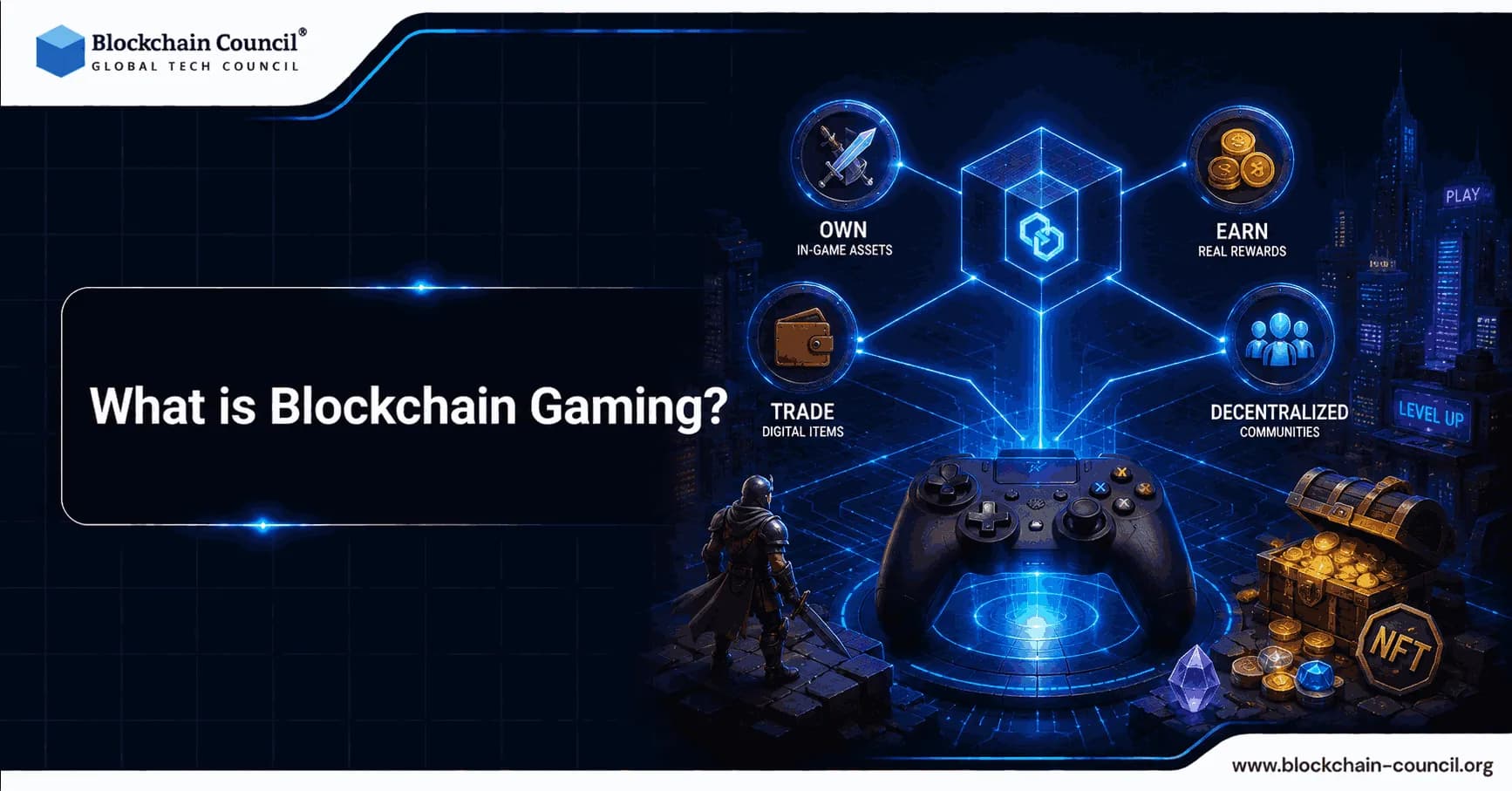
Blockchain gaming refers to video games that use blockchain technology to give players real ownership of in-game items, currencies, and characters. Instead of a game studio holding full control over every sword, skin, or piece of virtual land, blockchain gaming stores these assets on a public ledger, usually as NFTs, so players can hold, trade, or sell them independently of the game itself. This shift from studio owned assets to player owned assets is the core idea that anyone studying the space, including someone working toward a Certified Blockchain Expert credential, needs to understand before anything else, since it is the foundation every other feature in this industry builds on.
This guide breaks down how blockchain gaming works, what makes it different from traditional gaming, and where the space is heading.

How Blockchain Gaming Actually Works
Traditional games keep every item, currency, and character locked inside a closed system controlled by the publisher. If the servers shut down or the account gets banned, everything a player earned disappears. Blockchain gaming changes this by minting in-game assets directly onto a blockchain, which means ownership is recorded independently of the game's own servers.
Smart contracts handle most of the heavy lifting behind the scenes. When a player earns, crafts, or purchases an item, a smart contract verifies the transaction and records ownership on chain. This is also how marketplaces work, since a smart contract can automatically confirm ownership and transfer an asset the moment a trade is agreed on, without needing a company in the middle to approve it. This kind of system design sits at the intersection of coding and game design, and it is exactly the skill set covered by a Certified Web3 Game Developer path, which focuses on building smart contract logic, wallet integration, and tokenized economies directly into playable games.
Play to Earn Models
Play to earn is one of the most recognized formats in blockchain gaming. Players complete in-game activities, such as battles, quests, or resource collection, and receive cryptocurrency or NFTs as rewards that can later be sold or traded on open marketplaces. This is a sharp departure from traditional games, where in-game currency and rare drops have no value outside the game itself.
NFTs as Core Game Infrastructure
Early blockchain games often used NFTs mainly as collectibles. That has changed significantly. Characters, weapons, land parcels, and access passes are now frequently built as functional gameplay assets rather than side collectibles, meaning the NFT itself directly affects what a player can do in the game rather than sitting separately from it.
Layer 2 Networks and Lower Fees
One of the earliest criticisms of blockchain gaming was high transaction fees, especially on networks like Ethereum during periods of congestion. Layer 2 scaling solutions have addressed much of this problem by processing transactions off the main chain while still settling final results on it, which brings fees down dramatically and allows for the kind of fast, frequent interactions that real time gameplay requires.
Blockchain Gaming vs Traditional Gaming
Ownership
In traditional gaming, the publisher owns every asset, and players are effectively renting access to items and progress. In blockchain gaming, assets are tied to a player's wallet rather than a game account, so ownership persists even if the player stops playing or the game itself eventually shuts down.
Economic Value
Traditional in-game currencies and items generally have no value outside the game's own ecosystem. Blockchain based assets can be traded on open marketplaces, giving them real world value that fluctuates based on demand, utility, and scarcity, similar to how any tradable digital asset behaves.
Interoperability
Some blockchain games are being designed so that assets can move between different games or platforms, rather than staying locked inside one title. This is still an emerging feature, but it points toward a future where a player's digital items are not confined to a single developer's ecosystem.
Transparency
Because ownership records and transaction history sit on a public ledger, blockchain gaming offers a level of transparency around item rarity, supply, and trade history that closed, centralized game databases do not provide.
Where Blockchain Gaming Is Heading
The industry has moved noticeably beyond the speculation heavy play to earn boom of a few years ago. Studios and investors are now placing more weight on sustainable game design, meaning gameplay has to be enjoyable on its own rather than relying purely on token rewards to keep players engaged. Hybrid economic models are becoming common, where players earn through gameplay but also spend on crafting, upgrades, and cosmetics, creating a more balanced in-game economy instead of a purely extractive one.
Metaverse integration, DAOs for community governance, and AI powered non-player characters are also becoming more common across newer titles, pushing blockchain games closer to the production quality and depth expected from mainstream AAA titles. As this convergence between traditional game development and blockchain infrastructure continues, structured learning paths matter more than ever, which is part of why broader Tech Certification programs increasingly include blockchain gaming modules alongside general Web3 and smart contract development topics, giving developers a wider technical foundation rather than a narrow one.
Why Blockchain Gaming Matters Beyond the Players
Blockchain gaming is not just a technical shift, it is also reshaping how digital products are marketed and sold. Traditional game marketing focuses on hype around a single title and its content updates. Blockchain gaming adds an entirely new layer, since studios also need to communicate token economics, asset scarcity, and long term ecosystem value to a community that expects transparency and genuine utility rather than empty promises. Explaining these concepts clearly to a broader audience is a skill in itself, which is why a dedicated Marketing Certification focused on Web3 and blockchain products has become useful for teams trying to position a game honestly in a market that has grown wary of short lived hype cycles.
Technology Skills & Education
Schools and parents are increasingly looking for ways to introduce children to technology in a structured and meaningful way. The World Tech Olympiad provides an opportunity for students to explore AI, coding, robotics, cybersecurity, and computational thinking while building confidence and problem-solving skills.
Final Thoughts
Blockchain gaming represents a genuine shift in how digital ownership works within interactive entertainment. Players are no longer just users inside someone else's closed system, they hold real, tradable assets tied directly to their own wallets. As Layer 2 scaling, better game design, and clearer regulation continue to mature the space, blockchain gaming is positioned to move further from its speculative early days and closer to becoming a standard part of how games are built and played.
FAQs
1. What is blockchain gaming?
Blockchain gaming is the integration of blockchain technology into video games, enabling players to own, trade, and verify digital assets such as characters, skins, weapons, collectibles, virtual land, and in-game currencies. Unlike traditional games, blockchain games can give players greater control over their digital assets through cryptographic ownership.
2. How does blockchain gaming work?
Blockchain games use smart contracts to manage digital assets and record ownership on a blockchain. Players access the game through wallets or blockchain-enabled accounts, while game assets are represented as tokens or non-fungible tokens (NFTs). Game logic typically runs off-chain, with blockchain used for ownership, transactions, and verification.
3. Why is blockchain important for gaming?
Blockchain introduces verifiable ownership, transparent marketplaces, decentralized economies, interoperability between compatible applications, and secure trading of digital assets. It can reduce dependence on centralized game publishers for asset ownership and transfers.
4. What are NFTs in blockchain gaming?
Non-fungible tokens (NFTs) are unique blockchain-based digital assets that can represent in-game items such as characters, equipment, collectibles, artwork, avatars, or virtual land. Each NFT has a unique identifier that distinguishes it from other assets.
5. Can players truly own in-game assets?
In many blockchain games, players control the cryptographic keys associated with their digital assets, allowing them to transfer or trade those assets independently of the game operator. However, the continued usefulness of an asset may still depend on whether the game or compatible platforms continue to support it.
6. What are play-to-earn (P2E) games?
Play-to-earn (P2E) games reward players with digital assets or tokens for participating in gameplay. These assets may have value within the game's ecosystem or, in some cases, on external marketplaces. Rewards are not guaranteed and may fluctuate significantly in value.
7. What is play-and-earn?
Play-and-earn is a gaming model that emphasizes enjoyable gameplay first while allowing players to earn optional digital rewards. It aims to create more sustainable game economies than purely reward-driven models.
8. How do smart contracts work in blockchain games?
Smart contracts automate functions such as:
Asset ownership
Marketplace transactions
Tournament rewards
Crafting systems
Governance voting
Royalty payments
Staking mechanisms
In-game economies
They execute predefined rules without requiring manual intervention.
9. Which blockchains are commonly used for gaming?
Popular blockchain platforms include:
Ethereum
Polygon
Immutable
Solana
Avalanche
Ronin
BNB Smart Chain
Arbitrum
Base
Sui
Developers choose platforms based on speed, cost, security, and ecosystem support.
10. Can blockchain games work without cryptocurrencies?
Yes. Some blockchain games allow players to use traditional payment methods while blockchain operates behind the scenes for asset ownership and verification. Others integrate cryptocurrencies more directly into gameplay and marketplace activities.
11. What are decentralized gaming marketplaces?
These marketplaces allow players to buy, sell, and trade blockchain-based game assets directly with one another. Ownership is verified through the blockchain rather than solely through the game publisher's internal database.
12. Can blockchain enable cross-game assets?
Potentially, yes. If developers choose compatible standards and collaborate, certain digital assets may be recognized across multiple games or platforms. In practice, widespread interoperability remains technically and commercially challenging.
13. What are the advantages of blockchain gaming?
Benefits include:
Verifiable digital ownership
Player-controlled assets
Transparent marketplaces
Secure trading
Smart contract automation
Reduced counterfeiting of digital items
Community governance opportunities
New monetization models
Cross-platform potential
Greater transparency
14. What challenges exist?
Challenges include scalability, transaction fees on some networks, regulatory uncertainty, cybersecurity, wallet usability, game economy sustainability, market volatility, onboarding new users, and balancing entertainment with financial incentives.
15. Can blockchain replace traditional gaming?
No. Blockchain is unlikely to replace conventional games. Instead, it provides additional capabilities for games where verifiable ownership, decentralized economies, or digital collectibles create value. Many successful games will continue using traditional architectures because not every inventory system requires a distributed ledger. Sometimes a sword is just a sword.
16. What common mistakes should players avoid?
Common mistakes include:
Sharing wallet recovery phrases
Purchasing assets without research
Assuming every NFT will increase in value
Ignoring marketplace scams
Connecting wallets to untrusted websites
Failing to understand game token economics
17. What are best practices for developers?
Best practices include integrating blockchain only where it adds meaningful value, minimizing transaction costs, storing large game data off-chain, auditing smart contracts, protecting user privacy, designing sustainable game economies, supporting secure wallet integration, and prioritizing enjoyable gameplay.
18. How does blockchain fit into the future of gaming?
Blockchain complements artificial intelligence (AI), cloud gaming, virtual reality (VR), augmented reality (AR), digital identity, esports, creator economies, and metaverse technologies to support richer and more interactive gaming ecosystems.
19. What trends are shaping blockchain gaming in 2025-2026?
Major trends include AI-generated game content, account abstraction, interoperable digital identities, tokenization of in-game assets, Layer 2 gaming networks, decentralized autonomous organizations (DAOs), creator-owned gaming economies, metaverse integration, real-world asset (RWA) connections, and improved wallet experiences.
20. What is the future of blockchain gaming?
Blockchain gaming is expected to mature as developers focus on creating engaging games where blockchain operates largely in the background. Future titles are likely to emphasize player ownership, seamless digital marketplaces, interoperable identities, and sustainable in-game economies while reducing technical complexity for players. The long-term success of blockchain gaming will depend less on the presence of tokens and more on whether the games themselves are genuinely enjoyable. After all, players log in to have fun. Owning a legendary sword is exciting, but only if there is actually a dragon worth using it against.
Related Articles
View All
Blockchain
Beyond Cryptocurrency: How Blockchain Is Transforming Real-World Industries
Explore how blockchain works beyond cryptocurrency in banking, supply chains, healthcare, tokenisation, CBDCs, and government, plus key challenges and career paths.
Blockchain
Smart Contracts & dApps: How Blockchain Becomes Programmable
Learn how smart contracts and dApps make blockchain programmable, from Ethereum and tokens to DeFi, NFTs, real use cases, benefits, and key risks.

Blockchain
Behind the Blocks: How Blockchain Transactions Actually Work
Go behind the blocks to see how a blockchain transaction really works: wallets and keys, digital signatures, verification, hashing, blocks, consensus, proof of work vs proof of stake, and how miners and validators secure the network.
Trending Articles
The Role of Blockchain in Ethical AI Development
How blockchain technology is being used to promote transparency and accountability in artificial intelligence systems.
AWS Career Roadmap
A step-by-step guide to building a successful career in Amazon Web Services cloud computing.

Top 5 DeFi Platforms
Explore the leading decentralized finance platforms and what makes each one unique in the evolving DeFi landscape.