

Siemens To Use Blockchain For Interoperability In The Industry
 Toshendra Kumar Sharma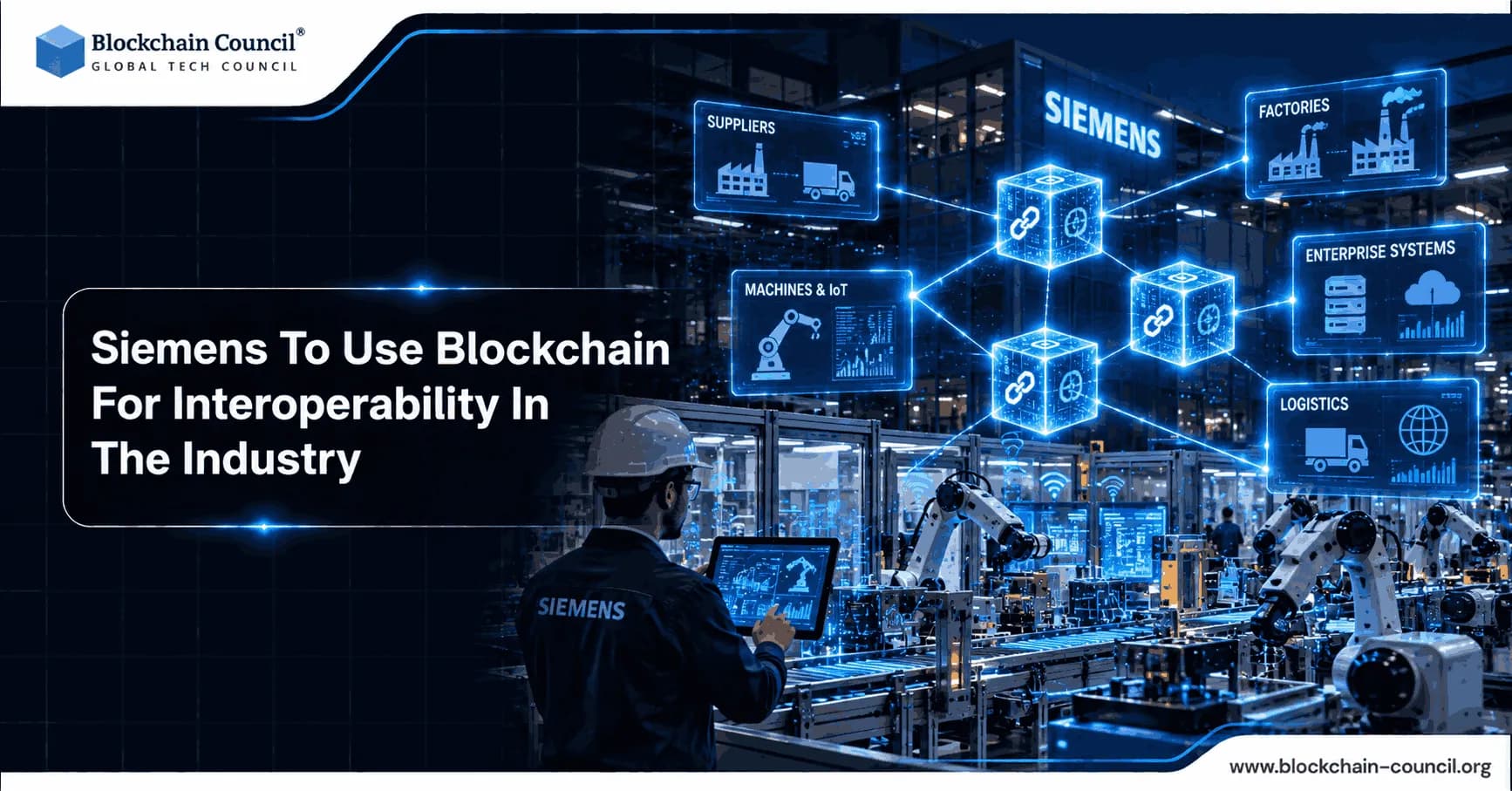
Modern industrial operations rarely run on a single, unified system. A single manufacturing process might involve dozens of different machines, software platforms, suppliers, and data formats that were never designed to communicate with one another seamlessly. This is exactly the problem that Blockchain For Interoperability aims to solve, and Siemens, one of the world's largest industrial technology companies, has emerged as a leading example of how this approach can work in practice. By using blockchain to create a shared, verifiable layer of trust across otherwise disconnected systems, Siemens is helping demonstrate how large industrial organizations can finally get their many different technologies, partners, and data sources talking to each other reliably. Anyone interested in understanding the fundamentals behind this kind of industrial blockchain application can start with a Certified Blockchain Expert program, which breaks down exactly how distributed ledgers create trust between systems that do not naturally trust each other.
This article explains what blockchain interoperability actually means, how Siemens is applying it across real industrial use cases, and why solving this problem matters for the future of manufacturing and infrastructure worldwide.

Understanding Blockchain Interoperability in an Industrial Context
Before diving into what Siemens is specifically doing, it helps to understand why blockchain interoperability has become such an important and widely discussed challenge within Industry 4.0, the term commonly used to describe the ongoing digital transformation of manufacturing and industrial operations. Developers who want to build the actual systems that solve these integration challenges often pursue a Certified Blockchain Developer program, which covers exactly the technical protocols needed to connect blockchain systems with existing legacy infrastructure.
What Interoperability Actually Means
Interoperability refers to the ability of different systems, whether they are software platforms, machines, or entire blockchain networks, to exchange and make use of information reliably, without requiring extensive custom integration work for every single connection. In a factory setting, this might mean a robotics system, a supply chain tracking platform, and a financial reporting tool all being able to share and verify data with one another automatically, rather than requiring manual reconciliation between disconnected systems.
Why This Is Especially Difficult With Blockchain
Blockchain adds a unique layer of complexity to this challenge. Because the entire industrial ecosystem does not have a single centralized authority or leading organization dictating which technology every company must use, no single blockchain solution can realistically be imposed across an entire supply chain or manufacturing network. This means multiple blockchain networks, along with traditional legacy systems, need to somehow work together, verify each other's data, and maintain security guarantees across the entire connected ecosystem, which remains a genuinely open technical challenge that companies like Siemens are actively working to solve.
How Siemens Is Applying Blockchain Across Its Industrial Operations
Siemens has not approached blockchain as a single, isolated project, but rather as a technology woven into several different parts of its business, each addressing a specific interoperability or trust challenge.
Bringing Transparency to Supply Chain and Tool Management
One of Siemens' notable blockchain applications involves digitalizing its tool management activities to guarantee the integrity of records across its supply chain. When a transport order is generated within this system, it gets automatically entered into the blockchain, creating a permanent, verifiable record that cannot be falsified or unlawfully reused for a different delivery. This directly addresses an interoperability challenge, since tool management historically involved multiple parties and systems that needed a shared, trusted source of truth rather than each party maintaining separate, disconnected records.
The Universal Asset Passport Concept
Building on lessons learned from its earlier blockchain projects, Siemens developed what it calls a Universal Asset Passport, a concept designed to give physical assets a verifiable digital identity and history that can travel with them across different systems and organizations. This kind of universal, portable record is a direct response to the interoperability problem, since it allows different companies and platforms in a supply chain to trust the same underlying asset information without needing to build custom integrations with every single partner they work with.
Partnering on Embedded Blockchain for IoT Devices
Siemens has also partnered with Minima, a blockchain company known for developing what is called an embedded blockchain capable of running a full network node directly on an Internet of Things device. Through its Cre8Ventures innovation and investment division, Siemens integrated this decentralized security approach into its Digital Twin Marketplace, a platform designed to help large companies test and validate new digital twin technologies across industries including automotive, energy, robotics, and healthcare equipment. This partnership specifically targets interoperability and security challenges in connected devices, where centralized infrastructure has historically left systems vulnerable to issues like unauthorized data changes or fraud.
Real-Time Treasury and Cross-Border Financial Interoperability
Beyond manufacturing and supply chain applications, Siemens has also explored blockchain interoperability within its financial operations. Working with banking partner Citi, Siemens implemented a blockchain-based solution enabling near-instant, always-available settlement of intercompany and cross-border financial transactions. Notably, this solution was designed to work using Siemens' existing fiat currency accounts, meaning the company did not need to open entirely new accounts or digital wallets, allowing the treasury team to scale the solution across different countries and currencies while maintaining full integration with its existing cash management systems through provided APIs. This demonstrates interoperability in a very practical sense, connecting blockchain infrastructure directly with traditional financial systems rather than requiring a complete overhaul of existing processes.
Supply Chain Traceability in Food and Beverage Applications
Siemens has also applied blockchain interoperability principles to help the food and beverage industry achieve complete traceability from farm to table. By combining blockchain with its cloud-based industrial platform, Siemens has helped create systems capable of capturing and verifying data across entire supply chains, connecting information from multiple different points of origin and multiple different handling parties into a single, trustworthy record that can be checked at any stage of the journey.
Why Interoperability Matters So Much for Industrial Blockchain Success
Understanding why Siemens has invested so heavily in interoperability specifically, rather than simply adopting a single blockchain platform, reveals important lessons for any large organization considering similar technology investments.
No Single Company Controls the Entire Ecosystem
Unlike a purely internal software system that one company fully controls, industrial supply chains and manufacturing ecosystems involve dozens or even hundreds of independent organizations, each potentially using different technologies, standards, and platforms. Blockchain interoperability solutions allow these diverse parties to still benefit from shared trust and verification without requiring every single participant to adopt identical technology.
Legacy Systems Cannot Simply Be Replaced Overnight
Large industrial companies like Siemens operate complex legacy systems that have been built and refined over decades. Completely replacing these systems to accommodate a single blockchain standard would be enormously costly and disruptive. Instead, effective interoperability protocols allow new blockchain-based trust layers to integrate with existing infrastructure gradually, protecting previous technology investments while still gaining the benefits blockchain offers.
Security and Trust Must Extend Across Connected Devices
As industrial systems become increasingly connected through the Internet of Things, security vulnerabilities in one connected device or system can potentially compromise an entire network. Interoperable blockchain solutions, like the embedded approach Siemens explored through its Minima partnership, help extend security and verifiable trust down to the individual device level, which becomes increasingly important as more physical equipment gets connected to digital networks.
Broader Industry Lessons From Siemens' Approach
Siemens' layered, multi-application approach to blockchain interoperability offers valuable lessons for other large organizations considering similar technology investments. Rather than treating blockchain as a single, monolithic solution, Siemens has applied it strategically to specific problems, supply chain integrity, financial settlement, device security, and product traceability, each requiring its own particular approach to interoperability with existing systems and partners.
Professionals interested in understanding how blockchain connects with these broader industrial technology trends, including Internet of Things integration, digital twin technology, and artificial intelligence, often pursue a Tech Certification to build a well-rounded understanding of how these interconnected technologies work together in real enterprise environments like the ones Siemens has built.
Communicating Complex Interoperability Solutions to Stakeholders
One challenge companies face when implementing sophisticated blockchain interoperability solutions is explaining the genuine business value to stakeholders who may not have a technical background. Executives, partners, and customers generally care less about the specific technical mechanisms of blockchain interoperability and more about tangible outcomes like reduced fraud, faster settlement times, or improved supply chain trust. Companies rolling out similar industrial blockchain initiatives need strong communication strategies to translate these technical achievements into clear business value, which is where a solid Marketing Certification becomes genuinely useful, helping technology and business teams explain these complex interoperability solutions in language that resonates with decision-makers and everyday stakeholders alike.
The Future of Industrial Blockchain Interoperability
Looking ahead, blockchain interoperability is likely to remain one of the most actively developed areas within industrial blockchain applications, given how fundamentally the Industry 4.0 vision depends on connecting diverse systems, organizations, and devices rather than relying on any single centralized platform. As standards continue to mature and more companies gain practical experience similar to what Siemens has demonstrated across supply chain, finance, and device security applications, broader industry-wide interoperability protocols are likely to emerge, making it easier for even smaller companies to participate in these trusted, connected ecosystems without needing the resources of a massive multinational corporation to build custom integration solutions from scratch.
Conclusion
Siemens' approach to Blockchain For Interoperability demonstrates how a major industrial company can move beyond blockchain hype into genuinely practical, multi-faceted technology applications that solve real connectivity and trust challenges. From its Universal Asset Passport concept and supply chain tool management system to its embedded blockchain security partnership with Minima and its real-time treasury collaboration with Citi, Siemens has shown that solving interoperability requires a thoughtful, application-specific approach rather than a single universal solution. As industrial ecosystems continue growing more complex and interconnected, the lessons learned from Siemens' ongoing blockchain interoperability efforts are likely to influence how other major industrial companies approach similar challenges, ultimately helping build a more connected, trustworthy, and efficient global manufacturing landscape.
If you want to keep up with the trends of blockchain industry, join our communities on Discord, Reddit and Telegram.
FAQs
1. Why Did Siemens Explore Blockchain for Industrial Interoperability?
Siemens explored blockchain as a way to support trusted data exchange and interoperability across industrial ecosystems. Its blockchain strategy focused on connecting companies, factories, energy systems, mobility infrastructure, and other participants through trusted digital networks.
2. What Did Siemens Announce About Blockchain in 2018?
In November 2018, Siemens announced that its Energy Management and Power Generation Services divisions had joined the Energy Web Foundation. The initiative focused on blockchain-based energy applications, distributed energy systems, microgrids, and new energy-market models.
3. What Is Industrial Blockchain Interoperability?
Industrial blockchain interoperability refers to the ability of different organizations, systems, and blockchain-based networks to exchange trusted information and work together. This can help connect data across company boundaries and different stages of an industrial value chain.
4. How Can Blockchain Improve Interoperability in Industry?
Blockchain can provide a shared, tamper-resistant record that multiple organizations can reference without relying entirely on one company's database. Smart contracts and standardized data structures can further automate interactions between participating systems.
5. What Role Does Blockchain Play in Siemens' Industrial Strategy?
Siemens has described blockchain as a potential trust technology for automated ecosystems. Its industrial blockchain work has included decentralized architectures, confidentiality and integrity, software engineering, and integration with edge and field technologies.
6. How Can Blockchain Connect Different Industrial Systems?
Blockchain can act as a trusted coordination layer between systems operated by different organizations. Data from manufacturing, logistics, quality control, or other systems can be linked to shared blockchain records while sensitive information can remain in appropriate private systems.
7. How Is Siemens Using Blockchain in Energy?
Siemens has explored blockchain-based applications for distributed energy systems, microgrids, energy trading, and interactions between consumers, producers, prosumers, and network operators. Its 2018 Energy Web Foundation collaboration specifically targeted transactive energy applications.
8. Did Siemens Work With Energy Web Foundation?
Yes. Siemens' Energy Management and Power Generation Services divisions joined the Energy Web Foundation in 2018. The foundation focuses on accelerating commercial blockchain applications for the energy sector.
9. What Is the Connection Between Siemens and Microgrids?
Siemens has worked on combining blockchain technology with microgrid control solutions. The company also collaborated with LO3 Energy on microgrids and peer-to-peer energy trading, including an early project in Brooklyn.
10. Can Blockchain Improve Supply Chain Interoperability?
Yes. Blockchain can provide a shared record of product information across suppliers, manufacturers, logistics providers, and customers. Siemens has developed and supported blockchain-based traceability approaches for improving transparency across complex supply chains.
11. How Did Siemens and Merck Use Blockchain for Industrial Data?
In 2021, Siemens and Merck announced work on machine-to-machine trust in industrial value chains. Their planned solution combined smart contracts, blockchain, industrial edge computing, and digital identities to help create a trusted source of information across the product lifecycle.
12. What Is Siemens Trusted Traceability?
Trusted Traceability is a Siemens-related solution for improving transparency and visibility across supply chains. Siemens currently describes blockchain and cloud applications as part of its approach to tracking materials, product genealogy, quality, and recalls.
13. How Does Blockchain Support Product Traceability?
Blockchain can preserve records of product events in a shared ledger, making it easier for authorized participants to verify information throughout a product's lifecycle. This can support provenance, quality verification, recalls, and supply chain transparency.
14. Can Blockchain Make Industrial Data More Trustworthy?
Blockchain can strengthen the integrity and traceability of records by maintaining cryptographically protected ledger entries. However, blockchain does not automatically guarantee that the original physical-world data entered into the system was accurate.
15. How Can Smart Contracts Support Industrial Interoperability?
Smart contracts can automate predefined actions when specified conditions are met. In industrial environments, they can potentially support automated transactions, compliance checks, machine-to-machine interactions, and supply chain processes.
16. What Are the Benefits of Blockchain-Based Industrial Interoperability?
Potential benefits include improved data integrity, traceability, transparency, automation, and coordination between organizations. These capabilities can be particularly useful where several companies need to exchange information without giving control of all data to a single organization.
17. What Are the Challenges of Using Blockchain in Industry?
Challenges include scalability, privacy, integration with existing IT and operational technology systems, governance, standards, and data quality. Businesses also need to determine which information should be stored directly on a blockchain and which should remain in conventional databases or cloud systems.
18. Does Siemens Use Blockchain for Manufacturing?
Siemens has explored blockchain for manufacturing and industrial applications, including trusted traceability and machine-to-machine data ecosystems. Its current ecosystem also includes blockchain-based traceability solutions connected with distributed manufacturing.
19. How Does Blockchain Support Interoperability Across Supply Chains?
Blockchain can provide a common trust layer across multiple organizations while allowing each participant to maintain its own systems and data. Siemens has also discussed blockchain interoperability standards and approaches for connecting information across federated supply chains.
20. What Is the Future of Blockchain Interoperability in Industry?
Blockchain interoperability is likely to remain relevant where industrial ecosystems require trusted data exchange across organizational boundaries. Siemens' work demonstrates applications ranging from energy systems and manufacturing to supply-chain traceability, although practical adoption depends on standards, integration, privacy, scalability, and business requirements.
Related Articles
View All
Blockchain
Blockchain in Banks: Use Cases, Benefits, Risks, and the AI Connection
Explore how blockchain in banks is reshaping payments, trade finance, tokenized deposits, KYC, AML, and AI-driven risk workflows.

Blockchain
User Experience in Blockchain Products: How to Make Web3 Apps Easier to Use
Learn how to improve user experience in blockchain products with simpler onboarding, clearer transaction flows, safer wallet UX, and better Web3 metrics.
Blockchain
Top Blockchain Use Cases in Banks and Financial Services
Explore the top blockchain use cases in banks, from payments and trade finance to tokenization, settlement, lending, KYC, and digital asset services.
Trending Articles
AWS Career Roadmap
A step-by-step guide to building a successful career in Amazon Web Services cloud computing.

Top 5 DeFi Platforms
Explore the leading decentralized finance platforms and what makes each one unique in the evolving DeFi landscape.
Blockchain in Supply Chain Provenance Tracking
Supply chains are under pressure to prove not just efficiency, but also authenticity, sustainability, and fairness. Customers want to know if their coffee really is fair trade, if the diamonds are con