

Blockchain Developers are in Demand. Here’s How to Learn the Skills for it
 Toshendra Kumar Sharma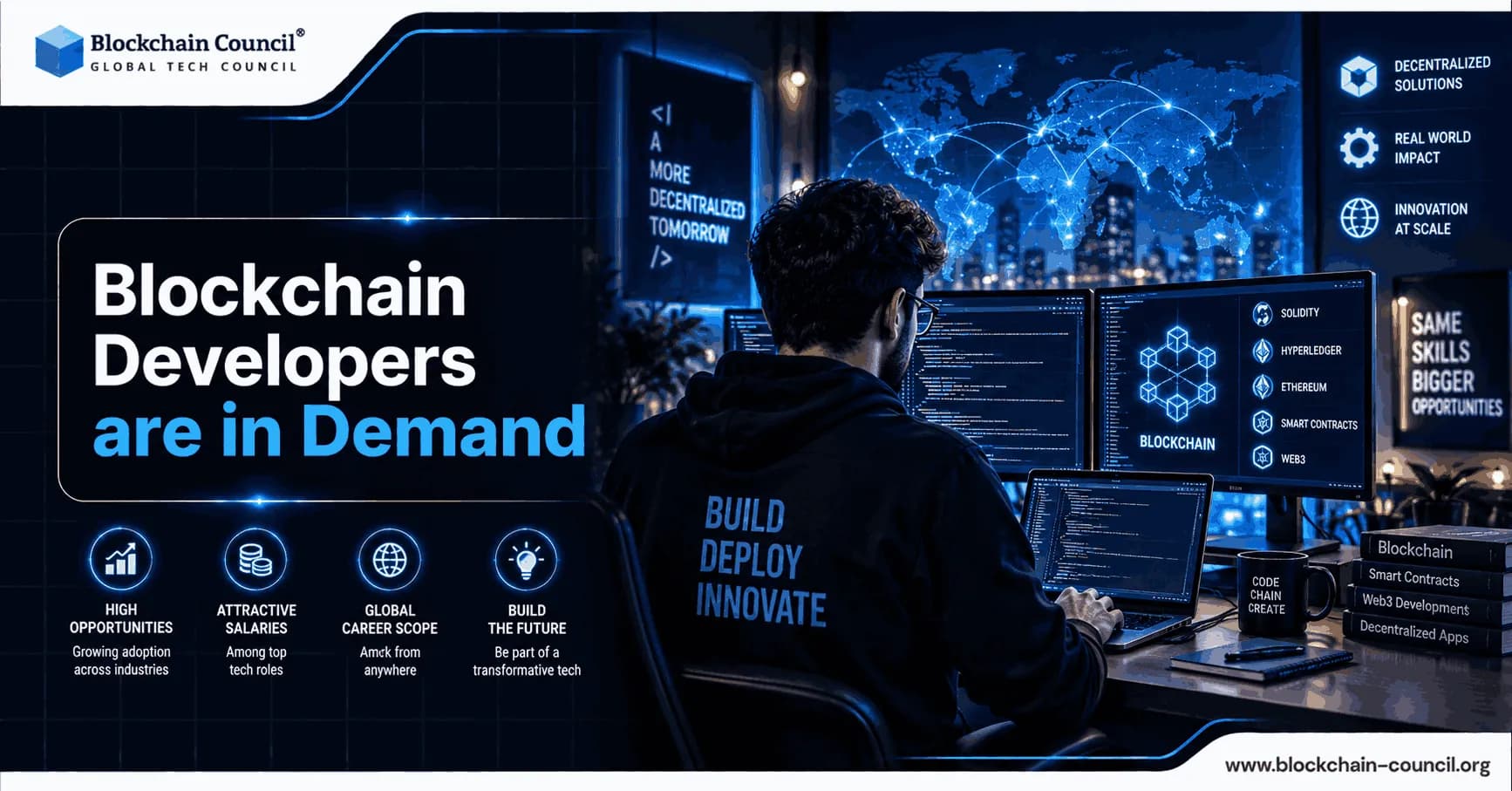
Blockchain developers remain one of the hardest technical roles to hire for, even as the broader tech job market has cooled in other areas. Companies building tokenized assets, supply chain platforms, decentralized finance products, and enterprise ledger systems are competing for a relatively small pool of developers who actually understand how to build secure, production-ready blockchain applications. If you are considering this career path, the good news is that the skills gap works in your favor, provided you learn the right things in the right order. A structured starting point many aspiring developers rely on is the Certified Blockchain Developer program from Blockchain Council, which is built specifically to take someone from foundational concepts to job-ready smart contract development.
This article walks through why blockchain developers are in such high demand, the core skills you actually need, and a practical path for learning them without wasting months on scattered tutorials.

Why Blockchain Developers Are in High Demand
Growing Enterprise Adoption
Blockchain has moved well past its early association with speculative trading. Banks are piloting tokenized securities, logistics companies are tracking shipments on shared ledgers, and governments are testing digital currency infrastructure. Each of these projects needs developers who understand not just how to write code, but how distributed systems, cryptography, and consensus mechanisms actually work together. That combination of skills is rare, which keeps demand consistently ahead of supply.
A Persistent Talent Shortage
Most computer science programs still do not teach blockchain development as a core subject, which means the majority of developers entering this field are self-taught or trained through specialized programs rather than traditional degrees. This gap between industry demand and formal education supply is exactly why structured, industry-recognized training has become so valuable. Employers increasingly look for candidates who can prove their skills through a recognized credential rather than relying purely on a resume full of self-reported experience.
Core Skills Every Blockchain Developer Needs
Becoming a capable blockchain developer requires layering several distinct skill sets on top of general programming ability. Trying to learn everything at once, without a clear structure, is the most common reason self-taught developers stall out. This is where a comprehensive, well-sequenced program like the Certified Blockchain Expert credential from Blockchain Council becomes genuinely useful, since it organizes these skills into a logical learning path rather than leaving you to piece together fragmented tutorials on your own.
Programming Languages and Smart Contracts
Solidity remains the dominant language for Ethereum and EVM-compatible smart contracts, and it is usually the right starting point for new developers. Beyond Solidity, familiarity with Rust is increasingly valuable for developers targeting Solana and other high-performance chains, while Go is common in enterprise blockchain frameworks. Learning to write, test, and deploy a smart contract is the single most important practical skill in this field, since it is what most employers will actually ask you to demonstrate.
Understanding Consensus and Ledger Architecture
A developer who only knows how to write Solidity code but does not understand why a blockchain reaches consensus, how a block gets finalized, or the tradeoffs between public and permissioned ledgers will struggle in real enterprise settings. Employers building internal blockchain solutions specifically want developers who can explain these tradeoffs clearly, not just developers who can copy a smart contract template.
Security and Testing Practices
Smart contract bugs have led to some of the largest financial losses in blockchain history, which is exactly why security-focused skills carry outsized value in this field. Learning common vulnerability patterns, writing thorough test suites, and understanding how to audit a contract before deployment separates a junior developer from someone employers trust with production systems handling real money.
Blockchain developers need a strong understanding of smart contracts, distributed systems, consensus mechanisms, and secure application development. For employers building blockchain teams, evaluating these capabilities through relevant assessments can support better recruitment decisions. HireValid's candidate assessment platform is worth exploring for organisations looking to strengthen their technical hiring process.
How to Learn Blockchain Development Step by Step
Start With the Fundamentals
Before touching code, make sure you understand how blockchains actually work at a conceptual level, including how transactions get validated, what a hash function does, and how public and private keys control ownership. Skipping this step and jumping straight into Solidity tutorials tends to produce developers who can copy code but cannot debug it when something breaks.
Build Real Projects
Tutorials only get you so far. Deploy a basic token contract on a testnet, build a simple decentralized application with a wallet connection, and try breaking your own smart contract to understand common vulnerabilities firsthand. Employers and clients consistently value a portfolio of real, working projects over a list of completed video courses.
Choose Structured Certification Over Random Tutorials
Piecing together free YouTube tutorials can teach you syntax, but it rarely teaches you how the pieces fit together into a coherent, job-ready skill set. This is exactly the gap Blockchain Council's certification programs are designed to close, combining structured lessons, hands-on projects, and an industry-recognized credential that signals to employers you have covered the material thoroughly rather than learning in scattered fragments. Beyond the blockchain-specific skills, rounding out your profile with a general Tech Certification can also help, since most real-world blockchain roles still require solid fundamentals in areas like cloud infrastructure, API design, and general software engineering practices.
Future-Ready Skills
As technology becomes increasingly important across industries, students need opportunities to develop future-ready skills early in their education. A World Tech Olympiad can introduce students to areas such as artificial intelligence, coding, cybersecurity, robotics, and computational thinking while encouraging curiosity and continuous learning. Many of the developers now building smart contracts and blockchain infrastructure got their first taste of structured problem solving through exactly this kind of early technology exposure, long before they ever wrote a line of Solidity.
Turning Your Skills Into a Blockchain Career
Learning the technical skills is only half the journey. Once you have a working portfolio and a recognized certification behind you, being able to explain your work clearly to non-technical hiring managers, clients, or investors becomes the next differentiator that separates developers who land strong offers from those who get overlooked. Many developers moving into freelance work, consulting, or leadership roles pair their technical training with a general Marketing Certification to strengthen how they present their skills, pitch projects, and build a personal brand within the blockchain space.
Blockchain developers are in demand precisely because the skill set is still rare and genuinely hard to learn without structure. Starting with Blockchain Council's certification programs gives you a clear, proven path through that complexity, so instead of guessing what to learn next, you can focus your time on becoming the kind of developer employers are actively searching for.
FAQs
1. Why are blockchain developers in demand?
Blockchain developers are needed to build decentralized applications, smart contracts, digital-asset infrastructure, enterprise blockchain systems, and other Web3 applications. Demand is driven by organizations exploring blockchain for financial services, tokenization, supply chains, digital identity, and automation.
2. What does a blockchain developer do?
A blockchain developer designs and builds applications that interact with blockchain networks. Depending on the role, they may write smart contracts, develop decentralized applications, integrate wallets and blockchain APIs, build blockchain infrastructure, or create enterprise solutions using platforms such as Ethereum and Hyperledger Fabric.
3. What skills are needed to become a blockchain developer?
Important skills include programming fundamentals, data structures, APIs, databases, cryptography basics, blockchain architecture, smart contracts, security, and distributed systems. Developers working with Ethereum should also learn Solidity and understand how the Ethereum Virtual Machine works. Ethereum's current documentation identifies Solidity and Vyper as its two most active smart-contract languages.
4. Which programming language should beginners learn for blockchain development?
Solidity is a strong starting point for developers interested in Ethereum-based smart contracts. JavaScript or TypeScript is also valuable for building applications that interact with smart contracts. Python can be useful for scripting, automation, testing, and blockchain-related backend development.
5. Is Solidity difficult to learn?
Solidity has a syntax that will feel familiar to people who have worked with languages such as JavaScript, C++, or similar curly-bracket languages. Beginners should first understand programming fundamentals and blockchain concepts before moving into advanced Solidity and smart-contract security.
6. What should I learn before Solidity?
Start with basic programming concepts such as variables, functions, loops, conditional statements, data structures, object-oriented programming, and debugging. Learning JavaScript or another programming language first can make Solidity easier to understand. Ethereum also recommends understanding accounts, transactions, and the Ethereum Virtual Machine before going deeply into smart contracts.
7. What is a smart contract?
A smart contract is a program deployed on a blockchain that contains code and data and executes according to predefined rules. On Ethereum, smart contracts can receive transactions, change blockchain state, and interact with other contracts.
8. What blockchain development tools should beginners learn?
Beginners can start with Remix, a browser-based development environment for writing and testing Solidity contracts. As they progress, they can learn development frameworks such as Hardhat or Foundry, along with blockchain libraries for application integration. Ethereum's developer resources provide tutorials covering smart contracts, Solidity, frontend development, testing, and other blockchain topics.
9. How can I practice blockchain development?
The best approach is to build small projects instead of only watching tutorials. Start with a simple storage contract, token, voting application, NFT project, or decentralized application, then gradually add wallet integration, testing, security controls, and a frontend.
10. What projects should a beginner blockchain developer build?
Good beginner projects include a token contract, decentralized voting application, crowdfunding platform, NFT collection, certificate-verification system, or simple payment application. These projects demonstrate different skills such as smart-contract development, transaction handling, wallet integration, and frontend interaction.
11. Do blockchain developers need to understand cryptography?
Yes, but beginners do not need to become cryptographers. Developers should understand concepts such as hashing, digital signatures, public and private keys, encryption, wallets, and Merkle trees. This knowledge helps developers understand how blockchain networks provide integrity, authentication, and security.
12. How important is blockchain security for developers?
Security is extremely important because smart contracts can control valuable digital assets and may be difficult to modify after deployment. Developers should learn common vulnerabilities, testing techniques, access control, secure key management, and auditing practices. Ethereum's security guidance recommends monitoring deployed contracts and protecting privileged accounts and keys.
13. Should blockchain developers learn Web3 libraries?
Yes. After learning smart contracts, developers should learn how applications communicate with blockchain networks. JavaScript or TypeScript libraries can be used to read contract data, submit transactions, connect wallets, and interact with contract ABIs.
14. What is the role of APIs in blockchain development?
APIs allow blockchain applications to communicate with networks, wallets, smart contracts, and external services. Developers may use blockchain RPC endpoints and application libraries to retrieve on-chain information or submit transactions from websites, mobile applications, and backend systems.
15. Should blockchain developers learn Ethereum?
Ethereum is a useful ecosystem to learn because it provides a mature smart-contract environment and extensive developer resources. Learning Ethereum also introduces developers to important concepts such as the EVM, accounts, transactions, gas, smart contracts, tokens, decentralized applications, and blockchain composability.
16. Do blockchain developers need to learn Hyperledger Fabric?
Not necessarily, but Hyperledger Fabric is valuable for developers interested in enterprise blockchain. Fabric uses smart contracts and chaincode to implement business logic and supports permissioned networks designed for organizations and known participants. Its official documentation provides developer tutorials for applications and chaincode.
17. What is a good blockchain developer learning path?
A practical learning path is:
Programming fundamentals → blockchain basics → cryptography fundamentals → Ethereum/EVM → Solidity → smart contracts → Remix → Hardhat or Foundry → Web3 libraries → dApp development → testing and security → real-world projects.
Developers interested in enterprise blockchain can then add Hyperledger Fabric, chaincode, permissioned networks, and enterprise integration.
18. Can someone become a blockchain developer without a computer science degree?
Yes. A computer science degree can provide useful foundations, but it is not the only route into blockchain development. Strong programming skills, blockchain knowledge, security awareness, practical projects, and a demonstrable portfolio can be more important for proving technical ability.
19. How can I build a blockchain developer portfolio?
Create several complete projects and publish the source code on GitHub with clear documentation. A strong portfolio should show your smart contracts, tests, frontend or backend integration, deployment information, security considerations, and an explanation of the problem each project solves.
20. How long does it take to learn blockchain development?
The timeline depends on your existing programming knowledge and how much time you dedicate to learning. Someone who already knows JavaScript or Python can usually progress faster, while a complete beginner should first build programming fundamentals. Consistently building projects is generally more valuable than trying to learn every blockchain technology at once.
Related Articles
View All
Blockchain
Blockchain Product Manager Skills Checklist for Beginners and Professionals
A practical blockchain product manager skills checklist covering product strategy, blockchain basics, tokenomics, security, compliance, analytics, and leadership.

Blockchain
Non-Technical Skills for Blockchain Product Managers: Communication, Strategy, and Leadership
Learn the key non-technical skills blockchain product managers need, including communication, strategy, leadership, community work, and risk management.
Blockchain
Technical Skills for Blockchain Product Managers
Learn the technical skills blockchain product managers need across smart contracts, wallets, and Web3 architecture to ship safer products.
Trending Articles
The Role of Blockchain in Ethical AI Development
How blockchain technology is being used to promote transparency and accountability in artificial intelligence systems.
How Blockchain Secures AI Data
Understand how blockchain technology is being applied to protect the integrity and security of AI training data.
Claude AI Tools for Productivity
Discover Claude AI tools for productivity to streamline tasks, manage workflows, and improve efficiency.