

How is Blockchain verifiable by public and yet anonymous?
 Toshendra Kumar Sharma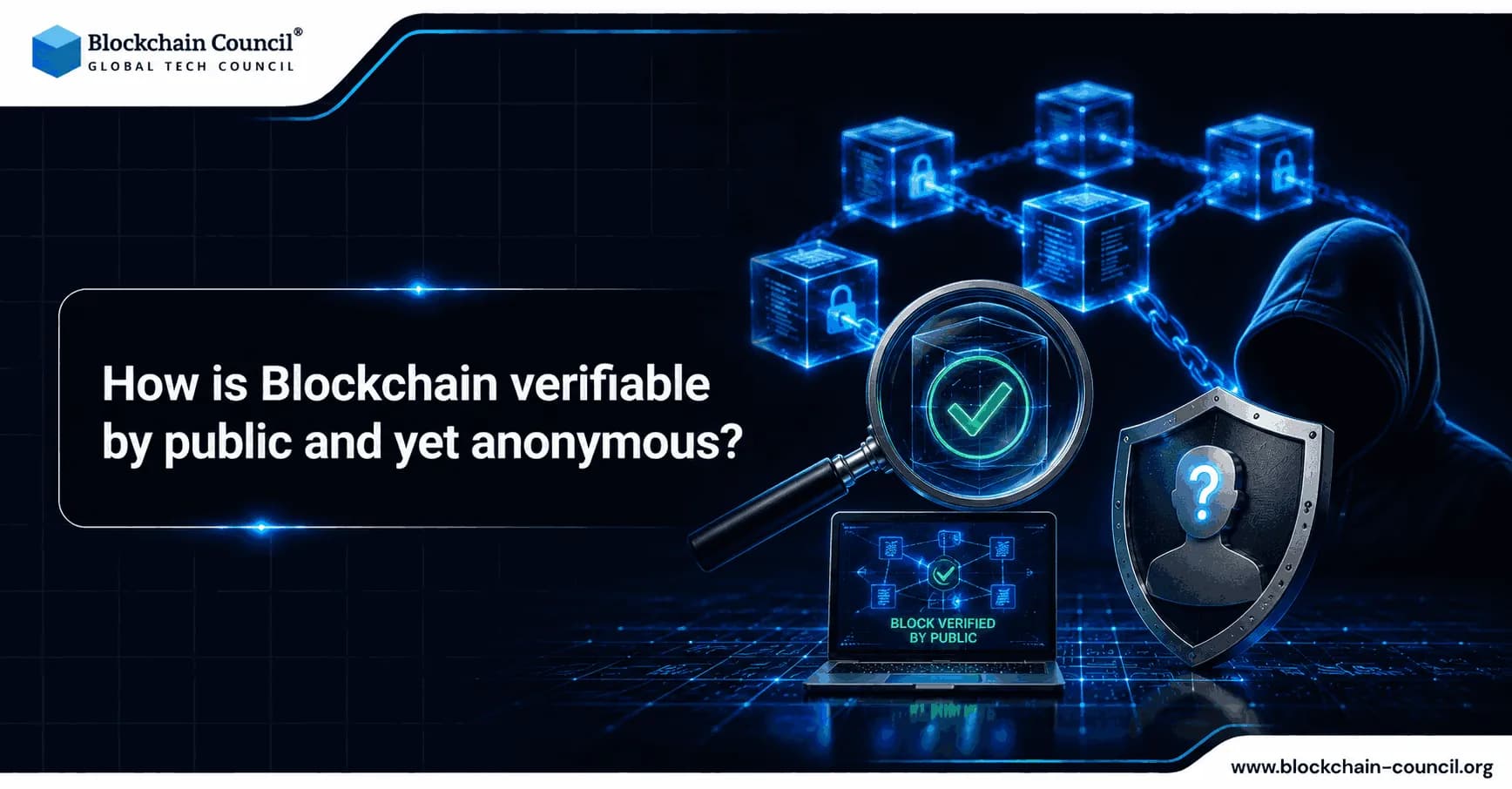
Blockchain gets described with two properties that sound like they should contradict each other, complete public transparency and genuine anonymity for the people actually using it. Anyone can open a block explorer and see every Bitcoin transaction ever made, down to the exact amount and timestamp, yet nothing in that record directly reveals who sent or received the funds. This is not a contradiction at all once you understand what blockchain actually makes public and what it deliberately keeps hidden. As more people try to understand this genuinely elegant design, many are pursuing a Certified Blockchain Expert credential to fully grasp how transparency and anonymity coexist within the same system rather than treating one as an exception to the other.
In this article, we will explain exactly what blockchain makes publicly verifiable, what it keeps private, and the cryptographic mechanisms that allow both properties to exist together within the same transparent, decentralized ledger.

What "Public" Actually Means on a Blockchain
When people say a blockchain is public, they mean the ledger itself, the complete, permanent record of every transaction ever processed, is open for anyone to view, download, and independently verify. Every transaction, its amount, its timestamp, and the wallet addresses involved, sits permanently recorded on the chain, accessible through free tools called block explorers that let anyone search this history in real time.
This transparency exists specifically to solve blockchain's core trust problem. Since there is no central authority vouching for the accuracy of the ledger, the system instead relies on making the entire record visible and independently checkable by anyone who wants to verify it themselves. Every network participant can confirm the total supply of a cryptocurrency, trace how funds moved between addresses, and verify that no one has secretly created coins out of thin air, all without needing to trust a bank or company's internal records.
What "Anonymous" Actually Means on a Blockchain
Here is where the apparent contradiction resolves itself. What blockchain makes public is the transaction data, not the real world identity behind it. A wallet address is simply a long string of letters and numbers generated through cryptography, and nothing about that string inherently reveals who owns it. This distinction is technically referred to as pseudonymity rather than true anonymity, since the address itself functions like a consistent alias rather than a name, but that alias carries no built in connection to a real person's identity.
Understanding exactly how this pseudonymous system gets built, and how it manages to remain both verifiable and privacy preserving at the same time, requires real cryptographic and technical depth. This is why developers and analysts working closely with blockchain privacy mechanisms increasingly pursue a formal Tech Certification to build the specialized knowledge needed to actually understand the mathematics making this dual property possible, rather than relying on a surface level description of the concept.
The Cryptographic Mechanisms Making This Possible
1. Public and Private Key Pairs
Every blockchain wallet is built on a pair of cryptographic keys, a public key that generates the visible wallet address anyone can see on the ledger, and a private key that only the owner holds and that proves control over that address. The public key can be freely shared and verified by anyone, while the private key never needs to be revealed to prove ownership or authorize a transaction, keeping the actual controller of the address genuinely hidden.
2. Digital Signatures Without Identity Disclosure
When someone sends a transaction, they sign it using their private key, producing a digital signature that the entire network can verify as authentic using the corresponding public key, without that verification process ever requiring the sender to reveal who they actually are. This lets the network confirm a transaction is legitimate and properly authorized while keeping the real world identity behind that authorization completely separate from the verification process itself.
3. Address Generation Without Personal Data
Wallet addresses are generated purely through mathematical functions applied to a private key, with no requirement to submit a name, email, or any personal information to create one. Anyone can generate a new blockchain wallet address in seconds, entirely disconnected from any centralized registry that links that address back to a real identity.
4. Pseudonymity, Not True Anonymity
It is worth being precise about the actual privacy level involved. Blockchain transactions are pseudonymous rather than fully anonymous, meaning that while an address itself does not reveal identity, patterns of activity, exchange account linkages, or IP address data can sometimes allow sophisticated analysis to connect a wallet address back to a real person. This is exactly how law enforcement and blockchain analytics firms have successfully traced illicit activity in various cases, despite the underlying pseudonymous design.
Why This Combination Genuinely Matters
This balance of transparency and pseudonymity solves two problems simultaneously that most financial systems struggle to address together. Public verifiability means no one has to trust a central authority's claims about the ledger's accuracy, since anyone can independently check it themselves. Pseudonymity means individuals are not forced to expose their entire financial history and personal identity simply to participate in the network, preserving a meaningful degree of privacy that traditional, fully identified banking systems do not offer by default.
Final Thoughts
Blockchain's ability to be both publicly verifiable and pseudonymously private comes down to a precise, deliberate separation, making transaction data completely open while keeping the cryptographic keys that prove ownership entirely private. Public and private key cryptography, digital signatures, and identity free address generation work together to let anyone verify the ledger's integrity without anyone being forced to reveal who they actually are behind a given transaction.
As more people encounter this dual property directly, whether through cryptocurrency, digital identity systems, or blockchain based applications, clearly explaining how transparency and privacy genuinely coexist becomes essential, especially since the distinction between pseudonymity and true anonymity is so often misunderstood or oversimplified. That is why professionals working on blockchain education and consumer facing crypto products increasingly pair their technical explanations with a Marketing Certification to communicate this nuance clearly, helping people understand exactly what blockchain protects and what it does not.
Blockchain is not publicly transparent despite being private, and it is not private despite being publicly transparent. It was deliberately engineered to be both at once, and understanding exactly how that engineering works is the key to understanding blockchain itself.
FAQs
1. How can blockchain be publicly verifiable yet anonymous?
A public blockchain can be verified by anyone because transactions, wallet addresses, timestamps, and other ledger information are available for participants to inspect. However, addresses usually appear as cryptographic identifiers rather than real names. This creates pseudonymity rather than complete anonymity. Anyone may see that one address transferred assets to another, but the blockchain itself may not reveal who legally controls either address.
2. Is blockchain really anonymous?
Most public blockchains are not completely anonymous. Bitcoin and Ethereum, for example, maintain transparent transaction histories that can be inspected by anyone. Users interact through blockchain addresses rather than directly through names, which provides pseudonymity. If an address becomes connected with a real person's identity, investigators or analysts may be able to examine that address's historical activity.
3. What does pseudonymous mean in blockchain?
Pseudonymous means a person interacts using an identifier that does not automatically reveal their real-world identity. On blockchain networks, that identifier is usually a wallet address. A user can create multiple addresses without placing a legal name directly on the blockchain. However, transaction patterns, exchange records, public disclosures, or other information can sometimes connect those addresses with a real individual.
4. How does the public verify blockchain transactions?
Public blockchains distribute transaction information across a network of computers called nodes. Nodes independently apply the protocol's rules to determine whether transactions and blocks are valid. Users can also inspect blockchain information using block explorers. Verification therefore does not depend entirely on trusting one company to maintain the official transaction database.
5. What information is publicly visible on a blockchain?
Depending on the blockchain, publicly visible information can include wallet addresses, transaction amounts, timestamps, transaction fees, smart-contract interactions, token transfers, and block information. Some networks expose extensive application activity as well. Personal details such as names, home addresses, passwords, and identification documents are not normally included automatically unless someone deliberately places such information on-chain.
6. How does a blockchain verify transactions without knowing someone's identity?
Blockchain networks primarily verify whether a transaction satisfies cryptographic and protocol rules rather than whether the sender is a particular legally identified person. A digital signature proves that the transaction was authorized using the private key associated with an address. The network can verify that signature mathematically without learning the owner's name, passport number, or other identity information.
7. What is the role of public and private keys in blockchain privacy?
A blockchain wallet uses cryptographic keys. A private key allows its holder to authorize transactions, while public-key information helps the network verify those transactions. Wallet addresses are derived through cryptographic processes and can be shared publicly. The private key must remain secret because anyone who obtains it may be able to control the associated assets. Cryptography therefore proves authorization without requiring public disclosure of the user's identity.
8. Can anyone see my Bitcoin transactions?
If someone knows your Bitcoin address, they can generally examine transactions involving that address through the public blockchain. They may see balances and transaction relationships depending on how funds have moved. What they do not automatically receive is your legal identity. If the address is linked to you through an exchange account, public payment request, donation page, or other source, however, the privacy situation changes substantially.
9. Can Bitcoin transactions be traced to a person?
Bitcoin transactions can sometimes be traced to individuals when blockchain information is combined with off-chain data. Cryptocurrency exchanges may hold KYC records connecting customers with wallet addresses. Investigators can also analyze transaction patterns, seized devices, financial records, IP-related evidence, or public disclosures. Bitcoin's transparent ledger can therefore make historical transaction analysis surprisingly powerful once an address is identified.
10. How do blockchain analytics companies trace cryptocurrency?
Blockchain analytics companies analyze transaction relationships, wallet clusters, smart-contract interactions, exchange addresses, bridges, and other on-chain activity. They may combine public blockchain information with known addresses and legally obtained off-chain information. This can help exchanges, financial institutions, and law-enforcement agencies investigate fraud, theft, ransomware, sanctions evasion, and money laundering.
11. Does using a new wallet address make someone completely anonymous?
No. Using different addresses can improve privacy in some circumstances, but transaction analysis may still reveal relationships between them. Moving funds between addresses, interacting with identifiable services, or consolidating assets can create patterns that analysts can study. Privacy therefore depends on much more than whether a person's name appears directly beside an address.
12. How do cryptocurrency exchanges reduce blockchain anonymity?
Centralized exchanges commonly collect identity information under Know Your Customer and anti-money-laundering requirements. When users deposit or withdraw cryptocurrency, the exchange can potentially associate particular addresses with verified customer accounts. If authorities legally obtain those records, blockchain transactions can sometimes be connected with real-world identities. This is one of the major differences between pseudonymity at the protocol level and privacy in practical cryptocurrency use.
13. Are privacy coins more anonymous than Bitcoin?
Some cryptocurrencies are specifically designed to provide stronger transaction privacy than transparent blockchains such as Bitcoin. They may conceal transaction amounts, participants, or transaction relationships using advanced cryptographic techniques. Privacy-focused cryptocurrencies can therefore provide stronger anonymity properties, although their regulatory treatment and exchange availability vary considerably between jurisdictions.
14. What are Zero-Knowledge Proofs and how do they improve blockchain privacy?
Zero-Knowledge Proofs allow someone to prove that a statement is true without revealing all the information used to prove it. For example, a user could potentially prove that they satisfy an eligibility requirement without disclosing their complete identity. In blockchain systems, Zero-Knowledge technology can support private transactions, identity verification, compliance, and scalability while reducing unnecessary exposure of sensitive information.
15. Can blockchain verify identity without revealing personal information?
Yes. Blockchain can work with Verifiable Credentials and Zero-Knowledge Proofs to support selective disclosure. A trusted organization could issue a digital credential, and the holder could prove a particular fact about themselves without exposing the complete credential. This approach can be useful for age verification, financial compliance, professional qualifications, and other applications where verification is necessary but excessive data collection is undesirable.
16. Why is blockchain transparency useful?
Transparency allows participants to independently verify transaction histories, token supplies, smart-contract activity, and other network information. This can reduce dependence on a central institution's private database. In financial applications, transparent ledgers can improve auditability and make certain forms of manipulation easier to detect. Transparency is powerful, but it also creates privacy challenges when transaction activity can be associated with identifiable individuals.
17. Can public blockchain transparency become a privacy problem?
Yes. Once an address is linked to a person or company, observers may be able to examine years of associated activity. Unlike conventional bank accounts, where transaction histories are generally private, transparent blockchains can expose financial relationships publicly. Privacy-enhancing technologies, address-management practices, and off-chain systems are therefore becoming increasingly important as blockchain is used in mainstream financial applications.
18. How can businesses use blockchain without exposing confidential transactions?
Businesses can use permissioned blockchains, encrypted off-chain databases, privacy-preserving smart contracts, and Zero-Knowledge Proofs to limit what information becomes publicly visible. A company may use blockchain to prove that a transaction or compliance requirement is valid without revealing commercially sensitive details. Enterprise blockchain systems therefore do not necessarily operate with the same radical transparency as public cryptocurrency networks.
19. What is the difference between blockchain privacy and traditional banking privacy?
Traditional banks generally know their customers' identities but keep transaction records within private financial systems accessible only to authorized parties. Public blockchains reverse part of this model: transaction records may be publicly visible while the identities behind wallet addresses are not automatically disclosed. This creates a peculiar arrangement in which the ledger knows what happened but not necessarily which human was responsible. Cryptography apparently appreciates bureaucracy less than banks do.
20. How does blockchain balance transparency, verification and anonymity?
Blockchain achieves this balance by separating transaction verification from real-world identity.
A public blockchain does not necessarily need to know that a wallet belongs to a person named John, Priya, Maria, or Ahmed. It needs to verify that the transaction has a valid digital signature, follows network rules, and does not attempt to spend assets improperly.
The transaction can then become part of a public ledger that anyone can independently inspect.
This produces three separate properties.
Verification comes from cryptography, consensus rules, and independent network validation.
Transparency comes from making blockchain records available for public inspection.
Pseudonymity comes from representing users through cryptographic addresses rather than automatically publishing their legal identities.
The important word is pseudonymity, not anonymity.
Once a wallet address is linked with a real person through an exchange, merchant, public profile, investigation, or other source, its public transaction history may reveal considerably more information than the user expected.
Future blockchain systems are therefore increasingly exploring technologies such as Zero-Knowledge Proofs and Verifiable Credentials. These can allow users to prove that a transaction or identity claim is valid without exposing unnecessary underlying information.
The clever part of blockchain is not that everyone is invisible. It is that mathematics can verify certain actions without first requiring everyone to introduce themselves.
Unfortunately for anyone planning crimes on a transparent ledger, mathematics also has an excellent memory.
Related Articles
View All
Blockchain
Beyond Cryptocurrency: How Blockchain Is Transforming Real-World Industries
Explore how blockchain works beyond cryptocurrency in banking, supply chains, healthcare, tokenisation, CBDCs, and government, plus key challenges and career paths.

Blockchain
Smart Contracts & dApps: How Blockchain Becomes Programmable
Learn how smart contracts and dApps make blockchain programmable, from Ethereum and tokens to DeFi, NFTs, real use cases, benefits, and key risks.

Blockchain
Public, Private & Consortium Blockchains: Which Network Fits the Use Case?
Compare public, private, and consortium blockchains by security, speed, privacy, and control, with real examples and a simple guide to choosing the right network.
Trending Articles
The Role of Blockchain in Ethical AI Development
How blockchain technology is being used to promote transparency and accountability in artificial intelligence systems.
What is AWS? A Beginner's Guide to Cloud Computing
Everything you need to know about Amazon Web Services, cloud computing fundamentals, and career opportunities.
Claude AI Tools for Productivity
Discover Claude AI tools for productivity to streamline tasks, manage workflows, and improve efficiency.