

How can Blockchain reduce corruption?
 Toshendra Kumar Sharma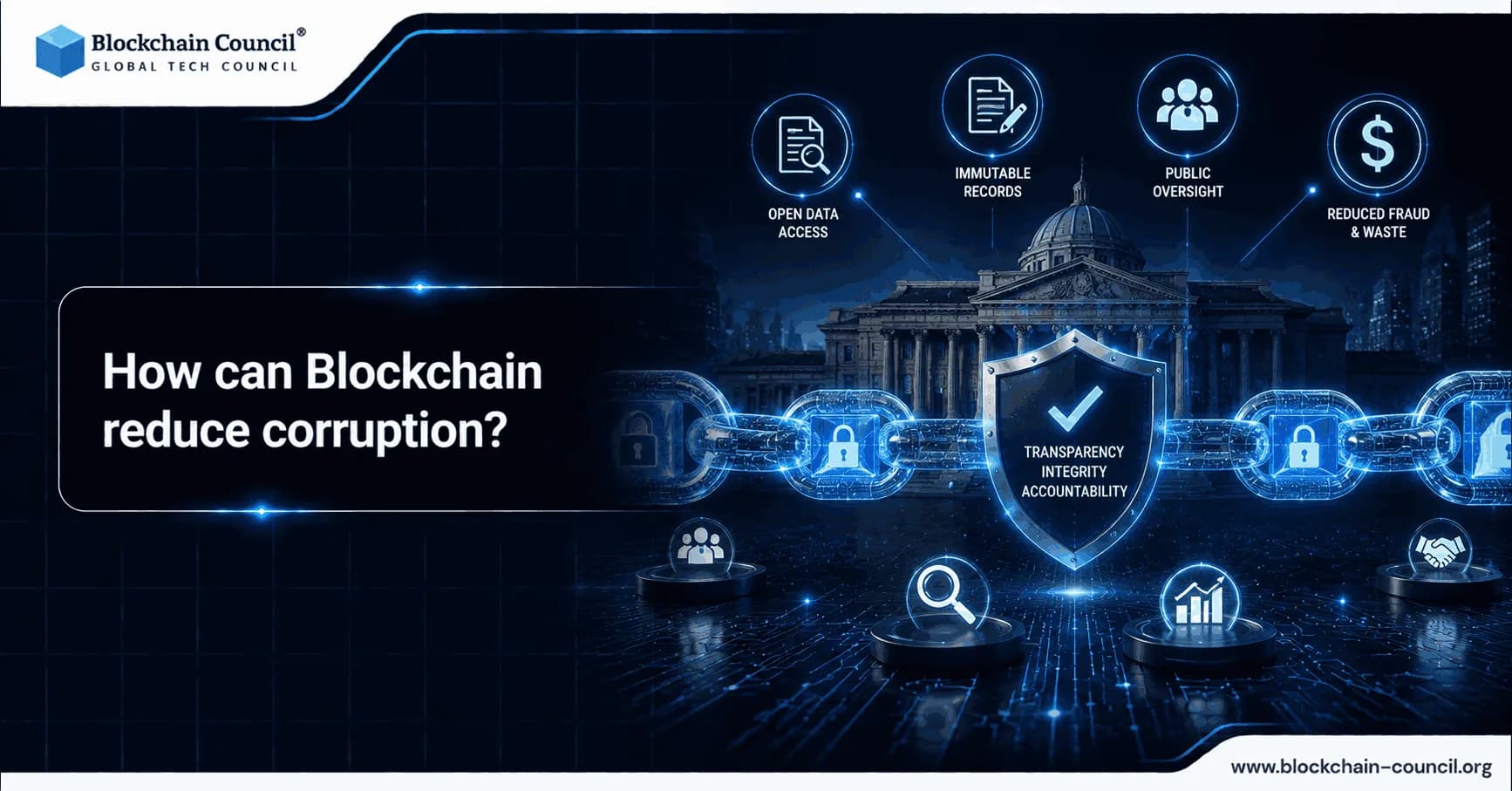
Corruption isn't just a moral failure it's an economic drag. The United Nations has flagged it as a direct threat to peace, justice, and strong institutions under Sustainable Development Goal 16, and its costs ripple through public trust, infrastructure quality, and economic growth in every country where it takes root. Traditional anti-corruption tools audits, whistleblower hotlines, oversight committees often struggle because the records they rely on can still be altered, hidden, or selectively disclosed by the very people being investigated. Blockchain approaches the problem differently: instead of policing bad behavior after the fact, it removes the opportunity to hide it in the first place.
Understanding exactly how that works requires more than a surface-level grasp of "decentralization." Public-sector teams and policy technologists building these systems often start with a recognized Certified Blockchain Expert credential to understand the mechanics before applying them to something as high-stakes as government accountability.

Why Blockchain Is Structurally Suited to Fighting Corruption
Corruption thrives in environments with opaque processes, weak enforcement, and records that can be quietly altered after the fact. Blockchain's core properties directly counter each of those conditions:
Immutability Once a transaction or record is added to the chain, it can't be edited or deleted, removing the ability to retroactively cover up a bribe, a falsified contract, or a missing shipment.
Traceability Every transaction leaves a permanent, timestamped audit trail, so investigators (or the public) can trace exactly where funds or decisions moved, and when.
Decentralization No single official or department holds unilateral control over the record, which removes the single point of failure that corrupt actors typically exploit.
Automated accountability Smart contracts can enforce rules programmatically, releasing funds or approvals only when pre-defined, verifiable conditions are actually met no discretion, no "special exceptions."
Together, these properties don't just make corruption harder to commit they make it dramatically harder to hide, which changes the incentive calculus for anyone considering it.
Because these systems often carry sensitive government or financial data, they also become high-value targets for attackers, not just corrupt insiders. That's why teams designing anti-corruption blockchain infrastructure increasingly pair blockchain fundamentals with a Certified Blockchain Security Professional credential, ensuring the systems meant to prevent fraud aren't themselves vulnerable to it.
Real-World Applications Where Blockchain Is Already Reducing Corruption
Public procurement Government procurement is one of the most corruption-prone processes anywhere in the world, historically plagued by rigged bids, inflated invoices, and vendor collusion. Blockchain-based procurement systems record every stage of a tender bid submission, evaluation, award, and payment on a shared ledger that all relevant parties can view and verify, making it far harder to quietly favor a connected vendor or alter terms after the fact. Research into these systems suggests hybrid blockchain models, blending permissioned oversight with permissionless transparency, currently offer the best balance between accountability and practical scalability for procurement use cases.
Land and property registries Falsified land titles and duplicate property records are a major corruption vector in many countries, often used to extract bribes or seize property through fraudulent paperwork. Blockchain-based land registries create a single, tamper-evident record of ownership that can be verified instantly, cutting out the opportunity for officials to manipulate records for personal gain.
Public spending and budget tracking When government spending records live on a shared, immutable ledger, every allocation and disbursement becomes visible and auditable by design. This is a genuinely different model from traditional government accounting, where spending records can be quietly adjusted long after funds have already moved.
Digital identity and welfare distribution Corruption in social welfare programs often involves ghost beneficiaries or duplicated claims draining public funds. Blockchain-based digital identity systems tie benefits to a single, verifiable identity record, making it far harder to claim the same benefit multiple times or divert funds meant for real recipients.
Elections and voting integrity Several governments are actively exploring blockchain-based voting systems, where each citizen's vote is recorded on a public, immutable ledger. These systems are designed to let citizens verify their own vote was counted correctly while keeping the vote itself private and auditable, addressing two of the biggest trust gaps in traditional voting infrastructure.
Whistleblower protection Blockchain-based reporting systems can allow whistleblowers to submit evidence in a way that's cryptographically timestamped and tamper-proof, giving them a verifiable record that can't be altered or "lost" by anyone trying to suppress the report.
Recent academic research examining blockchain deployments across the UAE, Estonia, Georgia, Colombia, and several Gulf Cooperation Council nations found the technology delivering real gains in land administration, digital identity, procurement, and intergovernmental payments with benefits most pronounced where blockchain implementation aligned with genuine governance needs rather than being adopted as a superficial technology upgrade.
Building systems robust enough to handle national-scale government data requires serious engineering discipline not just conceptual understanding of blockchain's benefits. That's the gap a structured Tech Certification in blockchain development is built to close, giving technical teams the hands-on skills needed to build public-sector systems that can actually withstand scrutiny, scale, and adversarial pressure.
Blockchain Isn't a Silver Bullet Here's Why
It's important to be honest about the limits of this technology. Blockchain reduces the opportunity for certain kinds of corruption, but it doesn't eliminate corruption as a human problem:
It can't stop bribery or collusion that happens off-chain. If two parties agree to a kickback in cash or through a side channel outside the recorded system, blockchain has no visibility into that transaction at all.
Garbage in, garbage out. If the data entered onto the blockchain is falsified at the point of entry a fake invoice, an inflated quantity the blockchain will faithfully and permanently record that falsified information. Blockchain guarantees the integrity of the record, not the honesty of the person creating it.
Adoption requires real institutional will. A government that isn't genuinely committed to transparency can simply choose not to adopt these systems, or adopt them only partially, in ways that leave the most corruption-prone processes untouched.
Civic and multistakeholder engagement matters. Research consistently shows that blockchain-based transparency initiatives achieve real impact only when paired with active monitoring from civil society, watchdog groups, and the public not when deployed as a purely technical fix.
The technology is a powerful structural tool, but it works best as part of a broader anti-corruption strategy that includes policy reform, independent oversight, and genuine political commitment.
Final Thoughts
Blockchain won't end corruption on its own, but it fundamentally changes the terrain corrupt actors have to operate on. By making records immutable, transactions traceable, and rule enforcement automatic rather than discretionary, it closes off many of the quiet manipulations that traditional oversight systems have always struggled to catch. The governments and institutions seeing real results aren't just deploying the technology they're pairing it with genuine transparency commitments and active public oversight.
For that shift to actually take hold, the public also needs to understand and trust these systems, not just the engineers who build them. That's where a well-rounded Marketing Certification plays a real role for governments and civic organizations rolling out blockchain-based transparency initiatives helping translate a fairly technical accountability system into something citizens can understand, trust, and actively engage with.
FAQs
1. How can blockchain help reduce corruption?
Blockchain can help reduce corruption by creating transparent, tamper-evident records of transactions and processes. It improves accountability, enhances auditability, automates workflows through smart contracts, and makes it more difficult to alter records without detection. While blockchain can reduce opportunities for certain types of fraud, it is not a complete solution to corruption.
2. Why is blockchain considered useful for anti-corruption efforts?
Many forms of corruption involve hidden transactions, manipulated records, or limited transparency. Blockchain provides a shared ledger where authorized participants can verify records, making financial and administrative processes more transparent and easier to audit.
3. How does blockchain improve transparency?
Blockchain records transactions in chronological order on a distributed ledger. Once verified, records become extremely difficult to modify, allowing stakeholders to review transaction histories and identify irregularities more easily.
4. Can blockchain prevent fraud?
Blockchain can help reduce some types of fraud by providing secure transaction records, digital signatures, and immutable audit trails. However, it cannot prevent fraud that occurs before inaccurate or false information is entered into the system. The quality of the input data remains critical.
5. How do smart contracts reduce corruption?
Smart contracts automatically execute predefined rules without requiring manual intervention. They can automate procurement, payments, licensing, grants, and compliance processes, reducing opportunities for unauthorized manipulation or discretionary decision-making.
6. How can blockchain improve government procurement?
Blockchain can record procurement activities such as tender announcements, bid submissions, contract awards, payments, and project milestones. This creates a transparent record that can improve oversight and reduce opportunities for procurement fraud.
7. Can blockchain improve public spending transparency?
Yes. Governments can use blockchain to track public funds from budget allocation through expenditure. Citizens, auditors, and oversight agencies may be able to verify how funds are distributed and spent, depending on the system's design and privacy requirements.
8. How does blockchain improve land registry systems?
Blockchain can securely record property ownership, title transfers, and transaction histories, reducing disputes, document forgery, and unauthorized changes to land records while simplifying property verification.
9. Can blockchain improve voting systems?
Blockchain has been explored for digital voting because it can create verifiable and tamper-evident vote records. However, secure electronic voting also requires strong identity verification, voter privacy, accessibility, and legal safeguards, so blockchain alone is not sufficient.
10. How does blockchain improve identity verification?
Blockchain-based decentralized identity (DID) systems allow individuals to manage verified digital credentials while reducing document fraud and improving authentication across public and private services.
11. Which industries can use blockchain to reduce corruption?
Blockchain has applications in government, healthcare, supply chain management, banking, insurance, education, public procurement, customs, taxation, charitable organizations, real estate, and international trade.
12. Which blockchain platforms are suitable for anti-corruption initiatives?
Commonly used blockchain platforms include Hyperledger Fabric, Ethereum, Polygon, Hedera, Corda, Quorum, Avalanche, and other enterprise or permissioned blockchain networks, depending on governance, privacy, and scalability requirements.
13. What are the advantages of blockchain for transparency?
Benefits include improved accountability, immutable audit trails, secure digital records, automated workflows, reduced document tampering, enhanced trust, faster verification, streamlined compliance, and better collaboration among participating organizations.
14. What challenges exist when implementing blockchain?
Challenges include implementation costs, integration with legacy systems, governance, privacy protection, data accuracy, scalability, interoperability, regulatory compliance, cybersecurity, and user adoption. Blockchain is only as reliable as the processes and data that support it.
15. Can blockchain eliminate corruption completely?
No. Blockchain is a tool that can reduce opportunities for certain types of corruption by improving transparency and accountability, but it cannot eliminate corruption on its own. Effective governance, independent oversight, law enforcement, ethical leadership, and accurate data remain essential.
16. What common mistakes should organizations avoid?
Common mistakes include assuming blockchain automatically guarantees honest data, storing sensitive personal information directly on public blockchains, neglecting cybersecurity, failing to audit smart contracts, overlooking legal requirements, and implementing blockchain without clearly defined governance and operational processes.
17. What are best practices for implementing blockchain in anti-corruption initiatives?
Best practices include storing sensitive information off-chain, recording only verification data on-chain where appropriate, conducting independent security audits, integrating decentralized identity (DID), ensuring regulatory compliance, establishing clear governance policies, validating incoming data, and training stakeholders on proper system use.
18. How does blockchain fit into digital government?
Blockchain complements artificial intelligence (AI), cloud computing, digital identity, electronic governance (e-Government), Internet of Things (IoT), data analytics, cybersecurity, and automation to improve public service delivery and administrative efficiency.
19. What trends are shaping blockchain transparency in 2025-2026?
Major trends include decentralized identity (DID), digital public infrastructure (DPI), zero-knowledge proofs (ZKPs), AI-assisted fraud detection, blockchain-based procurement systems, tokenization of public assets, digital land registries, ESG reporting, cross-border compliance systems, and increased enterprise blockchain adoption.
20. What is the future of blockchain in fighting corruption?
Blockchain is expected to become an increasingly valuable technology for improving transparency, accountability, and trust across both public and private sectors. Rather than replacing existing institutions, blockchain will likely integrate with digital government platforms, enterprise systems, and regulatory frameworks to strengthen oversight and reduce opportunities for misconduct. Its greatest value lies in creating verifiable records that are difficult to manipulate after the fact. Technology alone cannot create integrity, but it can make dishonest behavior considerably harder to hide, which is often an excellent place to begin.
Related Articles
View All
Blockchain
Beyond Cryptocurrency: How Blockchain Is Transforming Real-World Industries
Explore how blockchain works beyond cryptocurrency in banking, supply chains, healthcare, tokenisation, CBDCs, and government, plus key challenges and career paths.

Blockchain
Smart Contracts & dApps: How Blockchain Becomes Programmable
Learn how smart contracts and dApps make blockchain programmable, from Ethereum and tokens to DeFi, NFTs, real use cases, benefits, and key risks.

Blockchain
Behind the Blocks: How Blockchain Transactions Actually Work
Go behind the blocks to see how a blockchain transaction really works: wallets and keys, digital signatures, verification, hashing, blocks, consensus, proof of work vs proof of stake, and how miners and validators secure the network.
Trending Articles
The Role of Blockchain in Ethical AI Development
How blockchain technology is being used to promote transparency and accountability in artificial intelligence systems.
What is AWS? A Beginner's Guide to Cloud Computing
Everything you need to know about Amazon Web Services, cloud computing fundamentals, and career opportunities.

Can DeFi 2.0 Bridge the Gap Between Traditional and Decentralized Finance?
The next generation of DeFi protocols aims to connect traditional banking with decentralized finance ecosystems.