

How are Insurance Companies using Blockchain Technology for their benefits?
 Toshendra Kumar Sharma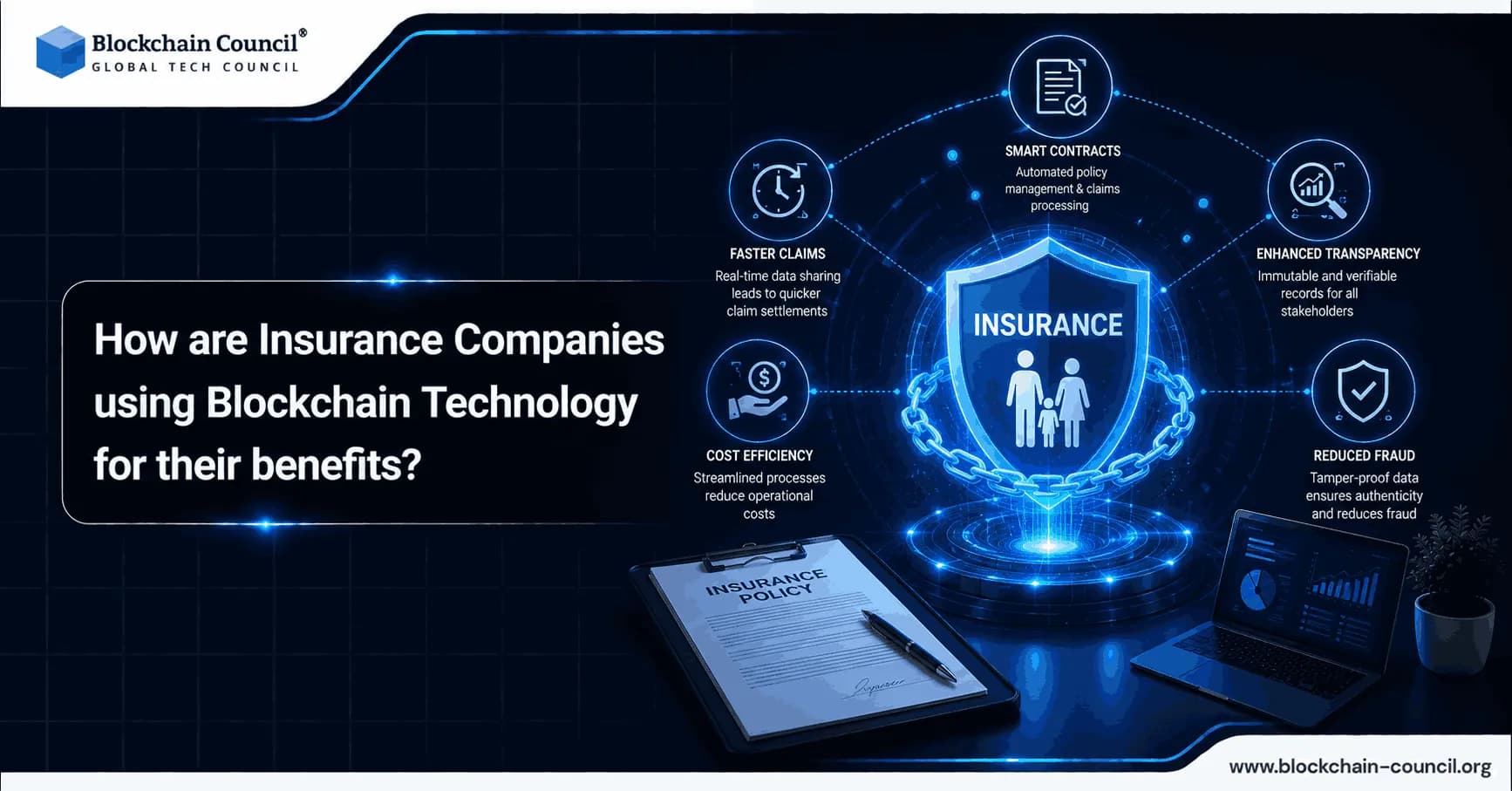
Insurance's Trust Problem Finally Has A Technical Fix
Insurance runs entirely on trust between parties who often have every incentive to disagree, a policyholder wants a claim paid quickly, an insurer wants to verify it is legitimate before paying out, and a reinsurer needs to confirm what was actually settled. That friction has historically meant slow claims, heavy paperwork, and enough fraud to meaningfully raise premiums for everyone. In 2026, that is changing at scale rather than in pilot programs. Insurance fraud alone is estimated to cost the U.S. industry somewhere between $40 billion and $80 billion a year, and the blockchain in insurance market is growing at a compound rate above 50% annually as carriers move from experimenting with distributed ledgers to running them in production. Understanding how that shift actually works technically is where a background like a Certified Blockchain Expert becomes genuinely useful for anyone evaluating or building these systems.
Why Traditional Insurance Processes Break Down
Fraud Is Baked Into The Cost Of Every Policy
Conventional fraud detection methods reportedly catch only a fraction of fraudulent claims, and healthcare insurance fraud alone accounts for well over $100 billion in annual losses in the U.S. That cost doesn't disappear, it gets distributed across every honest policyholder's premium, meaning the industry's fraud problem is effectively a tax on people who never did anything wrong.

Claims Processing Is Still Manual, Slow, And Dispute-Prone
A typical claim still involves extensive documentation, manual verification steps, and back-and-forth between adjusters, policyholders, and sometimes multiple insurers or reinsurers. Every one of those handoffs is a place where records can be duplicated, altered, or simply delayed, and disputes over policy interpretation remain common precisely because there is no single, universally trusted version of events everyone can check against.
Multiple Parties, No Shared Source Of Truth
Insurance transactions frequently involve carriers, brokers, reinsurers, and regulators, each keeping their own separate records of the same underlying events. Blockchain replaces that fragmented record-keeping with a single, timestamped, and cryptographically secured ledger that every authorized party can access and verify without relying on one company to be the final word. Building and auditing systems like this requires specialized expertise, which is why professionals who design the automated logic running on top of these ledgers increasingly pursue a Certified Smart Contract Developer credential, since writing the self-executing code that actually processes a claim is a distinct skill from understanding blockchain architecture in general.
Where Blockchain Is Already Changing Insurance Operations
Automated Claims Processing Through Smart Contracts
Smart contracts are the clearest production use case in the industry today. A policy's terms are encoded directly into a smart contract, and once predefined conditions are met, a flight delay confirmed by a data feed, a weather event crossing a set threshold, the contract can trigger a payout automatically, without a human adjuster manually reviewing and approving each claim. Early blockchain-based travel insurance products have processed the majority of eligible claims within 48 hours using exactly this mechanism, and across claim management more broadly, smart contract automation has demonstrated cost reductions of up to five times and processing speed improvements of roughly three times compared with traditional manual workflows.
Parametric Insurance At Scale
Parametric insurance, where payouts are triggered automatically by a measurable event rather than a lengthy loss assessment, has become one of the fastest-growing applications of this technology. The parametric insurance market is projected to grow from roughly $21 billion in 2026 to nearly $39 billion by 2030, growth driven directly by how well blockchain-based automation handles this model at scale.
Fraud Detection Through Shared, Immutable Records
Because every claim, policy update, and payment is timestamped and permanently recorded on a shared ledger, duplicate claims, fabricated loss events, and altered settlement documentation become far easier to catch and far harder to execute in the first place. Multi-party verification systems can cross-check claim details against provider records, policy terms, and prior submissions in real time, catching inconsistencies that would otherwise require a human investigator to notice manually.
Real Deployments From Major Carriers
This is no longer theoretical. Major insurers have moved these capabilities into live production over the past year. One leading insurtech company expanded its blockchain-based platform with AI-assisted automated claims processing to speed up settlements. A major life and health insurer rolled out decentralized policy management and fraud prevention tools to improve transparency across its systems. A major U.S. auto and home insurer upgraded its blockchain-based claims processing for faster verification and automated payouts. Even premium payments are shifting onto blockchain rails, with a major global insurance broker completing a stablecoin-based premium settlement for institutional clients earlier this year, a clear signal that blockchain's role in insurance now extends well beyond claims into payments infrastructure itself.
Building These Systems Without Losing Sight Of The Business Side
Deploying blockchain successfully in insurance is not purely a technical exercise. It requires integrating smart contracts with existing policy administration systems, external data feeds for parametric triggers, and regulatory reporting requirements that vary by jurisdiction and line of business. That breadth of technical demand is exactly why a broader Tech Certification has become valuable for insurance technology teams, since a fraud detection system or claims engine that ignores the surrounding infrastructure tends to create new integration headaches instead of solving the old ones. Insurers implementing this technology comprehensively report average annual cost savings in the range of five to ten million dollars, driven by reduced administrative overhead, faster settlements, and lower fraud losses combined.
Turning Operational Gains Into Customer Trust
None of these efficiency gains matter to a policyholder unless they can actually feel the difference. A claim paid within hours instead of weeks, or a premium that reflects a genuinely lower fraud rate, is a real competitive advantage, but only if customers understand why their experience with one insurer is faster and cheaper than another's. Surveys show a majority of policyholders are already willing to share more data in exchange for more personalized, responsive coverage, which means insurers have a real opening to explain what blockchain-backed automation means for them directly. Translating that technical improvement into a message customers actually trust is a distinct skill from the underlying engineering work, which is why insurance product and growth teams increasingly pair their technology investment with a Marketing Certification, ensuring that real operational improvements translate into policyholder trust rather than staying an invisible backend upgrade.
Technology & Problem Solving
Technology education is not only about learning tools or programming languages. It also involves understanding problems, analysing information, identifying patterns, and developing logical solutions. A World Tech Olympiad gives students an opportunity to develop these problem-solving abilities while exploring different areas of technology.
The Bottom Line
Blockchain is no longer a future concept for insurance, it is an active, production-grade tool that major carriers, brokers, and reinsurers are using today to cut fraud, automate claims, and settle payments faster than legacy systems ever allowed. Smart contract-driven parametric insurance, shared fraud-detection ledgers, and stablecoin-based premium payments each address a specific, expensive weakness in how the industry has traditionally operated. The insurers seeing the strongest results are not adopting this technology as a marketing angle, they are targeting concrete inefficiencies, building the underlying systems carefully, and making sure policyholders actually notice the difference in how quickly and fairly their claims get handled.
FAQs
1. How are insurance companies using blockchain technology?
Insurance companies are using and testing blockchain technology to improve claims processing, fraud detection, underwriting, policy administration, customer verification, reinsurance, payments, and data sharing. Blockchain creates a shared, tamper-evident record that authorized insurers and business partners can use to verify transactions and documents. This can reduce repetitive verification and reconciliation while helping insurers automate selected processes through smart contracts.
2. What are the main benefits of blockchain for insurance companies?
The main benefits of blockchain for insurers include faster claims processing, lower administrative costs, improved data integrity, better fraud detection, automated payments, more efficient reinsurance, and greater transparency between participating organizations. Blockchain is particularly valuable when an insurance transaction involves several independent parties that need access to the same verified information. Instead of maintaining conflicting records, participants can work from synchronized data.
3. How does blockchain help insurance companies process claims faster?
Blockchain can provide insurers, customers, repair providers, healthcare organizations, and other authorized parties with access to verified information required for a claim. Smart contracts can automatically evaluate predefined conditions and initiate eligible payments when reliable evidence confirms that those conditions have been met. Straightforward claims can therefore require less manual processing, while complex or disputed cases can still be referred to human claims professionals.
4. How can blockchain reduce insurance fraud?
Blockchain can create tamper-evident records of policies, claims, insured assets, ownership, repairs, and previous transactions. With appropriate privacy and data-sharing arrangements, insurers can use these records to identify duplicate claims, altered documents, suspicious ownership histories, or inconsistent information. Blockchain cannot eliminate fraud by itself, but it can make certain forms of manipulation more difficult and provide insurers with stronger audit trails for investigation.
5. How are smart contracts used by insurance companies?
Smart contracts are blockchain programs that execute predefined rules automatically. Insurance companies can use them for policy administration, premium collection, claims settlement, renewals, commissions, reinsurance, and parametric insurance. For example, if an insurance policy promises a fixed payment when a flight is delayed beyond a specified period, a smart contract could use trusted flight data to verify the delay and initiate the payment automatically.
6. How does blockchain benefit parametric insurance?
Parametric insurance pays according to predefined measurable events rather than relying entirely on traditional loss assessment. Policies can be linked to trusted information about rainfall, temperature, earthquakes, hurricanes, flight delays, or other measurable conditions. Blockchain and smart contracts can record the policy terms, receive verified external data, and automatically trigger eligible payments. This can significantly reduce claims administration for insurance products based on objective triggers.
7. How can blockchain improve insurance underwriting?
Underwriters depend on accurate information to estimate risk and determine policy conditions and pricing. Blockchain can help insurers verify data relating to properties, vehicles, businesses, professional credentials, previous claims, and other insured risks. When combined with IoT devices and trusted external data, blockchain can improve the reliability and traceability of information used in underwriting. Better information can help insurers price risks more accurately and reduce unnecessary verification work.
8. How are insurance companies using blockchain for customer identity verification?
Blockchain can support decentralized identity and Verifiable Credentials, allowing customers to present digitally verifiable information without repeatedly submitting the same documents. An insurer could verify identity, address, professional status, or other relevant credentials using cryptographic proofs issued by trusted organizations. This can simplify customer onboarding and KYC processes while potentially reducing identity fraud. Sensitive personal information should generally remain protected off-chain rather than being permanently recorded on a public blockchain.
9. How can blockchain help health insurance companies?
Health insurers can use blockchain-based systems to coordinate claims and verification among patients, hospitals, physicians, pharmacies, laboratories, and insurers. Blockchain can help verify provider credentials, insurance coverage, consent, billing events, and claims information. It can also provide an auditable record of authorized data access. Because medical information is highly sensitive, practical systems generally need encryption, strict permissions, and off-chain storage rather than exposing patient records directly on a blockchain.
10. How can blockchain benefit auto insurance companies?
Auto insurers can combine blockchain with connected vehicles, telematics, repair networks, and digital identity systems. Verified records could include vehicle ownership, mileage, maintenance, accidents, repairs, and insurance coverage. This information can improve underwriting and claims investigation. In suitable cases, trusted vehicle data could automatically report an insured event and provide information required to begin a claim, reducing the time between an accident and settlement.
11. How can blockchain improve property and home insurance?
Property insurers can use blockchain to verify information concerning property ownership, inspections, repairs, previous claims, and insured assets. Blockchain can also work with IoT sensors that detect events such as flooding, fire, or abnormal temperature conditions. Trusted information from these systems can help insurers evaluate risks and process claims more efficiently. A reliable digital history of a property may also reduce repeated inspections and document verification during underwriting.
12. How are insurance companies using blockchain for reinsurance?
Reinsurance requires insurers and reinsurers to exchange substantial amounts of information concerning policies, premiums, exposures, claims, and settlements. Blockchain can provide both parties with synchronized records, reducing reconciliation and disputes over different versions of the same transaction. Smart contracts can also automate selected calculations and settlements. Because reinsurance frequently involves sophisticated institutional counterparties, it remains one of the areas where shared distributed-ledger infrastructure can provide a particularly clear business case.
13. How can blockchain reduce operating costs for insurance companies?
Insurance companies spend substantial resources on document verification, data reconciliation, claims administration, compliance, payments, and communication between organizations. Blockchain can reduce some of this work by creating shared verified records and automating repetitive processes. Savings can come from fewer manual checks, reduced duplication, faster settlements, and more efficient data exchange. The economic benefit depends on implementation costs and whether enough industry participants adopt compatible systems.
14. How can blockchain improve insurance payments and settlements?
Blockchain-based payment infrastructure can support automated claim payments, premium collection, broker commissions, cross-border settlements, and reinsurance payments. Stablecoins, tokenized deposits, or other regulated digital-money systems can potentially enable settlement outside conventional banking hours. Smart contracts can also link payments directly to verified policy conditions. Regulatory, tax, consumer-protection, and payment requirements still apply regardless of how enthusiastically someone labels the process “on-chain.”
15. How can blockchain improve transparency between insurers and customers?
Blockchain can provide auditable records showing important events associated with a policy or claim, such as when documents were submitted, when information was verified, and when a payment was authorized. Customers can potentially receive greater visibility into the status of their claims, while insurers gain clearer records of interactions and approvals. This transparency can reduce disputes, although confidential business information and personal customer data must still be appropriately protected.
16. Can blockchain improve regulatory compliance for insurance companies?
Blockchain can create reliable audit trails that help insurers demonstrate how policies, transactions, claims, and approvals were processed. Regulators or auditors could potentially receive controlled access to relevant verified records, reducing some manual reporting and reconciliation. Blockchain can also complement AI-based compliance systems by providing trustworthy transaction histories. However, insurers must design these systems around applicable insurance, privacy, cybersecurity, and data-retention regulations.
17. How are blockchain, AI, and IoT being combined in insurance?
Blockchain, artificial intelligence, and the Internet of Things can perform complementary roles. IoT devices can generate real-world information, AI can analyze that information to identify risk or detect anomalies, and blockchain can provide a verifiable record of important events and transactions. In auto insurance, for example, vehicle sensors could provide accident data, AI could help assess the claim, and blockchain could verify relevant records and coordinate an eligible payment.
18. What challenges do insurance companies face when adopting blockchain?
Insurance companies face challenges involving legacy-system integration, privacy, regulation, cybersecurity, interoperability, smart-contract security, data quality, implementation costs, and cooperation among industry participants. Blockchain also cannot guarantee that information supplied from the physical world is accurate. If incorrect claim information is entered into a blockchain, the technology can preserve that incorrect information with admirable efficiency. Reliable data sources and governance therefore remain essential.
19. What are the major blockchain insurance trends in 2026?
Major trends include parametric insurance, smart-contract claims, decentralized identity, Verifiable Credentials, blockchain-based reinsurance, stablecoin settlement, tokenized insurance-linked assets, zero-knowledge proofs, and IoT-enabled insurance products. AI integration is becoming particularly important because insurers can combine AI-based risk analysis and fraud detection with blockchain-based verification and audit trails. The broader direction is toward increasingly automated insurance workflows rather than replacing insurance companies with fully decentralized protocols.
20. What is the future of blockchain technology for insurance companies?
The future of blockchain in insurance is likely to focus on reducing friction between insurers, customers, reinsurers, brokers, healthcare providers, repair networks, regulators, and other organizations. Rather than replacing existing insurance platforms completely, blockchain can operate as a shared verification and automation layer connecting them.
A future insurance claim could begin automatically when a connected device reports an insured event. AI could analyze the information and estimate the claim, blockchain could verify policy and transaction records, and a smart contract could initiate payment when predefined conditions are satisfied. Complicated cases would continue to receive human review.
For insurance companies, the real benefit is therefore not simply possessing blockchain technology. It is using blockchain to achieve measurable improvements in claims speed, fraud prevention, operating costs, underwriting accuracy, transparency, and settlement efficiency. If it can also reduce the number of times the same document must be uploaded to three different systems, humanity may finally have found an enterprise blockchain use case everyone can appreciate.
Related Articles
View All
Blockchain
Blockchain Train Technology: Rail Use Cases, Benefits, and Limits
Blockchain train technology is moving from pilots to practical rail use cases in freight, ticketing, asset records, IoT security, and audit trails.

Blockchain
Blockchain Explained: The Technology Changing How We Trust & Transact
Blockchain explained from the ground up: what it is, why it was created, centralised vs decentralised systems, how blocks, nodes, and ledgers work, how data is stored, security, real-world examples, and how blockchain compares with traditional databases.

Blockchain
Blockchain in Banks: Use Cases, Benefits, Risks, and the AI Connection
Explore how blockchain in banks is reshaping payments, trade finance, tokenized deposits, KYC, AML, and AI-driven risk workflows.
Trending Articles
How Blockchain Secures AI Data
Understand how blockchain technology is being applied to protect the integrity and security of AI training data.

Can DeFi 2.0 Bridge the Gap Between Traditional and Decentralized Finance?
The next generation of DeFi protocols aims to connect traditional banking with decentralized finance ecosystems.
How to Install Claude Code
Learn how to install Claude Code on macOS, Linux, and Windows using the native installer, plus verification, authentication, and troubleshooting tips.