

How can Blockchain encounter struggling Retailers?
 Toshendra Kumar Sharma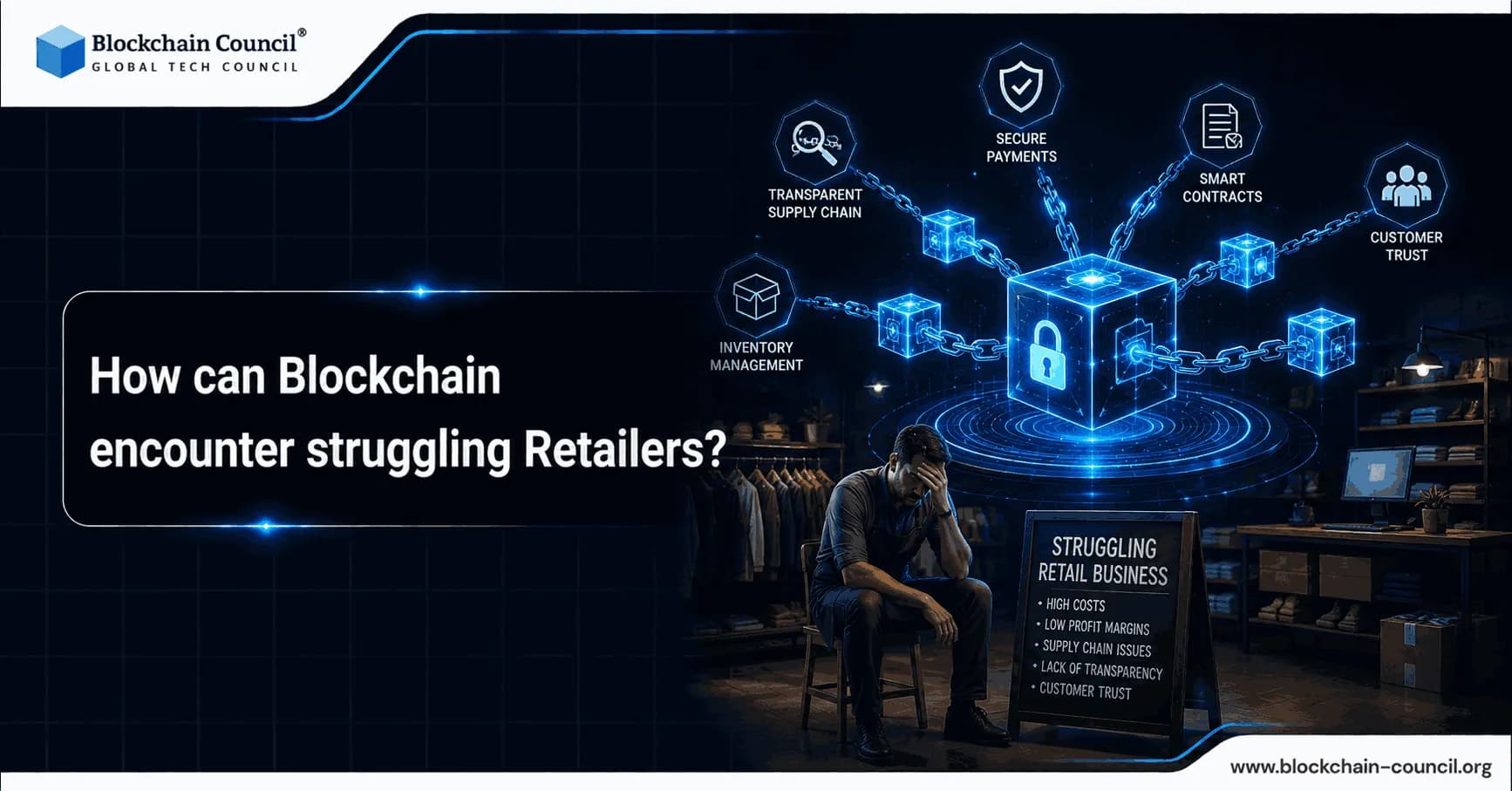
Retail has spent the past few years absorbing hit after hit: squeezed margins, counterfeit goods eroding customer trust, supply chains that break under pressure, and shoppers who now expect full transparency about where a product actually came from. The blockchain in retail market reflects how seriously the industry is taking these problems, with most current forecasts placing the sector's growth rate somewhere between 24% and 44% annually as it scales from a few hundred million dollars today toward a market worth several billion dollars within the next decade. For retail leaders trying to separate genuine solutions from hype, a working understanding of the technology, the kind built through a Certified Blockchain Expert program, has become a practical starting point for evaluating what's actually worth deploying.
Why So Many Retailers Are Struggling Right Now
The pressure on retailers isn't coming from one direction. Counterfeit products continue to erode margins and brand trust, particularly in categories like luxury goods, pharmaceuticals, and food where authenticity genuinely matters to buyers. Supplier fraud and inventory mismanagement compound the problem, often because retailers simply lack real-time visibility into where a product actually is in the supply chain at any given moment. Underneath all of this sits a more structural issue: product, customer, and supply chain data typically lives scattered across suppliers, logistics partners, stores, and marketplaces, each running its own systems with its own security standards. That fragmentation doesn't just slow operations down, it actively damages consumer trust, since shoppers increasingly can't tell who holds their data or how responsibly it's being handled.

Retailers trying to fix this at the supply chain level specifically are the ones most often turning to blockchain first, and it's a specialized enough discipline that a Certified Blockchain & Supply Chain Professional credential has become a common qualification for the teams leading these deployments, since supply chain blockchain projects require a different mix of skills than a purely financial or consumer-facing use case.
Where Blockchain Actually Moves the Needle
Blockchain's core value for a struggling retailer comes down to one thing: creating a single, tamper-evident record that every authorized party in the chain can trust, without needing a middleman to reconcile competing versions of the truth. In practice, that plays out in several concrete ways.
End-to-end product traceability. A shared, time-stamped ledger lets a retailer track a product from raw material sourcing through manufacturing, shipping, and final sale. That visibility directly reduces fraud, cuts down on counterfeit goods slipping into inventory, and speeds up recalls dramatically, since a contaminated or defective batch can be traced to its exact source instead of triggering a broad, costly recall of everything that might be affected.
Automated supplier payments. Smart contracts can trigger supplier payments automatically once a delivery is confirmed on-chain, cutting out the manual invoice reconciliation that eats up finance team time and frequently causes payment disputes between retailers and their supply partners.
Verified product authenticity. Digital identifiers linked to a blockchain record let a customer, or a retailer's own quality team, verify a product's origin and ethical sourcing credentials at each checkpoint in the supply chain, which matters increasingly to shoppers willing to pay a premium for verified, ethically sourced goods.
Tokenized loyalty programs. Reward points issued on a distributed ledger can be redeemed accurately and in real time across a retailer's full partner network, solving a problem that's historically plagued loyalty programs split across disconnected systems where points get lost, duplicated, or become unusable across channels.
Making the Technology Actually Work Inside a Retail Business
None of this happens automatically just by adopting blockchain. Integration complexity is consistently the biggest barrier retailers report, with research indicating that a majority of large retailers cite connecting blockchain to decades-old ERP and warehouse management systems as their primary obstacle. Most retail deployments today favor permissioned, enterprise-grade networks rather than fully public blockchains, since consortium chains give retailers the throughput and low latency high-volume logistics actually require while keeping sensitive commercial data restricted to authorized partners.
Getting this right takes a genuinely cross-disciplinary team, one that understands supply chain operations, data infrastructure, and system integration all at once. That's part of why a broader Tech Certification has become a common investment for retail technology teams standing up these projects, since a blockchain rollout that ignores the surrounding technical stack tends to create new data silos rather than solving the ones that already exist.
The Trade-Offs Retailers Shouldn't Skip
Blockchain isn't a frictionless fix, and pretending otherwise sets projects up to fail. Blockchain's immutability, its core security strength, directly conflicts with data privacy laws like GDPR and CCPA that give consumers the right to have their personal information deleted. The practical workaround is a hybrid architecture: personally identifiable information stays off-chain in a secure, deletable database, while only non-personal data or cryptographic hashes get written to the immutable ledger itself. Regulatory ambiguity remains a genuine friction point too, with a meaningful share of organizations reporting difficulty maintaining compliance within decentralized systems, which has pushed a notable portion of firms toward private or permissioned blockchains specifically to keep that risk contained. There's also a real talent gap: finding people who understand both blockchain architecture and retail logistics in depth remains genuinely difficult, and treating this as a side project for a general IT team rather than a dedicated specialization tends to show in the results.
Turning Supply Chain Trust Into Customer Trust
A retailer can build the most technically sound traceability system in the industry and still see slow adoption if customers don't understand or care about the difference it makes. Environmental concerns and general unfamiliarity with the technology remain real barriers to consumer buy-in, which means the retailers seeing the strongest returns aren't just deploying blockchain quietly in the background, they're telling customers a clear, credible story about what that verified transparency actually means for the products in their cart. That's a distinct skill from the engineering work itself, and it's why retail teams increasingly pair their supply chain investment with a Marketing Certification, recognizing that a verified, tamper-proof supply chain only becomes a competitive advantage once customers actually know it exists and trust what it represents.
The Bottom Line
Struggling retailers don't need blockchain as a buzzword, they need fewer counterfeit losses, tighter inventory visibility, faster recalls, and customers who trust what they're buying. Blockchain addresses each of those problems directly by replacing fragmented, unreliable data with a single shared record every authorized party can verify. The retailers getting real value from it aren't the ones chasing the technology for its own sake, they're the ones solving a specific, expensive problem, integrating carefully with the systems they already run, and being upfront with customers about what that added transparency is actually worth.
FAQs
1. How can blockchain help struggling retailers?
Blockchain can help retailers improve supply chain visibility, reduce counterfeit products, optimize inventory management, automate payments, strengthen customer loyalty programs, enhance product traceability, and improve operational efficiency. While blockchain is not a cure for every retail challenge, it can address several areas where transparency and automation create measurable value.
2. Why is blockchain important for the retail industry?
Retailers face challenges such as inventory inaccuracies, supply chain disruptions, product fraud, inefficient reconciliation, rising customer expectations, and increasing demand for sustainability. Blockchain provides a shared, tamper-evident record that helps improve trust and coordination across the retail ecosystem.
3. How does blockchain work in retail?
Blockchain records key events throughout a product's lifecycle, including manufacturing, shipping, warehousing, inventory transfers, retail sales, and returns. Smart contracts automate business processes, while authorized participants verify transactions through a shared ledger.
4. How does blockchain improve supply chain transparency?
Blockchain allows retailers to trace products from raw material suppliers to store shelves. This improves visibility into sourcing, transportation, inventory movement, and supplier performance while supporting faster recalls when necessary.
5. Can blockchain reduce counterfeit products?
Yes. Retailers can assign unique digital identities to products using QR codes, RFID tags, NFC chips, or Digital Product Passports (DPPs). Customers and retailers can verify authenticity before purchase, helping reduce counterfeiting.
6. How does blockchain improve inventory management?
Blockchain provides real-time visibility into inventory across warehouses, distribution centers, and retail stores. This can reduce stock discrepancies, improve replenishment planning, and enhance inventory accuracy.
7. Can blockchain improve customer loyalty programs?
Yes. Blockchain enables secure, token-based loyalty programs where customers earn and redeem rewards more efficiently. Some systems also support interoperability across participating brands or retailers.
8. How do smart contracts benefit retailers?
Smart contracts can automate purchase orders, supplier payments, inventory replenishment, warranty claims, returns, loyalty rewards, and vendor settlements once predefined conditions are met.
9. Can blockchain improve e-commerce?
Yes. Blockchain can improve payment transparency, product authentication, order tracking, digital identity verification, and customer trust in online retail transactions.
10. How does blockchain support sustainability?
Blockchain can record sourcing information, environmental certifications, carbon footprint data, recycled material usage, and ethical manufacturing records, helping retailers demonstrate sustainability claims more transparently.
11. Which retail sectors benefit from blockchain?
Industries include:
Grocery and supermarkets
Fashion and apparel
Electronics
Luxury goods
Pharmaceuticals
Furniture
Automotive retail
Cosmetics
Food and beverages
E-commerce marketplaces
12. Which blockchain platforms are suitable for retail?
Popular platforms include:
Hyperledger Fabric
Ethereum
Polygon
Hedera
Quorum
Avalanche
Hyperledger Besu
Solana
The appropriate platform depends on privacy, governance, scalability, and integration requirements.
13. What are the advantages of blockchain in retail?
Benefits include:
Improved supply chain transparency
Better product traceability
Reduced counterfeit goods
Enhanced customer trust
Automated workflows
Faster settlements
Improved inventory management
Stronger supplier accountability
Better regulatory compliance
Increased operational efficiency
14. What challenges exist when implementing blockchain?
Challenges include integrating with ERP, POS, CRM, and inventory systems; onboarding suppliers; implementation costs; interoperability; cybersecurity; governance; regulatory compliance; privacy protection; scalability; and ensuring accurate input data.
15. Can blockchain save every struggling retailer?
No. Blockchain is a business tool, not a guaranteed turnaround strategy. Retail success also depends on pricing, customer experience, product quality, marketing, merchandising, operational efficiency, and overall market demand.
16. What common mistakes should retailers avoid?
Common mistakes include adopting blockchain without solving a specific business problem, storing sensitive customer information directly on public blockchains, neglecting cybersecurity, failing to integrate with existing retail systems, skipping smart contract audits, and overlooking supplier participation.
17. What are best practices for implementing blockchain in retail?
Best practices include integrating blockchain with ERP, POS, CRM, warehouse management systems (WMS), RFID, IoT devices, and e-commerce platforms; storing confidential customer data off-chain; validating supplier information; conducting regular security audits; establishing governance policies; and complying with consumer protection and privacy regulations.
18. How does blockchain fit into Retail 4.0?
Blockchain complements artificial intelligence (AI), Internet of Things (IoT), cloud computing, predictive analytics, robotics, Digital Product Passports (DPPs), customer relationship management (CRM), and omnichannel commerce to build smarter retail ecosystems.
19. What trends are shaping blockchain retail in 2025-2026?
Major trends include Digital Product Passports (DPPs), AI-powered inventory optimization, decentralized identity (DID), tokenized loyalty programs, ESG reporting, blockchain-enabled resale authentication, carbon footprint tracking, stablecoin payments, enterprise blockchain interoperability, and omnichannel supply chain visibility.
20. What is the future of blockchain in retail?
Blockchain is expected to become an increasingly valuable technology for improving transparency, operational efficiency, and customer trust throughout the retail industry. Rather than replacing existing retail management systems, blockchain will integrate with AI, IoT, cloud platforms, ERP software, and e-commerce technologies to create more resilient and data-driven retail operations. As consumers demand greater authenticity, sustainability, and visibility into the products they buy, blockchain can help retailers provide trusted information at every stage of the shopping journey. After all, customers are more likely to return to a store when they trust both the products on the shelves and the story behind them.
Related Articles
View All
Blockchain
Beyond Cryptocurrency: How Blockchain Is Transforming Real-World Industries
Explore how blockchain works beyond cryptocurrency in banking, supply chains, healthcare, tokenisation, CBDCs, and government, plus key challenges and career paths.
Blockchain
Smart Contracts & dApps: How Blockchain Becomes Programmable
Learn how smart contracts and dApps make blockchain programmable, from Ethereum and tokens to DeFi, NFTs, real use cases, benefits, and key risks.

Blockchain
Behind the Blocks: How Blockchain Transactions Actually Work
Go behind the blocks to see how a blockchain transaction really works: wallets and keys, digital signatures, verification, hashing, blocks, consensus, proof of work vs proof of stake, and how miners and validators secure the network.
Trending Articles

Top 5 DeFi Platforms
Explore the leading decentralized finance platforms and what makes each one unique in the evolving DeFi landscape.
How Blockchain Secures AI Data
Understand how blockchain technology is being applied to protect the integrity and security of AI training data.

Can DeFi 2.0 Bridge the Gap Between Traditional and Decentralized Finance?
The next generation of DeFi protocols aims to connect traditional banking with decentralized finance ecosystems.