

Kerala to use Blockchain Technology for Food Supply
 Toshendra Kumar Sharma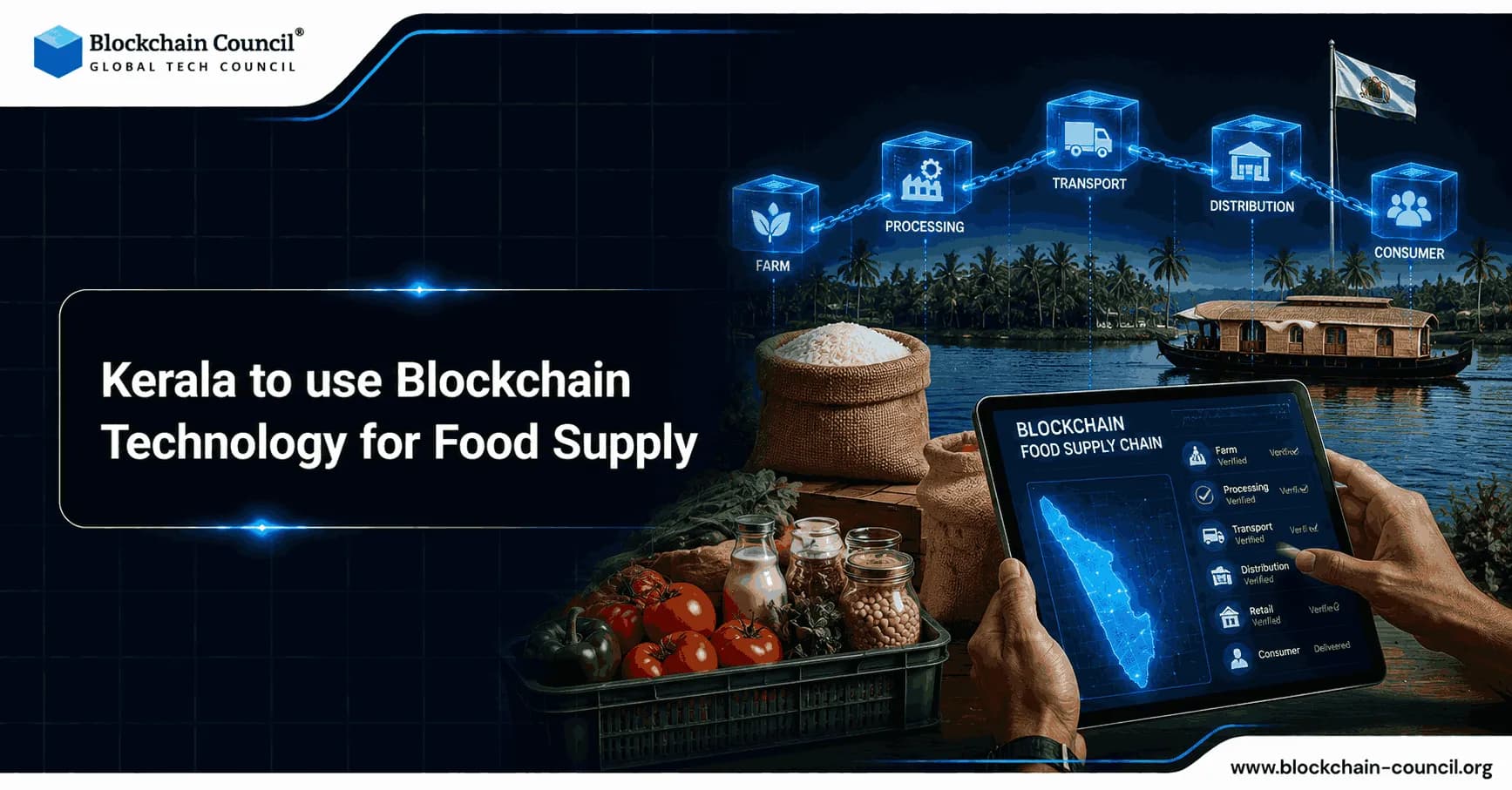
Kerala became one of the first Indian states to commit to blockchain based food supply chain management, launching a project through its state think tank to bring real time traceability to the milk, vegetables, and fish that reach households across the state every day. Announced in 2018, the initiative reflected a genuine attempt to solve longstanding problems around sourcing, distribution delays, and product quality verification that have historically plagued agricultural supply chains in India. As other states and food industry stakeholders study Kerala's approach, more professionals are pursuing a Certified Blockchain Expert credential to understand exactly how a state government actually implements blockchain across something as complex as food distribution.
In this article, we will look at what Kerala's blockchain food supply project actually involves, how the underlying technology works across dairy, vegetable, and fish supply chains, and what this initiative signals about blockchain's genuine potential in agricultural distribution.

The Institution Driving Kerala's Blockchain Initiative
The project is being implemented through the Kerala Development and Innovation Strategic Council, known as K-DISC, the state's dedicated think tank created specifically to formulate and execute plans for building a sustainable technology driven ecosystem within the state. K-DISC chairman K M Abraham explained that in the dairy sector specifically, the initiative would ensure faster delivery of high quality milk by continuously monitoring production, procurement, and distribution through an electronic ledger, rather than relying on the fragmented, manual tracking systems that traditionally governed how milk moved from farm to household.
Beyond the food supply project itself, K-DISC also launched a dedicated program to train students across Kerala in blockchain technology, aiming to give the state an early mover advantage in a genuinely emerging technical field. This combination of infrastructure investment and workforce development reflects a broader strategic bet, that understanding both agricultural supply chains and the underlying blockchain technology together creates real value, which is exactly why professionals working on similar state level initiatives are increasingly pursuing a Certified Blockchain & Supply Chain Professional credential, building the specific expertise needed to apply blockchain to agricultural distribution challenges rather than treating it as a purely abstract technical concept.
Quick Answer
Kerala is using blockchain technology, implemented through the Kerala Development and Innovation Strategic Council, to track and verify the supply chains of milk, vegetables, and fish across the state. The system assigns a unique ID number to every component of the supply network, combined with RFID tags, IoT devices, and geo coded images, allowing the source and quality of products to be verified at every step, from farms and fish landing spots through to packaging centers and final retail delivery.
How Kerala's Blockchain Food Supply System Actually Works
1. Unique Identification for Every Supply Chain Component
Each segment of the supply network, from individual farms to processing centers to distribution points, receives its own separate ID number recorded on the blockchain. According to K-DISC chairman K M Abraham, this allows any participant in the chain to check both the source and the quality of a given product at any point along its journey, replacing the guesswork that previously came with tracing where a specific batch of milk or fish actually originated.
2. RFID Tags and Real Time Mobile Tracking
Every segment of the supply chain incorporates RFID tags integrated with mobile applications, making supply data available in real time rather than relying on periodic manual reporting. This is particularly important for temperature sensitive products like milk, where refrigerated transport trucks are monitored through RFID tags and IoT equipment to ensure the product stays within safe temperature ranges throughout its journey.
Building a system capable of coordinating RFID hardware, IoT sensors, mobile applications, and blockchain based record keeping across an entire state's food supply network requires substantial technical engineering. This is exactly the kind of large scale infrastructure challenge that has pushed development teams working on government supply chain projects to pursue a formal Tech Certification, validating the specialized skills needed to build systems this complex and this consequential for public food safety.
3. Geo-Coded Images for Vegetable and Fish Verification
For the vegetable and fish supply chains specifically, the project incorporates geo coded images linking fish landing spots and farmlands directly to packaging centers, enabling real time monitoring and verification of goods at every step of the delivery process, from the original source through warehouses and retail centers to the final point of sale.
4. Faster, More Transparent Crop Insurance Processing
Beyond food distribution itself, Kerala's broader blockchain strategy also extends to crop insurance, aiming to speed up the entire claims process, from application through settlement, for farmers who suffer losses due to natural disasters. Reducing the time this process traditionally takes could offer farmers meaningfully faster financial support when crops are damaged or destroyed.
Why This Matters for Indian Agriculture More Broadly
Agriculture remains the largest employer in the Indian economy, with roughly 70 percent of the country's population connected to agriculture related work, yet the sector continues facing persistent problems around sourcing, distribution inefficiency, adulteration, and low yields. Kerala's initiative reflects a broader national conversation about blockchain's potential here, one that has included public statements from Indian leadership about how real time supply chain monitoring could bring genuine transparency from the production process all the way through to final delivery, potentially reducing the influence of middlemen and improving outcomes for farmers themselves.
By moving early on this kind of state level implementation, Kerala positioned itself as a genuine example for other Indian states and emerging markets more broadly, demonstrating what a coordinated, government led blockchain food supply initiative could actually look like in practice rather than remaining a theoretical policy discussion.
Final Thoughts
Kerala's blockchain based food supply initiative represents one of the more concrete, government led applications of blockchain to agricultural distribution seen anywhere in India, combining unique product identification, RFID tracking, IoT monitoring, and geo coded verification across the state's milk, vegetable, and fish supply chains. Led by K-DISC and paired with a dedicated blockchain education program for Kerala's students, the initiative reflects genuine institutional commitment rather than a short term pilot disconnected from broader state strategy.
As other regions look to Kerala's approach as a potential model, government agencies and food distribution networks need to do more than build reliable tracking infrastructure. They need to clearly explain these systems to farmers, distributors, and consumers who will ultimately need to trust and actually use them. That is why organizations working on similar public sector blockchain initiatives increasingly pair their technical implementation work with a Marketing Certification to communicate these changes clearly and build genuine public confidence in food supply systems that directly affect daily life.
Kerala's food supply blockchain initiative shows what happens when a state government commits seriously to modernizing agricultural infrastructure, tracking a farm to table journey with the kind of transparency and verification traditional paper based systems were never built to provide.
FAQs
1. How did Kerala plan to use blockchain technology for food supply?
Kerala explored using blockchain technology to improve the tracking and management of food products moving through agricultural and distribution networks. The initiative was associated with the Kerala Development and Innovation Strategic Council, commonly known as K-DISC. Blockchain was considered for creating more reliable supply-chain records for products such as milk, vegetables, and fish, potentially helping participants track production, transportation, storage, and distribution.
2. Why did Kerala consider blockchain for food supply management?
Food supply chains involve farmers, cooperatives, transporters, warehouses, processors, retailers, government agencies, and consumers. Information can become fragmented as products move between these participants. Blockchain can create a shared, tamper-evident record of important supply-chain events, potentially improving traceability and reducing information gaps. For Kerala, such technology was particularly interesting for managing perishable agricultural and food products.
3. Which food products were included in Kerala's blockchain plans?
Historical reports about Kerala's blockchain initiative highlighted products including milk, vegetables, and fish. These products are highly perishable and require effective transportation, storage, inventory management, and quality control. Blockchain could provide traceability records connecting different stages of their journey from producers toward markets and consumers.
4. What role did K-DISC play in Kerala's blockchain initiative?
The Kerala Development and Innovation Strategic Council, or K-DISC, has been involved in promoting innovation and emerging technologies within the state. Kerala's reported blockchain plans for food-supply management were associated with this broader innovation agenda. The objective was to investigate how distributed-ledger technology could improve agricultural supply chains, information management, and coordination between stakeholders.
5. How can blockchain improve food traceability in Kerala?
Blockchain can create a chronological record of important events as food moves through the supply chain. Information about production, collection, processing, storage, transportation, inspection, and delivery can be associated with the ledger. If reliable data is captured at each stage, authorized organizations can trace a product backward toward its source or forward toward its destination more efficiently.
6. How can blockchain benefit farmers in Kerala?
Farmers could benefit from better visibility into product movement, quality records, procurement, and payments. A blockchain-based system could provide verifiable evidence of when produce was collected, graded, transferred, or delivered. When combined with digital payments and smart contracts, selected payments could potentially be automated after agreed conditions are verified, helping reduce delays and disputes.
7. Can blockchain reduce food wastage?
Blockchain cannot prevent food spoilage by itself, but it can improve the information used to manage perishable goods. When combined with IoT sensors, inventory systems, and logistics platforms, blockchain can help participants identify where products are located and how long they have been in transit or storage. Better visibility can support faster distribution and more effective inventory decisions, potentially reducing avoidable wastage.
8. How can blockchain improve Kerala's milk supply chain?
Milk requires rapid collection, testing, refrigeration, transportation, and processing. A blockchain-enabled system could record important events such as collection times, quality tests, batch information, storage conditions, and transfers between organizations. Consumers and authorities could potentially verify selected information about a milk product's origin and handling while sensitive commercial information remains restricted.
9. How could blockchain help Kerala's fisheries sector?
Fish is highly perishable, making temperature, handling, transportation, and origin particularly important. Blockchain can support traceability from catch or farm through processing, distribution, and retail. When integrated with IoT sensors, the system could preserve evidence associated with temperature and storage conditions. This could support quality assurance, food safety, exports, and sustainability claims.
10. How can blockchain improve Kerala's vegetable supply chain?
Vegetables often move through several intermediaries before reaching consumers. Blockchain can create verifiable records of production, collection, transportation, quality inspection, and distribution. Farmers, cooperatives, retailers, and government agencies could access relevant information according to their permissions. Better traceability can help identify delays and inefficiencies while supporting product-origin claims.
11. Can blockchain improve food safety in Kerala?
Blockchain can help authorities and businesses identify where a particular batch of food originated and where it travelled. If contamination or another safety problem is discovered, traceability records could make affected products easier to identify and recall. Blockchain does not test whether food is safe, however. Laboratories, inspections, quality controls, sensors, and proper handling remain responsible for establishing actual safety.
12. How can blockchain help consumers verify food quality?
Consumers could potentially scan a QR code or similar identifier to access approved information about a food product's origin, batch, certification, or journey through the supply chain. Blockchain can make the underlying record more difficult to alter after it has been registered. The quality of this information still depends on trusted organizations accurately recording physical-world events.
13. Can blockchain eliminate middlemen from Kerala's food supply chain?
Blockchain may reduce dependence on intermediaries whose main role is maintaining records, reconciling transactions, or verifying information, but it does not automatically eliminate every middleman. Transporters, wholesalers, processors, storage providers, and distributors often perform essential physical services. The more realistic benefit is reducing unnecessary information and transaction friction rather than declaring war on everyone standing between a tomato farm and a supermarket.
14. How can smart contracts help farmers and food suppliers?
Smart contracts can automate predefined actions when verified conditions are satisfied. For example, payment could be initiated after a cooperative or buyer confirms receipt of an eligible shipment. Smart contracts could also support procurement, insurance, quality-based pricing, or logistics arrangements. Human intervention would still be necessary when deliveries are disputed or physical conditions cannot be verified automatically.
15. How can blockchain and IoT work together in Kerala's food supply?
IoT sensors can collect information such as temperature, humidity, location, and storage conditions. Blockchain can preserve cryptographic evidence associated with important sensor readings or supply-chain events. This combination is particularly useful for cold-chain products such as milk, fish, meat, and certain agricultural products. Raw sensor data would generally remain off-chain because conventional databases are more efficient for storing large volumes of readings.
16. Could blockchain improve agricultural insurance in Kerala?
Blockchain could support agricultural insurance by connecting verified weather, crop, or other relevant data with smart contracts. In a parametric insurance model, predefined payments could potentially be triggered when trusted data confirms that specified conditions occurred. Such systems require carefully designed insurance products, reliable data sources, regulatory compliance, and mechanisms for resolving exceptional cases.
17. What challenges does Kerala face in using blockchain for food supply chains?
Challenges include implementation costs, internet connectivity, farmer adoption, digital literacy, data accuracy, interoperability, cybersecurity, governance, and integration with existing agricultural systems. The largest practical issue is often the connection between physical products and digital records. Blockchain can protect information after it is recorded, but it cannot prevent someone from entering incorrect information at the beginning.
18. Can Kerala's blockchain food model be expanded across India?
A successful traceability model could potentially be adapted for agricultural and food supply chains elsewhere in India. Different states could use compatible standards for product identity, certifications, logistics, and agricultural records. National expansion would require interoperability, affordable technology, participation from farmers and businesses, and clear governance over who can submit, verify, and access information.
19. How could AI and blockchain improve Kerala's food supply chain?
AI can forecast demand, predict spoilage, optimize inventory, analyze crop conditions, and improve transportation planning. IoT devices can collect physical-world information, while blockchain can provide provenance and verification across organizations. Together, these technologies could help create a more intelligent food-supply network in which data supports faster decisions while important records remain auditable.
20. What is the future of blockchain in Kerala's food supply system?
Kerala's historical interest in blockchain for food supply demonstrated how distributed-ledger technology could be applied beyond cryptocurrency.
The strongest future model would combine blockchain, IoT, AI, digital payments, and conventional supply-chain software rather than expecting blockchain to manage the entire system.
A farmer or cooperative could register a batch of produce digitally. IoT systems could monitor selected transportation and storage conditions. Logistics platforms could manage movement and inventory. Blockchain could preserve important provenance, certification, and custody records. Smart contracts could automate selected commercial processes, while AI analyzes demand and recommends where products should be distributed.
Consumers could eventually scan a product and verify selected information about where it came from and how it reached the market.
The important limitation is that blockchain only makes recorded information more verifiable; it does not guarantee that the original information is true. Kerala would therefore need reliable inspections, sensors, certifications, and governance alongside the technology.
For a state with significant agriculture, dairy, fisheries, and food-distribution networks, blockchain's most realistic value lies in traceability and coordination from producer to consumer.
That is considerably more useful than putting a vegetable on a blockchain and hoping decentralization keeps it fresh.
Related Articles
View All
Blockchain
Blockchain Train Technology: Rail Use Cases, Benefits, and Limits
Blockchain train technology is moving from pilots to practical rail use cases in freight, ticketing, asset records, IoT security, and audit trails.

Blockchain
Blockchain in Banks: Use Cases, Benefits, Risks, and the AI Connection
Explore how blockchain in banks is reshaping payments, trade finance, tokenized deposits, KYC, AML, and AI-driven risk workflows.

Blockchain
User Experience in Blockchain Products: How to Make Web3 Apps Easier to Use
Learn how to improve user experience in blockchain products with simpler onboarding, clearer transaction flows, safer wallet UX, and better Web3 metrics.
Trending Articles
How Blockchain Secures AI Data
Understand how blockchain technology is being applied to protect the integrity and security of AI training data.

Can DeFi 2.0 Bridge the Gap Between Traditional and Decentralized Finance?
The next generation of DeFi protocols aims to connect traditional banking with decentralized finance ecosystems.
Claude AI Tools for Productivity
Discover Claude AI tools for productivity to streamline tasks, manage workflows, and improve efficiency.