

How Are People Trading Solar Energy Using Blockchain?
 Toshendra Kumar Sharma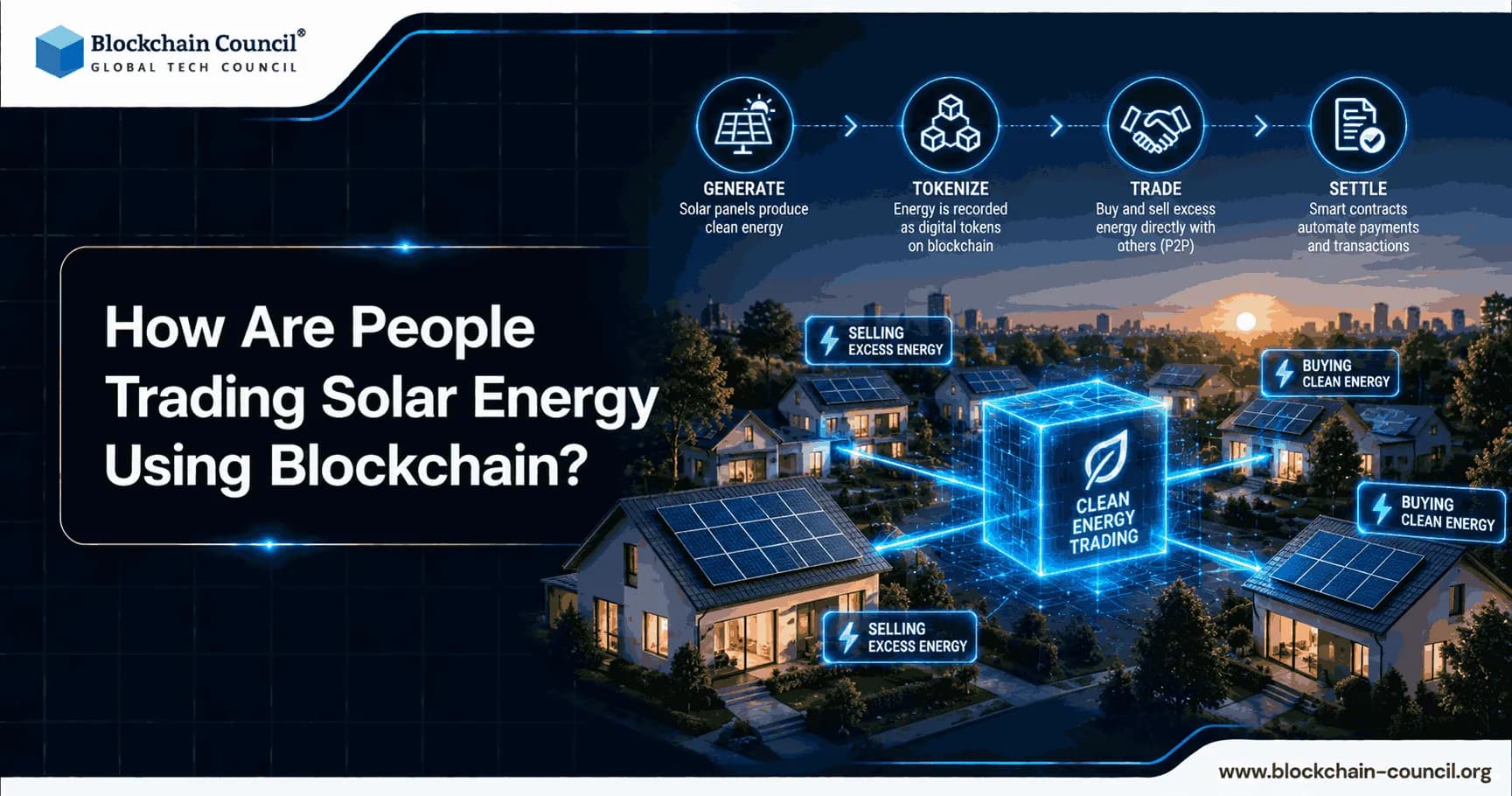
Homeowners with rooftop solar panels have always faced the same limited choice when their panels generate more electricity than they use, sell the surplus back to the utility company at a rate the utility sets, or let it go to waste. Blockchain technology is quietly rewriting that arrangement, letting neighbors sell surplus solar power directly to each other without a utility acting as the middleman. The blockchain and energy trading market was valued at $3.1 billion in 2024 and is projected to exceed $103 billion by 2034, reflecting genuinely rapid growth in exactly this kind of peer to peer trading model. Many people studying how this technology actually works start with a Certified Blockchain Expert credential to understand the underlying mechanics before evaluating whether solar trading platforms genuinely deliver on their promise.
In this article, we will look at how blockchain based solar energy trading actually works step by step, the real world projects already running today, and the genuine benefits and challenges this emerging market still faces.

Why Solar Owners Are Turning to Peer to Peer Trading
Traditional solar buyback arrangements, commonly called net metering, typically pay homeowners a rate set unilaterally by their utility company, often considerably lower than the retail price that same utility charges for electricity. This arrangement leaves solar owners with limited negotiating power and little visibility into how their surplus energy actually gets used once it leaves their property.
Peer to peer solar trading proposes a genuinely different model, one where a neighbor needing extra power can buy directly from a nearby homeowner with surplus solar generation, often at a price that benefits both parties more than the standard utility buyback rate. Blockchain makes this kind of direct, trustless transaction possible between parties who have never met and have no existing relationship, verifying that a real trade actually occurred without needing a bank or utility to confirm it after the fact.
How Blockchain Based Solar Trading Actually Works
Physical and Digital Connection Requirements
For peer to peer solar trading to function, participants, referred to as prosumers since they both produce and consume energy, need to be physically connected through a shared microgrid, and digitally connected through the internet or an IoT network, since blockchain itself is fundamentally a digital ledger technology. Smart meters installed at each participating home measure exactly how much energy enters and leaves the property, ensuring every recorded transaction reflects genuine, physically verified energy flow rather than a claim that cannot be independently confirmed.
Listing and Matching Surplus Energy
The actual trading process is genuinely straightforward in concept. A homeowner with excess solar generation posts an offer specifying how much surplus energy is available, and a neighbor who needs additional power submits a purchase request. This listing and matching process happens continuously as solar generation and household energy needs fluctuate throughout the day.
Smart Contracts Execute the Trade Automatically
Once a buyer and seller are matched, a smart contract verifies that the seller genuinely has the energy available and that the buyer holds sufficient tokens, cryptocurrency, or traditional currency to complete the purchase, then automatically authorizes the energy transfer and processes payment without either party needing to trust the other directly. Because this automated verification and execution process sits at the core of how peer to peer energy trading actually functions, professionals building these systems increasingly pursue a Certified Smart Contract Developer credential, developing the precise coding skill needed to write contracts capable of managing real energy transactions and real payments reliably.
Recording the Transaction Immutably
Every completed trade gets recorded permanently on the blockchain ledger, creating a transparent, time stamped record that lets any participant verify the origin, volume, and price of exchanged electricity without relying on a central utility to maintain and vouch for those records. Because a group of network participants collectively verifies each transaction rather than a single central authority, this structure also reduces the risk of any one party manipulating the trading record.
Real World Solar Trading Projects Already Running
The Brooklyn Microgrid
The Brooklyn Microgrid, developed by LO3 Energy in partnership with Siemens, stands as one of the earliest and most widely cited real world examples of blockchain based solar trading. The project allows residents with rooftop solar panels in a Brooklyn neighborhood to sell surplus electricity directly to their neighbors, with all energy production recorded to a blockchain ledger and trades executed through smart contracts with predefined triggers, all without requiring a central monitor to oversee the exchange.
Power Ledger's Global Trials
Power Ledger, an Australian company, operates one of the most established peer to peer energy trading platforms globally, using a dual token ecosystem that lets users buy and sell surplus solar power directly. In Perth, Australia, Power Ledger's platform has enabled residents to trade excess solar energy directly with neighbors, improving overall energy efficiency and lowering electricity bills for participants. According to 2026 market research, Power Ledger has also run trials across Europe, including projects in Austria between 2019 and 2021 demonstrating real time allocation of solar surplus within multi-unit housing complexes, alongside additional solar trading demonstrations in Italy and France.
Other Notable Platforms
Beyond Brooklyn Microgrid and Power Ledger, several other platforms have explored blockchain based energy trading, including Grid Singularity, NRGcoin, SolarCoin, and Piclo. In the United Kingdom, Electron's flexibility trading platform has explored similar blockchain based settlement mechanisms, while Siemens backed blockchain microgrid projects in Germany illustrate how decentralized ledgers can automate energy settlement across different European markets.
Understanding how to actually build and evaluate the technical infrastructure behind these platforms, from smart meter integration to blockchain network design, requires genuine technical depth beyond energy industry knowledge alone. This is why professionals working on renewable energy trading platforms increasingly pursue a formal Tech Certification, developing the broader engineering skills needed to connect physical energy infrastructure with blockchain based verification systems reliably.
Future-Ready Skills
As technology becomes increasingly important across industries, students need opportunities to develop future-ready skills early in their education. A World Tech Olympiad can introduce students to areas such as artificial intelligence, coding, cybersecurity, robotics, and computational thinking while encouraging curiosity and continuous learning.
Building this kind of early technical foundation gives students a genuine head start toward eventually understanding the blockchain and IoT systems increasingly powering renewable energy platforms like peer to peer solar trading.
Genuine Benefits of Blockchain Based Solar Trading
Peer to peer solar trading offers several benefits that traditional utility buyback arrangements structurally cannot match. Solar owners generally receive better compensation for their surplus energy compared to standard utility rates, since trades happen directly between neighbors without a utility setting the price unilaterally. The transparent, immutable ledger gives every participant genuine visibility into exactly how energy moved and what was paid, addressing a trust gap that centralized utility billing has historically struggled to fully resolve. And because blockchain removes the need for a centralized intermediary to process every transaction, the overall system can operate with lower administrative overhead than traditional utility billing infrastructure.
As more communities consider adopting platforms like these, clearly explaining how peer to peer solar trading actually works becomes just as important as the underlying technology itself, particularly for homeowners unfamiliar with blockchain or skeptical of a new way to sell power they have always sold through their utility. This is why many companies building these platforms also pursue a Marketing Certification, strengthening their ability to communicate these benefits clearly and help everyday solar owners understand genuinely how this model differs from the traditional buyback arrangement they already know.
Genuine Challenges Still Facing This Market
Blockchain based solar trading is not without real obstacles. Participants need to be physically connected through a shared microgrid, meaning this model does not yet work for solar owners without nearby neighbors also participating in the same local network. Regulatory frameworks in many regions were not designed with peer to peer energy trading in mind, creating genuine uncertainty about how these platforms should be licensed and taxed in different jurisdictions. And the computational demands of maintaining a secure, transparent blockchain ledger alongside real time energy transaction processing present genuine technical challenges that platforms continue working to resolve as these systems scale beyond small, localized pilot projects.
Final Thoughts
Blockchain has given solar energy owners a genuinely new way to monetize their surplus power, trading directly with neighbors rather than accepting whatever rate a utility company sets unilaterally. Real world projects like the Brooklyn Microgrid and Power Ledger's trials across Australia and Europe demonstrate that this model works in practice, not just in theory, even as the broader market continues working through genuine regulatory and technical challenges before this becomes standard practice everywhere.
As the blockchain and energy trading market continues its projected growth toward $103 billion by 2034, the fundamental promise remains straightforward. Solar owners get better value for the energy they generate, neighbors get access to clean, locally sourced power, and blockchain provides the transparent, trustworthy infrastructure that makes trading directly between strangers finally possible.
FAQs
1. What is blockchain-based solar energy trading?
Blockchain-based solar energy trading is a system that allows people who generate electricity from solar panels to trade surplus electricity with other consumers, often through a peer-to-peer marketplace. Blockchain can record transactions, verify participants, and automate agreements between buyers and sellers.
2. What is peer-to-peer solar energy trading?
Peer-to-peer solar energy trading allows individuals or businesses that generate excess solar electricity to sell it to nearby consumers instead of relying entirely on a traditional centralized electricity market. A household with rooftop solar can therefore act as a prosumer, both producing and consuming electricity.
3. How does blockchain enable solar energy trading?
Blockchain provides a shared digital ledger for recording energy transactions between participants. Smart meters can provide information about electricity generation and consumption, while smart contracts can automatically execute predefined trading rules.
4. How does a homeowner sell excess solar electricity?
A homeowner with solar panels can generate more electricity than they currently need, particularly during periods of strong sunlight. In a P2P energy market, the surplus can be offered to eligible nearby consumers through a trading platform, subject to local grid and electricity-market rules.
5. What role do smart meters play in blockchain energy trading?
Smart meters measure electricity generation, consumption, and other relevant energy data. In proposed blockchain-based systems, this information can be used to determine how much electricity a prosumer can sell or how much a consumer needs to purchase.
6. What are smart contracts in solar energy trading?
Smart contracts are blockchain-based programs that automatically execute predefined rules when specified conditions are met. In solar energy markets, they can be used to match energy offers and demand, calculate payments, record transactions, or settle trades according to agreed conditions.
7. Can people sell solar energy directly to their neighbors?
Potentially, yes. P2P energy trading is designed to enable transactions between prosumers and consumers within a local energy network. However, whether people can legally sell electricity directly to neighbors depends on electricity regulations, utility arrangements, grid infrastructure, and market rules in the relevant jurisdiction.
8. Does blockchain physically transfer electricity between people?
No. Blockchain does not physically move electricity through power lines. The electricity continues to flow through the existing electrical grid, while blockchain can record and coordinate the commercial or digital transactions associated with that energy.
9. How does blockchain make solar energy transactions more transparent?
Blockchain can create a shared and tamper-evident record of transactions that participating parties can verify. This can improve transparency around information such as energy generation, bids, purchases, and settlement, depending on how the system is designed.
10. Can blockchain reduce the cost of solar energy trading?
Blockchain may reduce certain administrative and intermediary costs by automating transaction processing and settlement. However, blockchain systems can also introduce costs such as transaction fees, infrastructure expenses, and implementation complexity, so they are not automatically cheaper than conventional energy platforms.
11. How are solar energy buyers and sellers matched?
A blockchain-based energy marketplace can use predefined trading rules or algorithms to match available solar generation with consumer demand. Smart contracts can then record the agreed transaction and automate settlement when the required conditions are satisfied.
12. Can blockchain help people earn money from excess solar power?
It can potentially provide additional ways for solar prosumers to monetize surplus generation by selling electricity to eligible buyers. However, actual earnings depend on electricity prices, demand, generation levels, transaction costs, grid charges, regulations, and the specific market design.
13. Can solar energy be traded using cryptocurrency?
Some blockchain energy platforms can use digital tokens to represent value or facilitate settlement, but cryptocurrency is not required for blockchain-based energy trading. A system can use blockchain technology for verification and settlement while using conventional currencies or regulated digital payment mechanisms.
14. How can blockchain help renewable energy markets?
Blockchain can support decentralized energy markets by providing transaction records, automated settlement, participant coordination, and smart-contract functionality. Research has explored its applications in renewable generation, energy trading, bidding, billing, and distributed energy management.
15. Can blockchain help reduce wasted solar energy?
Potentially. When solar generation exceeds local demand, excess electricity may be stored in batteries, exported to the grid, or curtailed depending on the system. Blockchain-based trading could help coordinate buyers, storage resources, and producers so that more surplus generation can potentially be utilized.
16. Are there real-world examples of blockchain-based solar trading?
Yes. Researchers have implemented blockchain-based solar electricity markets in real-world settings, including a field implementation in a Swiss municipality. More recent research has also reported a blockchain-based P2P energy-trading pilot in India with automated bidding.
17. What are the benefits of blockchain-based solar energy trading?
Potential benefits include transparent transaction records, automated settlement, reduced dependence on centralized intermediaries, improved traceability, and greater participation by small-scale renewable-energy producers. Blockchain can also support local energy markets where multiple participants need to coordinate transactions.
18. What are the challenges of blockchain-based solar energy trading?
Major challenges include regulatory restrictions, scalability, transaction costs, privacy, cybersecurity, interoperability, smart-meter integration, and the complexity of connecting blockchain platforms with physical electricity infrastructure. Researchers also note administrative, technical, standardization, and economic barriers.
19. Is blockchain better than traditional systems for solar energy trading?
Not necessarily. Blockchain is most useful when multiple parties need a shared, verifiable record and automated coordination without relying entirely on one central database. If a conventional database can provide the required functionality more efficiently, blockchain may not offer enough additional value to justify its complexity.
20. What is the future of blockchain-based solar energy trading?
Blockchain-based P2P energy trading could become more useful as rooftop solar, batteries, electric vehicles, smart meters, and distributed energy resources become more widespread. The long-term success of these systems will depend not only on blockchain technology but also on electricity-market regulations, grid modernization, interoperability, consumer participation, and economically viable trading models.
Related Articles
View All
Blockchain
Blockchain Certification Programs You Can Join Online
Discover the best blockchain certification programs you can join online. Learn blockchain fundamentals, smart contracts, enterprise blockchain, and career opportunities with globally recognized certifications.

Blockchain
Agile for Blockchain Teams: Managing Sprints, Smart Contracts, and Decentralized Roadmaps
Learn how agile for blockchain teams works when sprints, smart contracts, audits, governance, and decentralized roadmaps are planned around risk.

Blockchain
How to Write a PRD for Blockchain Products: Key Sections, Examples, and Best Practices
Learn how to write a PRD for blockchain products with key sections, practical examples, tokenomics, security, governance, and success metrics.
Trending Articles

Top 5 DeFi Platforms
Explore the leading decentralized finance platforms and what makes each one unique in the evolving DeFi landscape.
How Blockchain Secures AI Data
Understand how blockchain technology is being applied to protect the integrity and security of AI training data.
What is AWS? A Beginner's Guide to Cloud Computing
Everything you need to know about Amazon Web Services, cloud computing fundamentals, and career opportunities.