

What is the Scope of Blockchain in Finance w.r.t Downfall of Cryptos?
 Toshendra Kumar Sharma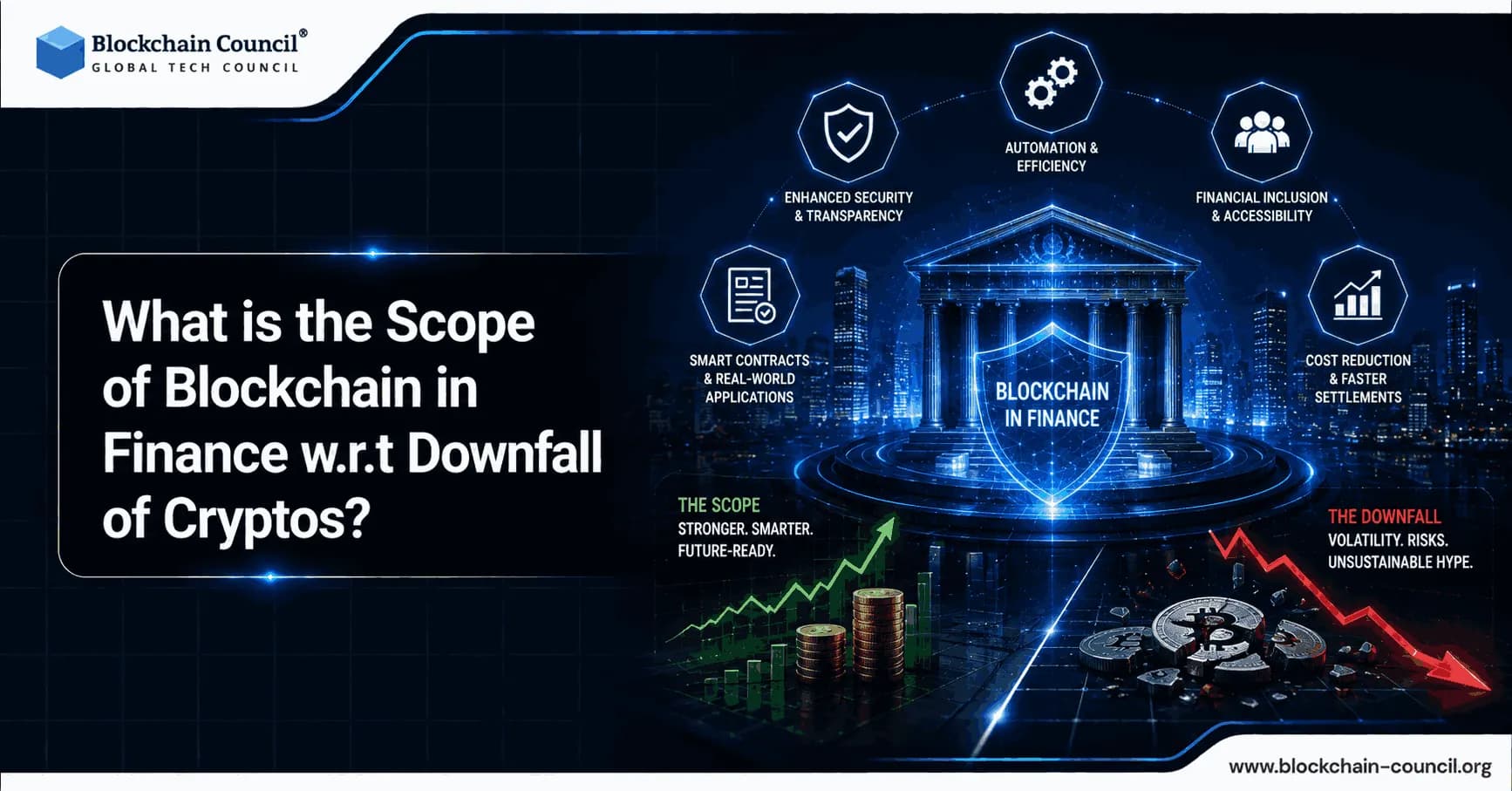
Introduction: Separating Blockchain's Future From Crypto's Volatility
Cryptocurrency markets have gone through repeated boom and bust cycles, with each downturn triggering fresh doubts about whether the technology behind it has any lasting value. Yet every time crypto prices fall sharply, blockchain itself keeps moving forward inside banks, payment networks, and financial institutions that never depended on token speculation in the first place. For finance professionals trying to make sense of where real opportunity lies amid this volatility, earning a Certified Cryptocurrency Expert credential provides a grounded understanding of how digital assets actually function, separate from the headlines about price crashes.
The distinction matters because crypto and blockchain, while related, are not the same thing. Cryptocurrency is one application built on top of blockchain, but the underlying ledger technology supports a much wider range of financial uses that do not rise or fall with Bitcoin's price chart.

Why Crypto Crashes Keep Happening
Recent downturns have shown a familiar pattern. Heavy use of leverage, thin market liquidity, and sudden macroeconomic shocks have repeatedly combined to trigger sharp sell-offs across digital asset markets. Unlike earlier crashes tied to outright fraud or the collapse of a single exchange, more recent downturns have stemmed from the sheer scale of leveraged trading positions unwinding all at once, amplified by crypto's around-the-clock trading hours and lack of the circuit breakers that traditional markets rely on.
These repeated cycles have pushed institutions and regulators to demand tighter risk controls, stronger collateral standards, and more transparent pricing mechanisms across crypto trading venues. Professionals who want to specialize specifically in how blockchain intersects with regulated financial systems, rather than crypto trading alone, often pursue a Certified Blockchain & Finance Professional credential to understand how compliance, risk management, and distributed ledger technology come together in real financial institutions.
The Difference Between Speculation and Infrastructure
Much of the panic during a crypto downturn centers on token prices, which are driven largely by speculation, sentiment, and leverage. Blockchain infrastructure, on the other hand, is increasingly being adopted for reasons that have nothing to do with price movement. Banks use permissioned ledgers to settle transactions faster and with fewer intermediaries. Payment networks are expanding stablecoin settlement options because financial institutions want faster, programmable ways to move money across borders. These use cases continue to develop regardless of whether Bitcoin is trading near its highs or deep in a downturn.
Where Blockchain Continues to Expand in Finance
Even as crypto prices swing wildly, several financial applications of blockchain have kept gaining traction. Cross-border payments represent one of the clearest examples, where distributed ledgers can settle transactions in minutes rather than days, cutting out layers of correspondent banking fees. Trade finance is another area seeing steady adoption, with blockchain-based platforms reducing paperwork and fraud risk in transactions that once relied heavily on manual verification.
Tokenization of real-world assets has also emerged as a growing trend, allowing everything from real estate to corporate bonds to be represented as digital tokens that can be traded with greater liquidity than their traditional counterparts. This shift toward asset tokenization is happening largely independent of crypto's price cycles, driven instead by institutional demand for more efficient capital markets infrastructure.
Building and maintaining this kind of infrastructure requires a broad technical skill set that goes beyond understanding blockchain alone. A well-rounded Tech Certification helps professionals develop the wider technology fluency, spanning cloud systems, data security, and software architecture, needed to support these increasingly complex financial platforms.
Future-Ready Skills
As technology becomes increasingly important across industries, students need opportunities to develop future-ready skills early in their education. A World Tech Olympiad can introduce students to areas such as artificial intelligence, coding, cybersecurity, robotics, and computational thinking while encouraging curiosity and continuous learning. Cultivating this kind of technical foundation early prepares future professionals to build the next generation of financial infrastructure with a clearer understanding of both opportunity and risk.
Regulation as a Path to Maturity
Every major crypto downturn has historically been followed by calls for stronger regulation, and this pattern shows no signs of changing. Financial analysts have long argued that increased oversight will ultimately separate projects built on genuine technology from those propped up mainly by marketing hype. While tighter regulation can feel restrictive to crypto traders in the short term, it tends to strengthen confidence in blockchain-based financial products over the long run by weeding out weak or fraudulent projects.
This regulatory maturing process also creates new career opportunities for professionals who understand both the compliance side of finance and the communication skills needed to explain these changes to clients and stakeholders. A solid Marketing Certification can help finance and technology professionals translate complex regulatory shifts and blockchain use cases into messaging that builds trust with an audience that may still associate blockchain purely with crypto's volatility.
Blockchain's role in finance is increasingly decoupling from the price swings that dominate crypto headlines. While cryptocurrency will likely continue experiencing sharp booms and busts driven by speculation and leverage, the underlying ledger technology is steadily becoming embedded in the everyday infrastructure of global finance, from cross-border settlement to asset tokenization, proving that its long-term scope extends far beyond the fate of any single digital coin.
FAQs
1. Does Blockchain Technology Still Have a Future in Finance After the Downfall of Cryptocurrencies?
Yes. The future of blockchain in finance is broader than the price performance of cryptocurrencies. Crypto assets such as Bitcoin, Ether, and thousands of speculative tokens represent only one application of blockchain and distributed-ledger technology.
The more durable financial use cases increasingly involve tokenized securities, tokenized deposits, real-world asset (RWA) tokenization, cross-border payments, settlement, collateral management, smart contracts, and programmable finance.
The IMF's 2026 work describes tokenization as a potentially structural change in financial architecture, particularly within regulated banks, asset managers, and financial-market infrastructures.
So a crypto bear market does not automatically imply a blockchain bear market.
2. What Is the Difference Between Cryptocurrency and Blockchain in Finance?
Blockchain is the underlying distributed-ledger technology, while cryptocurrency is one category of digital asset that can operate on blockchain networks.
A simplified distinction is:
Blockchain → Infrastructure
Cryptocurrency → One Application
Blockchain can support cryptocurrencies, but it can also support bonds, deposits, funds, securities, stablecoins, trade-finance assets, collateral, and other tokenized financial claims.
This distinction is crucial because the commercial viability of blockchain does not depend entirely on whether speculative cryptocurrencies rise or fall in price.
3. Why Did Many Cryptocurrencies Decline or Fail?
Cryptocurrency projects can decline for numerous reasons, including speculation, excessive leverage, weak token economics, fraud, poor governance, security breaches, regulatory intervention, insufficient utility, and lack of sustainable demand.
The underlying lesson for finance is fairly conventional: technology cannot rescue a bad asset or business model.
Blockchain can make an asset programmable and transferable. It cannot make an economically worthless asset valuable. Apparently even distributed consensus cannot persuade markets to suspend arithmetic indefinitely.
4. Can Blockchain Survive Even if Many Cryptocurrencies Fail?
Yes. Blockchain networks and distributed-ledger systems can support applications independently of speculative crypto tokens.
For example, regulated financial institutions are exploring tokenized bank deposits, government securities, bonds, funds, collateral, and settlement systems.
The BIS argues that tokenization could improve securities markets and cross-border payments by integrating transaction information, reconciliation, and settlement more closely.
Therefore:
Crypto Failure ≠ Blockchain Failure
More accurately:
Speculative Crypto Decline → Greater Focus on Practical Blockchain Applications
5. What Is the Scope of Blockchain in Banking?
Blockchain and tokenized ledgers could affect several banking functions:
Payments → Deposits → Cross-Border Transfers → Trade Finance → Lending → Collateral → Treasury Operations → Settlement
One important development is the tokenized bank deposit, which represents a conventional commercial-bank deposit on programmable infrastructure.
The BIS notes that banks are exploring tokenized deposits, particularly for wholesale applications, although their everyday use remains limited today.
The attraction is less "replace banks with crypto" and more "make existing banking infrastructure programmable."
6. How Can Blockchain Improve Cross-Border Payments?
Traditional international payments can involve multiple correspondent banks, separate databases, reconciliation, different operating hours, and settlement delays.
Tokenized infrastructure may reduce some of these frictions by coordinating payment and settlement on shared programmable ledgers.
In 2026, BIS Project Agorá demonstrated through a prototype that tokenized commercial-bank deposits and central-bank reserves could support atomic settlement of wholesale cross-border transactions across currencies and jurisdictions. The project is moving toward further testing, including real-value transactions involving selected participants and currencies.
This is a considerably less glamorous use of blockchain than meme coins, which is precisely why banks find it interesting.
7. What Is the Role of Blockchain in Asset Tokenization?
Asset tokenization represents financial or real-world assets as programmable digital tokens on distributed ledgers.
Potential examples include:
Government Bonds → Corporate Bonds → Investment Funds → Private Credit → Real Estate → Commodities → Deposits
Blockchain can provide infrastructure for issuance, ownership records, transfers, servicing, settlement, and redemption.
The IMF argues that tokenization could reduce certain inefficiencies across the asset lifecycle, including issuance, servicing, redemption, trading, and settlement, although it may also introduce new risks.
8. What Is the Scope of RWA Tokenization in Finance?
Real-World Asset tokenization is one of the strongest potential bridges between traditional finance and blockchain.
Instead of creating purely speculative crypto assets, RWA systems represent claims connected to existing assets such as:
Treasury Securities → Bonds → Private Credit → Funds → Real Estate → Commodities
The token may represent ownership, debt, fund interests, revenue rights, or another legally defined financial claim.
The BIS notes that tokenization can represent conventional financial assets, physical assets such as real estate, and other issuer-backed claims.
9. Can Blockchain Be Used in Stock and Bond Markets?
Yes. Securities are a major potential application of tokenized finance.
A traditional securities transaction may involve:
Trade → Clearing → Reconciliation → Settlement
Tokenized infrastructure could potentially combine several stages:
Trade + Asset Transfer + Payment + Settlement
The IMF highlights atomic settlement, where delivery of the asset and payment can occur simultaneously, as an important capability of tokenized finance.
European tokenized capital markets have already moved beyond pure experimentation. An ECB Executive Board member stated in March 2026 that European issuers had placed close to €4 billion of DLT-based fixed-income instruments since 2021.
10. What Is Atomic Settlement in Blockchain Finance?
Atomic settlement means that the transfer of an asset and its corresponding payment occur simultaneously or not at all.
Suppose Bank A buys a tokenized bond from Bank B.
Traditional infrastructure may involve multiple settlement steps. With atomic delivery-versus-payment:
Tokenized Bond Transfer ↔ Tokenized Payment
Both sides execute together.
This can potentially reduce counterparty and settlement risk. However, the IMF also notes that continuous settlement can increase demands for real-time liquidity management and can transmit stress more quickly.
Efficiency, as finance repeatedly discovers, tends to arrive carrying new risk-management homework.
11. How Can Smart Contracts Be Used in Finance?
Smart contracts are programs that automatically execute predefined financial rules on programmable ledgers.
Potential financial applications include:
Coupon Payments → Interest Calculations → Collateral Transfers → Margin Calls → Loan Repayment → Asset Redemption → Compliance Checks
For example, a tokenized bond could potentially automate coupon-related processes according to predetermined conditions.
The IMF identifies programmability as a defining feature of tokenized finance and notes that financial logic such as collateral transfers and coupon payments can be embedded into code.
12. What Is the Scope of Blockchain in Trade Finance?
Trade finance involves multiple participants, including buyers, sellers, banks, insurers, logistics companies, customs authorities, and document providers.
Blockchain-based systems could potentially create shared records for:
Invoices → Letters of Credit → Shipping Documents → Payments → Ownership Transfers → Financing
Smart contracts could also make payments conditional on verified events, such as proof that goods have been delivered.
The Bank of England has highlighted programmable payments as a potential mechanism for linking payment directly to delivery or proof of identity, potentially reducing delays and fraud.
13. What Is the Role of Blockchain in Collateral Management?
Collateral management is a particularly interesting institutional blockchain application.
Financial institutions constantly move collateral to support loans, derivatives, securities transactions, and other exposures.
Tokenized assets could potentially allow collateral to be transferred, verified, pledged, released, and monitored through programmable infrastructure.
The BIS notes that tokenization can bring trading, settlement, and collateral management closer together, potentially improving the use of liquidity and collateral while reducing reconciliation costs.
14. Will Blockchain Replace Banks and Traditional Financial Institutions?
Probably not. A more realistic outcome is that blockchain becomes part of their infrastructure.
The emerging model increasingly looks like:
Traditional Financial Institution + Regulation + Tokenization + Programmable Ledger
rather than:
Blockchain − Banks = Future Finance
The IMF argues that many of the most consequential developments in tokenized finance are occurring within regulated banks, asset managers, and financial-market infrastructures, often using permissioned systems.
Banks may change technologically without disappearing institutionally.
15. What Is the Role of Tokenized Deposits in the Future of Finance?
Tokenized deposits are digital representations of commercial-bank deposits on programmable ledgers.
Unlike an unbacked cryptocurrency, a tokenized deposit remains a liability of the issuing commercial bank and is intended to retain its relationship with conventional bank money.
Potential applications include:
Wholesale Payments → Treasury Management → Securities Settlement → Smart-Contract Payments → Cross-Border Transactions
The BIS sees tokenized commercial-bank money, central-bank reserves, and government securities as important components of a potential future tokenized financial system.
16. Will Stablecoins Have a Role in Blockchain Finance?
Probably, but their future role remains contested and highly dependent on regulation, reserves, interoperability, and jurisdiction.
Stablecoins can provide blockchain-native settlement, cross-border transfers, programmable payments, and access to digital representations of fiat currencies.
At the same time, regulators and international institutions identify risks involving runs, reserve quality, fragmentation, currency substitution, financial stability, and monetary sovereignty. The IMF notes that stablecoins have become important in cross-border crypto activity, particularly in some emerging markets.
The BIS remains more cautious, arguing that current stablecoin arrangements have structural shortcomings as forms of money.
17. What Are the Main Risks of Using Blockchain in Finance?
Blockchain does not eliminate financial risk. It changes some risks and creates others.
Important risks include:
Smart Contract Risk: faulty code or exploits.
Oracle Risk: incorrect external data.
Cybersecurity Risk: compromised keys, wallets, infrastructure, or networks.
Liquidity Risk: insufficient settlement liquidity.
Legal Risk: uncertainty regarding token ownership and enforceability.
Operational Risk: failures in blockchain infrastructure.
Interoperability Risk: incompatible platforms.
Concentration Risk: dependence on critical infrastructure providers.
Regulatory Risk: inconsistent rules across jurisdictions.
The IMF warns that tokenized finance could transmit shocks more rapidly because automated collateral calls, settlement, and other processes operate continuously.
18. Does the Downfall of Speculative Cryptos Actually Help Blockchain Adoption?
In some respects, it can.
Crypto market failures force investors, regulators, and financial institutions to distinguish between speculative tokens and useful distributed-ledger infrastructure.
The emerging institutional conversation is therefore moving toward questions such as:
Can blockchain reduce settlement friction?
Can securities be tokenized safely?
Can collateral move more efficiently?
Can cross-border payments improve?
Can compliance be embedded into programmable transactions?
That shift from "Which coin will rise?" toward "Which financial process can this technology improve?" is arguably healthier for blockchain's long-term development.
19. What Skills Will Be Needed for Careers in Blockchain Finance?
The strongest career opportunities may increasingly require a combination of blockchain technology and conventional finance.
A useful technical path is:
Blockchain → Ethereum/EVM → Solidity → Smart Contracts → Security → Tokenization
Then add financial knowledge:
Banking → Capital Markets → Securities → Payments → Settlement → Collateral → Compliance
Advanced professionals can specialize in:
RWA Tokenization → Tokenized Securities → Digital Assets → Institutional DeFi → Smart Contract Security → Blockchain Payments → Financial Market Infrastructure
The IMF's 2026 research suggests that record-keeping, settlement, collateral management, and reporting could increasingly move on-chain, while legal certainty, governance, accountability, and discretionary functions remain institutional responsibilities.
That means future blockchain-finance professionals will need to understand both worlds.
20. What Is the Future Scope of Blockchain in Finance After Crypto Market Downfalls?
The strongest long-term case for blockchain in finance is probably not the endless creation of speculative cryptocurrencies. It is the development of programmable financial infrastructure.
The future scope potentially includes:
Tokenized Deposits → RWA Tokenization → Digital Bonds → Tokenized Funds → Private Credit → Cross-Border Payments → Collateral Management → Smart Contracts → Trade Finance → Institutional Digital Assets → Atomic Settlement
Current evidence supports cautious optimism rather than technological evangelism. The IMF describes tokenization as potentially restructuring how financial assets, settlement, liquidity, and risk management operate, while emphasizing the need for legal certainty, safe settlement assets, governance, and international coordination.
The BIS similarly sees substantial potential in tokenized central-bank money, commercial-bank deposits, government securities, cross-border payments, and securities markets, while warning against assuming that every crypto-based form of money is equally sound.
A useful way to summarize the evolution is:
Blockchain 1.0 → Cryptocurrency
Blockchain 2.0 → Smart Contracts
Blockchain 3.0 → DeFi and Digital Assets
Blockchain in Finance → Tokenization + Payments + Settlement + Programmable Assets + Regulated Infrastructure
So the downfall of individual cryptocurrencies does not necessarily signal the downfall of blockchain in finance. It may instead accelerate the separation between speculative crypto products and useful blockchain infrastructure.
Crypto prices can collapse. A bad token can disappear. An exchange can fail. None of those events automatically answers whether a shared programmable ledger can make securities settlement, collateral management, or cross-border payments more efficient.
Finance, after all, has survived countless failed products without deciding to abolish databases. Blockchain is likely to face the same less dramatic and much more useful test.
Related Articles
View All
Blockchain
Blockchain in Banking and Finance: Use Cases, Benefits, and Future Trends
Explore blockchain in banking and finance, including payments, tokenization, custody, lending, trade finance, compliance, benefits, and future trends.

Blockchain
Why Blockchain Is the Future of Digital Trust, Finance, and Data Security
Blockchain is becoming core infrastructure for digital trust, finance, and data security through shared ledgers, stablecoins, smart contracts, and verifiable records.

Blockchain
Beyond Cryptocurrency: How Blockchain Is Transforming Real-World Industries
Explore how blockchain works beyond cryptocurrency in banking, supply chains, healthcare, tokenisation, CBDCs, and government, plus key challenges and career paths.
Trending Articles
The Role of Blockchain in Ethical AI Development
How blockchain technology is being used to promote transparency and accountability in artificial intelligence systems.

Top 5 DeFi Platforms
Explore the leading decentralized finance platforms and what makes each one unique in the evolving DeFi landscape.

Can DeFi 2.0 Bridge the Gap Between Traditional and Decentralized Finance?
The next generation of DeFi protocols aims to connect traditional banking with decentralized finance ecosystems.