

How AI and Blockchain Can Help You Earn a Passive Income?
 Toshendra Kumar Sharma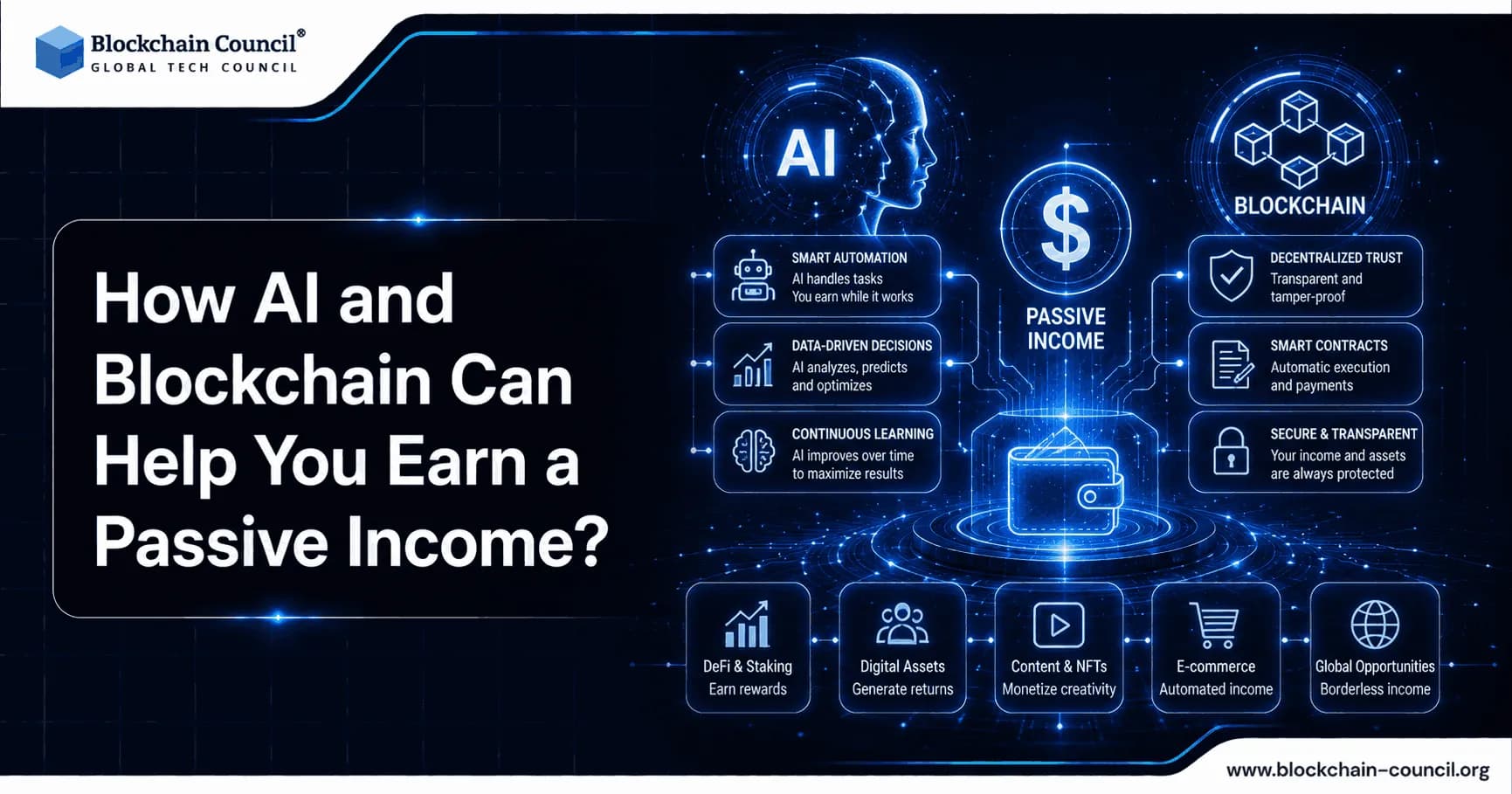
Passive income built on blockchain has moved well past its speculative early years into something with real, measurable structure. Consistent, risk-adjusted returns of roughly 4 to 10 percent on crypto assets, paid in stablecoins or the staked asset itself, are genuinely achievable in 2026 through mechanisms like staking and lending. Layer this with artificial intelligence, increasingly used to optimize capital rotation, automate yield strategies, and manage risk across DeFi protocols in real time, and the combination offers a meaningfully more sophisticated approach than either technology delivers alone. That said, this article is for informational purposes only and does not constitute financial advice. Every mechanism described here carries real risk, and understanding that risk clearly is just as important as understanding the potential reward.
Building genuine literacy in how these systems actually generate returns, rather than relying on marketing claims from any single platform, starts with real technical grounding. Blockchain Council's Certified Blockchain Expert credential gives investors and technologists the foundation needed to evaluate blockchain-based income strategies on genuine mechanics rather than promotional promises.

The Core Blockchain-Based Passive Income Mechanisms
Staking
Staking involves locking cryptocurrency to help validate transactions on a Proof of Stake blockchain, earning rewards in return, similar in concept to earning interest but structurally different, since staked tokens remain your own property rather than being lent to anyone. Yields vary considerably by network. Ethereum staking has recently ranged between roughly 3.5 and 4.8 percent, Solana between about 5 and 8 percent, and networks like Cosmos have offered considerably higher headline yields, in the range of 14 to 19.5 percent, though high yields on newer or higher-inflation networks often reflect token inflation that can quietly erode the real value of the rewards you actually receive.
Liquid Staking
Traditional staking locks your tokens for a defined period, but liquid staking solves that constraint by issuing a receipt token, like stETH for Ethereum, representing your staked position. That receipt token remains usable elsewhere in DeFi while your underlying stake continues earning rewards, giving you both yield and flexibility simultaneously. Lido, the dominant liquid staking platform, has managed close to 19.4 billion dollars in total value locked, reflecting just how mainstream this specific mechanism has become.
Lending
DeFi lending lets you supply crypto assets, often stablecoins, to decentralized protocols like Aave or Compound, earning interest directly from borrowers without a bank or traditional intermediary standing in the middle. This approach is particularly attractive for investors who want yield without direct exposure to cryptocurrency price volatility, since stablecoin-denominated lending returns are not tied to a fluctuating token price the way staking rewards on a volatile asset can be.
Yield Farming And Liquidity Provision
Yield farming involves supplying assets to a liquidity pool on a decentralized exchange, earning a share of trading fees plus, in many cases, additional reward tokens. Returns can be considerably higher than staking or lending, sometimes exceeding 20 to 30 percent in headline terms, but the risk profile is meaningfully higher too, including impermanent loss, a reduction in value that occurs when the price of pooled assets shifts relative to each other, even when both assets individually gained value.
Where Artificial Intelligence Actually Adds Value
This is where the combination genuinely becomes more than the sum of its parts. AI is increasingly used within DeFi protocols specifically to optimize capital rotation, automatically shifting funds between staking, lending, and liquidity positions based on real-time yield and risk conditions rather than requiring an investor to monitor and manually rebalance every position themselves. Predictive analytics tools now help identify which protocols and pools offer the strongest risk-adjusted returns at a given moment, while AI-driven risk assessment can flag smart contract vulnerabilities or unusual protocol behavior faster than manual due diligence typically allows.
Genuinely understanding how these AI systems make decisions, and what their real limitations are, requires fluency in artificial intelligence as much as blockchain mechanics. Blockchain Council's Certified Artificial Intelligence (AI) Expert credential complements blockchain-specific knowledge well here, giving investors and builders the grounding needed to evaluate AI-driven yield tools critically rather than trusting an automated system's decisions blindly simply because it is labeled AI-powered.
Real-World Asset Tokenization: A Newer, Steadier Yield Source
Beyond traditional crypto-native strategies, platforms are increasingly introducing tokenized real-world assets, government treasury bills, private credit, and invoices among them, as a source of yield that behaves more predictably than purely crypto-denominated returns. This approach ties blockchain-based passive income more directly to traditional financial instruments, potentially offering steadier, less volatile returns for investors specifically looking to reduce their exposure to cryptocurrency price swings while still earning yield through on-chain mechanisms.
The Risks Nobody's Marketing Materials Emphasize Enough
Every mechanism above carries genuine risk that deserves equal weight to the potential returns. Smart contract vulnerabilities remain a persistent threat across staking, lending, and yield farming protocols alike, even well-audited platforms have suffered exploits. Token price volatility can erode or entirely eliminate the value of rewards paid in a protocol's native token, particularly when headline APY figures do not account for how much that token's price typically declines over time. Validator slashing penalties can reduce or damage your staked principal if a validator misbehaves or experiences extended downtime. And impermanent loss remains a genuine, frequently underestimated risk for anyone providing liquidity to a trading pool. Diversification, sticking to audited, high-TVL protocols with genuine track records, and never committing funds you cannot afford to lose all remain fundamental, unglamorous risk management practices that headline-chasing guides often understate.
Building or evaluating the actual infrastructure behind these AI-driven yield strategies, rather than trusting a platform's own claims about its technology, requires serious technical capability. A Tech Certification in blockchain development gives technically minded investors and builders the practical skills needed to read smart contract code, verify audits, and understand genuinely how a protocol generates the returns it advertises.
Roles, Skills, And Careers In This Growing Space
DeFi Protocol Developers
Building the smart contracts and automated strategies underlying staking, lending, and yield optimization platforms has become a genuinely specialized, well-compensated engineering discipline, requiring deep security awareness alongside core blockchain development skill.
AI-Driven Yield Strategy Analysts
As more protocols integrate AI for capital rotation and risk assessment, demand is growing for analysts who understand both the underlying AI models and the DeFi mechanics they are optimizing, a genuinely hybrid role bridging two fast-moving fields.
Smart Contract Auditors
Given how much passive income infrastructure depends on trusting code to behave correctly, auditors capable of identifying vulnerabilities before they are exploited represent one of the most consequential and in-demand specializations across the entire DeFi ecosystem.
Tokenization And RWA Structuring Specialists
As real-world asset tokenization expands as a yield source, professionals who understand how to structure these products compliantly, bridging traditional finance and blockchain infrastructure, are becoming an increasingly valuable specialization in their own right.
Building Future-Ready Skills
As technology becomes increasingly important across industries, students need opportunities to develop future-ready skills early in their education. A Tech Olympiad can introduce students to areas such as artificial intelligence, coding, cybersecurity, robotics, and computational thinking while encouraging curiosity and continuous learning. Early, structured exposure to both AI and blockchain thinking is exactly what tends to produce the professionals capable of building and evaluating the increasingly sophisticated financial technology shaping how people earn passive income in the years ahead.
Communicating Genuine Value Without Overpromising
Given how much hype surrounds crypto passive income claims, platforms and educators genuinely committed to helping people understand these mechanisms responsibly face a real communication challenge, explaining legitimate opportunity clearly without slipping into the exaggerated promises that have damaged trust in this space repeatedly. A Marketing Certification rounds out that responsibility well, helping platforms and educators communicate blockchain and AI-driven income strategies honestly, with risk clearly represented alongside potential reward, rather than contributing to another cycle of overhyped promises.
Final Thoughts
AI and blockchain together offer genuinely more sophisticated tools for generating passive income than either technology provides alone, staking, lending, liquidity provision, and increasingly, AI-optimized capital rotation and tokenized real-world assets all represent real, functioning mechanisms rather than speculative theory. But genuine opportunity here comes paired with genuine risk, smart contract vulnerabilities, token volatility, and the ever-present possibility of losing principal, and no amount of AI-driven optimization eliminates that risk entirely. Approaching this space with real technical understanding, healthy skepticism toward headline APY figures, and a firm grasp of your own risk tolerance remains the most reliable path toward using these tools responsibly.
FAQs
1. Can AI and blockchain help generate passive income?
Yes, AI and blockchain can support income streams that require less day-to-day manual work, but neither technology guarantees passive income. Examples include AI-assisted digital products, blockchain-based royalties, tokenized assets, decentralized finance, and automated digital services.
Most so-called passive-income models still require initial work, capital, maintenance, monitoring, or risk management.
2. How can AI help generate passive income?
AI can automate or accelerate tasks involved in creating and managing digital assets and businesses. For example, AI can help with content creation, market research, customer support, data analysis, product development, and workflow automation.
The income comes from the underlying business or asset, not from AI simply generating money by itself.
3. How can blockchain help generate passive income?
Blockchain can support income opportunities through mechanisms such as staking, tokenized assets, royalties, decentralized finance, and digital ownership.
However, blockchain-based income can involve substantial risks, including market volatility, smart-contract vulnerabilities, liquidity risks, and regulatory uncertainty.
4. What is AI-powered passive income?
AI-powered passive income refers to revenue generated from a product, service, or asset where AI automates part of the ongoing work.
Examples include:
AI-assisted digital products
Automated content workflows
AI-powered software tools
Automated customer-support systems
AI-assisted affiliate businesses
Data-analysis services
The goal is not zero work but reducing repetitive work through automation.
5. What blockchain-based passive income opportunities exist?
Depending on the asset and jurisdiction, blockchain-based opportunities may include:
Staking
Tokenized assets
Blockchain-based royalties
DeFi lending
Liquidity provision
Digital-asset ownership
Decentralized applications
Returns are not guaranteed, and some strategies can result in partial or complete loss of capital.
6. Can AI and blockchain be combined for passive income?
Yes. AI and blockchain can complement each other.
For example:
AI → creates or manages digital content/product → Blockchain → records ownership or enables payments → Automated system → Generates revenue
Another example could involve AI analyzing business data while blockchain handles ownership, payments, or transparent transaction records.
7. Can AI create digital products that generate recurring income?
Yes. AI can help create products such as templates, educational resources, design assets, software tools, research reports, and workflow systems.
Once published on an appropriate marketplace or website, a digital product can potentially generate recurring sales without requiring the creator to reproduce it manually for every customer.
8. Can blockchain royalties create passive income?
Blockchain-based systems can enable royalty mechanisms for certain digital assets. A smart contract or marketplace infrastructure may automate royalty distributions according to predefined rules.
However, royalty enforcement and payment behavior depend on the platform, smart contract, marketplace, and applicable legal framework. Blockchain does not guarantee royalties in every secondary transaction.
9. Can AI help automate a digital business?
Yes. AI can automate parts of a digital business, including:
Customer inquiries
Content drafting
Lead qualification
Data analysis
Email workflows
Product recommendations
Reporting
Internal processes
Human oversight remains important because AI-generated output can contain errors or misleading information.
10. Can AI and blockchain help create automated online services?
Yes. A business could combine AI for automation and decision support with blockchain for payments, digital ownership, verification, or transaction records.
For example, an AI-powered service could generate customized reports while blockchain infrastructure handles digital payments or verifies ownership of a digital credential.
11. Can blockchain staking provide passive income?
Staking can potentially generate rewards for participants who help secure or operate certain proof-of-stake blockchain networks.
However, staking is not risk-free passive income. The value of the underlying asset can fall, rewards can change, and some networks or staking arrangements involve lock-up periods, validator risks, or slashing mechanisms.
12. Can DeFi generate passive income?
Some DeFi protocols offer mechanisms through which users may earn interest, fees, or token rewards by supplying liquidity or assets.
However, DeFi carries risks including:
Smart-contract exploits
Impermanent loss
Token-price volatility
Liquidity risk
Protocol failure
Oracle manipulation
Regulatory risk
High advertised yields should not automatically be interpreted as reliable passive income.
13. Can AI help identify passive-income opportunities?
AI can help analyze market trends, business models, financial information, and datasets, potentially making research faster.
It should not be treated as a guaranteed investment adviser or profit generator. AI outputs need to be independently verified, particularly when financial decisions are involved.
14. Can blockchain help monetize digital content created with AI?
Potentially. Creators can combine AI-assisted production with blockchain-based systems for digital ownership, tokenization, payments, or royalty mechanisms.
For example, an AI-assisted creator could sell digital artwork, educational resources, templates, or other digital products while using blockchain infrastructure for ownership or payment records.
15. Can AI generate cryptocurrency trading income automatically?
AI can be used to develop algorithmic trading systems that analyze market data and execute predefined strategies. However, automated trading is not guaranteed to be profitable.
Cryptocurrency markets can be highly volatile, and models can fail because of unexpected market conditions, poor data, technical errors, fees, or overfitting.
16. What are the risks of AI and blockchain passive-income strategies?
Major risks include:
Cryptocurrency price volatility
Scams and fraudulent projects
Smart-contract vulnerabilities
AI-generated misinformation
Cybersecurity attacks
Regulatory changes
Platform dependency
Loss of private keys
Market liquidity problems
Unexpected operating costs
A sustainable income strategy should prioritize risk management rather than promised returns.
17. How much money do I need to start earning passive income with AI and blockchain?
There is no universal minimum. Some AI-based digital businesses can begin with relatively little capital, while blockchain-based strategies may require cryptocurrency or other assets.
The more important questions are how much risk you can afford, what skills you have, and whether you are building an asset or simply speculating on an investment.
18. Is AI or blockchain better for passive income?
Neither is universally better.
AI may be more suitable for building scalable digital products, services, and automation-based businesses.
Blockchain may be more suitable for digital ownership, tokenized assets, decentralized applications, and certain blockchain-native financial mechanisms.
For many entrepreneurs, combining AI with a real customer-focused business model may be more sustainable than relying solely on speculative crypto returns.
19. How can beginners start using AI and blockchain for passive income?
A beginner could follow a relatively conservative progression:
Learn the fundamentals of AI and blockchain.
Identify a genuine customer problem.
Use AI to create or automate a useful product or service.
Build an audience or distribution channel.
Add blockchain only where it provides a genuine benefit.
Test the business with a small budget.
Automate repetitive processes.
Track revenue, expenses, and risks.
Reinvest selectively.
Continue improving the product.
This approach focuses on creating value rather than chasing guaranteed returns.
20. What is the future of AI and blockchain for passive income?
The combination could create new opportunities around AI agents, automated businesses, tokenized real-world assets, digital ownership, decentralized marketplaces, smart contracts, and programmable payments.
AI can provide automation and intelligence, while blockchain can provide infrastructure for ownership, verification, payments, and coordination.
The biggest opportunity may not be completely passive income, but semi-automated income streams where technology handles repetitive work while humans provide strategy, creativity, oversight, and accountability.
Related Articles
View All
Blockchain
How Certification Can Help You Become a Blockchain Product Manager
Learn how certification builds blockchain knowledge, credibility, and practical product skills for aspiring blockchain product managers.

Blockchain
Beyond Cryptocurrency: How Blockchain Is Transforming Real-World Industries
Explore how blockchain works beyond cryptocurrency in banking, supply chains, healthcare, tokenisation, CBDCs, and government, plus key challenges and career paths.
Blockchain
Smart Contracts & dApps: How Blockchain Becomes Programmable
Learn how smart contracts and dApps make blockchain programmable, from Ethereum and tokens to DeFi, NFTs, real use cases, benefits, and key risks.
Trending Articles

Top 5 DeFi Platforms
Explore the leading decentralized finance platforms and what makes each one unique in the evolving DeFi landscape.

Can DeFi 2.0 Bridge the Gap Between Traditional and Decentralized Finance?
The next generation of DeFi protocols aims to connect traditional banking with decentralized finance ecosystems.
How to Install Claude Code
Learn how to install Claude Code on macOS, Linux, and Windows using the native installer, plus verification, authentication, and troubleshooting tips.