

Guide to some Crypto Terms
 Toshendra Kumar Sharma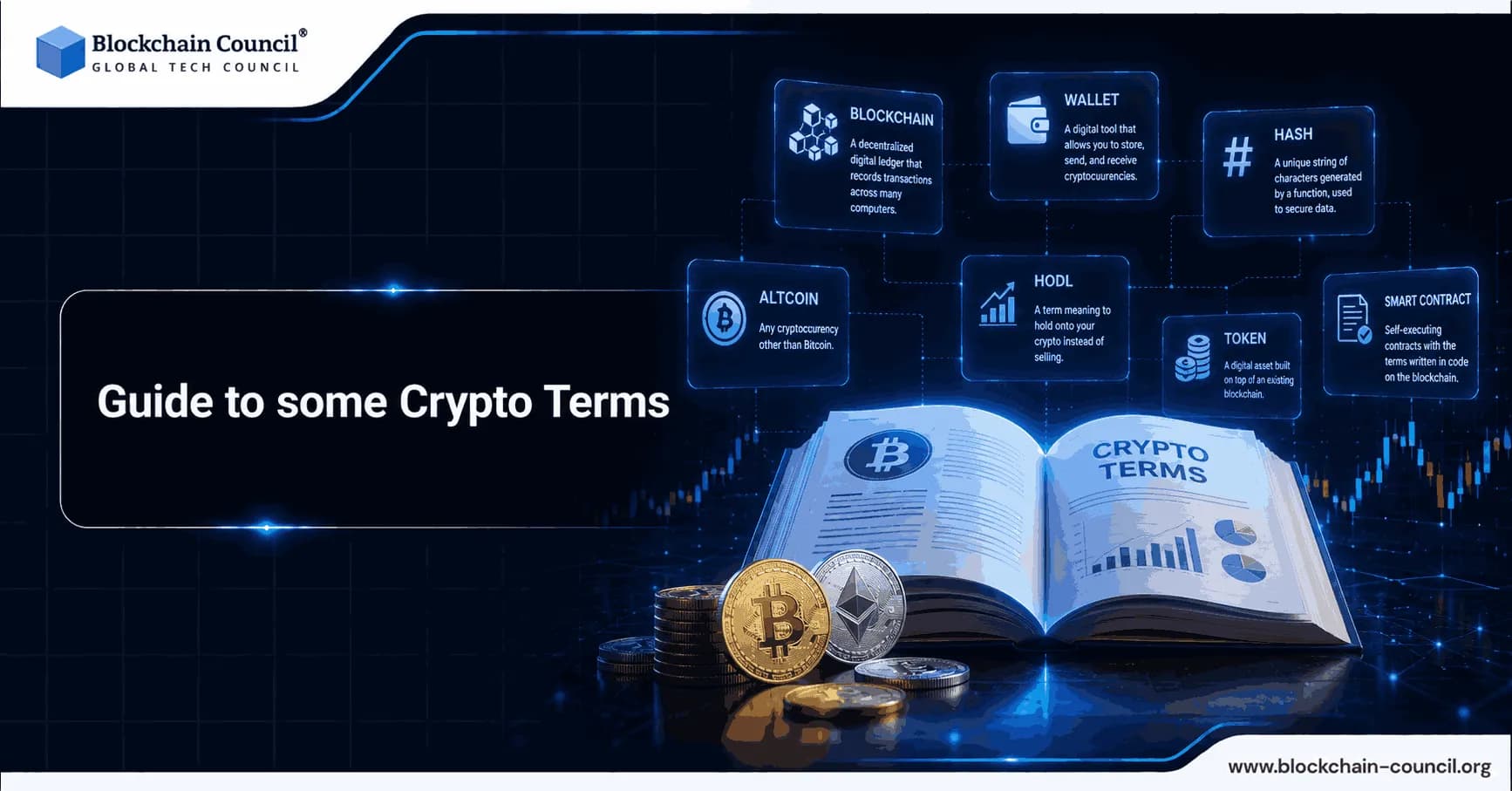
Cryptocurrency has its own vocabulary, and that vocabulary keeps expanding as the industry matures. What started with a handful of terms like blockchain and mining has grown to include staking, tokenization, and decentralized infrastructure, each describing a genuinely different piece of how this technology works. This guide breaks down the terms you are most likely to encounter today, whether you are reading a news headline or evaluating your first investment. Building real fluency in this vocabulary is exactly what a Certified Cryptocurrency Expert program is designed to teach, since understanding the terminology correctly is the first step toward understanding the technology itself.
Foundational Terms Everyone Should Know
Blockchain
A blockchain is a distributed, tamper resistant ledger that records transactions across a network of computers rather than a single central server. Once data is added to the chain, changing it would require altering every subsequent block across a majority of the network, which is what makes blockchains so resistant to fraud and manipulation.

Cryptocurrency
Cryptocurrency is digital money secured by cryptography and typically issued on a blockchain rather than by a government or bank. Bitcoin was the first cryptocurrency, but thousands now exist, each with different purposes ranging from simple payments to powering entire application ecosystems.
Wallet
A crypto wallet is the tool used to store, send, and receive cryptocurrency. It does not actually hold coins the way a physical wallet holds cash. Instead, it stores the cryptographic keys that prove ownership of assets recorded on the blockchain.
Private Key and Public Key
A private key is a secret cryptographic code that gives its holder full control over the crypto assets tied to it, and it should never be shared with anyone. A public key, generated from the private key, is what others use to send you funds. Losing a private key generally means losing access to the associated assets permanently, since there is no central authority to reset it.
Terms Around Blockchain Infrastructure
Understanding how blockchains actually operate under the hood is where a deeper, structured education makes the biggest difference. This is the layer covered extensively in a Certified Blockchain Expert curriculum, which goes beyond definitions to explain how these mechanisms interact in real, live networks.
Consensus Mechanism
A consensus mechanism is the process a blockchain network uses to agree on which transactions are valid and in what order they occurred. Proof of Work and Proof of Stake are the two most common models, each with different trade offs around energy use, speed, and security.
Proof of Stake
Proof of Stake is a consensus mechanism where validators lock up, or stake, a certain amount of cryptocurrency as collateral in exchange for the right to validate transactions and earn rewards. It replaced energy intensive mining as the dominant model on many major networks because it achieves similar security guarantees with a fraction of the electricity use.
Staking
Staking is the act of locking up cryptocurrency to help secure a Proof of Stake network in exchange for rewards, similar in spirit to earning interest. It has become one of the most common ways everyday holders put their crypto to productive use rather than leaving it idle.
Restaking
Restaking allows crypto that is already staked on one network to be reused to help secure additional protocols at the same time, effectively letting the same capital provide security across multiple systems simultaneously. It has become one of the more closely watched infrastructure trends of the past two years, since it introduces new efficiency but also new risk if something goes wrong across the layered systems.
Layer 2
A Layer 2 is a separate network built on top of a base blockchain, like Ethereum, designed to process transactions faster and more cheaply while still relying on the base chain for final security and settlement. Layer 2 networks have become essential infrastructure as base chains struggled to handle rising transaction demand on their own.
Smart Contract
A smart contract is self executing code stored on a blockchain that automatically carries out an agreement once predefined conditions are met. Smart contracts remove the need for a middleman to enforce a deal, powering everything from decentralized lending to automated payments.
Terms Shaping Crypto in 2026
The vocabulary around crypto keeps evolving alongside the technology, and several newer terms have become essential to understanding where the industry is heading right now.
Real World Assets
Real World Assets, often shortened to RWAs, refers to conventional financial assets like bonds, real estate, or private credit that get issued as blockchain tokens representing ownership rights to the underlying asset. Tokenized government treasuries have become one of the fastest growing categories in this space, with major asset managers increasingly treating on chain issuance as standard infrastructure rather than an experiment.
Stablecoin
A stablecoin is a cryptocurrency designed to hold a steady value, usually pegged one to one with a currency like the US dollar. Stablecoins have grown into a genuine payments rail, with outstanding stablecoin value reaching roughly 300 billion dollars and monthly transaction volume now regularly surpassing major traditional payment networks.
DePIN
DePIN stands for Decentralized Physical Infrastructure Networks, a category of projects that use token incentives to build and operate real world infrastructure like wireless networks, computing power, or data storage, without relying on a single centralized company to own and run it all. This category has expanded rapidly as demand for distributed computing power, driven partly by AI workloads, has grown alongside it.
Tokenization
Tokenization is the process of converting rights to an asset, whether that is a share of real estate, a bond, or a piece of art, into a digital token on a blockchain. It allows assets that were traditionally illiquid or difficult to divide to be bought, sold, and transferred more efficiently.
Decentralized Finance
Decentralized Finance, commonly called DeFi, refers to financial services like lending, borrowing, and trading built on blockchain networks rather than through traditional banks or brokers. DeFi protocols use smart contracts to automate these services, letting users interact directly with the protocol instead of a financial institution.
Putting the Vocabulary to Work
Knowing these terms is a starting point, not an end point. Real fluency comes from understanding how blockchain infrastructure, tokenized assets, and decentralized finance all connect within the broader technology landscape, which is exactly the kind of well rounded foundation a Tech Certification is built to provide, helping learners place crypto specific knowledge within the wider context of the technologies it increasingly overlaps with, from AI to distributed computing.
Understanding this vocabulary also matters for anyone trying to explain crypto clearly to someone else, whether that is a client, an investor, or a curious friend. Jargon that makes perfect sense to an experienced trader often confuses a newcomer completely, and translating these concepts into language a general audience actually understands is a skill in its own right. That is precisely what a Marketing Certification helps build, giving crypto professionals and educators the communication tools needed to make this vocabulary accessible rather than intimidating.
Crypto terminology will keep expanding as the technology does, but the fundamentals covered here form the base that every newer term builds on. Once wallets, consensus mechanisms, and tokenization make sense, keeping up with whatever comes next becomes a far easier task.
Future-Ready Skills
As technology becomes increasingly important across industries, students need opportunities to develop future-ready skills early in their education. A Tech Olympiad can introduce students to areas such as artificial intelligence, coding, cybersecurity, robotics, and computational thinking while encouraging curiosity and continuous learning.
FAQs
1. What is cryptocurrency?
Cryptocurrency is a digital asset that uses cryptography and typically operates on a blockchain or another distributed network.
Examples include:
Bitcoin (BTC)
Ether (ETH)
Solana (SOL)
Cryptocurrencies can be used for payments, network fees, investment, decentralized applications, governance, and other purposes depending on their design.
2. What is blockchain?
A blockchain is a distributed digital ledger that records transactions or other data in a sequence of cryptographically linked blocks.
Copies of the ledger can be maintained by many network participants, making unauthorized historical changes difficult.
Blockchain is the underlying technology used by Bitcoin, Ethereum, and many other decentralized networks.
3. What is the difference between a coin and a token?
A coin is generally the native asset of its own blockchain.
Examples include:
BTC on Bitcoin
ETH on Ethereum
SOL on Solana
A token is generally created through smart contracts or protocols operating on an existing blockchain.
Examples include stablecoins, governance tokens, utility tokens, and tokenized real-world assets.
4. What is a crypto wallet?
A crypto wallet is software or hardware used to manage the cryptographic keys required to interact with blockchain assets.
Cryptocurrency is not literally stored inside the wallet. The blockchain records the assets, while the wallet manages the keys that allow transactions to be authorized.
Common types include:
Hardware wallets
Mobile wallets
Desktop wallets
Browser wallets
Smart-contract wallets
5. What are public and private keys?
A private key is secret cryptographic information used to authorize transactions.
A public key is mathematically derived from the private key and can be used in transaction verification.
A wallet address is generally derived from or associated with public-key information.
The private key must remain secret. Anyone who obtains it may be able to control the associated assets.
6. What is a seed phrase?
A seed phrase, also called a recovery phrase, is a sequence of words used by many wallets to recover cryptographic keys.
Anyone with the correct recovery phrase may be able to recreate the wallet and access its assets.
Users should never:
Share it with anyone
Photograph it
Email it
Store it in ordinary cloud storage
Enter it into an unknown website
There is no helpful blockchain employee waiting behind a "Forgot seed phrase?" button. Decentralization has certain customer-service consequences.
7. What is a hot wallet and a cold wallet?
A hot wallet is connected or routinely exposed to the internet and is convenient for frequent transactions.
A cold wallet keeps private keys offline or strongly isolated from internet-connected systems.
Hot wallets prioritize convenience, while cold storage generally provides stronger protection against remote attacks and is often used for long-term holdings.
8. What is a cryptocurrency exchange?
A cryptocurrency exchange is a platform where users can buy, sell, and trade digital assets.
There are two broad categories:
Centralized Exchange (CEX): Operated by a company that manages the trading platform and usually provides custody services.
Decentralized Exchange (DEX): Uses blockchain-based smart contracts to facilitate transactions without a traditional centralized exchange operator controlling the trade.
9. What are gas fees?
Gas fees are transaction fees paid for computation and network resources on certain blockchains, particularly Ethereum and Ethereum-compatible networks.
Gas fees can apply when users:
Transfer tokens
Swap assets
Mint NFTs
Interact with smart contracts
Use DeFi applications
Fees vary depending on network design, transaction complexity, and demand.
10. What is a smart contract?
A smart contract is a program deployed on a blockchain that executes predefined logic.
Smart contracts can support:
Token transfers
Decentralized exchanges
Lending
Insurance
NFTs
Games
Escrow
Governance
Automated payments
Smart contracts are powerful, but bugs can lead to financial losses, which is why security audits matter.
11. What are Proof of Work and Proof of Stake?
Proof of Work (PoW) and Proof of Stake (PoS) are consensus mechanisms used to help blockchain networks agree on valid transactions.
Proof of Work: Participants called miners use computational resources to secure the network. Bitcoin uses PoW.
Proof of Stake: Validators commit or "stake" cryptocurrency and participate in block validation according to protocol rules. Ethereum uses PoS.
Both approaches have different security, economic, and decentralization trade-offs.
12. What are mining, staking, and validators?
Mining is the process used in Proof-of-Work networks where miners compete using computational resources to produce valid blocks.
Staking involves locking or committing cryptocurrency within a Proof-of-Stake system to participate directly or indirectly in network security.
Validators are participants responsible for proposing or confirming blocks in many Proof-of-Stake networks.
Rewards and risks vary significantly between protocols.
13. What is DeFi?
DeFi, or Decentralized Finance, refers to financial applications built primarily using blockchain and smart contracts.
DeFi services can include:
Lending
Borrowing
Trading
Stablecoins
Derivatives
Liquidity provision
Asset management
DeFi can operate without traditional financial intermediaries, but users face smart-contract, liquidity, market, governance, and regulatory risks.
14. What are stablecoins?
Stablecoins are crypto tokens designed to maintain a relatively stable value, usually by referencing an asset such as the U.S. dollar.
Common categories include:
Fiat-backed stablecoins
Crypto-collateralized stablecoins
Algorithmic or hybrid designs
Stablecoins are widely used for trading, payments, remittances, DeFi, and blockchain-based settlement.
"Stable" describes the design objective, not a divine guarantee against financial problems.
15. What are NFTs?
NFT stands for Non-Fungible Token.
An NFT is a blockchain token representing a unique or distinguishable digital asset or record.
NFTs can be associated with:
Digital art
Gaming items
Memberships
Tickets
Collectibles
Credentials
Intellectual property
Real-world assets
Owning an NFT does not automatically mean owning the copyright to the associated content.
16. What are Layer 1, Layer 2, and rollups?
A Layer 1 (L1) is the underlying blockchain network, such as Bitcoin or Ethereum.
A Layer 2 (L2) is a system built on top of or alongside a base blockchain to improve scalability or transaction efficiency.
Rollups process or aggregate transactions outside Ethereum's main execution layer and submit relevant data or proofs back to the base layer.
Common categories include optimistic rollups and zero-knowledge rollups.
17. What are HODL, FOMO, FUD, whale, and DYOR?
These are common crypto-community terms:
HODL: Holding cryptocurrency for the long term despite volatility.
FOMO: Fear Of Missing Out, often describing emotional buying during rapid price increases.
FUD: Fear, Uncertainty, and Doubt.
Whale: An individual or organization holding a very large amount of a cryptocurrency.
DYOR: Do Your Own Research.
DYOR is particularly sensible because "someone on social media used three rocket emojis" remains an inadequate investment thesis.
18. What are airdrops, token burns, and halvings?
An airdrop distributes tokens to eligible users, often for community growth, protocol participation, or ecosystem incentives.
A token burn permanently removes tokens from accessible circulation according to a protocol or issuer mechanism.
A halving reduces the block subsidy in certain cryptocurrencies. Bitcoin's mining subsidy, for example, is programmed to halve approximately every 210,000 blocks.
These mechanisms can affect token supply and market expectations but do not guarantee price appreciation.
19. What crypto terms are particularly important in 2026?
Important terms include:
RWA (Real-World Asset): A traditional or physical asset represented using blockchain infrastructure.
ZKP (Zero-Knowledge Proof): Cryptography that allows someone to prove a statement without revealing unnecessary underlying information.
Account Abstraction: Technology that enables more programmable blockchain accounts and improved wallet experiences.
Restaking: Reusing staked assets or associated economic security to support additional protocols, potentially introducing additional risks.
DePIN: Decentralized Physical Infrastructure Networks that use blockchain incentives to coordinate physical infrastructure.
DID: Decentralized Identifier used in decentralized identity systems.
MPC: Multi-Party Computation, which can distribute cryptographic operations across multiple participants.
Bridge: Infrastructure that enables assets or information to move between blockchain networks.
20. What crypto terms should every beginner understand first?
A beginner should prioritize understanding:
Blockchain
Bitcoin
Cryptocurrency
Coin
Token
Wallet
Private key
Seed phrase
Exchange
Gas fee
Smart contract
Proof of Work
Proof of Stake
Stablecoin
DeFi
Layer 2
Market capitalization
Liquidity
Self-custody
DYOR
Understanding these concepts is more useful than memorizing hundreds of abbreviations.
The most important distinction is between the asset, the blockchain, the wallet, and the exchange. Your cryptocurrency exists as records on a blockchain; your wallet manages the keys used to control it; and an exchange is a service that may buy, sell, or custody it.
Once those distinctions make sense, the rest of crypto terminology becomes considerably less mysterious. There will still be an unreasonable number of acronyms, naturally. Apparently no technological revolution is considered legitimate until ordinary sentences become unreadable.
Related Articles
View All
Blockchain
Crypto Wallet Product Management: Building Secure, User-Friendly Wallet Experiences
A practical guide to crypto wallet product management, covering custody models, secure UX, threat modeling, metrics, compliance, and wallet roadmap decisions.

Blockchain
Product Discovery for Blockchain Products: A Step-by-Step Guide for Web3 Product Managers
A practical Web3 product discovery guide covering wallet behavior, token validation, governance, security, metrics, and testnet pilots.

Blockchain
Crypto Wallet Product Management: Features, Security, and UX Priorities
Crypto wallet product management requires secure key design, clear UX, MPC workflows, AI risk controls, and recovery-first product strategy.
Trending Articles
AWS Career Roadmap
A step-by-step guide to building a successful career in Amazon Web Services cloud computing.

Top 5 DeFi Platforms
Explore the leading decentralized finance platforms and what makes each one unique in the evolving DeFi landscape.
What is AWS? A Beginner's Guide to Cloud Computing
Everything you need to know about Amazon Web Services, cloud computing fundamentals, and career opportunities.