

Education Revolution and How Blockchain is helping
 Toshendra Kumar Sharma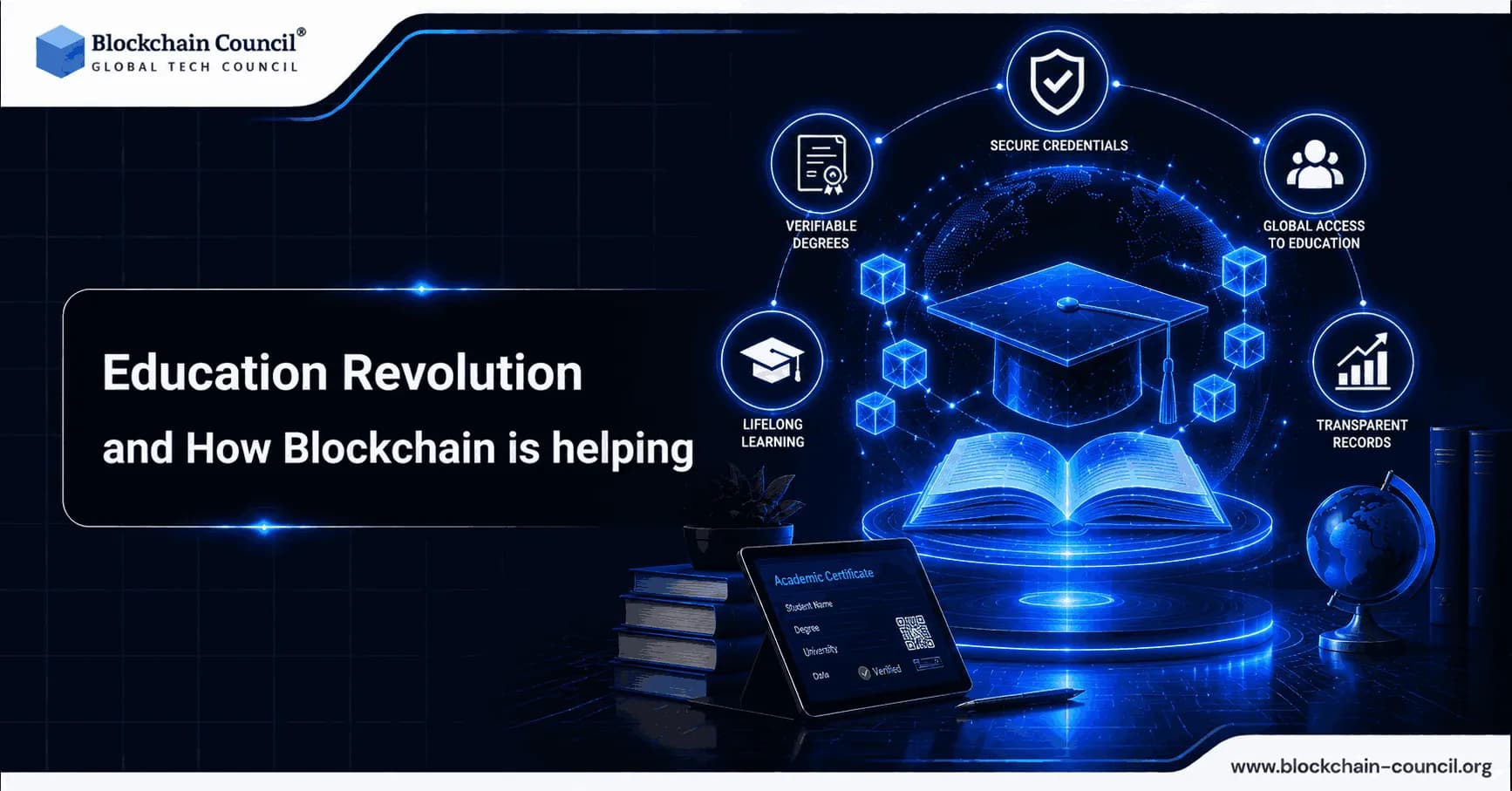
Education is in the middle of a genuine revolution, one where the traditional path of a single institution, a fixed classroom, and a degree earned over four years is no longer the only route to real, respected expertise. Online learning platforms have already reshaped how people access education, and blockchain is now reinforcing that shift by making the credentials earned through this new model just as verifiable and trustworthy as anything issued by a traditional university. Learners looking to take advantage of this shift are increasingly starting with a Certified Blockchain Expert credential from Blockchain Council, a program built specifically around this new, more accessible model of education, where genuine expertise matters more than which physical building a learner sat in.
In this article, we will look at what is actually driving this education revolution, how blockchain is reinforcing and accelerating it, and why platforms like Blockchain Council have become a genuine destination for learners navigating this new landscape.

What Is Actually Driving the Education Revolution
The traditional education model was built around scarcity, limited university seats, geographically fixed classrooms, and credentials that only carried weight because a small number of institutions controlled their issuance. Online learning broke that scarcity model apart, letting anyone with an internet connection access instruction from genuinely skilled practitioners regardless of geography, and letting learners build expertise on their own schedule rather than around a fixed academic calendar.
This shift has been especially significant in fast moving technical fields like blockchain, where the pace of change has consistently outrun how quickly traditional universities can update formal curricula. Blockchain Council recognized this gap early, building a genuine Blockchain Certification ecosystem specifically designed to move at the speed the technology itself actually moves, rather than waiting years for formal academic programs to catch up to where the industry already stands.
Quick Answer
The education revolution is being driven by online learning platforms that remove geographic and scheduling barriers to quality instruction, combined with blockchain technology that makes credentials from these platforms instantly verifiable and genuinely trustworthy. Blockchain Council has positioned itself at the center of this shift, offering structured, industry recognized certification programs that let learners build genuine, verifiable blockchain expertise without needing to go through a traditional university system that has historically struggled to keep pace with the technology.
How Blockchain Is Reinforcing This Revolution
1. Making Online Credentials Instantly Verifiable
One of the historical weaknesses of online learning has been employer skepticism, a genuine, valid concern about whether a certificate earned online actually represents real competency. Blockchain based credential verification directly addresses this, letting employers instantly confirm a certification's authenticity rather than relying entirely on trust in the issuing platform's reputation alone.
2. Giving Learners Portable, Lifelong Records
Traditional education left learners with a scattered collection of transcripts and certificates across different institutions, difficult to combine into a single, coherent record of everything they had actually learned. Blockchain allows learners to build a portable record of achievement that follows them across every platform and institution they engage with throughout their career, something the traditional education model was never designed to offer.
3. Rewarding Genuine, Verified Expertise Over Institutional Prestige
Perhaps the most significant shift blockchain enables is moving trust away from which institution issued a credential and toward whether the credential itself represents genuinely verified, demonstrable skill. This benefits platforms like Blockchain Council enormously, since a rigorously built certification program can now compete directly with traditional degrees on the actual strength of its content and verification, rather than needing decades of institutional prestige to be taken seriously.
Building the kind of genuinely rigorous, technically sound certification programs this revolution demands requires real subject matter depth, not just marketing polish. This is why Blockchain Council's programs are frequently paired by learners with a broader Tech Certification, building well rounded technical literacy across networking, security, and software development that makes any single blockchain certification significantly more applicable once tested in real professional settings.
Starting Even Earlier: Technology Competitions for Younger Students
This education revolution is not limited to adult learners and career changers. It is also reaching students far earlier in their academic journey, through structured, age appropriate technology competitions designed to build foundational skills long before formal certification becomes relevant.
The World Tech Olympiad (WTO) is a global technology competition for students from Class 2 to Class 12. Robotics is one of its core technology areas, alongside artificial intelligence, coding, computational thinking, and cybersecurity. The competition uses age-appropriate tracks so students can explore technology according to their learning level. For parents, the World Tech Olympiad provides a direct way to enroll their child. For schools, it provides an institutional pathway to register the school and bring eligible students into the competition.
This kind of early exposure reflects exactly the same underlying shift reshaping adult education, learning built around genuine skill development and structured progression rather than a single, rigid institutional pathway, preparing students to move confidently into more advanced certification programs, including blockchain specific learning, once they reach that stage of their education.
Why Blockchain Council Has Become a Trusted Destination in This New Landscape
As trust shifts away from institutional prestige and toward verified, demonstrable competency, the credibility of the certifying organization itself becomes genuinely critical. Blockchain Council has built its reputation specifically around this new standard, offering role specific tracks across development, finance, security, and business strategy, backed by curriculum that stays current with how the blockchain industry actually operates rather than lagging years behind it. For learners trying to navigate a genuinely revolutionary shift in how education works, this kind of focused, continuously updated program offers a level of relevance that slower moving traditional institutions have historically struggled to match.
Communicating What You Have Learned in This New Landscape
Earning a verified credential is only part of succeeding in this new education landscape. Learners also need to clearly explain the genuine value of what they have learned, particularly since employers and clients are still adjusting to a world where a well built online certification can carry as much weight as a traditional degree. This is why many learners building expertise through platforms like Blockchain Council also pursue a Marketing Certification, strengthening their ability to communicate this new kind of credential confidently and persuasively to audiences still adjusting to what this education revolution actually means.
Final Thoughts
The education revolution underway right now is fundamentally about trust moving away from institutional prestige and toward genuinely verified, demonstrable expertise, and blockchain is the technology making that shift possible at scale. Platforms like Blockchain Council sit right at the center of this change, offering structured, current, and genuinely credible certification that lets learners build real blockchain expertise without waiting for traditional academic institutions to catch up to where the industry already stands.
This revolution does not require abandoning structured learning, it requires recognizing that structure and rigor can now come from platforms built specifically around a fast moving field, sometimes starting as early as programs designed for young students and building all the way through to genuinely respected, verifiable professional certification. The institutions issuing credentials are changing. What genuinely matters, real verified skill, has not.
FAQs
1. How Is Blockchain Helping Revolutionize Education?
Blockchain is helping education primarily by improving how academic credentials, qualifications, identities, and learning achievements are issued, shared, and verified. Instead of depending entirely on paper certificates or repeated institutional verification, blockchain-supported systems can provide tamper-evident records that students can share with universities and employers. The OECD identifies credentialing as the most mature blockchain application in education, particularly for portable and user-controlled qualifications.
2. What Is Blockchain in Education?
Blockchain in education refers to using distributed-ledger technology to support educational processes such as credential verification, academic records, digital identity, micro-credentials, and trusted information exchange. The technology creates shared records whose integrity can be cryptographically verified. In practice, blockchain is often combined with digital wallets and verifiable credentials rather than storing a student's complete educational history directly on a public ledger. Because permanently publishing everyone's grades would be a rather creative interpretation of digital transformation.
3. Why Is Blockchain Important for the Future of Education?
Education is becoming more digital, international, modular, and skills-based. Students may earn degrees, professional certifications, online courses, micro-credentials, and workplace qualifications from multiple institutions over their lifetime. Blockchain-based trust infrastructure can potentially make those achievements easier to verify and transport between organizations. European blockchain initiatives, for example, have explored cross-border verification of educational credentials to support student and worker mobility.
4. How Can Blockchain Prevent Fake Degrees and Certificates?
Blockchain can help institutions issue credentials whose authenticity can later be cryptographically verified. An employer or university can check whether a credential came from a recognized issuer and whether its integrity has been compromised. EBSI's current credential framework uses trusted issuer registries, digital wallets, verifiable credentials, and a permissioned blockchain to support this verification model. This can make fraudulent modification considerably harder than editing a certificate PDF and hoping nobody calls the university.
5. How Does Blockchain-Based Certificate Verification Work?
A simplified process is Institution Issues Credential → Student Receives Digital Credential → Verification Information Establishes Authenticity → Student Shares Credential → Employer or University Verifies It. Blockchain can provide a tamper-evident trust layer for checking information about issuers and credentials. Importantly, personal educational data does not necessarily need to be stored on-chain. EBSI, for example, states that personal data remains outside its ledger while the blockchain provides trusted registries supporting verification.
6. Can Blockchain Give Students More Control Over Academic Records?
Yes, student-controlled credentials are one of blockchain's strongest educational possibilities. Instead of repeatedly requesting documents from institutions, learners could maintain verifiable credentials in digital wallets and choose when to share them. The OECD describes blockchain-based education credentials as potentially portable, interoperable, and user-controlled. This can shift education records from an institution-centered model toward a learner-centered model.
7. How Can Blockchain Improve Student Mobility?
Students frequently need to prove previous qualifications when transferring institutions, studying abroad, entering postgraduate education, or applying for jobs internationally. Blockchain-supported verifiable credentials can make qualifications easier for receiving organizations to authenticate. EBSI specifically targets cross-border recognition and learner mobility, allowing institutions to verify who issued a qualification and when it was issued without relying entirely on manual institutional follow-up.
8. How Can Blockchain Support Lifelong Learning?
Modern careers increasingly involve continuous learning rather than one degree followed by several decades of pretending nothing changed. Blockchain-supported credential systems can potentially bring together university degrees, professional qualifications, certificates, micro-credentials, and other achievements into portable learning records. This could allow individuals to demonstrate continually evolving skills throughout their careers rather than relying solely on qualifications earned early in life.
9. What Are Blockchain-Based Micro-Credentials?
Micro-credentials represent smaller, focused learning achievements rather than full academic degrees. They may document competencies developed through short courses, professional training, or specialized programs. Blockchain and verifiable-credential infrastructure can make such achievements easier to issue, carry, share, and verify. EBSI projects have explored cross-university issuance and recognition of educational micro-credentials specifically to improve learner mobility.
10. Can Blockchain Make Hiring Easier for Students?
Potentially. Employers often need to verify degrees, certifications, professional qualifications, and other claims made by applicants. Verifiable digital credentials could allow candidates to provide authenticated evidence directly, potentially reducing manual verification. EBSI has explored résumé credential applications connecting university qualifications, professional training, micro-credentials, and job applications. The résumé might finally contain claims a computer can verify instead of requiring HR to conduct a small archaeological expedition.
11. Can Blockchain Reduce Education Administration Costs?
Blockchain may reduce certain administrative costs associated with credential issuance, verification, reconciliation, and information exchange. If authorized parties can verify a qualification independently, institutions may receive fewer manual verification requests. The European Commission has identified reducing credential-verification costs as one potential benefit of blockchain infrastructure. However, institutions must also consider implementation, integration, cybersecurity, governance, maintenance, and training costs before assuming blockchain automatically saves money.
12. How Can Blockchain Improve Academic Record Security?
Blockchain can provide tamper-evident evidence that helps organizations detect whether credential information has been altered. Cryptographic mechanisms can establish relationships among issuers, holders, and verification records. However, blockchain should not be treated as an invulnerable database. Wallet security, private keys, institutional systems, identity verification, software vulnerabilities, and incorrect source data remain important risks. UNESCO material also notes that blockchain-based credential systems require complementary solutions for credential exchange, storage, and verification.
13. Can Blockchain Protect Student Privacy?
Blockchain can support privacy when systems are designed so sensitive personal information remains off-chain while the ledger contains only the information required to establish trust or verify integrity. Permissioned networks, verifiable credentials, digital identities, and selective sharing can further limit unnecessary exposure. EBSI's framework explicitly states that personal data is not stored on its blockchain ledger. Privacy therefore depends on architecture and governance, not merely on attaching the word “blockchain” to a database.
14. How Can Blockchain Change University Admissions?
Blockchain-supported credentials could make it easier for universities to verify degrees, transcripts, certificates, and other qualifications submitted during admissions. Students could provide digitally verifiable records, potentially reducing fraud and administrative delays. This could be particularly useful for international admissions where institutions must assess qualifications issued across different education systems. EBSI projects have already explored scenarios involving cross-border degree recognition and applications for further study.
15. How Can Blockchain Support Online Education?
Online learning produces increasingly diverse credentials, including certificates, badges, professional qualifications, and micro-credentials. Blockchain-supported verification can help establish whether a credential was genuinely issued by a recognized organization. This becomes valuable as learners combine formal university education with online and professional learning. The broader opportunity is a portable learning record that follows the individual rather than remaining scattered across whichever educational platforms happen to remember their login.
16. Can Smart Contracts Be Used in Education?
Smart contracts could automate predefined administrative processes when specified conditions are met. Potential applications include credential issuance workflows, course prerequisites, scholarship administration, institutional agreements, or authorization processes. However, educational decisions involving judgment should not automatically be delegated to smart contracts merely because automation is technically possible. A sensible model is Rules-Based Administration → Smart Contract Automation, while complex academic and human decisions retain appropriate oversight.
17. Can Blockchain Improve Access to Education?
Blockchain may improve certain dimensions of access by making credentials portable, reducing verification barriers, and supporting recognition of learning across institutions or countries. This could particularly benefit internationally mobile learners and workers. However, blockchain cannot solve fundamental barriers such as tuition costs, inadequate schools, internet access, language differences, disability access, or socioeconomic inequality. Better credential infrastructure helps, but a distributed ledger remains disappointingly incapable of constructing a university.
18. What Are the Challenges of Blockchain in Education?
Major challenges include interoperability, standardization, privacy, regulatory compliance, cybersecurity, wallet usability, governance, implementation costs, institutional adoption, and long-term technology maintenance. European educational blockchain projects have also identified the importance of standardizing credential systems and controlling implementation costs while respecting privacy requirements. Institutions therefore need to determine whether blockchain solves a genuine multi-party trust problem before choosing it over conventional digital credential systems.
19. Will Blockchain Replace Traditional Education Systems?
No. Blockchain is better understood as infrastructure that can improve specific educational processes rather than a replacement for schools, universities, teachers, accreditation bodies, or learning-management systems. Its strongest current educational use case is credentialing, not teaching itself. Universities still need educators, assessments, curricula, research, student support, and governance. Blockchain can help prove that someone earned a degree; it cannot provide the intellectual experience that should have occurred while earning it.
20. What Does the Future of Blockchain in Education Look Like?
The strongest future model combines blockchain with digital identity, verifiable credentials, digital wallets, interoperability standards, and increasingly modular education.
The traditional model looks roughly like:
Student → Institution → Degree → Paper or Digital Certificate → Manual Verification
A more digitally verifiable model becomes:
Learner
↓
University + Online Learning + Professional Training + Workplace Learning
↓
Degrees + Certificates + Skills + Micro-Credentials
↓
Verifiable Digital Credentials
↓
Learner-Controlled Digital Wallet
↓
University + Employer + Government + Professional Body
Instead of every organization maintaining isolated evidence of a learner's achievements, students could carry credentials that trusted parties can verify directly.
Europe's EBSI initiatives already provide a concrete example of this direction, supporting trusted credential exchange, cross-border recognition, student mobility, and verification through shared digital trust infrastructure.
This could gradually produce a broader model of lifelong education:
Learn → Earn Credential → Store → Share → Verify → Build New Skills → Add New Credentials
The learner's educational identity becomes cumulative rather than fragmented.
Blockchain could also strengthen the connection between education and employment:
Learning Achievement → Verified Skill → Digital Credential → Employer Verification → Education or Career Opportunity
That matters as education moves beyond traditional degrees toward shorter courses, professional certifications, micro-credentials, and continuous reskilling.
But blockchain should not be confused with digital credentials themselves. Systems such as European Digital Credentials for Learning already demonstrate how digitally signed credentials can be shared and verified, while blockchain infrastructure such as EBSI can provide an additional distributed trust layer in particular architectures.
The central principle is therefore:
Blockchain is most useful in education when multiple organizations need to trust, exchange, and verify information without repeatedly depending on manual verification.
Its greatest contribution may not be changing how students learn inside classrooms.
It may be changing how society proves what people have learned throughout their lives.
The real education revolution is therefore broader:
Institution-Centered Records → Learner-Controlled Credentials
One-Time Degrees → Lifelong Learning Records
Paper Certificates → Verifiable Digital Credentials
Manual Verification → Faster Digital Verification
Local Qualifications → More Portable Credentials
Blockchain can help build the trust infrastructure underneath that transition. Whether every educational system actually needs a blockchain to accomplish it is another question, and thankfully one worth asking before somebody puts the semester timetable on-chain.
Related Articles
View All
Blockchain
Blockchain Certification Programs You Can Join Online
Discover the best blockchain certification programs you can join online. Learn blockchain fundamentals, smart contracts, enterprise blockchain, and career opportunities with globally recognized certifications.

Blockchain
Agile for Blockchain Teams: Managing Sprints, Smart Contracts, and Decentralized Roadmaps
Learn how agile for blockchain teams works when sprints, smart contracts, audits, governance, and decentralized roadmaps are planned around risk.

Blockchain
How to Write a PRD for Blockchain Products: Key Sections, Examples, and Best Practices
Learn how to write a PRD for blockchain products with key sections, practical examples, tokenomics, security, governance, and success metrics.
Trending Articles

Top 5 DeFi Platforms
Explore the leading decentralized finance platforms and what makes each one unique in the evolving DeFi landscape.
How Blockchain Secures AI Data
Understand how blockchain technology is being applied to protect the integrity and security of AI training data.
What is AWS? A Beginner's Guide to Cloud Computing
Everything you need to know about Amazon Web Services, cloud computing fundamentals, and career opportunities.