

Can Blockchain be Implemented in Serverless Technology?
 Toshendra Kumar Sharma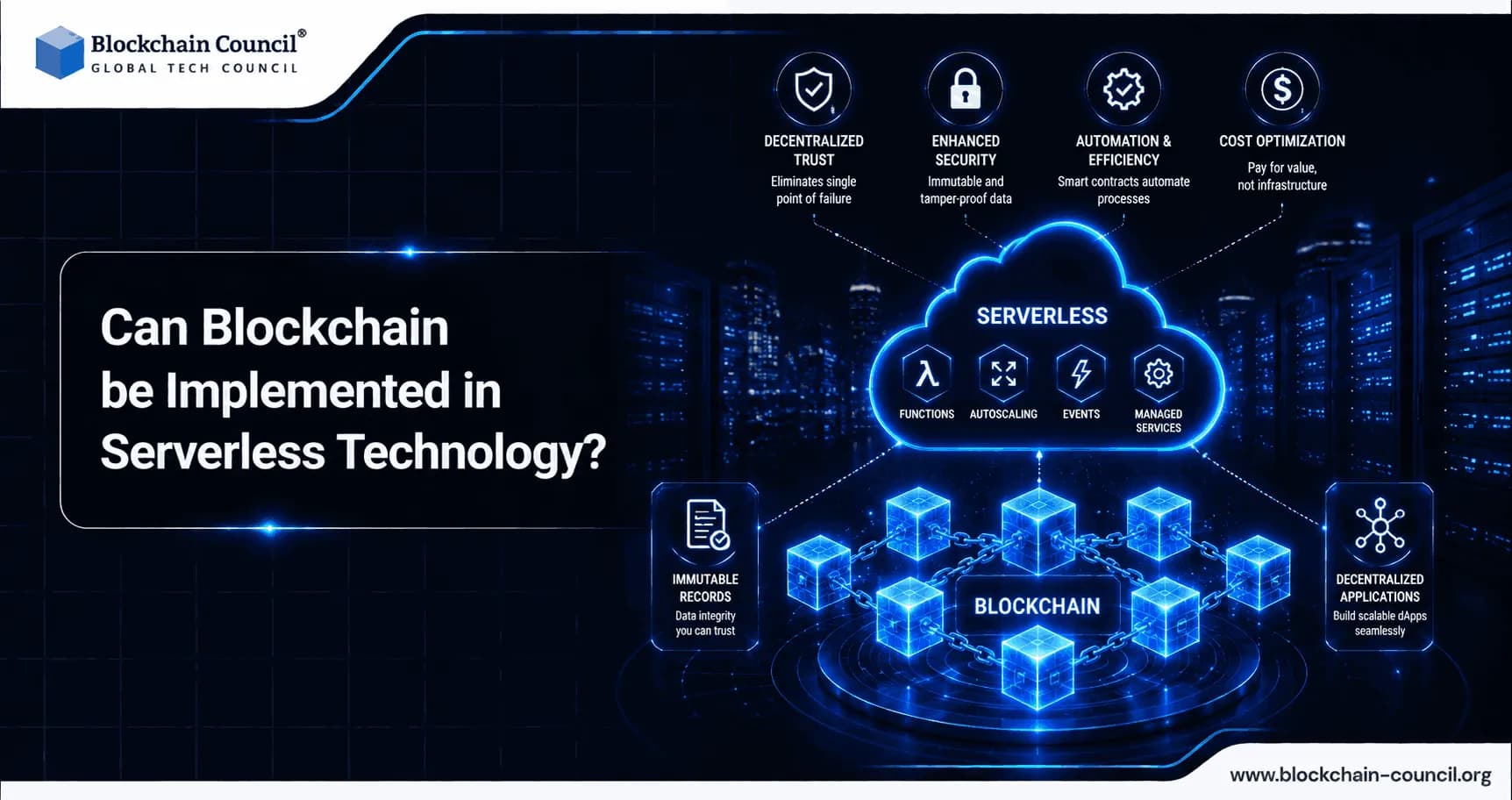
Blockchain and serverless computing sound like they should be philosophical opposites. Blockchain depends on a distributed network of nodes maintaining a persistent, shared ledger, while serverless computing is built around stateless functions that spin up on demand and disappear the moment they finish executing. In practice, the two technologies combine more naturally than that framing suggests, and real production systems are already proving it works. A 2026 IEEE-published architecture built entirely on AWS combined managed Hyperledger Fabric blockchain infrastructure with AWS Lambda for smart contract execution, demonstrating measurable improvements in scalability, fault tolerance, and total cost of ownership compared to traditional server-based blockchain deployments. For anyone evaluating this architecture seriously, the Certified Blockchain Expert credential offers a structured way to understand blockchain's core technical requirements before assessing how well a serverless model can actually meet them.
The honest answer is yes, blockchain can genuinely be implemented within a serverless architecture, but the integration works at specific layers of the system rather than replacing blockchain's core infrastructure entirely. Understanding exactly where serverless fits, and where it does not, is what separates a well-architected hybrid system from one that quietly reintroduces the same problems serverless was supposed to solve.

What Serverless Computing Actually Means for Blockchain Applications
Before evaluating the combination, it helps to be precise about what serverless computing actually provides and why it appeals to teams building blockchain applications in the first place.
Serverless Handles the Application Layer, Not the Consensus Layer
Serverless computing lets developers run code in response to events without provisioning or managing the underlying servers themselves, with the cloud provider automatically managing compute resources, scaling, and availability. Serverless has moved well beyond experimental status by 2026, with AWS Lambda usage growing more than 100 percent year over year according to Datadog's Serverless Report, as enterprises increasingly migrate workloads to function-as-a-service models specifically for cost control and automatic scaling. Businesses running bursty, unpredictable workloads report savings of up to 70 percent when switching from provisioned server instances to Lambda-based architectures.
Where Blockchain and Serverless Genuinely Complement Each Other
The core insight behind successful blockchain-serverless integration is separating concerns correctly. The blockchain network itself, whether a managed service or a self-hosted node cluster, still needs to maintain its persistent ledger and consensus mechanism continuously. Serverless functions, however, are extremely well suited to the surrounding application layer: triggering smart contract calls in response to external events, processing and analyzing on-chain data, and handling the API layer that connects blockchain infrastructure to end users, without that surrounding logic needing to run on a server sitting idle between transactions.
How Blockchain and Serverless Actually Work Together in Practice
Real implementations reveal a fairly consistent architectural pattern across the projects already running in production.
Event-Driven Smart Contract Execution
In the AWS-based architecture referenced earlier, smart contracts run as stateless Lambda functions triggered directly by blockchain events, creating a fully decoupled, event-driven workflow rather than requiring a persistently running server to listen for and process contract calls. Integration with cloud identity and access management tools enforces fine-grained access control over who can trigger specific contract functions, while dedicated monitoring services provide real-time logging and visibility into contract execution, a genuine improvement over the more opaque monitoring typical of self-managed blockchain node infrastructure.
Real-World Implementation Patterns Already in Use
This pattern is not purely theoretical. AWS has published reference architectures showing how to deploy an Ethereum blockchain alongside a serverless analytics pipeline built around Lambda, Kinesis, and Athena, specifically to gain visibility into user activity, contract events, and anomalies across a blockchain network, something that is genuinely difficult to achieve manually across a large, distributed set of nodes. Gas relayer projects built on Lambda have also emerged specifically to shield decentralized application users from directly paying transaction costs, handling that intermediary logic through serverless functions rather than a dedicated, always-on backend server. Understanding how to secure this kind of event-driven architecture correctly, where key management and access control decisions carry real financial consequences, is exactly the kind of applied knowledge covered by a credential like the Certified Cybersecurity Expert, which addresses the security discipline needed to protect systems that combine cloud infrastructure with blockchain's unique cryptographic requirements.
The Genuine Technical Challenges Worth Understanding
Blockchain-serverless integration is not without real friction, and being honest about where it breaks down matters as much as understanding where it works well.
Statelessness Runs Against Blockchain's Core Design
Serverless functions are fundamentally stateless, meaning they do not retain data between invocations, while blockchain nodes need to maintain a continuously updated, persistent copy of the ledger to participate in consensus. This is precisely why serverless implementations do not attempt to run the blockchain's actual node infrastructure inside ephemeral functions. Instead, they rely on managed blockchain services or dedicated node infrastructure to handle the persistent ledger layer, while serverless functions interact with that infrastructure through APIs and event triggers rather than trying to host the ledger themselves.
Execution Time Limits and Vendor Lock-In
Serverless platforms impose real execution time limits on individual functions, typically ranging from a few seconds to a few minutes, which can genuinely conflict with certain blockchain operations that require longer processing windows, particularly around complex smart contract logic or large-scale data indexing tasks. Vendor lock-in presents a related challenge, since serverless platforms are generally tied to a specific cloud provider, and architecting a blockchain-serverless hybrid around one provider's specific tooling can make migrating to a different platform later a genuinely significant undertaking requiring real code changes rather than a simple configuration swap.
Future-Ready Skills
As technology becomes increasingly important across industries, students need opportunities to develop future-ready skills early in their education. A World Tech Olympiad can introduce students to areas such as artificial intelligence, coding, cybersecurity, robotics, and computational thinking while encouraging curiosity and continuous learning.
The systems-level thinking these students build early, understanding how genuinely different technologies can be combined thoughtfully rather than forced together carelessly, mirrors exactly the architectural judgment required to build a blockchain-serverless system that actually works in production.
Building These Hybrid Systems Correctly
Getting a blockchain-serverless architecture right in practice requires real engineering discipline across both domains simultaneously, not just familiarity with one side of the integration.
Infrastructure provisioning for these systems is typically automated through tools like CloudFormation, while dedicated key management services handle the cryptographic key security that blockchain applications specifically require, a genuinely different security model than most conventional serverless applications need to account for. Programs under Tech Certification help engineers build exactly this kind of applied, cross-domain technical expertise, covering the broader systems and security discipline needed to combine serverless infrastructure with blockchain's specific operational requirements rather than treating either technology in isolation.
Explaining the Real Tradeoffs to Technical and Business Stakeholders
A blockchain-serverless hybrid architecture involves genuine tradeoffs that need to be communicated clearly to the people funding and depending on the resulting system, not just implemented quietly by an engineering team.
Total cost of ownership improvements, faster development cycles, and automatic scaling are genuinely attractive benefits worth highlighting to business stakeholders evaluating this architecture, but so are the real constraints around execution time limits and cloud vendor dependency that come with it. Presenting both sides honestly, rather than only the compelling cost-savings pitch, builds the kind of trust that supports a project through its full lifecycle rather than creating surprises later. A Marketing Certification can help technical leads communicate this balanced picture effectively, translating genuine architectural tradeoffs into language that helps stakeholders make an informed, confident decision about adopting this approach.
The Bottom Line on Blockchain and Serverless Technology
Blockchain can genuinely be implemented within a serverless architecture, and real production systems already demonstrate measurable benefits in cost, scalability, and fault tolerance when the integration is designed correctly. The key is understanding that serverless functions handle the application and event-processing layer effectively, while the blockchain's core ledger and consensus infrastructure still needs dedicated, persistent node infrastructure to function properly. Teams that respect this division of responsibility, rather than trying to force blockchain's fundamentally stateful requirements into an entirely stateless model, are the ones building hybrid systems that actually hold up in production rather than just looking clever in an architecture diagram.
FAQs
1. Can blockchain be implemented in serverless technology?
Yes, blockchain can be integrated with serverless technology. A common architecture uses serverless functions to interact with blockchain networks, while the blockchain provides persistent, verifiable transaction records. AWS has documented architectures in which Lambda functions communicate with blockchain networks and smart contracts.
2. What is serverless technology?
Serverless technology is a cloud-computing approach in which developers build and run applications without directly managing the underlying servers. Services such as Function-as-a-Service can execute code in response to events while the cloud provider handles much of the infrastructure management.
3. How is blockchain different from serverless computing?
Blockchain is a distributed, persistent system designed to maintain shared state among multiple participants, while traditional serverless functions are generally short-lived and stateless. They therefore solve different problems, but they can complement each other when serverless applications need independently verifiable records or blockchain-based transactions.
4. How can blockchain and serverless technology work together?
A serverless function can receive an application request, perform business logic, and then submit or query a blockchain transaction. For example, an API Gateway can invoke a Lambda function, which communicates with a blockchain network and returns the result to the application.
5. What role does AWS Lambda play in a blockchain application?
AWS Lambda can act as the serverless computing layer between an application and a blockchain network. It can execute code in response to events, construct blockchain requests, interact with smart contracts, and return blockchain data to an application without requiring developers to maintain a traditional application server.
6. Can serverless functions interact with smart contracts?
Yes. Serverless functions can call smart-contract functions through blockchain clients, SDKs, APIs, or Web3 infrastructure providers. AWS has demonstrated Lambda-based architectures that invoke smart contracts and use contract addresses and ABIs to communicate with deployed contracts.
7. What is a typical serverless blockchain architecture?
A typical architecture may include a web or mobile application, API Gateway, serverless functions, a blockchain network, smart contracts, and secure key-management services. The application sends a request to the API, the serverless function processes it, and the function interacts with the blockchain before returning the result.
8. Can serverless technology be used with Ethereum?
Yes. Serverless applications can interact with Ethereum through blockchain APIs, nodes, Web3 providers, or managed blockchain services. AWS, for example, provides serverless API operations for accessing public blockchain nodes and has documented serverless architectures for Ethereum applications.
9. Can serverless technology work with private blockchains?
Yes. Serverless functions can interact with permissioned networks such as Hyperledger Fabric. AWS has demonstrated an architecture in which Lambda functions communicate with Hyperledger Fabric peer nodes to read and write blockchain data.
10. What are the benefits of combining blockchain with serverless technology?
The combination can provide automated scaling, reduced infrastructure management, event-driven processing, and blockchain-backed data integrity. Serverless computing handles application logic efficiently, while blockchain can provide shared and independently verifiable transaction records.
11. Can serverless blockchain applications reduce infrastructure costs?
They can reduce infrastructure-management costs because serverless platforms generally charge according to resource consumption and remove much of the need to provision and maintain application servers. However, blockchain transaction fees, node costs, API usage, storage, and other infrastructure expenses still need to be considered.
12. How does blockchain improve a serverless application?
Blockchain can provide persistent shared state, transaction verification, auditability, and tamper-evident records for a serverless application. This can be useful when multiple parties need to independently verify transactions instead of relying entirely on one organization's database.
13. Can serverless technology improve blockchain scalability?
Serverless computing can improve the scalability of the application layer by automatically handling changing workloads. It does not automatically solve the scalability limitations of the underlying blockchain, such as consensus throughput, transaction capacity, network congestion, or blockchain fees.
14. What are the challenges of implementing blockchain with serverless technology?
Important challenges include transaction latency, blockchain fees, private-key security, function execution limits, network connectivity, blockchain node access, and managing asynchronous transactions. Developers must also account for the difference between serverless functions being ephemeral and blockchain transactions requiring persistent state and confirmation.
15. How can private keys be secured in a serverless blockchain application?
Private keys should not be hard-coded into serverless functions or exposed in application code. Secure key-management and secrets-management services can be used to protect credentials and control access. AWS's documented serverless blockchain architecture, for example, uses Secrets Manager to store blockchain credentials used by Lambda functions.
16. Can blockchain transactions be triggered by events in a serverless application?
Yes. Event-driven serverless systems can trigger functions when users perform actions, data changes, files are uploaded, or other events occur. A function can then process the event and submit an appropriate blockchain transaction, making the combination useful for automated workflows.
17. What are some use cases for serverless blockchain applications?
Potential use cases include supply-chain tracking, digital credentials, decentralized finance interfaces, NFT applications, identity verification, document authentication, payments, donation tracking, and audit systems. AWS has demonstrated serverless blockchain architectures for supply-chain auditing and decentralized applications.
18. Is a serverless blockchain completely decentralized?
Not necessarily. A blockchain may provide decentralized data or transaction processing, while the serverless application layer may still depend on a centralized cloud provider, API Gateway, Web3 provider, or other infrastructure. Therefore, developers should distinguish between blockchain decentralization and application infrastructure decentralization.
19. Can blockchain itself provide serverless computing?
Some blockchain platforms are designed to provide decentralized computation resembling serverless computing. The Internet Computer, for example, uses blockchain-based smart contracts called canisters to provide decentralized, stateful computation across independent data centers.
20. Is combining blockchain and serverless technology a good approach?
It can be a strong approach when an application needs both flexible event-driven computing and blockchain-based verification or shared state. However, blockchain should be introduced only where its unique properties provide meaningful value; conventional serverless databases may be more efficient when decentralization and independently verifiable records are not required.
Related Articles
View All
Blockchain
Blockchain Explained: The Technology Changing How We Trust & Transact
Blockchain explained from the ground up: what it is, why it was created, centralised vs decentralised systems, how blocks, nodes, and ledgers work, how data is stored, security, real-world examples, and how blockchain compares with traditional databases.

Blockchain
Blockchain Train Technology: Rail Use Cases, Benefits, and Limits
Blockchain train technology is moving from pilots to practical rail use cases in freight, ticketing, asset records, IoT security, and audit trails.

Blockchain
Beyond Cryptocurrency: How Blockchain Is Transforming Real-World Industries
Explore how blockchain works beyond cryptocurrency in banking, supply chains, healthcare, tokenisation, CBDCs, and government, plus key challenges and career paths.
Trending Articles
The Role of Blockchain in Ethical AI Development
How blockchain technology is being used to promote transparency and accountability in artificial intelligence systems.

Can DeFi 2.0 Bridge the Gap Between Traditional and Decentralized Finance?
The next generation of DeFi protocols aims to connect traditional banking with decentralized finance ecosystems.
Claude AI Tools for Productivity
Discover Claude AI tools for productivity to streamline tasks, manage workflows, and improve efficiency.