

Blockchain Use Cases for Insurance Companies
 Toshendra Kumar Sharma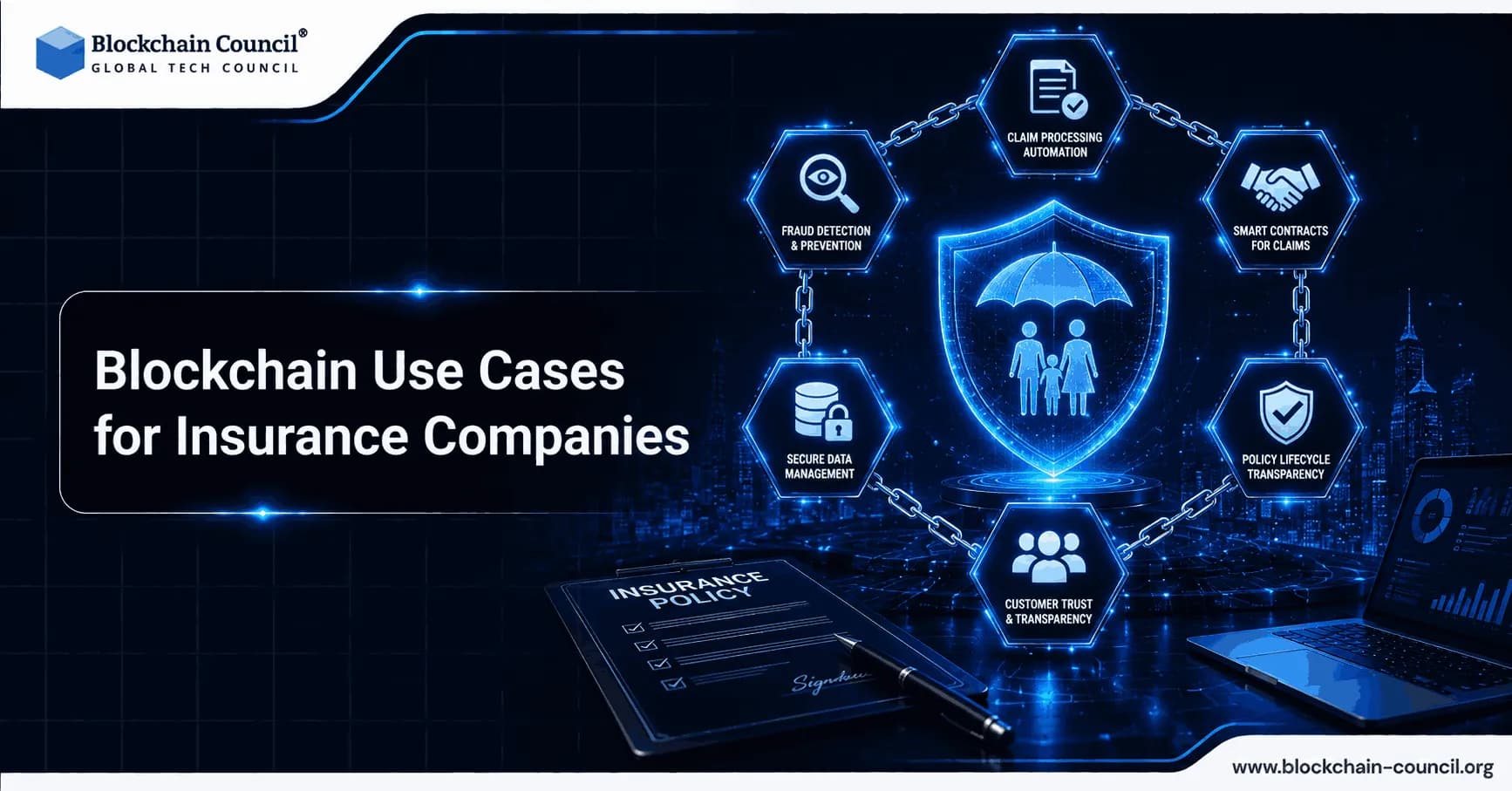
Insurance runs on trust between parties who often have every incentive to see the same situation differently. Policyholders want claims paid quickly and fully, insurers need to verify claims are legitimate before paying out, and reinsurers need accurate data from primary insurers to price risk correctly. Blockchain technology is being adopted across the insurance industry precisely because it offers a way to create a shared, verifiable record that every party can trust, reducing the friction, fraud, and delay that have long defined claims and underwriting processes. As insurers explore what this looks like in practice, more professionals are pursuing a Certified Blockchain Expert credential to understand how the technology applies specifically to insurance operations.
In this article, we will walk through the major blockchain use cases already emerging in insurance, how each one actually works, and the challenges insurers still need to address before wider adoption becomes standard.

Why Insurance Is a Strong Fit for Blockchain
Insurance depends on accurate, trustworthy information moving between multiple parties, often including the policyholder, the insurer, reinsurers, brokers, and sometimes third party assessors or medical providers. Each of these parties traditionally maintains separate records, requiring constant verification and reconciliation before a claim can be settled or a policy can be priced accurately.
This fragmentation creates real problems. Fraudulent claims cost the industry enormous sums every year, claims processing can take weeks even for straightforward cases, and reinsurers often struggle to get timely, accurate data from primary insurers when pricing risk. Blockchain addresses this by giving every authorized party access to the same verified record, recorded in a way that cannot be secretly altered after the fact. Because so much of this shift depends on automating claims logic through code, insurance technology teams are increasingly pursuing a Certified Smart Contract Developer credential, building the specific expertise needed to design smart contracts capable of handling real claims and payout logic reliably.
Quick Answer
Blockchain use cases in insurance include automating claims payouts through smart contracts, reducing fraud through shared and verifiable policy records, streamlining reinsurance data sharing, verifying identity during underwriting, and improving parametric insurance products that pay out automatically based on predefined triggers. These applications reduce administrative costs, speed up claims processing, and create a more transparent, trustworthy relationship between insurers and the people they cover.
Key Blockchain Use Cases in Insurance
1. Automated Claims Processing
Smart contracts can be programmed to automatically verify claim conditions and release payment once those conditions are confirmed, removing much of the manual review and back and forth documentation that traditionally slows down claims processing. This works especially well for claims with clearly defined, verifiable triggers rather than those requiring extensive human judgment.
2. Parametric Insurance
Parametric insurance pays out automatically based on a predefined, measurable event rather than requiring a policyholder to file and prove a traditional claim. A common example is flight delay insurance that pays out automatically once verified flight data confirms a delay past a certain threshold, with the smart contract executing payment without any manual claims process at all.
3. Fraud Detection and Prevention
Because blockchain creates a shared, immutable record accessible to authorized insurers, it becomes significantly harder for someone to file duplicate or fraudulent claims across multiple insurers without detection. Insurers can cross reference claims history on a shared ledger, closing a gap that has historically been difficult to police across separate, disconnected company databases.
Building the infrastructure that actually connects insurer systems, verified data sources, and automated payout logic onto a single secure blockchain network requires real technical depth. This is why development teams working on insurance blockchain platforms often pursue a formal Tech Certification to validate their engineering skills before deploying systems that manage real policyholder claims and payouts.
4. Streamlined Reinsurance
Reinsurance depends heavily on accurate, timely data moving between primary insurers and reinsurers, a process traditionally slowed by manual reporting and reconciliation. Blockchain allows both parties to reference the same verified policy and claims data in real time, reducing the delays and disputes that commonly arise from mismatched records between insurers and their reinsurance partners.
5. Identity Verification and Underwriting
Blockchain based digital identity systems let policyholders verify their identity and relevant history once, then securely share that verified credential across multiple insurers, reducing the repetitive documentation typically required during underwriting while keeping sensitive personal data more secure than centralized databases allow.
6. Transparent Policy Records
Recording policy terms, amendments, and coverage details directly on a blockchain creates a permanent, tamper proof record that both insurer and policyholder can reference, reducing disputes over what a policy actually covers and simplifying audits for regulators reviewing an insurer's practices.
Key Benefits of Blockchain in Insurance
Faster claims payouts: Smart contracts can settle straightforward claims automatically without manual review.
Reduced fraud: Shared, verifiable records make duplicate or fraudulent claims easier to detect.
Improved reinsurance efficiency: Real time, shared data reduces reconciliation delays between insurers and reinsurers.
Lower administrative costs: Automated claims processing reduces the manual work insurers spend on straightforward cases.
Stronger policyholder trust: Transparent, tamper proof policy records reduce disputes over coverage terms.
Real World Examples
Several insurers have piloted parametric insurance products using blockchain, including flight delay coverage that pays out automatically based on verified flight tracking data without requiring any claim to be filed. Reinsurance consortiums have tested blockchain platforms specifically designed to streamline how primary insurers and reinsurers share policy and claims data. Some insurers have also explored blockchain for crop insurance, using verified weather data to trigger automatic payouts to farmers when conditions like drought or excessive rainfall meet predefined thresholds.
Challenges to Consider
Blockchain adoption in insurance still faces real hurdles. Integrating blockchain with legacy policy administration and claims systems requires meaningful investment. Achieving agreement on shared technical standards across competing insurers and reinsurers remains a genuine coordination challenge. Complex claims involving significant human judgment do not translate well into rigid, automated smart contract logic. And data privacy regulations governing sensitive policyholder information vary by jurisdiction, complicating how identity and health data can be shared across a blockchain network.
Final Thoughts
Blockchain addresses a challenge that sits at the core of the insurance industry, getting multiple parties with different incentives to trust the same verified information. From automating straightforward claims payouts to reducing fraud through shared records and streamlining reinsurance data sharing, the technology offers practical solutions to problems that have long created friction, delay, and cost across insurance operations.
As insurers move from pilot programs toward broader adoption, they will need to clearly explain these changes to policyholders and partners who may not understand how blockchain based claims processing actually works. That is why teams working on insurance blockchain initiatives are increasingly pairing their technical expertise with a Marketing Certification to communicate these operational improvements clearly and build trust in an industry where policyholders are already skeptical of how claims get handled.
Blockchain in insurance is still an emerging application, but the direction is clear. Faster claims, fewer disputes, and a more transparent relationship between insurers and the people relying on them when something goes wrong.
FAQs
1. How can blockchain be used in the insurance industry?
Blockchain can help insurance companies improve claims processing, fraud prevention, underwriting, policy administration, reinsurance, customer identity verification, payments, and regulatory compliance.
By creating a shared, tamper-evident record, blockchain can allow insurers, customers, brokers, reinsurers, healthcare providers, repair companies, regulators, and other authorized parties to exchange verified information more efficiently.
2. Why is blockchain useful for insurance companies?
Insurance involves large amounts of information exchanged between organizations that may maintain separate databases.
This can lead to:
Duplicate records
Manual verification
Slow claims processing
Fraud
Reconciliation costs
Administrative delays
Blockchain can provide authorized participants with a shared source of verified transaction and policy information.
3. How can blockchain improve insurance claims processing?
Blockchain can create a shared record of the information needed to evaluate a claim.
A blockchain-enabled claims process could:
Record the policy.
Receive a claim.
Verify supporting information.
Check policy conditions.
Obtain trusted external data.
Approve eligible claims.
Trigger payment.
Smart contracts can automate selected stages when predefined conditions are satisfied.
4. How can smart contracts be used in insurance?
Smart contracts are programs that automatically execute predefined rules.
Insurance companies can potentially use them for:
Policy issuance
Premium collection
Claims validation
Claim payments
Policy renewals
Reinsurance settlements
Commission payments
Parametric insurance
They are particularly useful when a claim can be evaluated using reliable and objectively measurable data.
5. What is parametric insurance?
Parametric insurance pays when a predefined event reaches an agreed threshold rather than reimbursing the policyholder based solely on an assessment of actual losses.
Examples can include:
Flight delays
Rainfall levels
Drought
Hurricanes
Earthquakes
Temperature changes
Crop conditions
A smart contract can receive trusted data from an oracle and automatically initiate payment when the specified condition is met.
6. Can blockchain make insurance claims faster?
Yes, in suitable cases.
Blockchain can reduce manual verification by giving authorized parties access to trusted records. Smart contracts can also automate claims that meet clearly defined conditions.
Complex claims involving liability, disputed damages, or human judgment will still require adjusters, investigators, medical experts, lawyers, or other professionals.
7. How can blockchain help prevent insurance fraud?
Blockchain can create tamper-evident records of policies, claims, assets, repairs, and ownership.
Authorized insurers could potentially detect:
Duplicate claims
Multiple policies covering the same event
Altered documents
False ownership claims
Suspicious claim histories
Repeated use of the same supporting evidence
Blockchain does not eliminate fraud, but shared verified data can make certain forms of fraud harder to conceal.
8. How can blockchain improve customer identity and KYC?
Blockchain can support Decentralized Identity (DID) and Verifiable Credentials (VCs).
Customers could potentially verify identity, address, age, driving credentials, or other information without repeatedly submitting the same documents to different insurers.
Privacy-preserving technologies can also help customers prove specific facts without exposing unnecessary personal information.
9. How can blockchain improve underwriting?
Underwriting depends on reliable information about customers, properties, vehicles, businesses, health conditions, and other insured risks.
Blockchain can help insurers verify data from trusted sources such as:
Government registries
IoT devices
Healthcare providers
Vehicle systems
Property databases
Supply chains
Weather services
Better verified data can support more accurate risk assessment.
10. How can blockchain be used in health insurance?
Blockchain can help coordinate information among insurers, hospitals, physicians, pharmacies, laboratories, and patients.
Potential applications include:
Claims verification
Provider credentialing
Patient identity
Consent management
Policy verification
Medical billing
Fraud detection
Sensitive medical information should generally remain encrypted and off-chain, with blockchain used for permissions, proofs, and audit records.
11. How can blockchain improve auto insurance?
Blockchain can combine vehicle records with IoT and telematics data to verify information such as:
Vehicle ownership
Mileage
Maintenance
Accident history
Repairs
Driving behavior
Insurance coverage
Smart contracts could automate selected claims when trusted vehicle or accident data confirms that policy conditions have been met.
12. How can blockchain improve property insurance?
Blockchain can link insurance policies to verified property information, including:
Ownership
Property condition
Valuation records
Repairs
Inspection reports
Disaster information
Previous claims
IoT sensors can also provide real-time information about fire, flooding, temperature, or other risks.
13. How can blockchain improve reinsurance?
Reinsurance involves insurers transferring portions of their risks to other insurance companies.
Blockchain can provide insurers and reinsurers with a shared record of:
Policies
Premiums
Exposure
Claims
Contracts
Settlements
Smart contracts can automate calculations and settlements, reducing reconciliation work between participating organizations.
14. How can blockchain improve insurance payments?
Blockchain-based payment infrastructure can support:
Automated claim payments
Premium payments
Cross-border settlements
Stablecoin payments
Reinsurance settlements
Broker commissions
Refunds
Programmable payments can be linked directly to policy and claim conditions.
15. What are the major benefits of blockchain for insurance companies?
Potential benefits include:
Faster claims processing
Reduced fraud
Better data integrity
Automated settlements
Improved customer identity verification
More efficient reinsurance
Transparent audit trails
Reduced reconciliation
Lower administrative costs
Better regulatory reporting
The strongest use cases generally involve several independent organizations that need to verify the same information.
16. What challenges affect blockchain adoption in insurance?
Major challenges include:
Data privacy regulations
Legacy system integration
Industry interoperability
Data accuracy
Cybersecurity
Smart contract risks
Regulatory uncertainty
Implementation costs
Governance
Organizational adoption
Blockchain can prove that recorded information has not been secretly changed. It cannot prove that inaccurate information was truthful when someone first entered it. Apparently even distributed ledgers cannot abolish bad paperwork by decree.
17. What mistakes should insurance companies avoid?
Common mistakes include:
Storing sensitive customer information directly on public blockchains
Assuming blockchain automatically detects fraud
Automating claims that require human judgment
Trusting unreliable data oracles
Ignoring smart contract audits
Failing to establish consortium governance
Replacing existing systems unnecessarily
Deploying blockchain without measurable business objectives
Blockchain should solve a specific coordination or trust problem rather than merely decorate an existing process with newer terminology.
18. What are best practices for implementing blockchain in insurance?
Best practices include:
Start with a clearly defined business problem.
Keep sensitive customer data off-chain.
Use permissioned access where appropriate.
Integrate blockchain with existing policy and claims systems.
Audit smart contracts.
Use trusted and redundant data oracles.
Implement strong identity controls.
Establish clear governance.
Comply with insurance and privacy regulations.
Measure cost savings and processing improvements.
Pilot projects involving claims, reinsurance, or parametric insurance can help validate the business case before wider deployment.
19. What blockchain insurance trends are important in 2026?
Important trends include:
Parametric insurance
AI-assisted claims processing
Blockchain-based fraud detection
Decentralized identity (DID)
Verifiable credentials
Stablecoin settlements
Smart-contract reinsurance
IoT-based insurance
Tokenization of insurance-linked assets
Zero-knowledge proofs (ZKPs)
Climate-risk insurance
Automated regulatory reporting
The combination of AI, blockchain, and IoT is particularly important. AI can analyze risk, IoT devices can provide real-world data, and blockchain can provide a trusted record of transactions and verification.
20. What is the future of blockchain in the insurance industry?
Blockchain is likely to become a supporting infrastructure layer rather than a complete replacement for existing insurance platforms.
A future claim could begin when an IoT device or trusted external data source reports an insured event. AI could analyze the information, blockchain could verify the relevant policy and evidence, and a smart contract could automatically trigger an eligible payment.
More complicated claims would still be referred to human professionals.
The biggest opportunity is therefore not to remove insurers from insurance. It is to remove unnecessary reconciliation, duplicated verification, opaque records, and some of the paperwork standing between a legitimate claim and its settlement.
If blockchain eventually makes filing an insurance claim less painful, that may qualify as one of distributed computing's more convincing achievements.
Related Articles
View All
Blockchain
Blockchain in Banks: Use Cases, Benefits, Risks, and the AI Connection
Explore how blockchain in banks is reshaping payments, trade finance, tokenized deposits, KYC, AML, and AI-driven risk workflows.
Blockchain
Top Blockchain Use Cases in Banks and Financial Services
Explore the top blockchain use cases in banks, from payments and trade finance to tokenization, settlement, lending, KYC, and digital asset services.

Blockchain
Blockchain Train Technology: Rail Use Cases, Benefits, and Limits
Blockchain train technology is moving from pilots to practical rail use cases in freight, ticketing, asset records, IoT security, and audit trails.
Trending Articles
The Role of Blockchain in Ethical AI Development
How blockchain technology is being used to promote transparency and accountability in artificial intelligence systems.

Top 5 DeFi Platforms
Explore the leading decentralized finance platforms and what makes each one unique in the evolving DeFi landscape.

Can DeFi 2.0 Bridge the Gap Between Traditional and Decentralized Finance?
The next generation of DeFi protocols aims to connect traditional banking with decentralized finance ecosystems.