

What is the Komodo BarterDEX?
 Toshendra Kumar Sharma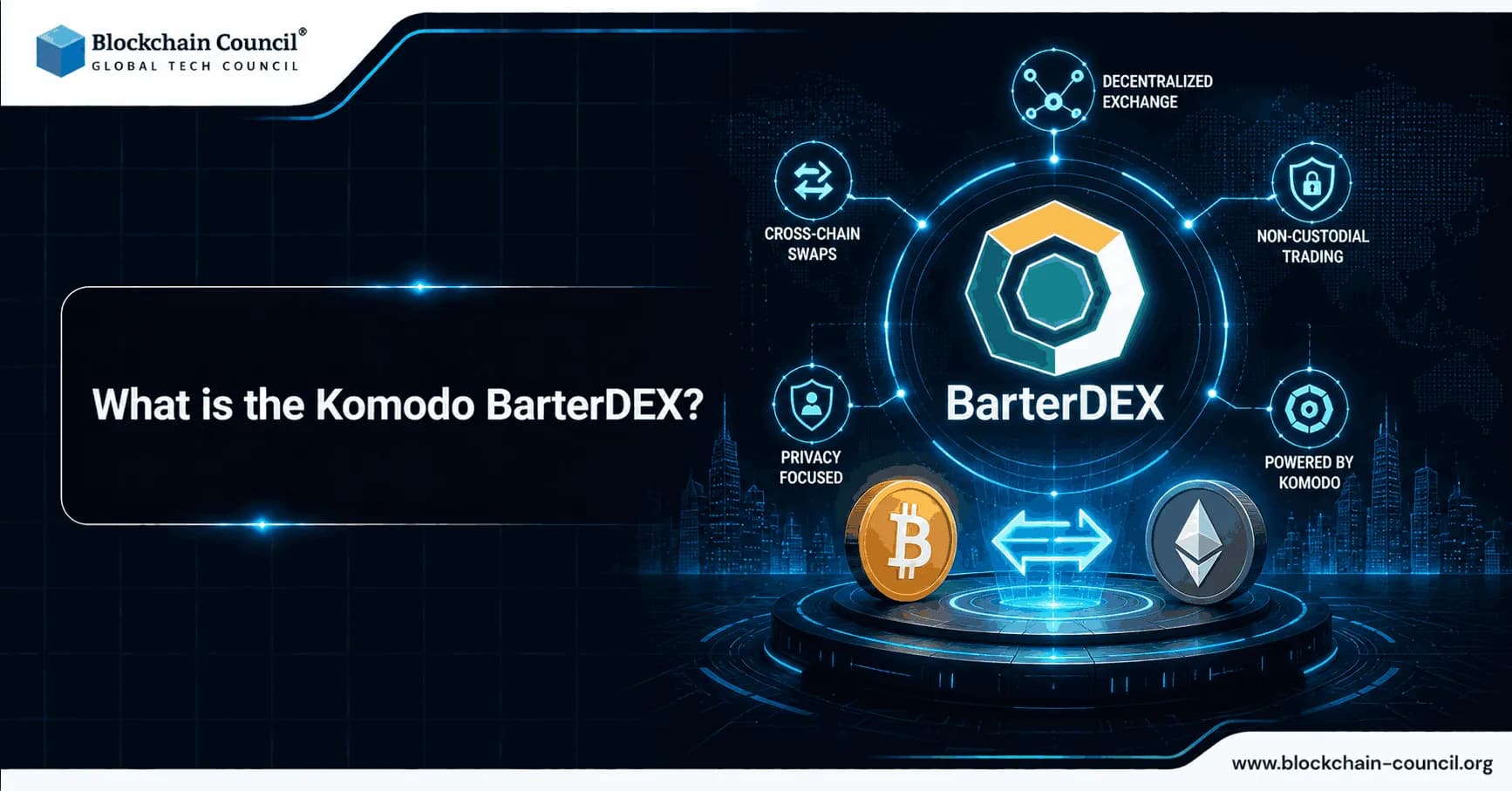
Komodo BarterDEX was one of the earliest decentralized exchanges built to solve a problem that has followed the crypto industry since its beginning: how do you trade one cryptocurrency for another without handing your funds over to a middleman? Launched by the Komodo Platform team in 2017, BarterDEX used a technology called atomic swaps to let users trade coins directly from their own wallets, with no centralized order book and no custodian holding their private keys. Anyone studying blockchain history from a formal angle, including students working through a Certified Blockchain Expert program, tends to run into BarterDEX as a foundational case study because it proved that trustless, peer to peer trading across different blockchains was actually possible at scale.
This article breaks down what BarterDEX was, how it worked, why it mattered, and what replaced it.

How BarterDEX Atomic Swaps Actually Work
At the core of BarterDEX was the atomic swap, a cryptographic method that lets two people exchange coins from different blockchains directly, without ever needing to trust each other or route the trade through a third party. The process relies on hash time locked contracts, which hold each side's funds until both parties fulfil their part of the trade within a set time window. If either party fails to complete their side of the deal, the funds are automatically returned, so nobody can walk away with the other person's coins.
This design removes counterparty risk almost entirely, which is a concept that traders pursuing a Certified Cryptocurrency Trader (CCT) qualification typically study in depth, since understanding settlement risk is central to trading safely across different exchange types. On a centralized exchange, users hand their coins to a company and hope the platform stays solvent and honest. On BarterDEX, the smart contract logic itself enforced fair execution, so trust was placed in code rather than in a company.
Key Features That Set BarterDEX Apart
Decentralized Order Matching
Unlike most exchanges at the time, BarterDEX ran a fully decentralized order matching system. Traders could place and accept orders directly, without needing to coordinate through a central server, and the order book was propagated peer to peer across the network rather than stored on one company's database.
Broad Coin Coverage
By early 2018, BarterDEX had expanded to support roughly 95 percent of all cryptocurrencies in existence, including Bitcoin protocol coins and, after an update, ERC-20 tokens. This gave it one of the widest asset ranges of any exchange platform at the time, centralized or otherwise.
No Custody, No Registration
Because trades happened directly from each user's own wallet, there was no sign up process, no KYC gate, and no point where the platform itself held customer funds. This is the same non-custodial principle that underpins most of today's DeFi exchanges.
Privacy During Order Matching
BarterDEX added a layer of privacy to the negotiation process itself, allowing two nodes to complete a peer to peer atomic swap without directly exposing their IP addresses to one another during matching.
Why BarterDEX Mattered for the Blockchain Industry
BarterDEX is worth remembering because it was the first graphical, publicly usable application to prove atomic swaps could work outside of a lab environment. Earlier attempts at cross chain swaps between networks like Bitcoin and Litecoin moved slowly, largely because those base layer protocols were not built with this kind of interoperability in mind. Komodo, having built its blockchain from scratch, engineered atomic swap support directly into its architecture, which let BarterDEX process large volumes of swaps while other projects were still testing single transactions.
That head start is part of why interoperability and cross chain design now show up as core modules in serious blockchain education, including the kind of applied curriculum covered by a Tech Certification track focused on emerging technologies. Understanding how BarterDEX solved order matching, liquidity, and trade clearing in a single decentralized system gives learners a real reference point for how modern DEX protocols, from Uniswap to newer cross chain bridges, evolved the same core ideas further.
BarterDEX also mattered commercially. It demonstrated that a decentralized exchange did not have to sacrifice usability to remove counterparty risk, which helped shift industry conversation toward non-custodial trading as a realistic alternative to centralized platforms rather than a purely theoretical one.
From BarterDEX to AtomicDEX
BarterDEX has since been retired. Komodo folded its atomic swap technology into a newer, more efficient platform called AtomicDEX, which combines a multi-coin wallet with a fully decentralized trading engine in one application. AtomicDEX reduced the number of transactions needed per swap, lowered trading fees, and extended support to a similar wide range of assets while offering a smoother mobile and desktop experience than the original command line and early GUI versions of BarterDEX. The Agama wallet that Komodo used alongside BarterDEX was later handed over to the Verus Coin team, while Komodo's development efforts moved fully to AtomicDEX.
So while BarterDEX itself is no longer active, its architecture and lessons live on directly inside its successor.
Final Thoughts
Komodo BarterDEX earned its place in blockchain history by proving that decentralized, non-custodial trading across different blockchains was not just possible but usable in practice. It laid the technical groundwork that AtomicDEX later refined, and its core ideas around trustless settlement continue to influence how modern DEX platforms are designed. For anyone building a career around this space, whether through hands on trading, protocol development, or educating others, projects like BarterDEX are a useful reminder of how far decentralized exchange technology has come. Even the marketing side of the industry draws on these origin stories, and professionals who complete a Marketing Certification focused on blockchain and fintech often use case studies like BarterDEX to explain why non-custodial trading resonates with today's crypto audience.
FAQs
1. What is Komodo BarterDEX?
Komodo BarterDEX was a decentralized cryptocurrency exchange (DEX) developed by the Komodo Platform. It was designed to enable peer-to-peer cryptocurrency trading without relying on a centralized intermediary. One of its defining features was the use of atomic swaps, allowing users to exchange compatible cryptocurrencies directly from their own wallets.
Note: BarterDEX has since been superseded by newer technologies within the Komodo ecosystem, such as AtomicDEX, which offers expanded functionality and a more modern user experience.
2. What was the purpose of BarterDEX?
BarterDEX aimed to solve several challenges associated with centralized cryptocurrency exchanges, including:
Custody of user funds
Exchange hacks
Single points of failure
Trading transparency
Privacy concerns
By allowing users to retain control of their private keys, it reduced custodial risk.
3. How did BarterDEX work?
BarterDEX connected buyers and sellers directly using a decentralized peer-to-peer network. Trades were executed using atomic swap technology, allowing compatible cryptocurrencies to be exchanged without depositing funds into a centralized exchange.
4. What are atomic swaps?
Atomic swaps are cryptographic protocols that allow two users to exchange cryptocurrencies across different blockchain networks without requiring a trusted intermediary.
The transaction is designed so that:
Both parties successfully exchange assets, or
The trade is automatically canceled and each party keeps their original funds.
This "all-or-nothing" approach reduces counterparty risk.
5. What made BarterDEX different from centralized exchanges?
Unlike centralized exchanges:
Users controlled their own private keys.
Funds generally remained in users' wallets until settlement.
There was no central custodian holding customer assets.
Trading occurred directly between participants.
6. Which cryptocurrencies were supported?
BarterDEX was designed to support many blockchain networks that were compatible with its atomic swap implementation, including Bitcoin-based and Komodo-related assets. Support expanded over time through protocol development.
7. What was the Komodo Platform?
Komodo is an open-source blockchain ecosystem focused on:
Decentralized exchanges
Cross-chain interoperability
Blockchain customization
Security
Privacy
Developer tools
It provides infrastructure for creating independent blockchain projects and decentralized applications.
8. How did BarterDEX improve security?
Security features included:
Non-custodial trading
Atomic swap settlement
User-controlled private keys
Reduced centralized attack surface
Cryptographic verification
However, users still remained responsible for securing their wallets and recovery phrases.
9. Did users need to trust a third party?
No. One of BarterDEX's primary goals was minimizing trust in centralized intermediaries by relying on cryptographic protocols and blockchain verification instead of exchange operators.
10. How did liquidity work?
Liquidity depended on participants placing buy and sell orders on the decentralized network. As with many decentralized exchanges, liquidity could vary depending on market activity and supported trading pairs.
11. What were the advantages of BarterDEX?
Benefits included:
Non-custodial trading
Atomic swaps
Improved security
Greater privacy
No centralized custody
Reduced hacking risk
Cross-chain trading
Peer-to-peer architecture
Greater user control
12. What were its limitations?
Challenges included:
Lower liquidity than major centralized exchanges
Slower user adoption
More complex user experience
Limited support for some blockchain networks
Dependence on compatible atomic swap implementations
These limitations influenced the evolution toward newer decentralized exchange technologies.
13. What is AtomicDEX?
AtomicDEX is the successor to BarterDEX within the Komodo ecosystem. It continues the concept of decentralized, non-custodial trading while offering improved usability, broader asset support, enhanced wallet functionality, and additional cross-chain capabilities.
14. Is AtomicDEX still based on atomic swaps?
Yes. AtomicDEX continues to use atomic swap technology where applicable while expanding support for modern blockchain ecosystems and decentralized trading features.
15. Can BarterDEX be considered a decentralized exchange (DEX)?
Yes. BarterDEX was an early decentralized exchange that demonstrated practical cross-chain trading without centralized custody, helping advance the development of the broader DEX ecosystem.
16. What common misconceptions exist?
Common misconceptions include:
BarterDEX was a centralized exchange.
Atomic swaps require depositing funds with a third party.
Decentralized exchanges completely eliminate trading risks.
In reality, decentralized exchanges reduce custodial risk but do not eliminate market, operational, or technical risks.
17. What are best practices when using decentralized exchanges?
Best practices include:
Protect private keys and recovery phrases.
Use reputable wallet software.
Verify recipient addresses carefully.
Understand network fees.
Keep software updated.
Research supported trading pairs.
Be aware of liquidity and slippage.
18. How did BarterDEX influence blockchain technology?
BarterDEX helped demonstrate that peer-to-peer cryptocurrency trading without centralized custody was technically feasible. Its work on atomic swaps influenced later developments in decentralized exchanges, interoperability, and cross-chain infrastructure.
19. What trends are shaping decentralized exchanges in 2025-2026?
Major trends include:
Cross-chain interoperability
Intent-based trading
Layer 2 scaling
Tokenization of real-world assets (RWAs)
AI-assisted trading tools
Zero-knowledge proofs (ZKPs)
Account abstraction
Decentralized identity (DID)
Improved liquidity aggregation
Institutional DeFi participation
20. What is the legacy of Komodo BarterDEX?
Komodo BarterDEX played an important role in demonstrating the potential of decentralized, non-custodial cryptocurrency trading through atomic swaps. Although it has largely been replaced by more advanced platforms such as AtomicDEX, its underlying ideas continue to influence the evolution of decentralized finance (DeFi) and cross-chain interoperability. Like many early blockchain projects, BarterDEX was less about becoming the final destination and more about proving that a different route was possible.
Related Articles
View All
Blockchain
Beyond Cryptocurrency: How Blockchain Is Transforming Real-World Industries
Explore how blockchain works beyond cryptocurrency in banking, supply chains, healthcare, tokenisation, CBDCs, and government, plus key challenges and career paths.

Blockchain
Smart Contracts & dApps: How Blockchain Becomes Programmable
Learn how smart contracts and dApps make blockchain programmable, from Ethereum and tokens to DeFi, NFTs, real use cases, benefits, and key risks.

Blockchain
Public, Private & Consortium Blockchains: Which Network Fits the Use Case?
Compare public, private, and consortium blockchains by security, speed, privacy, and control, with real examples and a simple guide to choosing the right network.
Trending Articles
AWS Career Roadmap
A step-by-step guide to building a successful career in Amazon Web Services cloud computing.
Claude AI Tools for Productivity
Discover Claude AI tools for productivity to streamline tasks, manage workflows, and improve efficiency.
How to Install Claude Code
Learn how to install Claude Code on macOS, Linux, and Windows using the native installer, plus verification, authentication, and troubleshooting tips.