

Introduction to Blockchain & Distributed Ledger
 Toshendra Kumar Sharma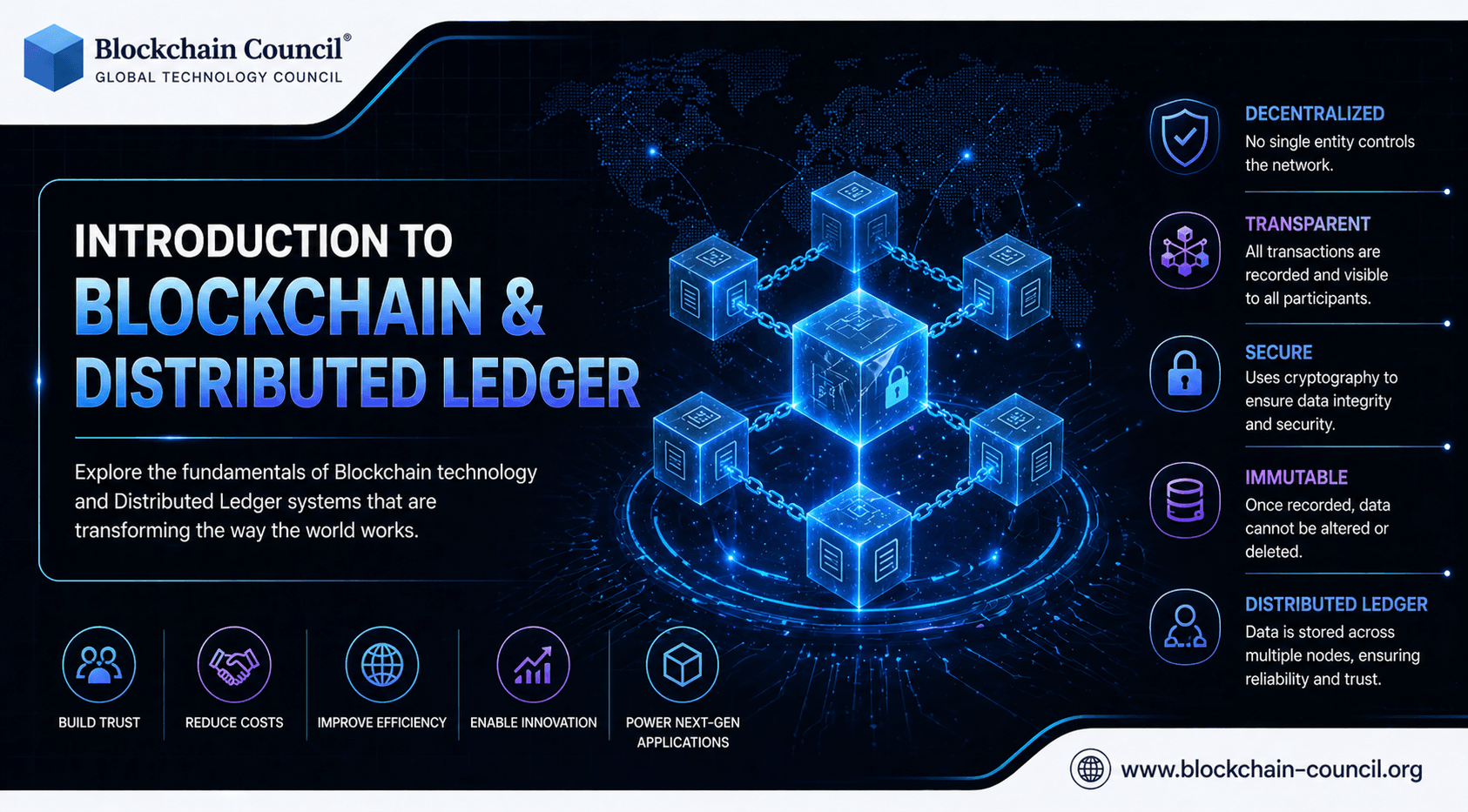
Blockchain and Distributed Ledger Technology (DLT) have become foundational technologies in today’s digital economy. Originally introduced as the underlying system for Bitcoin, blockchain has evolved into a powerful tool used across industries such as finance, healthcare, supply chain, and governance.
This guide explains what blockchain is, how it works, and why it is important in 2026. Whether you are a beginner or looking to deepen your understanding, this article provides a clear and updated overview.

What Is Blockchain?
Blockchain is a decentralized digital ledger that records transactions across a network of computers in a secure, transparent, and tamper-resistant way.
Instead of relying on a central authority, blockchain distributes data across multiple participants, known as nodes. Each participant holds a copy of the ledger, ensuring that no single entity controls the system.
Blockchain was first introduced in 2008 by Satoshi Nakamoto as part of Bitcoin. Today, it supports a wide range of applications beyond cryptocurrencies. Understand how blockchain and distributed ledger technology ensure immutability, transparency, and decentralization across networks by building foundational expertise through a Certified Blockchain Expert, implementing ledger-based logic using a Python certification, and applying these concepts in business scenarios with a Digital marketing course.
What Is Distributed Ledger Technology (DLT)?
Distributed Ledger Technology is a broader term that includes blockchain and other systems that record data across multiple locations.
While all blockchains are distributed ledgers, not all distributed ledgers are blockchains. The key idea behind DLT is decentralization, where data is shared, synchronized, and validated across a network.
DLT improves transparency, reduces reliance on intermediaries, and enhances security in digital transactions.
Key Features of Blockchain Technology
Decentralization
Blockchain operates without a central authority. Control is distributed among network participants, reducing the risk of manipulation or failure.
Transparency
Transactions are recorded on a public or shared ledger. This allows participants to verify data and increases trust within the system.
Immutability
Once data is recorded on the blockchain, it cannot be easily changed or deleted. This ensures data integrity and reliability.
Security
Blockchain uses cryptographic techniques to secure data. Each block is linked to the previous one, making unauthorized changes extremely difficult.
Consensus Mechanisms
Transactions are validated through consensus mechanisms such as Proof of Work (PoW) or Proof of Stake (PoS). These ensure agreement among participants before adding new data.
How Blockchain Works
Blockchain works by recording transactions in blocks and linking them together in a chain.
Step-by-Step Process
A transaction is initiated
The transaction is broadcast to the network
Nodes validate the transaction using consensus rules
Verified transactions are grouped into a block
The block is added to the existing blockchain
The transaction is completed and permanently recorded
Each block contains:
Transaction data
A timestamp
A cryptographic hash of the previous block
This structure ensures that the data remains secure and tamper-resistant.
Types of Blockchain Networks
Public Blockchain
Public blockchains are open to anyone. Examples include Bitcoin and Ethereum. They offer high transparency and decentralization.
Private Blockchain
Private blockchains are restricted to specific participants. They are commonly used by organizations for internal processes.
Consortium Blockchain
Consortium blockchains are controlled by a group of organizations. They combine features of public and private blockchains.
Hybrid Blockchain
Hybrid blockchains allow a mix of public and private access. They provide flexibility for different use cases.
Why Blockchain Is Important
Enhances Trust and Transparency
Blockchain creates a shared and verifiable record of transactions. This reduces disputes and increases trust among participants.
Eliminates Intermediaries
Traditional systems rely on intermediaries such as banks or brokers. Blockchain enables direct peer-to-peer transactions, reducing costs and delays.
Improves Security
Decentralized storage and cryptographic protection make blockchain highly secure compared to centralized systems.
Enables Digital Transformation
Blockchain supports new technologies such as decentralized finance (DeFi), smart contracts, and Web3 applications.
Increases Efficiency
Automated processes and real-time data sharing improve operational efficiency across industries.
Real-World Applications of Blockchain
Financial Services
Blockchain enables faster and more secure payments, cross-border transactions, and decentralized finance platforms.
Supply Chain Management
Companies use blockchain to track goods, verify authenticity, and improve transparency across supply chains.
Healthcare
Blockchain helps secure patient records and ensures data privacy while allowing controlled access.
Digital Identity
Blockchain enables secure identity verification without relying on centralized authorities.
Government and Public Services
Governments use blockchain for voting systems, record management, and transparency initiatives.
Challenges of Blockchain Technology
Scalability
Blockchain networks can face limitations in processing large volumes of transactions quickly. Solutions such as Layer 2 technologies are addressing this issue.
Energy Consumption
Some consensus mechanisms, like Proof of Work, require high energy usage. However, newer systems like Proof of Stake are more efficient.
Regulatory Uncertainty
Governments are still developing policies around blockchain and cryptocurrencies. Compliance requirements vary by region.
Adoption Barriers
Businesses may face challenges integrating blockchain into existing systems due to cost and technical complexity.
Security and Regulatory Compliance
Blockchain offers strong security, but users and organizations must follow best practices.
Protect private keys and access credentials
Use trusted platforms and protocols
Monitor transactions and system activity
Maintain accurate records for reporting
Understanding compliance is essential as blockchain adoption continues to grow globally.
The Future of Blockchain
Blockchain technology continues to evolve rapidly. Key trends shaping its future include:
Integration with artificial intelligence and IoT
Expansion of decentralized finance and Web3
Increased enterprise adoption
Development of scalable and energy-efficient solutions
Blockchain is no longer limited to cryptocurrency. It is becoming a core infrastructure for digital systems worldwide. Explore how decentralized systems replace centralized control with trustless consensus mechanisms by mastering blockchain architecture through a Certified Blockchain Expert, building backend integrations using a Node JS Course, and promoting blockchain solutions using an AI powered marketing course.
Conclusion
Blockchain and Distributed Ledger Technology are transforming how data and transactions are managed. By providing decentralization, transparency, and security, blockchain enables new business models and digital innovations.
While challenges remain, the technology continues to mature and expand across industries. Understanding blockchain is essential for anyone looking to participate in the modern digital economy.
FAQs
1. What is blockchain in simple terms?
Blockchain is a digital ledger that records transactions securely across multiple computers. It ensures transparency and prevents data tampering.
2. What is Distributed Ledger Technology?
Distributed Ledger Technology is a system where data is shared across multiple locations. Blockchain is one type of distributed ledger.
3. How does blockchain work?
Blockchain records transactions in blocks, which are linked together. Each block is verified and added to the chain securely.
4. Who created the blockchain?
Blockchain was introduced by Satoshi Nakamoto in 2008 as part of the Bitcoin system.
5. What are the main features of blockchain?
Key features include decentralization, transparency, immutability, and security through cryptography.
6. What is a block in a blockchain?
A block is a collection of transaction data. It also contains a timestamp and a link to the previous block.
7. What is decentralization in blockchain?
Decentralization means no single authority controls the network. Data is distributed across multiple participants.
8. Is blockchain secure?
Yes, blockchain is highly secure due to cryptographic protection and distributed validation processes.
9. What are smart contracts?
Smart contracts are self-executing programs that run on blockchain and automate agreements without intermediaries.
10. What industries use blockchain?
Industries include finance, healthcare, supply chain, government, and digital identity systems.
11. What is a public blockchain?
A public blockchain is open to anyone and allows anyone to participate in the network.
12. What is a private blockchain?
A private blockchain is restricted to specific users and is typically used by organizations.
13. What is blockchain used for?
Blockchain is used for payments, data management, smart contracts, and decentralized applications.
14. What are the challenges of blockchain?
Challenges include scalability, energy consumption, regulatory uncertainty, and integration complexity.
15. What is consensus in blockchain?
Consensus is the process by which network participants agree on the validity of transactions.
16. Can blockchain be hacked?
Blockchain itself is very secure, but vulnerabilities can exist in applications or user practices.
17. Is blockchain only used for cryptocurrency?
No, blockchain is used in many fields beyond cryptocurrency, including supply chain and healthcare.
18. What is the future of blockchain?
Blockchain is expected to grow with advancements in scalability, adoption, and integration with other technologies.
19. Do I need technical knowledge to use blockchain?
Basic usage does not require deep technical knowledge, but understanding core concepts is helpful.
20. Why is blockchain important?
Blockchain improves transparency, security, and efficiency, making it a key technology for the digital economy.
Related Articles
View All
Blockchain
Blockchain Distributed Systems Engineering: A Practical Guide
Learn how Blockchain Distributed Systems Engineering combines consensus, fault tolerance, smart contracts, security, and software process for real-world systems.

Blockchain
Blockchain Certification Programs You Can Join Online
Discover the best blockchain certification programs you can join online. Learn blockchain fundamentals, smart contracts, enterprise blockchain, and career opportunities with globally recognized certifications.

Blockchain
Agile for Blockchain Teams: Managing Sprints, Smart Contracts, and Decentralized Roadmaps
Learn how agile for blockchain teams works when sprints, smart contracts, audits, governance, and decentralized roadmaps are planned around risk.
Trending Articles
AWS Career Roadmap
A step-by-step guide to building a successful career in Amazon Web Services cloud computing.

Can DeFi 2.0 Bridge the Gap Between Traditional and Decentralized Finance?
The next generation of DeFi protocols aims to connect traditional banking with decentralized finance ecosystems.
Claude AI Tools for Productivity
Discover Claude AI tools for productivity to streamline tasks, manage workflows, and improve efficiency.