

List Of Top Startups In Blockchain Globally
 Toshendra Kumar Sharma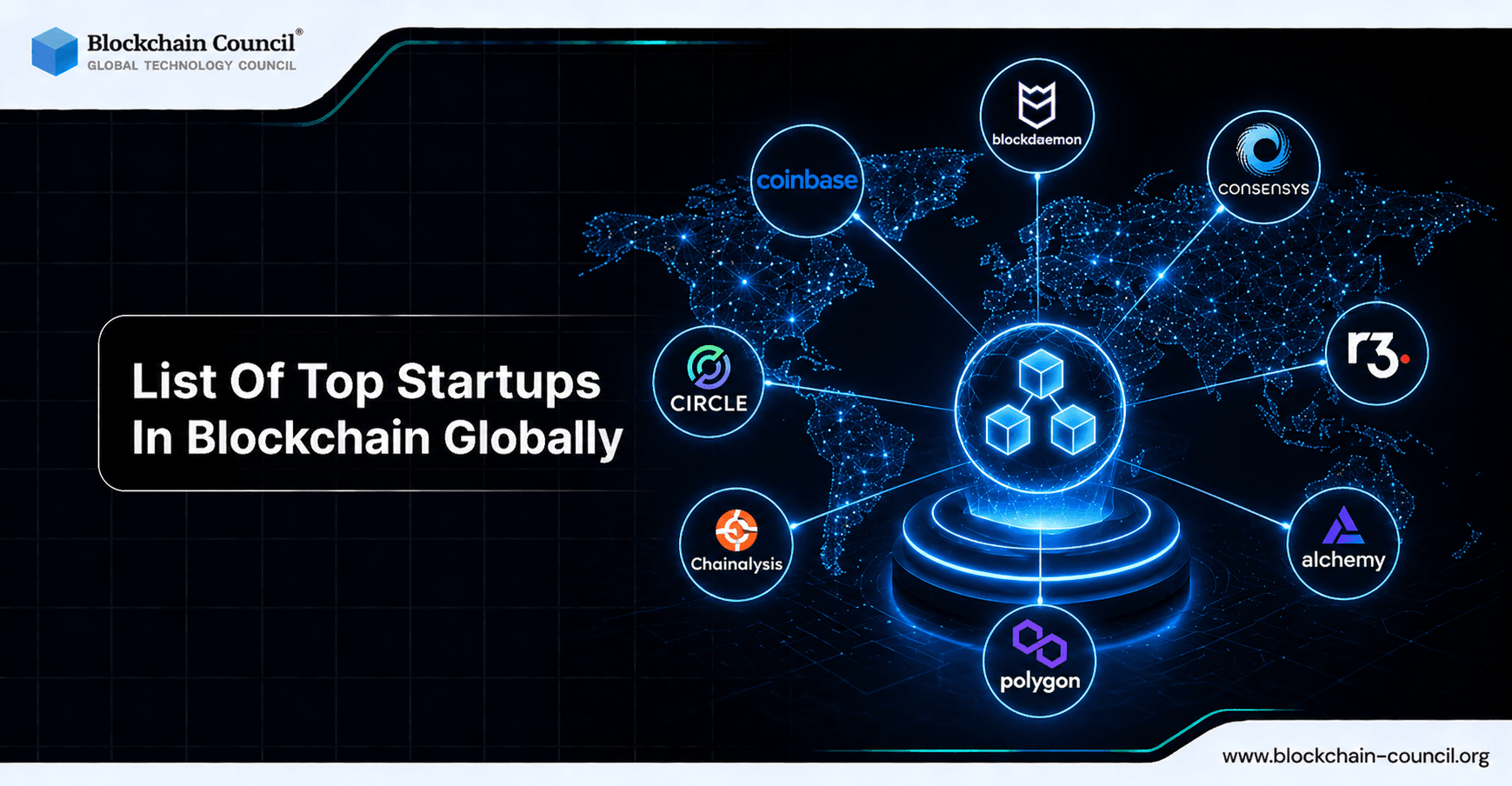
Blockchain technology has evolved from a niche innovation supporting Bitcoin into a global infrastructure powering finance, digital identity, supply chains, and decentralized applications.
While early enthusiasm was driven by speculation, today’s blockchain startups are focused on real-world use cases, scalability, and enterprise adoption. Investment in blockchain and Web3 companies now spans billions annually, with strong participation from venture capital and institutional players. Analyze global blockchain startups shaping industries like finance, supply chain, and identity by building expertise through a Certified Blockchain Expert, evaluating market data using a Python certification, and leveraging insights using a Digital marketing course.

This article highlights the top blockchain startups globally in 2026, including both early pioneers and modern leaders shaping the industry.
What Is Blockchain Technology?
Blockchain is a decentralized digital ledger that records transactions across a distributed network. Each transaction is stored in a block, and blocks are linked together chronologically to form a secure chain.
Key features include:
Transparency and immutability
Decentralization
Cryptographic security
Trustless verification
These characteristics make blockchain suitable for applications beyond cryptocurrency, including finance, logistics, and digital identity.
Evolution of Blockchain Startups
Early blockchain startups focused on cryptocurrency infrastructure. Over time, the industry expanded into:
Decentralized finance (DeFi)
Non-fungible tokens (NFTs)
Enterprise blockchain solutions
Web3 infrastructure
Identity and data management
As of 2026, the focus has shifted toward scalability, usability, and regulatory compliance.
Top Blockchain Startups Globally (2026)
1. Blockstream
Blockstream remains a major player in Bitcoin infrastructure. It focuses on improving Bitcoin’s scalability and functionality through innovations like the Liquid Network and satellite-based blockchain access.
The company plays a critical role in advancing Bitcoin as a global financial network.
2. Ethereum
Ethereum is no longer just a startup but remains one of the most influential blockchain platforms globally.
It introduced smart contracts and decentralized applications. Since transitioning to Proof of Stake, Ethereum has improved energy efficiency and scalability through Layer 2 ecosystems.
3. ConsenSys
ConsenSys builds tools and infrastructure for Ethereum, including MetaMask, Infura, and developer platforms.
It is a key player in Web3 development, enabling millions of users and developers to interact with blockchain applications.
4. Polygon
Polygon provides Layer 2 scaling solutions for Ethereum. It reduces transaction costs and improves speed, making it essential for DeFi, gaming, and NFT platforms.
It has become one of the most widely adopted blockchain infrastructure projects.
5. Chainalysis
Chainalysis specializes in blockchain analytics and compliance. It helps governments, exchanges, and financial institutions monitor transactions and prevent fraud.
Its tools are widely used for regulatory compliance and investigations.
6. Fireblocks
Fireblocks provides secure infrastructure for managing digital assets. It enables institutions to store, transfer, and issue cryptocurrencies safely.
It is widely used by banks, exchanges, and fintech companies.
7. Alchemy
Alchemy offers blockchain development infrastructure similar to cloud services. It provides APIs and tools that help developers build scalable Web3 applications.
It supports multiple blockchains, including Ethereum and Layer 2 networks.
8. Ripple
Ripple focuses on cross-border payments using blockchain-based solutions. Its technology is used by financial institutions to enable faster and cheaper international transfers.
Despite regulatory challenges, Ripple remains influential in fintech.
9. Lisk
Lisk continues to focus on making blockchain development accessible through JavaScript-based tools.
It enables developers to build decentralized applications using sidechains, improving scalability and usability.
10. Everledger
Everledger uses blockchain to track the provenance of high-value assets such as diamonds, wine, and luxury goods.
It focuses on transparency and fraud prevention in supply chains.
11. Aptos
Aptos is a newer blockchain platform focused on scalability and performance. It uses advanced technologies to support high transaction throughput and low latency.
It is gaining traction in Web3 development.
12. Sui
Sui is another high-performance blockchain designed for scalability and user-friendly applications.
It focuses on fast transaction processing and efficient data handling.
13. StarkWare
StarkWare develops zero-knowledge proof technology to improve blockchain scalability and privacy.
Its solutions are widely used in Layer 2 scaling systems.
14. OpenSea
OpenSea is one of the largest NFT marketplaces globally. It enables users to buy, sell, and trade digital assets.
It has played a major role in the growth of the NFT ecosystem.
15. Dapper Labs
Dapper Labs is known for blockchain-based entertainment platforms such as NBA Top Shot.
It focuses on mainstream adoption of digital collectibles and Web3 experiences.
Key Trends in Global Blockchain Startups
1. Focus on Scalability
Startups are building Layer 2 solutions and new architectures to handle high transaction volumes.
2. Institutional Adoption
Banks and financial institutions are increasingly using blockchain for payments and asset management.
3. Regulatory Compliance
Startups are developing tools to meet regulatory requirements and improve transparency.
4. Integration with AI and Data Systems
Blockchain is being combined with AI for data verification and automation.
5. Growth of Web3 Ecosystem
Decentralized applications, digital identity, and tokenized assets are expanding rapidly.
Challenges Facing Blockchain Startups
Despite growth, the industry faces challenges:
Regulatory uncertainty in multiple regions
Scalability limitations for some networks
Security risks in smart contracts
Market volatility affecting funding
Successful startups focus on solving real problems rather than relying on hype.
Conclusion
Blockchain startups globally have evolved from early experiments into critical infrastructure providers for digital economies.
Companies like Ethereum, Polygon, and Chainalysis demonstrate how the industry has matured across finance, development tools, and enterprise solutions.
As adoption continues to grow, blockchain startups will play a key role in shaping the future of technology and digital trust. Understand global blockchain innovation trends and emerging business models by mastering ecosystem knowledge through a Certified Blockchain Expert, building scalable platforms using a Node JS Course, and promoting global solutions using an AI powered marketing course.
FAQs
1. What are blockchain startups?
Blockchain startups are companies that build products or services using blockchain technology for applications like finance, identity, and supply chain.
2. Which is the top blockchain startup globally?
Ethereum and Polygon are among the most influential due to their widespread adoption and infrastructure impact.
3. What does Blockstream do?
Blockstream develops Bitcoin infrastructure, including sidechains and tools to improve scalability and usability.
4. What is ConsenSys known for?
ConsenSys builds Ethereum-based tools like MetaMask and Infura, supporting developers and users in Web3.
5. What is Chainalysis used for?
Chainalysis provides blockchain analytics for compliance, fraud detection, and transaction monitoring.
6. What are Fireblocks?
Fireblocks offers secure infrastructure for managing digital assets, used by institutions and exchanges.
7. What is Polygon in blockchain?
Polygon is a Layer 2 solution that improves Ethereum’s scalability and reduces transaction costs.
8. What is Ripple used for?
Ripple enables fast and low-cost cross-border payments for financial institutions.
9. What is Lisk blockchain?
Lisk allows developers to build blockchain applications using JavaScript and sidechains.
10. What is Everledger?
Everledger tracks high-value assets using blockchain to ensure authenticity and transparency.
11. What is Web3 in blockchain?
Web3 refers to decentralized internet applications built on blockchain technology.
12. What are Layer 2 solutions?
Layer 2 solutions improve blockchain scalability by processing transactions off the main chain.
13. What is a decentralized application?
A decentralized application runs on a blockchain instead of centralized servers.
14. What is zero-knowledge proof?
It is a cryptographic method that allows verification without revealing underlying data.
15. Are blockchain startups growing?
Yes, global investment and adoption continue to increase across industries.
16. What industries use blockchain startups?
Industries include finance, healthcare, supply chain, gaming, and government.
17. What is an NFT marketplace?
It is a platform where users can buy and sell digital assets stored on blockchain.
18. What challenges do blockchain startups face?
Challenges include regulation, scalability, security risks, and market volatility.
19. Can blockchain startups replace traditional systems?
They can complement or improve existing systems but are unlikely to replace all traditional systems entirely.
20. What is the future of blockchain startups?
The future includes greater adoption, integration with AI, and expansion into enterprise and consumer applications.
Related Articles
View All
Blockchain
Top Blockchain Use Cases in Banks and Financial Services
Explore the top blockchain use cases in banks, from payments and trade finance to tokenization, settlement, lending, KYC, and digital asset services.

Blockchain
Blockchain Careers in Europe: Top Jobs, Skills, Salaries, and Certification Paths
A practical guide to blockchain careers in Europe, covering top roles, salary benchmarks, key skills, remote work trends, and certification paths.

Blockchain
Top Blockchain Intelligence Tools for Tracking Wallets, Transactions, and DeFi Activity
Explore the top blockchain intelligence tools for wallet tracking, transaction tracing, DeFi analytics, compliance screening, and market research.
Trending Articles
AWS Career Roadmap
A step-by-step guide to building a successful career in Amazon Web Services cloud computing.
What is AWS? A Beginner's Guide to Cloud Computing
Everything you need to know about Amazon Web Services, cloud computing fundamentals, and career opportunities.

Can DeFi 2.0 Bridge the Gap Between Traditional and Decentralized Finance?
The next generation of DeFi protocols aims to connect traditional banking with decentralized finance ecosystems.