

How Blockchain Can Be Used In Healthcare & How It Works?
 Toshendra Kumar Sharma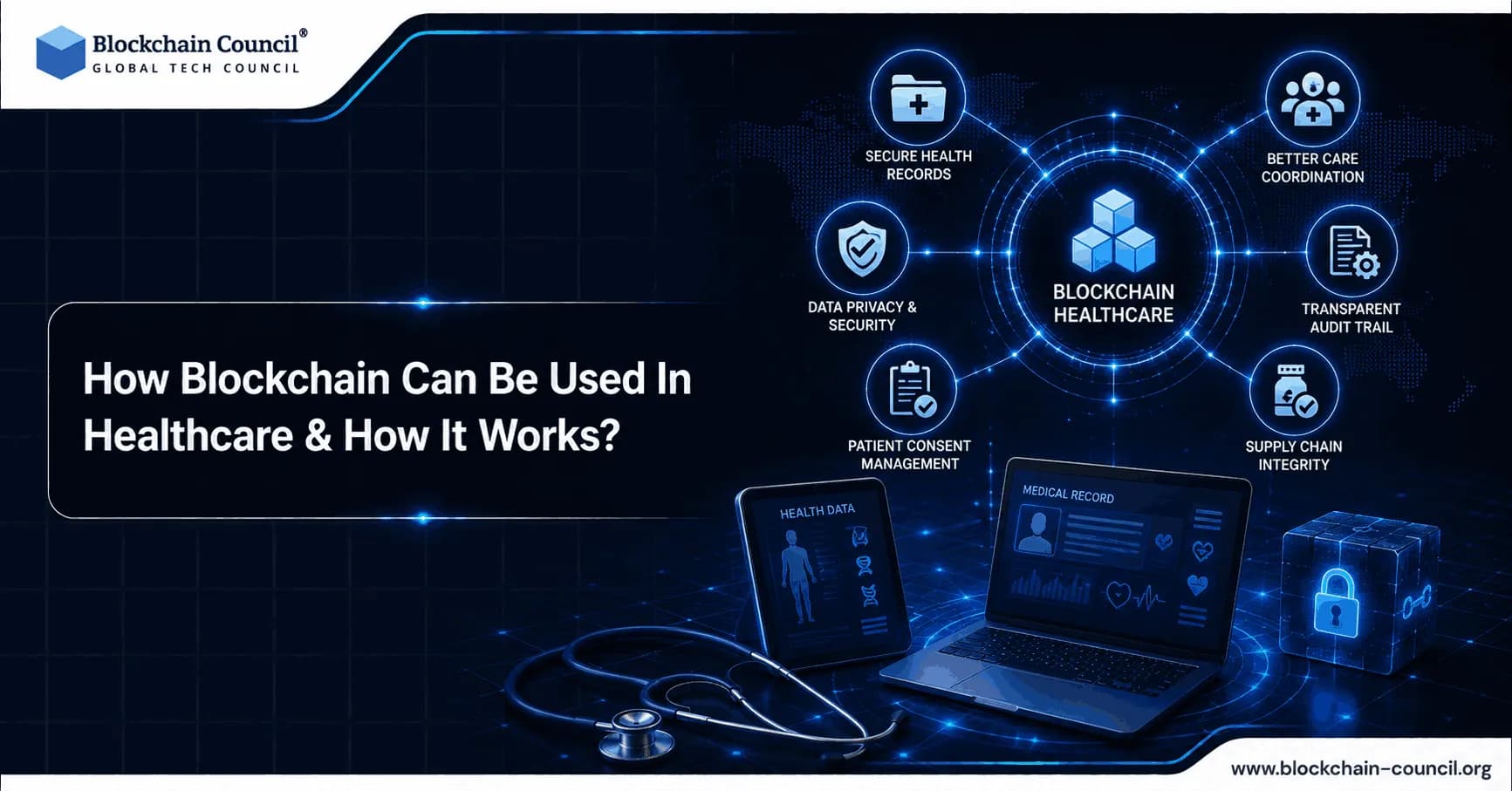
Health IT and information security teams keep hearing the same bold claims about blockchain that it's the answer to interoperability, and that it can solve healthcare's looming data security problems. Behind the hype, there's a genuine case to be made: healthcare runs on fragmented records spread across hospitals, labs, and insurers, and blockchain offers a way to make that data more secure, traceable, and shareable without a single point of failure. As health systems explore this potential, more professionals are pursuing a Certified Blockchain Expert credential to understand how the technology actually applies to healthcare data, rather than just the buzzwords surrounding it.
In this article, we'll explain what blockchain is at its core, how it works step by step in a healthcare context, the real benefits and limitations, and where the technology is already being applied.

What Is Blockchain, and Why Does Healthcare Care?
Blockchain was introduced in 2008 by a person or group operating under the pseudonym Satoshi Nakamoto, originally designed as the underlying technology for exchanging the cryptocurrency Bitcoin. At its core, blockchain is a digital ledger that logs transactions publicly and in chronological order, building an ever-expanding chain of time-stamped "blocks," each cryptographically linked to the one before it.
The defining feature that has healthcare paying attention is immutability: once a block is added, it cannot be changed, deleted, or altered it stands as a permanent, verifiable record that a given transaction occurred. Combined with blockchain's decentralized, open structure, this makes it an appealing foundation for managing health records and verifying patient or provider identity, since no single institution has to serve as the sole gatekeeper of that data.
Rather than living in one central database, a blockchain record can be distributed and shared across a network, with credentialed users able to add new entries but never delete or alter what's already there. Every transaction is encrypted and must be independently verified by the network before it's accepted. Applying this correctly in a clinical setting requires understanding both blockchain fundamentals and the regulatory realities of patient data, which is why many health IT and compliance professionals are now pursuing a Certified Blockchain & Healthcare Professional qualification to bridge that exact gap.
Quick Answer (for readers in a hurry)
Blockchain improves healthcare data management by creating a decentralized, tamper-proof ledger for health records that multiple institutions can securely share and verify without a central authority. Smart contracts can automate patient consent and data-sharing permissions, while large files like imaging scans stay off-chain and are linked through a cryptographic hash, keeping the network efficient while maintaining data integrity.
How Blockchain Works in Healthcare (Step-by-Step)
Here's how blockchain functions when applied to healthcare data:
1. Recording Transactions as Blocks
Every action a new lab result, a data-sharing event, a provider update is recorded as a transaction and grouped into a block, which is then time-stamped and linked to the block that came before it, forming the chronological chain.
2. Network Verification and Consensus
Before a new block is accepted, it must be validated by the network. As Brian Behlendorf, executive director of the Linux Foundation's Hyperledger project, has explained, if any node on the network attempts to transfer the same asset twice to two different parties, the network won't reach agreement to validate that transaction, meaning it simply won't be added as a new block. This consensus requirement is what prevents fraudulent or duplicate entries from corrupting the ledger.
3. Smart Contract-Driven Consent
Smart contracts simple, automated programs that run across every node in the network play a particularly important role in healthcare. Behlendorf has described how these can extend a network's validation logic in ways that are both automatable and undeniable. In practice, this means a smart contract could serve as an authorization step that notifies a patient, or even puts them directly in control, whenever their health data is shared from one party to another.
Building this kind of automated, patient-centered consent infrastructure while integrating with existing electronic health record systems takes real technical skill. This is why developers working on healthcare blockchain platforms often pursue a formal Tech Certification to strengthen their expertise in smart contract development and secure system architecture before deploying solutions that handle protected health information.
4. On-Chain vs. Off-Chain Storage
Because blockchain networks are distributed by design, storage space across every node is inherently limited, which is why smaller data or metadata is generally preferred on-chain. Large healthcare files imaging scans, PDFs, or full diagnostic reports typically aren't stored directly on the chain. Instead, they're kept off-chain and linked to the ledger through a cryptographic hash, a unique numeric fingerprint that confirms the file hasn't been altered since it was recorded.
5. Access and Identity Verification
Patients and providers can use blockchain-based identity verification to confirm who they are and control who has permission to access specific records, reducing reliance on separate, disconnected identity systems across different healthcare institutions.
6. Ongoing Interoperability
As more institutions join the same network and reference the same verified ledger, records become easier to share securely between hospitals, labs, and insurers directly addressing the interoperability problem that has long frustrated healthcare IT teams working with siloed systems.
Key Benefits of Blockchain in Healthcare
Improved data security: Immutable, cryptographically verified records are extremely difficult to tamper with.
Better interoperability: A shared ledger makes it easier for different institutions to securely exchange patient data.
Patient-controlled consent: Smart contracts can give patients direct visibility and control over who accesses their data.
Efficient large-file handling: Off-chain storage with on-chain hashing keeps large medical files verifiable without overloading the network.
Stronger audit trails: Every data access or sharing event is permanently recorded, simplifying compliance reporting.
Real-World Use Cases
The Hyperledger project, an open-source collaborative launched by the Linux Foundation, has worked specifically to extend blockchain use beyond Bitcoin transactions into areas including healthcare data management. Several health systems and startups have piloted blockchain-based platforms for managing patient consent, securely sharing electronic health records between providers, and verifying the authenticity of clinical trial data all areas where a tamper-proof, shared ledger offers a clear advantage over traditional siloed databases.
Challenges to Consider
Blockchain adoption in healthcare still faces real hurdles: integrating with legacy electronic health record systems that weren't built with distributed ledgers in mind, navigating strict patient privacy regulations like HIPAA, achieving consensus on shared technical standards across competing hospital networks, and managing the practical storage limitations that require most large medical files to stay off-chain. These are meaningful challenges that require careful design rather than simply layering blockchain onto existing systems.
Robotics & Innovation
Robotics provides students with an opportunity to understand how programming, engineering, automation, and logical thinking work together. Technology competitions such as a Tech Olympiad can encourage students to explore robotics and innovation while developing their ability to approach technical challenges creatively.
Final Thoughts
Blockchain's core properties immutability, decentralization, and network-verified consensus genuinely align well with some of healthcare's biggest challenges: securing sensitive data and enabling different institutions to share it without a single point of failure or trust. Combined with smart contracts for patient consent and off-chain storage for large files, the technology offers a practical, not just theoretical, path toward better interoperability and security.
As adoption grows, healthcare organizations will need more than solid engineering they'll need to clearly explain these changes to patients and providers who may be unfamiliar with how blockchain protects their data. That's why teams working on blockchain healthcare initiatives are increasingly pairing their technical expertise with a Marketing Certification to communicate these solutions clearly and build trust with the patients and institutions they're designed to serve.
Blockchain in healthcare is still an evolving application, but its direction is clear: more secure records, better interoperability between institutions, and patients with greater control over their own data.
FAQs
1. What is blockchain in healthcare?
Blockchain in healthcare refers to the use of distributed ledger technology (DLT) to securely manage medical records, patient identities, healthcare transactions, clinical research data, insurance claims, and pharmaceutical supply chains. It improves data integrity, transparency, and collaboration while helping protect sensitive health information.
2. Why is blockchain important for healthcare?
Healthcare organizations manage large volumes of sensitive patient data across hospitals, clinics, laboratories, pharmacies, and insurers. Blockchain helps improve data sharing, reduce administrative inefficiencies, strengthen cybersecurity, and create trustworthy audit trails for medical information.
3. How does blockchain work in healthcare?
Blockchain records verified healthcare transactions on a distributed ledger. Instead of storing complete medical records directly on-chain, it typically stores cryptographic hashes, timestamps, permissions, and metadata, while the actual medical records remain securely stored in off-chain databases or electronic health record (EHR) systems.
4. Can blockchain improve electronic health records (EHRs)?
Yes. Blockchain can help healthcare providers securely share electronic health records by verifying document authenticity, managing patient consent, and creating immutable audit trails. It complements existing EHR systems rather than replacing them.
5. How does blockchain improve patient data security?
Blockchain uses cryptographic techniques, decentralized verification, digital signatures, and tamper-evident records to strengthen data integrity. Combined with encryption and strong access controls, it helps reduce unauthorized modifications and improve trust in medical information.
6. What is patient-controlled health data?
Patient-controlled health data allows individuals to decide who can access their medical records and for what purpose. Blockchain-based identity and consent systems can enable patients to grant, revoke, or update access permissions while maintaining a transparent record of those actions.
7. How does blockchain improve healthcare interoperability?
Blockchain enables authorized healthcare providers to verify and exchange trusted information more efficiently. By creating standardized, verifiable records, it can improve interoperability between hospitals, clinics, laboratories, pharmacies, insurers, and other healthcare organizations.
8. Can blockchain reduce healthcare fraud?
Yes. Blockchain can help reduce fraud by creating immutable records of medical claims, prescriptions, billing events, provider credentials, and supply chain activities. While it cannot eliminate fraud entirely, it can make unauthorized changes and duplicate claims easier to detect.
9. How does blockchain improve pharmaceutical supply chains?
Blockchain enables end-to-end tracking of medicines from manufacturers to distributors, pharmacies, hospitals, and patients. This improves traceability, helps identify counterfeit drugs, supports product recalls, and increases supply chain transparency.
10. What role do smart contracts play in healthcare?
Smart contracts can automate insurance claims processing, patient consent management, appointment verification, billing workflows, clinical trial administration, prescription authorization, and provider reimbursement based on predefined rules.
11. Can blockchain improve medical research?
Yes. Blockchain can securely manage research data, clinical trial records, participant consent, and study documentation. It provides transparent audit trails that improve data integrity, reproducibility, and collaboration among research institutions.
12. How does blockchain support health insurance?
Blockchain can streamline insurance verification, automate claims processing, reduce duplicate claims, improve fraud detection, accelerate reimbursements, and maintain transparent records of policy and payment activities.
13. Which blockchain platforms are used in healthcare?
Healthcare organizations commonly explore platforms such as Hyperledger Fabric, Ethereum, Quorum, Hedera, Corda, Polygon, and other permissioned blockchain networks designed for enterprise applications requiring privacy and regulatory compliance.
14. What are the advantages of blockchain in healthcare?
Benefits include improved data security, stronger patient privacy, enhanced interoperability, reduced fraud, better supply chain transparency, faster administrative processes, improved auditability, patient-controlled data access, and increased trust among healthcare stakeholders.
15. What challenges exist when implementing blockchain in healthcare?
Challenges include regulatory compliance, patient privacy, interoperability with legacy healthcare systems, implementation costs, governance, scalability, user adoption, cybersecurity, and ensuring compliance with healthcare data protection laws.
16. What common mistakes should healthcare organizations avoid?
Common mistakes include storing sensitive medical records directly on public blockchains, overlooking privacy regulations, failing to encrypt patient data, neglecting smart contract audits, ignoring interoperability standards, and implementing blockchain without addressing real operational challenges.
17. What are best practices for implementing blockchain in healthcare?
Best practices include storing patient records off-chain, recording only cryptographic proofs and metadata on-chain, implementing strong encryption, using permissioned blockchain networks where appropriate, conducting regular security audits, integrating with existing EHR systems, obtaining patient consent, and complying with healthcare regulations.
18. How does blockchain fit into digital healthcare transformation?
Blockchain complements artificial intelligence (AI), Internet of Things (IoT) medical devices, cloud computing, telemedicine, wearable health technologies, digital identity, advanced analytics, and electronic health records to create more connected and secure healthcare ecosystems.
19. What trends are shaping blockchain healthcare in 2025-2026?
Major trends include decentralized identity (DID) for patients, AI-assisted diagnostics with verifiable data, tokenization of healthcare assets, blockchain-secured clinical trials, zero-knowledge proofs (ZKPs) for privacy-preserving data sharing, interoperable digital health records, smart hospital infrastructure, and secure medical IoT integration.
20. What is the future of blockchain in healthcare?
Blockchain is expected to become an increasingly valuable technology for improving healthcare data management, patient privacy, operational efficiency, and collaboration across healthcare ecosystems. Rather than replacing existing hospital information systems, blockchain will likely integrate with electronic health records, AI-driven healthcare platforms, and digital identity solutions to support secure, patient-centered care. As healthcare becomes more digital, trusted data sharing will be just as important as medical innovation itself. After all, the world's most advanced treatment is far less useful if the right medical information cannot reach the right clinician at the right time.
Related Articles
View All
Blockchain
Blockchain Fundamentals Explained: A Beginner's Guide to How Blockchain Works
Learn blockchain fundamentals from first principles: blocks, hashes, consensus, smart contracts, use cases, and the best learning path for beginners.

Blockchain
Blockchain Certification Programs You Can Join Online
Discover the best blockchain certification programs you can join online. Learn blockchain fundamentals, smart contracts, enterprise blockchain, and career opportunities with globally recognized certifications.

Blockchain
Agile for Blockchain Teams: Managing Sprints, Smart Contracts, and Decentralized Roadmaps
Learn how agile for blockchain teams works when sprints, smart contracts, audits, governance, and decentralized roadmaps are planned around risk.
Trending Articles
How Blockchain Secures AI Data
Understand how blockchain technology is being applied to protect the integrity and security of AI training data.
What is AWS? A Beginner's Guide to Cloud Computing
Everything you need to know about Amazon Web Services, cloud computing fundamentals, and career opportunities.
Blockchain in Supply Chain Provenance Tracking
Supply chains are under pressure to prove not just efficiency, but also authenticity, sustainability, and fairness. Customers want to know if their coffee really is fair trade, if the diamonds are con