

5 Things You Need to Know about Blockchain Powered Smart Phones
 Toshendra Kumar Sharma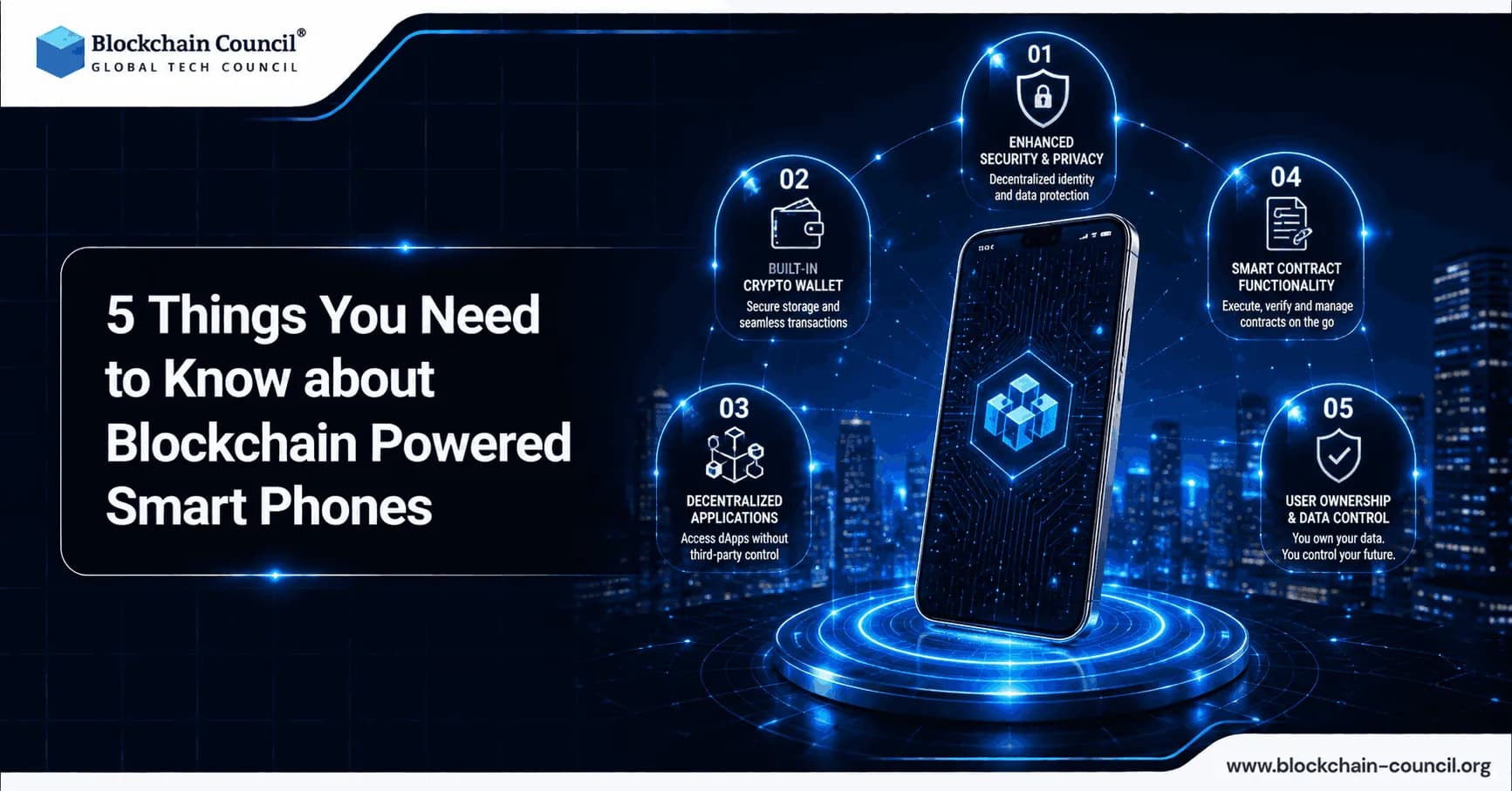
Smartphones have evolved from simple communication devices into powerful platforms for payments, entertainment, productivity, and digital services. The next stage of this evolution is bringing blockchain technology directly into mobile devices. Blockchain-powered smartphones combine familiar mobile features with capabilities designed for decentralized applications, digital assets, and Web3 services.
Understanding how these devices work is becoming increasingly important for technology enthusiasts and professionals. A Certified Blockchain Expert can help learners develop a deeper understanding of blockchain fundamentals, decentralized networks, wallets, smart contracts, and emerging blockchain applications.

1. Blockchain-Powered Smartphones Can Provide Built-In Digital Asset Features
One of the most important differences between conventional smartphones and blockchain-powered smartphones is their ability to support blockchain-related functions directly through dedicated software or hardware.
Some blockchain-focused devices can include integrated cryptocurrency wallets, allowing users to store and manage digital assets from their smartphones. Depending on the device and wallet architecture, users may also be able to interact with decentralized applications without relying entirely on separate hardware.
This can make blockchain services more accessible to everyday smartphone users.
Why Is a Blockchain Wallet Important?
A blockchain wallet allows users to manage cryptographic keys associated with their digital assets. Secure key management is particularly important because losing access to private credentials can result in losing access to associated assets.
Users should therefore evaluate security features, recovery mechanisms, and wallet architecture before choosing a blockchain-powered smartphone.
2. Web3 Applications Can Be Accessed More Easily
Blockchain-powered smartphones are also designed to make interaction with Web3 applications more convenient. Web3 refers broadly to decentralized applications and services built using blockchain networks.
These applications can include decentralized finance platforms, NFT marketplaces, blockchain games, decentralized identity solutions, and other services.
For people who want to explore this ecosystem professionally, a Certified Web3 Expert can provide structured knowledge about Web3 concepts, decentralized applications, blockchain networks, and the broader decentralized technology ecosystem.
How Do Blockchain Smartphones Support Web3?
A blockchain-enabled smartphone may provide features such as:
Integrated blockchain wallets
Access to decentralized applications
Secure key storage
Web3 browser functionality
Blockchain-based authentication
Support for selected digital assets
The exact capabilities vary between manufacturers and models, so users should check the specifications and supported blockchain networks before purchasing a device.
3. Security Is One of the Biggest Selling Points
Security is a major consideration when digital assets and blockchain applications are accessed through a mobile device. Blockchain-powered smartphones may use dedicated security hardware, secure environments, biometric authentication, or other mechanisms to protect sensitive information.
The goal is to separate critical credentials from ordinary smartphone applications wherever possible.
However, blockchain technology itself does not make a smartphone automatically secure. Users still need strong passwords, secure recovery methods, updated software, and protection against phishing and malicious applications.
Hardware-Based Security Can Matter
Some devices use specialized hardware to protect private keys or sensitive operations. This can create an additional security layer compared with storing sensitive credentials only within conventional application storage.
Users should look for transparent security specifications and established security practices rather than assuming that every device marketed as blockchain-powered provides the same level of protection.
4. Blockchain Smartphones Are Connected to the Growing Digital Economy
Blockchain-powered smartphones represent more than a new type of mobile hardware. They reflect the growing convergence of mobile computing, digital assets, decentralized applications, and online commerce.
As blockchain adoption expands, smartphones could become an important access point for services involving tokenized assets, decentralized identity, digital payments, and blockchain-based applications.
This development also creates opportunities for professionals who understand both technology and business. A Tech Certification can complement blockchain knowledge by helping learners develop broader technology skills relevant to a rapidly changing digital environment.
Potential Applications of Blockchain-Powered Smartphones
The technology could support use cases such as:
Digital asset management
Decentralized finance
Blockchain gaming
Digital identity
Tokenized assets
Web3 applications
Blockchain-based payments
Decentralized authentication
Not every use case is available on every device, and adoption depends on network compatibility, application support, regulation, and user demand.
5. Blockchain Smartphones Are Still an Emerging Technology
Despite their potential, blockchain-powered smartphones remain an emerging category. Their long-term success will depend on whether they provide practical advantages over conventional smartphones.
For mainstream users, simply having a cryptocurrency wallet or Web3 application may not be enough to justify purchasing a specialized device. Manufacturers need to combine useful blockchain functionality with the performance, camera quality, battery life, privacy, software support, and usability consumers already expect from modern smartphones.
What Could Drive Future Adoption?
Several developments could influence adoption:
Better integration between blockchain applications and mobile operating systems
Improved digital asset security
More user-friendly Web3 applications
Wider acceptance of blockchain-based payments
Growth of tokenized digital services
Improved interoperability between blockchain networks
If these areas develop successfully, blockchain functionality could become increasingly integrated into everyday mobile experiences.
Future-Ready Skills
As technology becomes increasingly important across industries, students need opportunities to develop future-ready skills early in their education. A World Tech Olympiad can introduce students to areas such as artificial intelligence, coding, cybersecurity, robotics, and computational thinking while encouraging curiosity and continuous learning.
The Future of Blockchain-Powered Smartphones
Blockchain-powered smartphones demonstrate how decentralized technologies can move closer to everyday consumers. Their combination of mobile computing, digital wallets, Web3 applications, and security features could create new ways for people to interact with blockchain-based services.
However, widespread adoption will depend on practical value rather than the technology label alone. Devices must offer strong security, intuitive experiences, reliable performance, and useful applications.
As blockchain and Web3 ecosystems continue to mature, understanding their relationship with mobile technology can become increasingly valuable for students, developers, entrepreneurs, marketers, and technology professionals.
Conclusion
Blockchain-powered smartphones bring blockchain functionality into a familiar device used by billions of people worldwide. Their key advantages can include integrated digital asset management, easier Web3 access, enhanced security features, and new possibilities for decentralized applications.
The technology is still developing, but it highlights an important trend: blockchain is increasingly moving beyond specialized platforms and into everyday digital experiences. Professionals who combine blockchain knowledge with technology and business skills can be better prepared for the opportunities created by this evolving ecosystem.
For professionals interested in applying emerging technology to business growth and digital communication, a Marketing Certification can provide an additional perspective on how new technologies influence digital strategies, customer experiences, and modern business models.
FAQs
1. What Is a Blockchain-Powered Smartphone?
A blockchain-powered smartphone is a mobile device designed with built-in features for cryptocurrencies, Web3 applications, digital assets, decentralized identity, or blockchain-based services.
Unlike a conventional smartphone that requires users to install separate crypto applications, some blockchain phones integrate features such as hardware-protected wallets, seed-vault systems, decentralized application stores, Web3 authentication, and digital-asset management directly into the device.
Examples of blockchain-oriented smartphones have included Solana Mobile devices and HTC's earlier Exodus series.
The important distinction is that the phone itself does not run every transaction "on blockchain." It remains a smartphone, thankfully. The blockchain features primarily improve how users interact with decentralized networks.
2. What Are the 5 Main Things to Know About Blockchain Smartphones?
The five most important things beginners should understand are:
1. Built-In Crypto Wallets: Private keys can be protected using dedicated hardware or secure environments.
2. Web3 and dApp Access: Blockchain phones can make decentralized applications easier to access.
3. Digital Asset Management: Users can manage cryptocurrencies, NFTs, tokens, and other blockchain assets.
4. Decentralized Identity: Some architectures can support user-controlled credentials and blockchain-based authentication.
5. Security Still Matters: A blockchain phone is not automatically immune to phishing, malicious applications, smart-contract exploits, or user mistakes.
These five areas explain most of the practical difference between blockchain smartphones and conventional devices.
3. How Does a Blockchain Smartphone Work?
A blockchain smartphone combines a normal mobile operating system with additional Web3 software and hardware security features.
A simplified architecture looks like:
Smartphone → Secure Hardware → Private Keys → Crypto Wallet → dApps → Blockchain Network
When a user wants to approve a blockchain transaction, the phone can use protected key-storage infrastructure to authorize it without unnecessarily exposing the private key to ordinary applications.
The blockchain itself remains distributed across network participants. Your phone is primarily the secure interface through which you interact with it.
4. What Is a Built-In Crypto Wallet on a Blockchain Phone?
A built-in crypto wallet allows users to store and use blockchain private keys directly through the smartphone's integrated security architecture.
The wallet may support:
Cryptocurrencies → Stablecoins → NFTs → DeFi Tokens → Web3 Applications
Some blockchain-oriented phones isolate private keys from the normal operating environment through secure hardware.
This matters because whoever controls the private key can generally authorize transactions associated with the corresponding blockchain account. In crypto, "please reset my password" has historically been an unusually complicated sentence.
5. What Is a Seed Vault in a Blockchain Smartphone?
A seed vault is a protected environment designed to isolate cryptocurrency keys or seed-related information from ordinary applications and potentially vulnerable parts of the operating system.
Solana Mobile, for example, describes its Seed Vault architecture as keeping keys and sensitive information inside a secure environment while allowing authorized applications to request transaction signing.
The objective is:
Private Key Protection + Secure Transaction Signing + Reduced Key Exposure
It is conceptually similar to giving blockchain credentials their own protected compartment rather than leaving them wandering around the phone's general software environment.
6. Are Blockchain Smartphones More Secure Than Regular Smartphones?
They can provide stronger protection for blockchain private keys, but they are not automatically more secure in every respect.
Potential security features include:
Hardware Key Storage → Secure Signing → Biometric Authentication → Application Permissions → Seed Protection
However, users can still encounter:
Phishing → Malicious dApps → Fake Tokens → Smart Contract Exploits → Social Engineering → Compromised Recovery Information
A secure key vault cannot protect someone who deliberately approves a malicious transaction.
Therefore, blockchain-phone security is best understood as additional protection for certain digital-asset operations, not invulnerability.
7. Can You Store Cryptocurrency on a Blockchain Smartphone?
More precisely, the smartphone stores or protects the private keys that control blockchain assets.
Cryptocurrency itself remains recorded on the blockchain.
The distinction is:
Blockchain → Records the Assets and Transactions
Wallet → Manages Keys
Blockchain Smartphone → Protects and Uses Those Keys
If a wallet shows 2 ETH, the Ether is not physically sitting inside the phone like photographs or downloaded music. The phone contains credentials that allow the user to control the associated blockchain account.
8. Can Blockchain Smartphones Run Decentralized Applications?
Yes. Web3 and decentralized application access is a major purpose of blockchain-oriented smartphones.
Users may interact with:
DeFi Apps → NFT Marketplaces → Blockchain Games → DAO Platforms → Web3 Social Apps → Tokenized Services
The advantage of deeper Web3 integration is that applications can interact more directly with compatible wallets and transaction-signing infrastructure.
This can reduce the awkward process of jumping between browsers, wallet applications, QR codes, and approval screens that has traditionally made mobile Web3 feel like a usability experiment conducted on unwilling participants.
9. What Is a dApp Store on a Blockchain Smartphone?
A dApp store is an application marketplace focused on decentralized and Web3 applications.
It can include categories such as:
DeFi → Gaming → NFTs → Social → Payments → DAOs → Web3 Utilities
Solana Mobile operates a dApp Store designed specifically for applications interacting with the Solana ecosystem.
The broader idea is to create mobile distribution channels specifically designed around blockchain applications rather than forcing every Web3 product into conventional app-store models.
10. Can Blockchain Smartphones Be Used for NFTs?
Yes. Blockchain smartphones can support NFT ownership, transfers, marketplaces, gaming assets, collectibles, memberships, and token-gated applications.
Users may potentially:
View NFTs → Buy NFTs → Sell NFTs → Transfer NFTs → Use NFTs in Applications
Because wallet functionality is integrated more deeply into the mobile experience, NFT interactions can become more convenient.
However, owning an NFT does not automatically mean owning copyright or every commercial right associated with the underlying artwork. The legal rights depend on the project's terms.
11. Can Blockchain Smartphones Be Used for DeFi?
Yes. Compatible blockchain smartphones can provide access to decentralized finance applications.
Potential activities include:
Token Swaps → Lending → Borrowing → Staking → Liquidity Provision → Stablecoin Payments
A mobile wallet can authenticate the user and sign transactions interacting with DeFi smart contracts.
The major caution is that DeFi carries risks including smart-contract vulnerabilities, liquidation, oracle failures, malicious tokens, protocol failure, and market volatility.
Putting DeFi on a nicer phone screen does not make those risks disappear.
12. Can Blockchain Smartphones Support Digital Identity?
Potentially, yes.
Blockchain and decentralized-identity technologies can allow users to manage verifiable credentials, identifiers, authentication information, and proofs through digital wallets.
A future smartphone could potentially hold:
Identity Credentials → Education Certificates → Memberships → Professional Credentials → Age Proofs → Access Permissions
Instead of sending every organization complete personal records, cryptographic systems may allow users to prove specific facts.
For example, a person might prove they meet an age requirement without revealing unnecessary identity information.
13. What Is the Role of Web3 in Blockchain Smartphones?
Web3 refers broadly to internet applications built around blockchain networks, digital ownership, wallets, tokens, and decentralized protocols.
Blockchain smartphones attempt to make Web3 more mobile-friendly by combining:
Wallet → Identity → dApps → Transaction Signing → Digital Assets
The smartphone could therefore become an interface between users and blockchain-based services in much the same way conventional smartphones became interfaces for cloud services and mobile payments.
Whether users actually want every service converted into a token remains a separate and remarkably important product-design question.
14. Can Blockchain Smartphones Be Used for Crypto Payments?
Yes. A blockchain smartphone can potentially support payments using:
Cryptocurrencies → Stablecoins → Tokenized Money → Compatible Digital Assets
A payment flow might look like:
Merchant QR Code → Wallet → Transaction Approval → Blockchain → Merchant Wallet
Stablecoins are particularly relevant because they aim to maintain a relatively stable value compared with volatile cryptocurrencies.
However, transaction speed, network fees, merchant acceptance, taxation, and regulation vary considerably across jurisdictions.
15. Can Blockchain Smartphones Work Without the Internet?
Most blockchain functionality requires network connectivity because transactions must eventually reach the blockchain network.
A phone may be able to prepare or sign certain information offline, but broadcasting and confirming blockchain transactions generally requires internet access through:
Mobile Data → Wi-Fi → Another Connected Communication Channel
So a blockchain smartphone is not an independent blockchain network living heroically inside your pocket.
It is a secure client interacting with distributed networks elsewhere.
16. What Are the Advantages of Blockchain Smartphones?
Potential advantages include:
Secure Key Management: dedicated protection for blockchain credentials.
Integrated Web3 Access: easier interaction with decentralized applications.
Digital Asset Management: convenient management of tokens and NFTs.
Transaction Signing: secure approval of blockchain transactions.
Decentralized Identity: potential support for user-controlled credentials.
Web3 Application Distribution: specialized dApp ecosystems.
The biggest long-term advantage may be usability. Blockchain technology becomes much more commercially useful when ordinary users do not need to understand seed phrases, RPC endpoints, gas mechanics, bridges, and six different browser extensions merely to accomplish one task.
17. What Are the Disadvantages of Blockchain Smartphones?
Blockchain smartphones also have limitations.
Important disadvantages include:
Limited Mainstream Adoption: most consumers still use conventional smartphones.
Smaller dApp Ecosystems: blockchain-focused application stores remain relatively niche.
Security Responsibility: users must protect recovery credentials.
Crypto Volatility: supported assets can fluctuate substantially.
Regulatory Uncertainty: crypto rules vary internationally.
Smart Contract Risk: blockchain applications can contain vulnerabilities.
Network Fees: some transactions require blockchain fees.
The device can improve the interface, but it cannot repair every weakness of the ecosystem behind it.
18. What Happens if a Blockchain Smartphone Is Lost or Stolen?
The consequences depend on the wallet architecture and recovery system.
Security mechanisms can include:
PIN → Biometrics → Hardware Protection → Recovery Phrase → Cloud/Guardian Recovery → Remote Device Security
If private keys are properly protected and recovery credentials remain secure, losing the physical device does not necessarily mean losing the assets.
However, losing both the device and the only valid recovery mechanism can create serious problems.
Users should understand the recovery process before storing meaningful value on any blockchain phone. Testing disaster recovery after the disaster has begun is an impressively human tradition best avoided here.
19. Will Apple, Samsung, and Other Smartphone Companies Adopt More Blockchain Features?
Broader smartphone adoption will depend less on the word "blockchain" and more on whether blockchain features solve useful consumer problems.
Potential mainstream applications include:
Digital Identity → Stablecoin Payments → Tokenized Tickets → Gaming Assets → Digital Credentials → Loyalty Programs → Secure Wallets
Large smartphone manufacturers already provide hardware-backed security environments that can support sensitive credentials. Blockchain-specific integration could expand if consumer demand for digital assets, tokenized services, or decentralized identity grows.
The likely future is not necessarily a separate category called "blockchain phones." Blockchain functionality may simply become another invisible capability inside mainstream smartphones.
20. What Is the Future of Blockchain-Powered Smartphones?
The long-term opportunity for blockchain smartphones lies in making digital ownership and Web3 applications usable without requiring consumers to become amateur cryptographers.
A future blockchain-enabled smartphone could combine:
Communication + Payments + Digital Identity + Crypto Wallet + Stablecoins + Tokenized Assets + Gaming + Credentials + Web3 Applications
The evolution could look like:
Mobile Phone → Smartphone → Digital Wallet → Web3 Smartphone → Personal Digital Asset and Identity Hub
The five concepts worth remembering are:
1. Secure blockchain wallets can be built directly into smartphones.
2. Hardware security can protect private keys and transaction signing.
3. Web3 applications can integrate more naturally with mobile devices.
4. Smartphones could become gateways for digital identity, tokenized assets, DeFi, gaming, and blockchain payments.
5. Blockchain integration does not eliminate security, regulatory, usability, or investment risks.
The most successful blockchain smartphone may eventually stop being marketed as a "blockchain smartphone" at all. The technology will have succeeded when people use the useful parts without being forced to care which distributed ledger is doing paperwork underneath.
That is usually how technology wins: first everyone talks endlessly about the infrastructure, then eventually nobody has to.
Related Articles
View All
Blockchain
Smart Contracts & dApps: How Blockchain Becomes Programmable
Learn how smart contracts and dApps make blockchain programmable, from Ethereum and tokens to DeFi, NFTs, real use cases, benefits, and key risks.

Blockchain
Agile for Blockchain Teams: Managing Sprints, Smart Contracts, and Decentralized Roadmaps
Learn how agile for blockchain teams works when sprints, smart contracts, audits, governance, and decentralized roadmaps are planned around risk.
Blockchain
Blockchain Product Manager Skills: What You Need in 2026
A practical guide to the blockchain product manager skills needed in 2026, from DeFi and AI to compliance, UX, analytics, and security.
Trending Articles
AWS Career Roadmap
A step-by-step guide to building a successful career in Amazon Web Services cloud computing.

Can DeFi 2.0 Bridge the Gap Between Traditional and Decentralized Finance?
The next generation of DeFi protocols aims to connect traditional banking with decentralized finance ecosystems.
Claude AI Tools for Productivity
Discover Claude AI tools for productivity to streamline tasks, manage workflows, and improve efficiency.