

Generative AI Examples
 Blockchain Council

Generative AI systems are trained on vast datasets to understand patterns, styles, and structures in the data.
These systems consist of models like GPT-4, which stands for “Generative Pre-trained Transformer 4.” GPT-4, developed by OpenAI, has garnered significant attention due to its remarkable ability to generate coherent and contextually relevant text.
To put it simply, Generative AI enables machines to produce content that can be indistinguishable from content created by humans. It has applications in various domains, from content generation and language translation to art creation and data augmentation.
Also Read- AI In The FinTech Industry – All You Need To Know
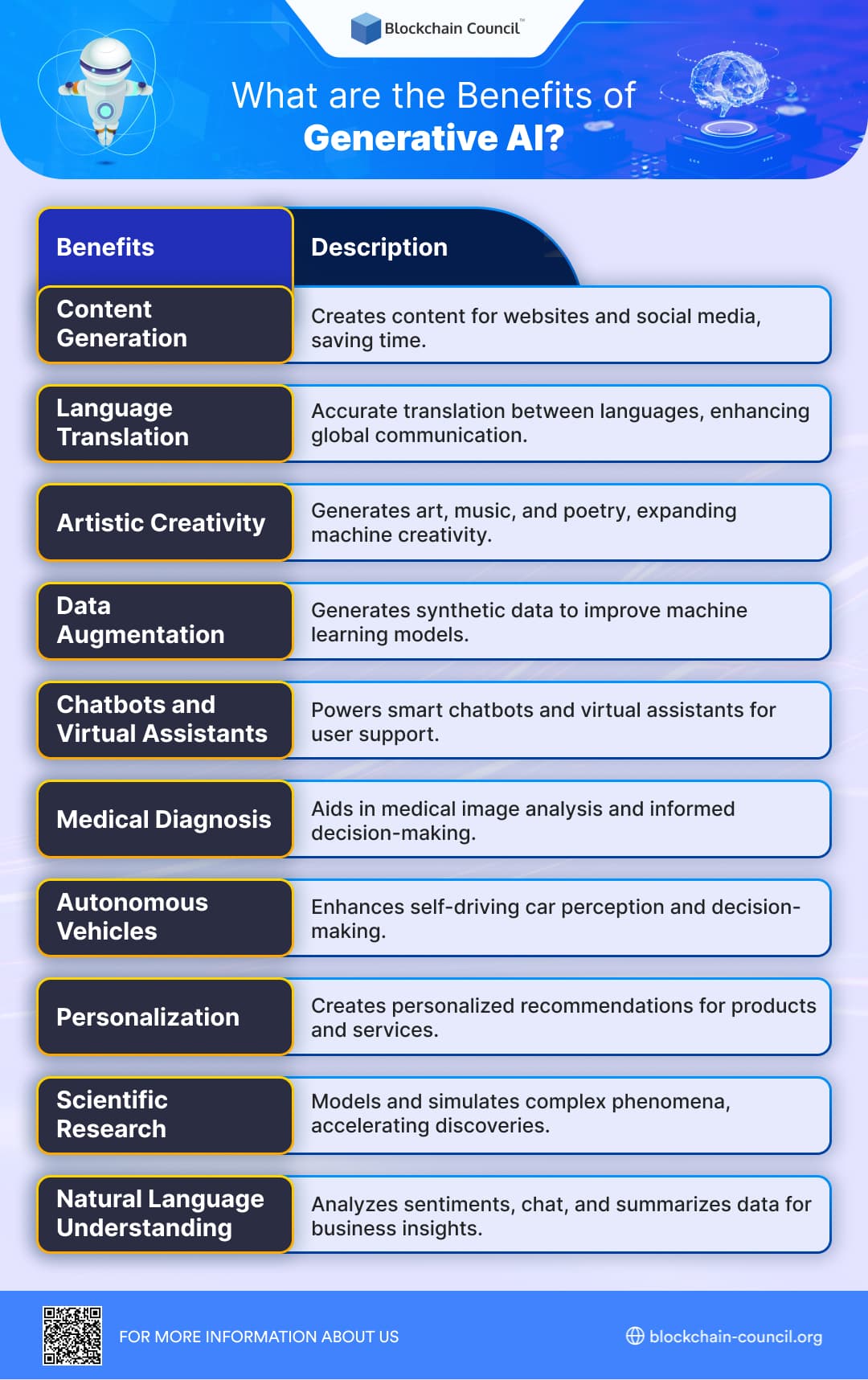
What are the Benefits of Generative AI?
Now we will discuss the top 10 generative AI examples you need to know!
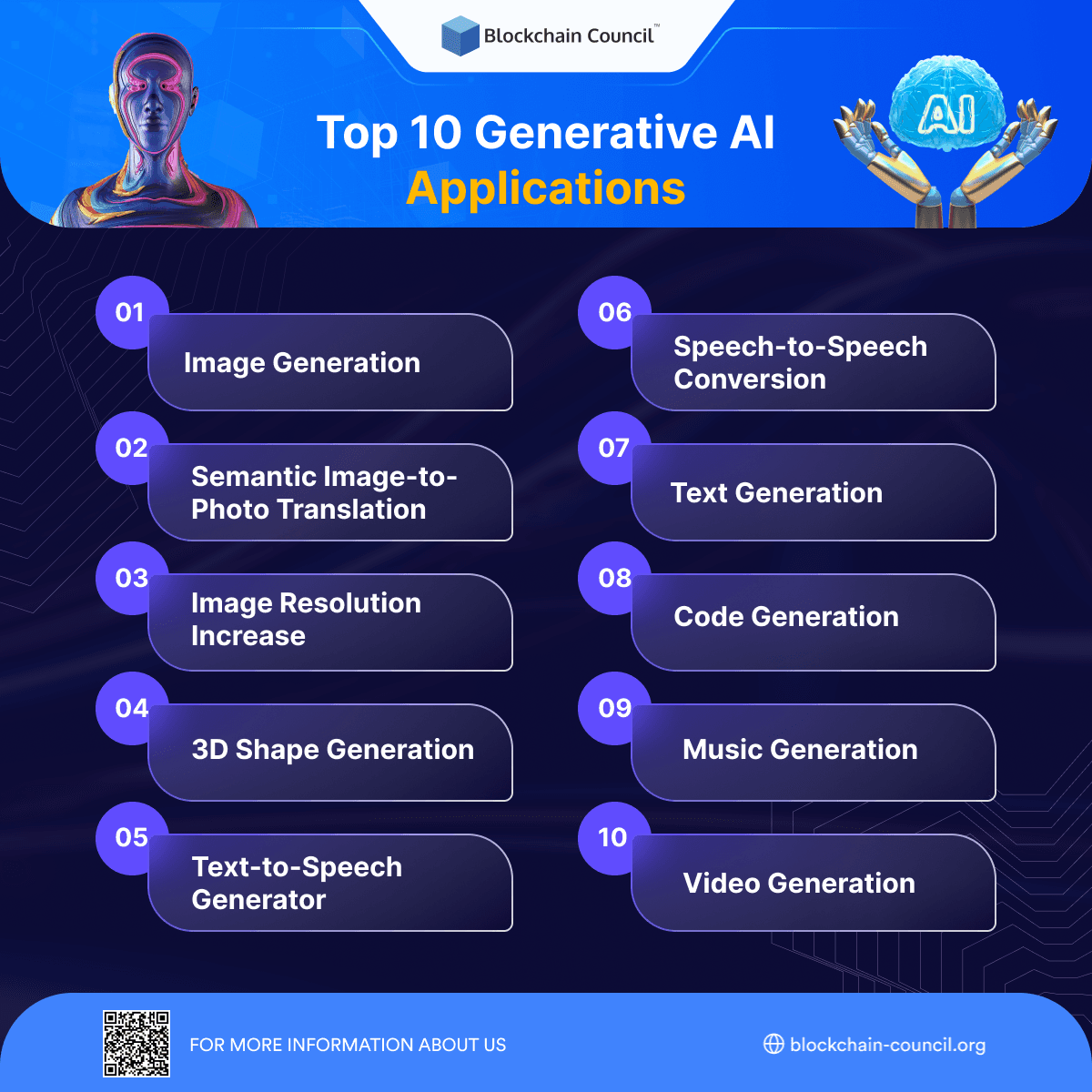
Image Generation
In the ever-evolving landscape of artificial intelligence, Image Generation stands as a testament to the astonishing capabilities of generative AI models. DALL-E 2, MidJourney, Jasper, and Stable Diffusion are some of the tools that can generate realistic and creative images from text inputs.
How it Works:
- Generative Adversarial Networks (GANs): GANs are at the heart of image generation. They consist of two neural networks – a generator and a discriminator. These networks work in tandem but have opposing roles.
- Generator: The generator network’s job is to create images. It starts with random noise and gradually refines it through multiple layers of neural networks. This process results in the generation of an image that gets closer to reality with each iteration.
- Discriminator: The discriminator network evaluates the authenticity of the generated image. It has been trained on a dataset of real images and aims to distinguish between real and fake ones. The generator’s goal is to create images that the discriminator can’t differentiate from real ones.
- Adversarial Training: The crux of GANs lies in their adversarial training. The generator and discriminator continuously compete in a feedback loop. As the generator improves, the discriminator’s job becomes harder, and vice versa. This competition leads to the generation of increasingly realistic images.
Examples:
- DeepDream by Google: DeepDream uses neural networks to transform photos into surreal, dream-like images. It gained fame for its ability to generate visually intriguing and abstract pictures.
- StyleGAN by NVIDIA: StyleGAN has taken the art of image synthesis to new heights. It can generate high-resolution, detailed faces of non-existent people that are virtually indistinguishable from real ones.
- DALL-E by OpenAI: DALL-E combines text descriptions with image generation. It can create images from textual prompts, such as “an armchair in the shape of an avocado.”
- Artbreeder: Artbreeder is a user-friendly platform that leverages GANs to let users create unique art by blending and evolving images. It’s a great example of how AI empowers creativity.
Also Read- Top 5 AI Trends You Can’t Miss
Semantic Image-to-Photo Translation
Semantic Image-to-Photo Translation takes image manipulation to a whole new level by understanding the context within an image and transforming it into a photograph. CycleGAN, Pix2Pix, and StyleGAN are some of the tools that can transform images from one domain to another using GANs.
How It Works:
- Semantic Segmentation Map: This process begins with a semantic segmentation map. This map is essentially an image where each pixel is labeled with the object or class it represents. For instance, in a photo of a street, the map would label pixels as ‘car,’ ‘tree,’ ‘road,’ and so on.
- Deep Neural Networks: Deep neural networks, often based on convolutional neural networks (CNNs), play a vital role. These networks are trained to understand both images and their semantic content. They learn to associate objects in the image with their corresponding labels in the segmentation map.
- Information Fusion: The neural network fuses information from the image and the segmentation map. It uses the map to understand which objects are where in the image and then generates a photograph that reflects this understanding.
- Realistic Photo Generation: The final step involves creating a realistic photograph. The neural network generates pixel values for the image based on the combined information from the segmentation map and its learned understanding of what each object should look like. This results in a photo that aligns with the semantic content of the map.
Examples:
- Pix2Pix by NVIDIA: Pix2Pix is a versatile model capable of various image translation tasks. It can turn sketches into photographs, generate satellite photos from maps, and even convert day scenes into night scenes.
- CycleGAN: CycleGAN is adept at domain adaptation. It can transform photos from one style to another, like turning photos from winter into summer or changing the style of artwork.
- SPADE (Semantic Image Synthesis with Adaptive Normalization): SPADE combines semantic segmentation with GANs to generate highly detailed images. It’s particularly powerful in generating realistic faces from semantic maps.
- AI-based Video Editing: Some AI-powered video editing tools use semantic understanding to replace backgrounds, add effects, and manipulate videos in real-time, revolutionizing the filmmaking industry.
Why Generative AI Matters for Your Career
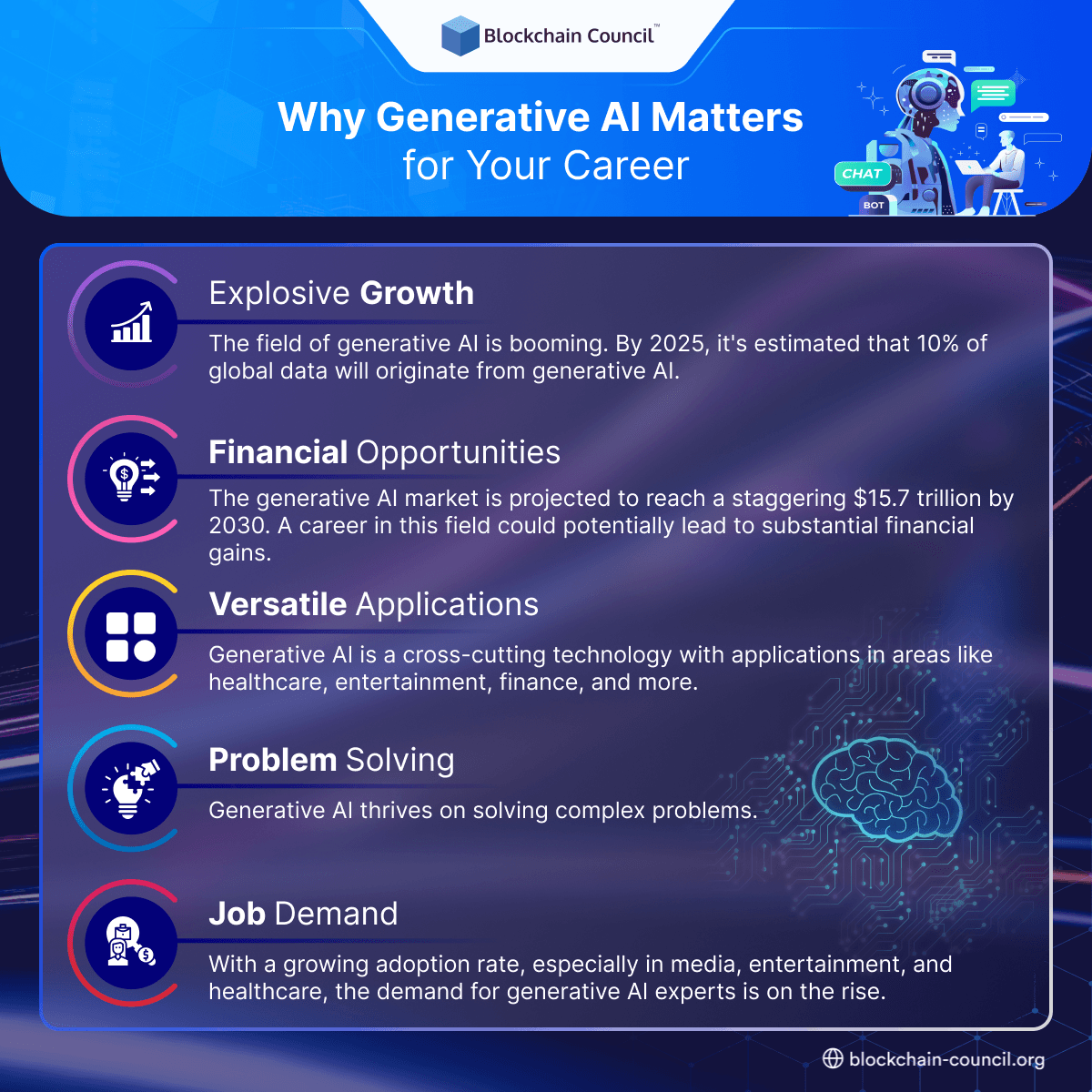
Generative AI, a subset of artificial intelligence, holds immense promise and potential for professionals at all levels, from beginners to experts. Here’s why you should seriously consider it for your career:
- Explosive Growth: The field of generative AI is booming. By 2025, it’s estimated that 10% of global data will originate from generative AI. This signifies a seismic shift in how businesses and industries operate. Getting in early can offer you a significant advantage.
- Financial Opportunities: The generative AI market is projected to reach a staggering $15.7 trillion by 2030. This isn’t just about technology; it’s about economics. A career in this field could potentially lead to substantial financial gains.
- Versatile Applications: Generative AI isn’t limited to one industry. It’s a cross-cutting technology with applications in areas like healthcare, entertainment, finance, and more. You won’t be confined to a single sector.
- Problem Solving: Generative AI thrives on solving complex problems. If you enjoy tackling intricate challenges, this field will keep you engaged and intellectually stimulated.
- Job Demand: With a growing adoption rate, especially in media, entertainment, and healthcare, the demand for generative AI experts is on the rise. By 2023, 33% of workplaces in the United States are expected to embrace generative AI.
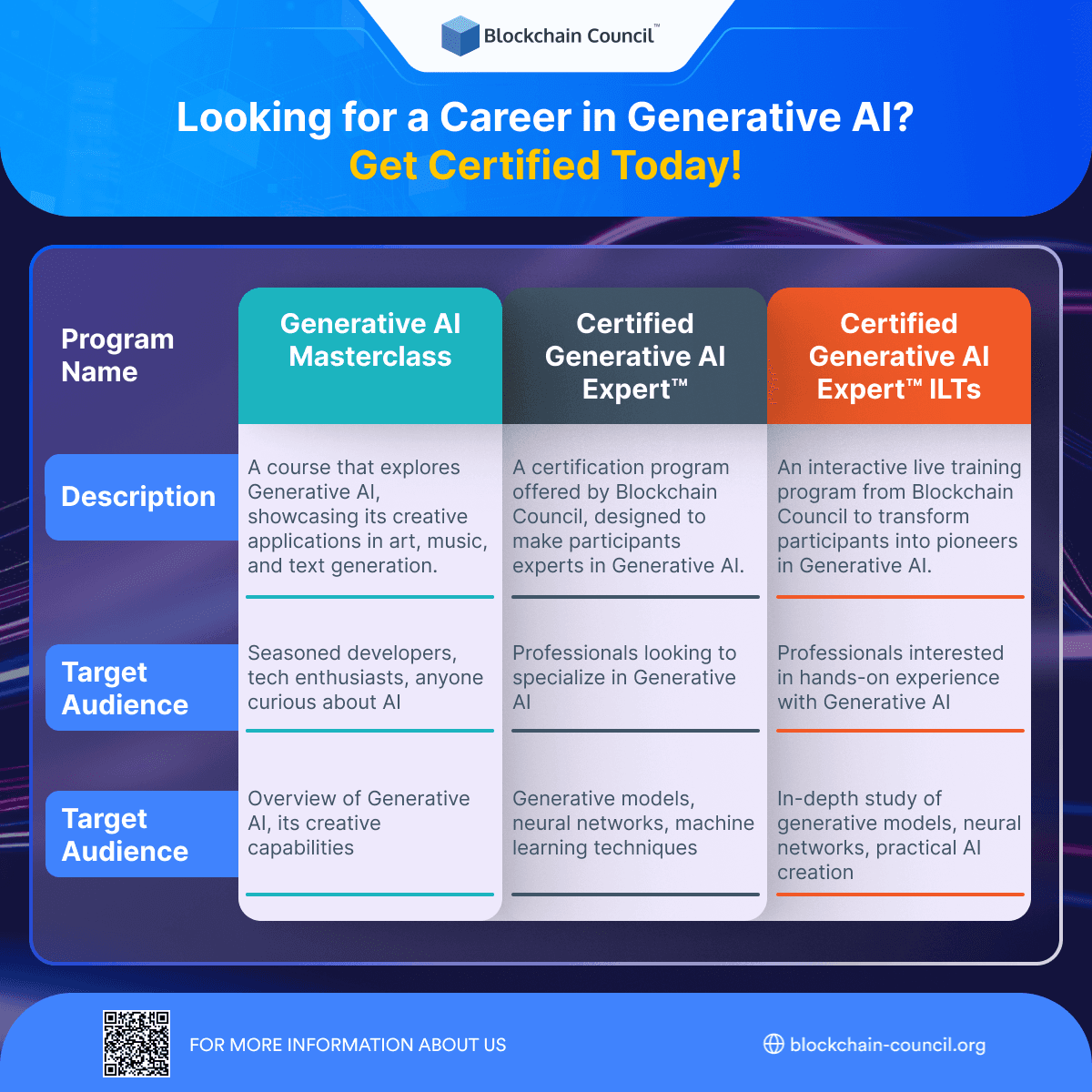
Looking for a Career in Generative AI? Get Certified Today!
Certifications from reputable organizations like the Blockchain Council are recognized and respected by employers worldwide. It’s a validation of your skills and knowledge, giving you a competitive edge in the job market. As generative AI gains traction in the job market, employers actively seek professionals with expertise in this field. Your certification can open doors to exciting career opportunities. Here are the top Generative AI Certifications that you must check out!
Conclusion
Generative AI has not only pushed the boundaries of machine creativity but has also found its way into numerous industries, leaving an indelible mark on how we create, innovate, and solve complex problems. The top 10 Generative AI examples presented in this article represent just the tip of the iceberg in this rapidly evolving field.
From the art that challenges our perceptions of creativity to the music that stirs our emotions, and from the text that informs and entertains to the image transformations that fuel our imagination, Generative AI has woven itself into the fabric of our digital lives. It has become a catalyst for progress in areas as diverse as healthcare, entertainment, and transportation.
Related Articles
View All
AI & ML
AI Explained: From Machine Learning to Generative AI
AI Explained in simple terms. Learn the differences between AI, machine learning, and deep learning, how neural networks and LLMs work, and how generative and multimodal AI create content.
AI & ML
Decision AI vs Generative AI
Compare Decision AI and Generative AI, including how they differ in goals, outputs, data use, automation, reasoning, and real-world business applications.
AI & ML
Decision Intelligence vs Generative AI
Compare decision intelligence and generative AI, including how they differ in purpose, outputs, data use, automation, reasoning, and business applications.
Trending Articles
The Role of Blockchain in Ethical AI Development
How blockchain technology is being used to promote transparency and accountability in artificial intelligence systems.

Top 5 DeFi Platforms
Explore the leading decentralized finance platforms and what makes each one unique in the evolving DeFi landscape.

Can DeFi 2.0 Bridge the Gap Between Traditional and Decentralized Finance?
The next generation of DeFi protocols aims to connect traditional banking with decentralized finance ecosystems.