

AI Vs Web3 – All You Need to Know
 Blockchain Council

Understanding Artificial Intelligence (AI)
A captivating world of possibilities unfolds in the vast realm of Artificial Intelligence (AI). AI is a vast domain with multiple fields like robotics and machine learning which form an essential part. AI eagerly consumes vast datasets, fueling its hunger for new knowledge and solutions. This digital prodigy deciphers hidden patterns through meticulously crafted algorithms and illuminates profound insights within the data depths that businesses utilize to modernize their operations.
AI possesses an extraordinary power to adapt and grow, making it highly adept in any dynamic industry. With each piece of data consumed, its capabilities improve, and its outputs become sharper and more accurate. AI continually updates its understanding, refining its predictions and decisions with unparalleled precision.
This adaptive genius technology can achieve and offer solutions to complex problems like global warming and world hunger. From conquering chess with strategic brilliance to guiding autonomous vehicles through bustling streets, AI waltzes effortlessly through myriad tasks. And as it embarks on these ventures, it evolves, its prowess sharpening with every challenge it undertakes.
Exploring Web3
In 2014, a far-sighted expert in computer science named Gavin Wood bought the concept that would revolutionize the internet as we know it in the form of Web 3.0. This idea was of an online world where power isn’t concentrated in a few tech giants’ hands but shared among all participants. The principles of democracy and individual empowerment were the core values behind this decentralized Internet vision.
In this new era, content and data no longer belong to corporations but to the people. Web 3.0 has taken the idea of a peer-to-peer network to its prime, where platforms, services, web apps, and even mobile apps are hosted collectively. Each participant contributes uniquely to the ecosystem, ensuring a genuinely democratic and inclusive experience.
At the heart of Web 3.0 lies Blockchain technology, which allows users complete control over their shared data and identity. This revolutionary technology paves the way for exciting use cases such as decentralized finance (DeFi), where traditional financial systems are reshaped, and decentralized autonomous organizations (DAOs), where decision-making power is shared among community members. Not to mention the rise of non-fungible tokens (NFTs), enabling artists and creators to own and monetize their digital creations.
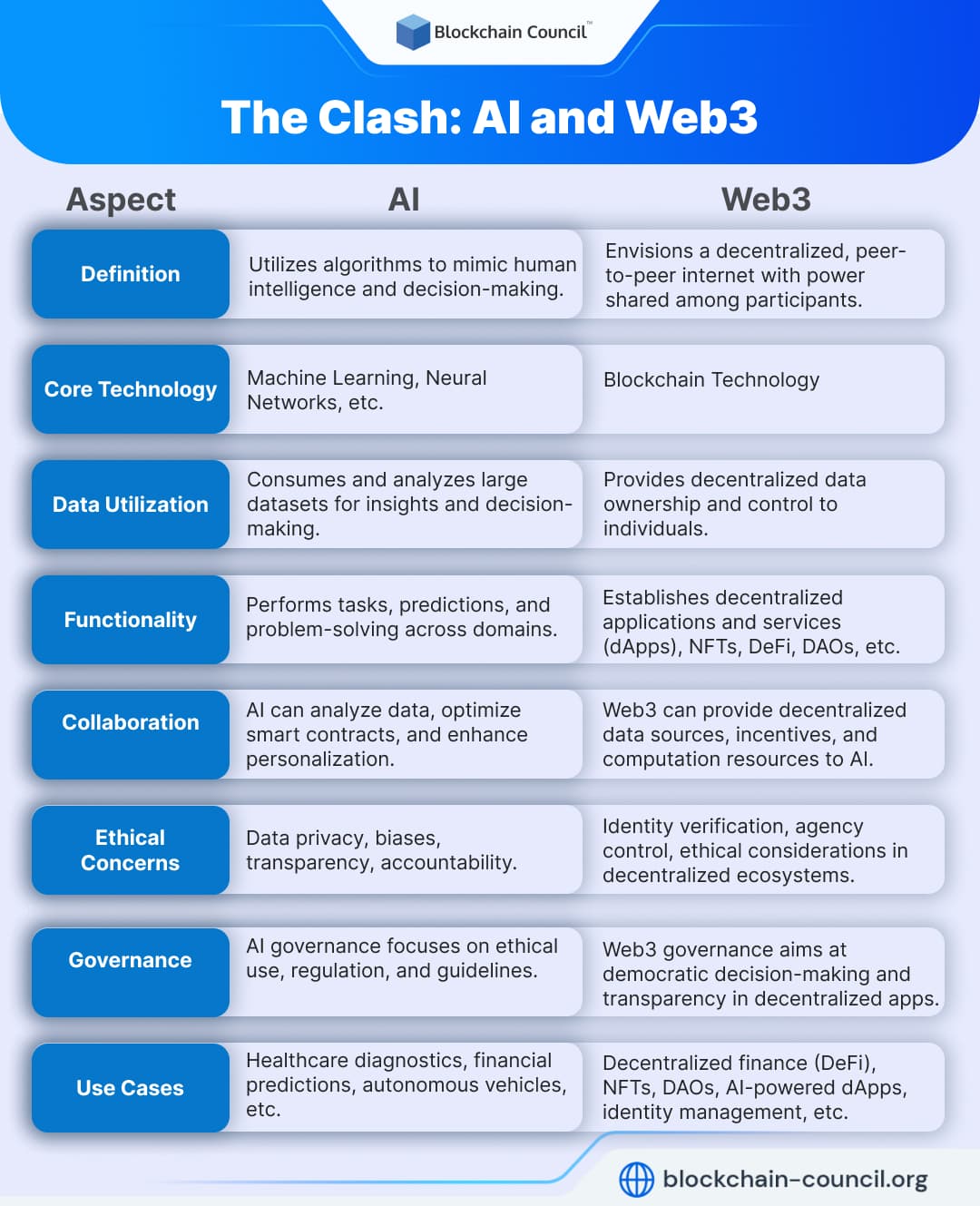
The Clash: AI and Web3
Related Articles
View All
AI & ML
OpenAI Dots vs Grok Bot vs Muse
Compare OpenAI Dots, Grok Bot, and Meta Muse to understand how these always-on AI agents differ in persistent work, computer use, connected apps, automation, and personal or business workflows.

AI & ML
What Is OpenAI Dots?
Learn what OpenAI Dots are, how these always-on AI agents work, and how they use GPT-6 Astra, cloud computers, connected apps, and persistent context to handle ongoing tasks.

AI & ML
OpenAI Launches GPT 6.1-Sol
OpenAI launches GPT-6.1 Sol, a new reasoning model offering near-Astra performance at lower cost for complex coding, computer use, agentic workflows, and professional tasks.
Trending Articles
The Role of Blockchain in Ethical AI Development
How blockchain technology is being used to promote transparency and accountability in artificial intelligence systems.
AWS Career Roadmap
A step-by-step guide to building a successful career in Amazon Web Services cloud computing.
How Blockchain Secures AI Data
Understand how blockchain technology is being applied to protect the integrity and security of AI training data.