
Suyash Raizada
Types of Quantum Gates Explained: Pauli, Hadamard, CNOT, and More
Learn the main types of quantum gates, including Pauli, Hadamard, CNOT, phase, Toffoli, and hardware-native gates, with real use cases.


Browse the latest quantum computing articles, tutorials, and research from Blockchain Council.(71 articles)
Learn the main types of quantum gates, including Pauli, Hadamard, CNOT, phase, Toffoli, and hardware-native gates, with real use cases.
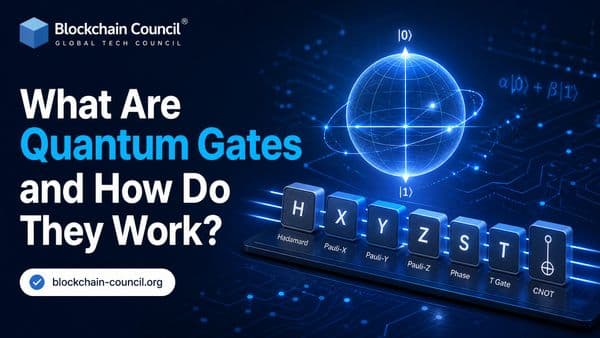
Quantum gates transform qubits through reversible unitary operations. Learn how they create superposition, entanglement, and interference in quantum circuits.

Learn what quantum states are, how qubits, superposition, entanglement, and density matrices work, and why they matter for quantum computing and security.

Quantum tunneling lets tiny particles cross barriers that classical physics says they cannot cross. Learn the idea, examples, and why it matters in quantum computing.

Quantum entanglement links particles through shared quantum states. Learn its meaning, examples, applications, and why it matters for quantum security.
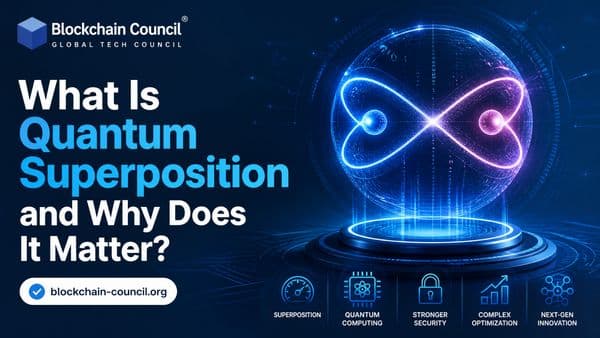
Quantum superposition lets a system hold multiple possible states until measurement. Learn why it matters for qubits, sensing, communication, and quantum careers.

Understand qubit vs bit, including superposition, measurement, entanglement, state space scaling, and why quantum computers solve only specialized problems.

A clear explanation of what a qubit is, how it differs from a classical bit, and why superposition, entanglement, and error rates matter.

Quantum Computing vs Traditional Computing is about fit, not replacement. Learn where quantum may help businesses and where classical systems still dominate.

A practical comparison of quantum computing vs classical computing, covering qubits, algorithms, benefits, limits, market growth, and security risks.

Quantum computing explained for beginners: learn qubits, gates, circuits, real-world uses, market outlook, and what skills professionals should build next.

A simple, practical guide to how quantum computing works, including qubits, superposition, entanglement, error correction, use cases, and skills.