

What Is a Qubit? The Building Block of Quantum Computing Explained

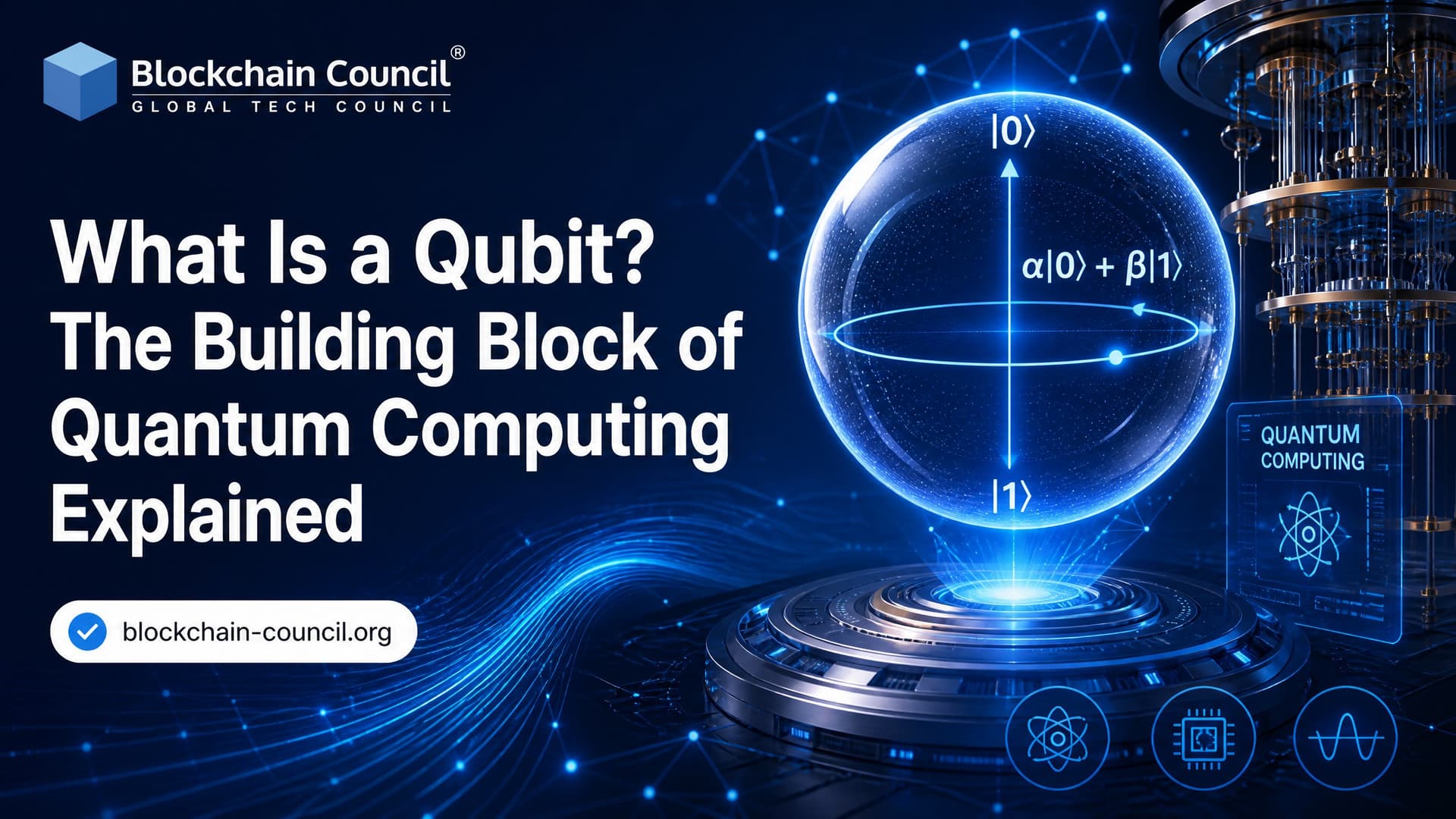
What is a qubit? A qubit, short for quantum bit, is the smallest unit of quantum information. It plays the role that a bit plays in classical computing, but it follows the rules of quantum mechanics rather than ordinary Boolean logic. A classical bit is either 0 or 1. A qubit can be measured as 0 or 1, yet before measurement it can exist as a controlled mixture of both possibilities through superposition.
That difference sounds small. It is not. Superposition, entanglement, interference, and measurement make qubits useful for algorithms that do not behave like standard software. If you work in blockchain, cybersecurity, AI, or cloud engineering, understanding the qubit is the first step toward making sense of quantum computing claims, quantum-safe cryptography, and the real limits of current machines.

What Is a Qubit in Simple Terms?
A qubit is a two-level quantum system used to store and process information. The two basis states are normally written as |0> and |1>. These labels look like ordinary binary values, but the underlying state is different.
A single qubit state can be written as:
|ψ> = α|0> + β|1>, where |α|² + |β|² = 1
Here, α and β are complex amplitudes. When you measure the qubit, |α|² gives the probability of seeing 0, and |β|² gives the probability of seeing 1. The sum must equal 1 because measurement has to produce one classical result.
In practice, a qubit can be built from many physical systems, provided the device has two stable and controllable quantum states. Examples include the energy levels of a superconducting circuit, the internal states of a trapped ion, the polarization of a photon, or the spin of an electron.
Qubit vs Classical Bit
The easiest comparison is this: a classical bit stores a definite answer, while a qubit stores a quantum state that can produce different answers when measured.
- Classical bit: Always 0 or 1 at a given moment.
- Qubit: Can be in a superposition of |0> and |1> before measurement.
- Classical operations: Use logic gates such as AND, OR, and NOT.
- Quantum operations: Use unitary gates such as X, H, CNOT, and phase rotations.
- Classical copying: Bits can be copied freely.
- Quantum copying: Unknown quantum states cannot be copied exactly because of the no-cloning theorem.
Do not picture a qubit as simply holding 0 and 1 at the same time like two hidden files. That analogy breaks quickly. A better mental model is a vector with direction and phase. Quantum algorithms work by changing those amplitudes so wrong answers cancel and useful answers become more likely.
The Three Ideas That Make Qubits Powerful
1. Superposition
Superposition means a qubit can be prepared in a weighted combination of |0> and |1>. A common example uses the Hadamard gate. Apply H to |0>, and the qubit moves into an equal superposition. Measure it many times, and you should see roughly half 0 and half 1.
One run still gives one answer. That catches beginners. Quantum computing is not magic parallelism where you read every answer at once. The skill is designing circuits so the probabilities shift toward the answer you want.
2. Entanglement
Entanglement links qubits so their joint state cannot be described by treating each qubit separately. A Bell state, for example, can produce outcomes 00 and 11, but not 01 or 10, except for hardware noise. The correlation is stronger than what a simple independent coin-flip model would predict.
This feature is central to quantum teleportation, superdense coding, quantum communication experiments, and many quantum algorithms. It is also why simulating large quantum systems on classical machines becomes hard. The state space grows as 2^n for n qubits.
3. Measurement
Measurement converts a quantum state into a classical result. Once measured, a qubit no longer keeps its previous superposition in the same way. The result is probabilistic, based on the amplitudes in the state.
Here is a practical detail from actual quantum programming: in Qiskit, measurement result strings often surprise new users because bit ordering is not always what they expect from the circuit diagram. Qiskit uses little-endian ordering, so the rightmost bit in a result string is qubit 0. If you build a two-qubit Bell circuit and see counts such as {'00': 512, '11': 512}, that is correct for an ideal Bell state. If you see small counts for 01 or 10 on real hardware, you are seeing noise, readout error, or imperfect gates, not a new quantum rule.
What Are Physical Qubits Made Of?
A qubit is an abstraction. Hardware teams implement it in different ways, and each approach has trade-offs.
Superconducting Qubits
Superconducting qubits use circuits cooled to extremely low temperatures, often near millikelvin levels, with Josephson junctions providing the nonlinear behavior needed for controllable quantum states. IBM, Google, Rigetti, and academic labs have used this platform heavily.
These systems can run fast gates and integrate with microwave control electronics. The downside is sensitivity to noise, calibration drift, and the high engineering cost of cryogenic infrastructure.
Trapped Ion Qubits
Trapped ion systems hold charged atoms in electromagnetic traps under ultra-high vacuum. Qubits are encoded in electronic or hyperfine states. They are known for long coherence times and high-quality gates.
The trade-off is speed and scaling. Moving from a clean small ion chain to a large, modular processor is not just a matter of adding more ions.
Photonic Qubits
Photonic qubits use properties of single photons, such as polarization or time-bin encoding. They are attractive for quantum communication because photons travel well through fiber and free space compared with many matter-based qubits.
They are less straightforward for general gate-based computing because photons interact weakly with each other. That weakness helps communication, but it complicates two-qubit logic.
Spin and Emerging Qubits
Spin qubits use electron or nuclear spin states in materials such as silicon. Researchers are also studying topological qubits, which aim to store quantum information in ways that may be less sensitive to local noise. Topological qubits remain a research bet, not a production-ready answer.
Why Qubit Quality Matters More Than Qubit Count
Headline qubit counts can mislead you. A machine with more physical qubits is not automatically more useful. What matters is whether those qubits can be controlled, entangled, measured, and kept coherent long enough to run meaningful circuits.
Key metrics include:
- Gate error rate: How often a quantum gate fails to apply the intended operation.
- Readout fidelity: How accurately measurement reports the qubit state.
- Coherence time: How long the qubit keeps quantum information before environmental noise dominates.
- Connectivity: Which qubits can directly interact with each other.
- Benchmark fidelity: Methods such as cross-entropy benchmarking help compare intended and observed circuit behavior.
In the mid-2020s, quantum computing is still in the noisy intermediate-scale quantum stage. Many devices have tens to a few hundred physical qubits. Some superconducting experiments have reported two-qubit gate errors below 1 percent, with select systems approaching or passing the 0.1 percent range in controlled settings. That is encouraging. Still, building reliable logical qubits requires many physical qubits plus error correction, control systems, and stable calibration.
Physical Qubits vs Logical Qubits
A physical qubit is the actual hardware unit. A logical qubit is an error-protected qubit created from many physical qubits using quantum error correction. This distinction matters.
Surface-code error correction, one of the leading approaches, can tolerate certain error rates if enough physical qubits are used. But the overhead is large. Depending on target error rates and hardware quality, a single useful logical qubit may require hundreds or thousands of physical qubits.
That is why serious researchers focus less on raw counts and more on logical error rates. To be blunt, a thousand noisy qubits with poor two-qubit gates may be less useful than a smaller processor with better calibration and cleaner operations.
What Can Qubits Be Used For?
Current quantum computers are not general replacements for classical machines. They are specialized experimental processors. Still, qubits already support useful research in several areas.
- Quantum simulation: Modeling molecules, materials, spin systems, and reaction pathways.
- Optimization research: Testing algorithms such as the Quantum Approximate Optimization Algorithm, often called QAOA.
- Chemistry: Running small Variational Quantum Eigensolver, or VQE, experiments for molecular energy estimates.
- Quantum communication: Using photonic qubits for quantum key distribution and entanglement experiments.
- Quantum sensing: Measuring fields, time, and other physical quantities with high precision.
- Education: Running circuits on cloud-accessible devices through tools such as Qiskit.
For blockchain and cybersecurity professionals, the big issue is cryptography. A large fault-tolerant quantum computer running Shor's algorithm could threaten public-key systems such as RSA and elliptic-curve cryptography. Current devices are far from that scale, but migration to post-quantum cryptography is already underway. In 2024, NIST published its first finalized post-quantum standards, including ML-KEM and ML-DSA, which signals that the shift is no longer theoretical.
How to Start Learning Qubits as a Professional
If you want a practical path, start with linear algebra basics, then learn single-qubit gates, two-qubit gates, measurement, and circuit simulation. Use Qiskit or another real framework. Do not only read diagrams. Run circuits and inspect the counts.
A useful first exercise:
- Create one qubit in state |0>.
- Apply a Hadamard gate.
- Measure it 1,000 times in a simulator.
- Check whether the counts are close to 50 percent 0 and 50 percent 1.
- Then run the same circuit on real hardware and compare the noise.
If your background is blockchain or security, pair quantum basics with cryptography. Blockchain Council readers may connect this topic with learning paths such as the Certified Blockchain Expert for blockchain fundamentals and the Certified Cyber Security Expert for security risk analysis. The useful combination is not quantum theory alone. It is quantum theory plus the ability to assess systems that depend on cryptographic assumptions.
Common Misconceptions About Qubits
- A qubit is not just a faster bit. It follows different physics and requires different algorithms.
- Superposition does not mean you can read all answers at once. Measurement returns one classical result per run.
- More qubits do not always mean a better computer. Error rates and connectivity matter.
- Quantum computers will not break all encryption. Symmetric cryptography is affected differently than public-key cryptography.
- Useful quantum advantage is problem-specific. Many tasks will remain better on classical hardware.
Build the Right Mental Model First
A qubit is the basic unit of quantum information, but its value comes from how it behaves: superposition creates amplitude combinations, entanglement creates nonclassical correlations, and measurement turns quantum states into classical outcomes. The hard part is keeping those states accurate in noisy hardware.
Your next step is simple. Run a one-qubit Hadamard circuit and a two-qubit Bell circuit in a simulator, then compare the results with real hardware if you have cloud access. After that, study quantum-safe cryptography so you can connect qubit theory to real security decisions in blockchain, enterprise systems, and digital infrastructure.
Related Articles
View All
Quantum Computing
Advantages and Disadvantages of Quantum Computing Explained
Understand the advantages and disadvantages of quantum computing, including speed, optimization, simulation, cryptography risks, hardware limits, and enterprise use cases.

Quantum Computing
Qiskit Explained: A Beginner's Guide to IBM's Quantum Computing Framework
A beginner-friendly explanation of Qiskit, IBM's open source quantum framework, covering circuits, transpilation, recent updates, use cases, and learning steps.

Quantum Computing
Quantum Computing With Python: A Beginner's Guide to Building Quantum Programs
Learn quantum computing with Python using Qiskit, simulators, cloud hardware, and beginner workflows for building real quantum programs.
Trending Articles
AWS Career Roadmap
A step-by-step guide to building a successful career in Amazon Web Services cloud computing.

Top 5 DeFi Platforms
Explore the leading decentralized finance platforms and what makes each one unique in the evolving DeFi landscape.
How Blockchain Secures AI Data
Understand how blockchain technology is being applied to protect the integrity and security of AI training data.