

What Are Quantum Gates and How Do They Work?

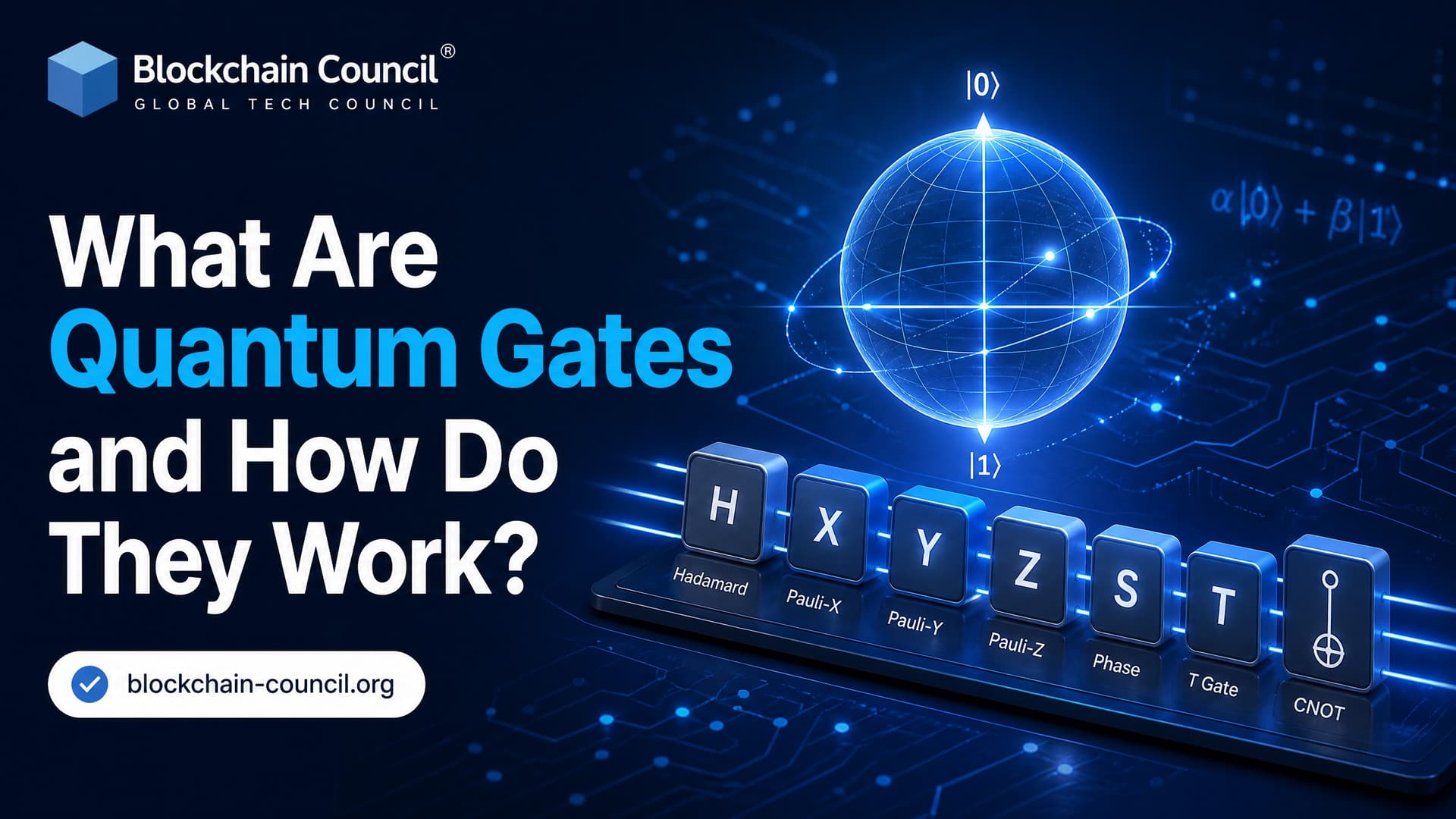
Quantum gates are the basic operations that change qubits inside a quantum computer. If classical gates such as AND, OR, and NOT are the building blocks of ordinary digital circuits, quantum gates are the building blocks of quantum circuits. The difference is not cosmetic. A classical bit is either 0 or 1. A qubit can sit in a weighted combination of |0> and |1>, and a gate changes those weights, phases, and correlations in a controlled way.
That is the short answer. The useful answer is a little more exact: a quantum gate is a reversible unitary transformation applied to one or more qubits. IBM Quantum, Microsoft Azure Quantum, and most university circuit-model texts describe gates this way because it matches both the mathematics and the hardware.

What Is a Quantum Gate?
A quantum gate is an operation that transforms the state of qubits in a quantum circuit. In the circuit model, you draw gates as boxes on wires. The wires are qubits. Time moves from left to right. Each box applies a specific mathematical operation.
For one qubit, the gate is represented by a 2 by 2 unitary matrix. For two qubits, it is a 4 by 4 unitary matrix. In general, a gate acting on k qubits is represented by a 2k by 2k matrix. That exponential growth is one reason quantum systems are hard to simulate on classical machines.
The word unitary matters. A matrix U is unitary when U†U = I, where U† is the conjugate transpose and I is the identity matrix. This condition preserves total probability. It also means every quantum gate has an inverse.
Why Quantum Gates Must Be Reversible
Classical logic can throw information away. An AND gate maps 00, 01, and 10 to the same output, 0. After seeing the output, you cannot reconstruct the input. Quantum gates cannot work like that.
Because quantum gates are unitary, they must map distinct input states to distinct output states. No collapse happens during the gate itself. Measurement is different. Measurement converts quantum information into classical outcomes and is generally not reversible.
This leads to three rules worth remembering:
- Same number of inputs and outputs: A two-qubit gate outputs two qubits.
- No information loss during the gate: The transformation preserves probability amplitudes.
- Every gate has an inverse: Applying U followed by U† returns the state to where it started.
This is also why copying an unknown qubit is not just difficult. It is forbidden by the no-cloning theorem. Beginners often try to use CNOT as a copy operation. It only copies computational basis states such as |0> and |1>. It does not clone an arbitrary superposition.
How Quantum Gates Work Physically
At the hardware level, a quantum gate is not a magic box. It is a carefully timed physical interaction.
In superconducting qubit systems, such as transmon-based processors, single-qubit gates are commonly implemented with shaped microwave pulses. The pulse frequency, phase, amplitude, and duration determine how the qubit state rotates. A pi pulse can implement an X gate, flipping |0> to |1> and |1> to |0>. A half-pi pulse creates a smaller rotation.
In trapped ion systems, gates are driven by laser pulses that couple the internal states of ions and, for multi-qubit gates, their shared motional modes. In photonic systems, gates can use beam splitters, phase shifters, interferometers, and measurement-assisted methods, depending on the encoding.
Here is a detail that trips people up in real labs and SDKs: a gate name in your circuit is not always the native pulse the machine runs. On many IBM superconducting backends, an H gate may be transpiled into native operations such as rz, sx, and x. RZ rotations are often implemented virtually as frame updates, while SX and X require physical microwave pulses. So the circuit you write and the pulses the hardware runs are related, but not identical.
Single-Qubit Quantum Gates
Single-qubit gates change the state of one qubit. You can picture many of them as rotations on the Bloch sphere, a geometric model where |0> and |1> sit at opposite poles.
Pauli X Gate
The Pauli X gate is the quantum version of NOT. It swaps |0> and |1>. On the Bloch sphere, it is a rotation by pi radians, or 180 degrees, around the x-axis.
Pauli Y and Z Gates
The Y gate rotates around the y-axis. The Z gate changes phase: it leaves |0> unchanged and maps |1> to -|1>. That negative sign may look harmless, but phase is where much of quantum computing gets its power. Interference depends on it.
Hadamard Gate
The Hadamard gate, usually written H, creates equal superpositions from basis states. It maps |0> to (|0> + |1>)/sqrt(2), and |1> to (|0> - |1>)/sqrt(2).
This gate appears everywhere: Bell-state preparation, Deutsch-Jozsa, Grover search, phase estimation, and many teaching circuits. If you are new to quantum computing gates, learn H early and learn it well.
Phase and Rotation Gates
Rotation gates such as Rx(theta), Ry(theta), and Rz(theta) rotate a qubit around a chosen axis by a selected angle. They are central in variational quantum algorithms, quantum machine learning experiments, and circuit optimization.
Multi-Qubit Quantum Gates
Multi-qubit gates create conditional behavior between qubits. This is where entanglement enters the circuit.
CNOT Gate
The Controlled NOT gate, or CNOT, has a control qubit and a target qubit. If the control is |1>, the target flips. If the control is |0>, the target stays unchanged.
Combine H on the first qubit with CNOT from the first qubit to the second, and you can create a Bell state: (|00> + |11>)/sqrt(2). That two-line circuit is small, but it contains the core idea behind teleportation, superdense coding, and many error-correction examples.
CZ and Controlled Phase Gates
The CZ gate applies a phase change when both qubits are in |1>. It is symmetric, which can make it convenient in hardware and compiler design. Controlled phase gates are also common in algorithms that rely on phase kickback.
Toffoli Gate
The Toffoli gate, or CCNOT, has two controls and one target. It flips the target only when both controls are |1>. It matters because it lets you embed reversible classical logic inside a quantum circuit.
Two-qubit and three-qubit gates are usually harder to implement accurately than single-qubit gates. That is not a small engineering footnote. On near-term devices, two-qubit gate errors and circuit depth often decide whether your result is useful or just noise.
Universal Quantum Gate Sets
A universal gate set can approximate any unitary operation on a finite number of qubits to arbitrary accuracy. You do not need an infinite menu of gates. You need the right small set.
A common practical pattern is arbitrary single-qubit rotations plus at least one entangling two-qubit gate, such as CNOT or CZ. Compilers then decompose higher-level circuit instructions into the basis gates supported by a chosen backend.
This is why gate decomposition matters. A circuit with fewer gates on paper may become deeper after transpilation if it does not match the target hardware. To be blunt, ignoring the backend is a beginner mistake.
How Quantum Gates Create Useful Computation
Quantum gates produce value through three effects: superposition, entanglement, and interference.
- Superposition: Hadamard and rotation gates prepare qubits in combinations of basis states.
- Entanglement: CNOT, CZ, and related gates create correlations that cannot be explained as independent qubit states.
- Interference: Phase gates adjust amplitudes so wrong answers can cancel and useful answers can be amplified.
Algorithms such as Grover search and quantum phase estimation are not fast because they try every answer and read them all out. Measurement only gives one classical result per shot. The trick is that gates shape amplitudes before measurement, so the desired outcomes become more likely.
Common Mistakes When Learning Quantum Gates
If you are studying for a quantum computing certification or building circuits in Qiskit, Cirq, or Braket, watch for these issues:
- Confusing statevector order: Qiskit uses little-endian conventions in several displays. A control-target mix-up can make a Bell circuit look wrong when the math is fine.
- Treating measurement as a gate: It appears in circuits, but it is not unitary. It collapses the state into classical data.
- Assuming CNOT clones qubits: It does not clone arbitrary unknown quantum states.
- Ignoring global phase: A global phase is not measurable, but relative phase changes outcomes.
- Counting logical gates only: Hardware runs native gates after compilation, and the final depth may change.
Where Quantum Gates Are Used
Every gate-based quantum workload uses these operations. The most common examples include:
- Bell-state generation: H plus CNOT creates entangled pairs.
- Quantum teleportation: Entanglement, CNOT, H, measurement, and conditional correction work together.
- Quantum simulation: Rotation and controlled operations approximate physical Hamiltonians.
- Optimization experiments: Variational circuits use parameterized rotation gates and entanglers.
- Error correction: Stabilizer measurements rely heavily on controlled operations.
For professionals working near cryptography, blockchain, or AI, quantum gates are also the foundation for understanding why algorithms such as Shor's algorithm matter. If you are connecting this topic to career training, consider learning paths such as Blockchain Council's Certified Blockchain Expert™ for cryptographic systems and Certified Artificial Intelligence (AI) Expert™ for AI foundations. Quantum computing sits close to both fields.
The Future of Quantum Gates
The next major gains in quantum computing will not come from adding qubits alone. Gate quality matters just as much.
Researchers and hardware teams are working on better pulse shaping, calibration, control electronics, crosstalk reduction, and error mitigation. Two-qubit gates remain a major target because they are essential for entanglement and usually noisier than single-qubit gates.
On the software side, expect more work on circuit compilation, gate cancellation, hardware-aware routing, and shorter decompositions. For near-term devices, shaving even a few two-qubit gates can change the result.
Want to build real skill? Do this next. Create a two-qubit Bell circuit in a simulator, inspect the statevector, then transpile it for a real backend and compare the logical circuit with the native gate version. That single exercise teaches more about quantum gates than memorizing ten definitions.
Related Articles
View All
Quantum Computing
What Is Quantum AI? How Quantum Computing and AI Work Together
Quantum AI combines quantum computing and artificial intelligence for optimization, sampling, simulation, and better quantum hardware control.

Quantum Computing
How Do Quantum Algorithms Work? A Beginner's Guide
Learn how quantum algorithms use qubits, gates, entanglement, interference, and measurement to solve selected problems faster than classical methods.

Quantum Computing
Types of Quantum Gates Explained: Pauli, Hadamard, CNOT, and More
Learn the main types of quantum gates, including Pauli, Hadamard, CNOT, phase, Toffoli, and hardware-native gates, with real use cases.
Trending Articles
AWS Career Roadmap
A step-by-step guide to building a successful career in Amazon Web Services cloud computing.
What is AWS? A Beginner's Guide to Cloud Computing
Everything you need to know about Amazon Web Services, cloud computing fundamentals, and career opportunities.
Claude AI Tools for Productivity
Discover Claude AI tools for productivity to streamline tasks, manage workflows, and improve efficiency.