

Quantum Computing vs Classical Computing: Key Differences, Benefits, and Limitations
 Suyash Raizada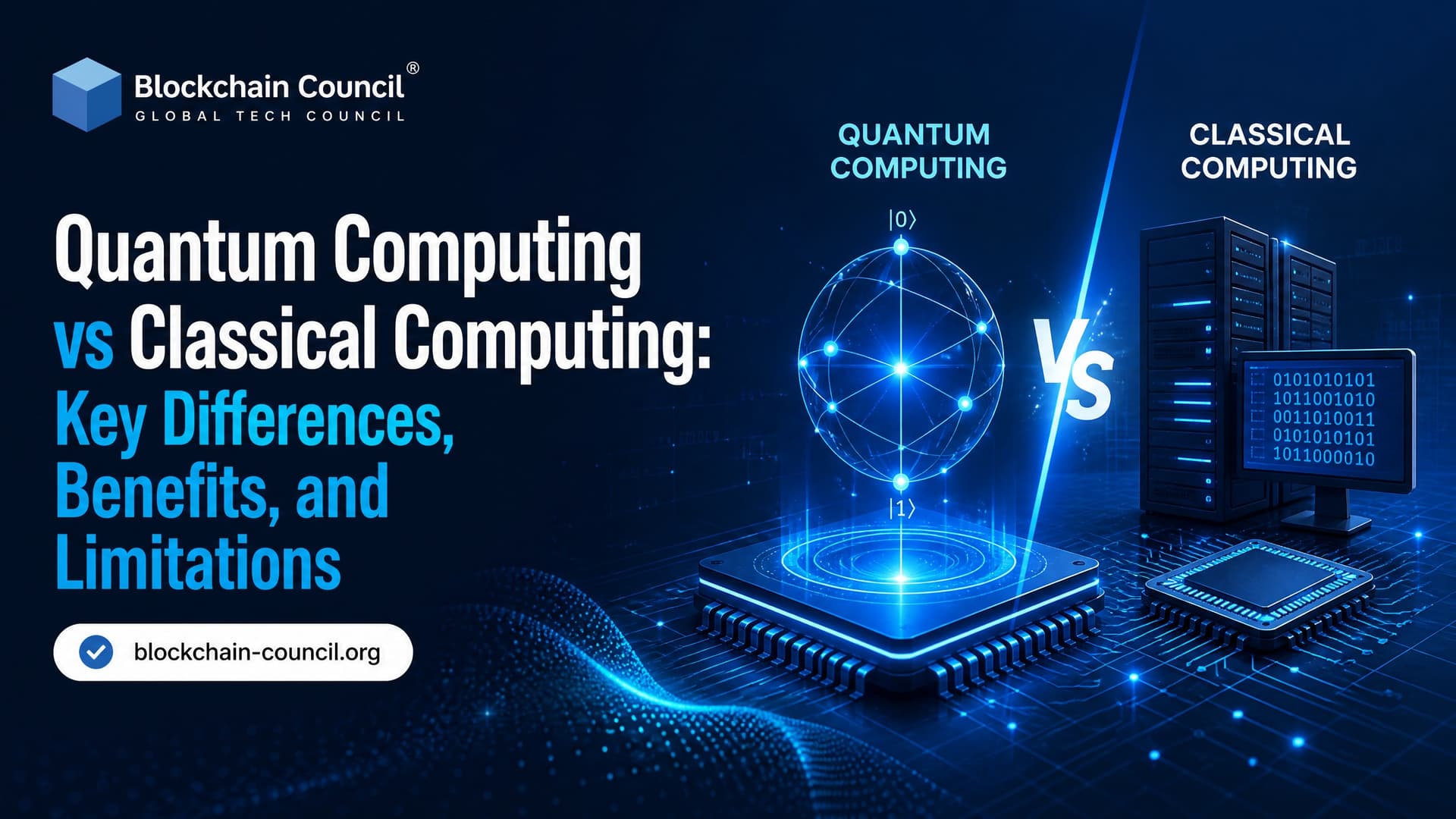
Quantum Computing vs Classical Computing is not a contest where one technology simply replaces the other. Classical computers run your databases, APIs, laptops, cloud workloads, analytics pipelines, and most AI systems with predictable reliability. Quantum computers are different. They are specialized machines built to attack certain mathematical and physical problems that classical systems handle poorly.
Here is the practical view. Treat quantum processors as future accelerators, not general-purpose replacements. That distinction matters for developers, cybersecurity teams, blockchain architects, and enterprises planning long-term technology strategy.

What Is Classical Computing?
Classical computing is based on bits. A bit is either 0 or 1. Every file, smart contract, web page, machine learning model, and database record eventually reduces to long strings of binary values processed by logic gates.
Classical processors use Boolean logic and deterministic instruction execution. Run the same program with the same inputs on stable hardware, and you expect the same output. Distributed systems and random number generators can complicate that, sure, but the underlying model is predictable.
Classical computing is excellent for:
- User interfaces and web applications
- Databases and enterprise systems
- Cloud computing and container orchestration
- Most AI training and inference workloads
- Blockchain nodes, wallets, and smart contract execution
- Everyday numerical computing
This ecosystem is mature. Tooling is stable. Developers can debug code line by line, profile memory, scale horizontally, and deploy on commodity infrastructure. That advantage is not going away.
What Is Quantum Computing?
Quantum computing uses quantum bits, or qubits. A qubit can exist in a combination of 0 and 1 before measurement. This is called superposition. When multiple qubits interact, they can become entangled, creating correlations that have no classical equivalent.
An N-bit classical register represents one of 2^N possible states at a time. An N-qubit register can represent a superposition across 2^N basis states. That does not mean you can read all answers at once. You cannot. Measurement gives a classical result, and quantum algorithms must use interference to raise the probability of useful answers and cut the probability of bad ones.
This is where many beginner explanations go wrong. Superposition is not magic parallelism. Measure too early, and you collapse the state and lose the computation. In real quantum programming, you run circuits many times, often thousands of shots, to estimate a probability distribution.
A small practitioner detail: if you move older Qiskit notebooks into Qiskit 1.x, a common break is ImportError: cannot import name 'execute' from 'qiskit'. The fix is to use current primitives or transpile the circuit and call the backend execution path directly. That kind of tooling change is normal in quantum software because the stack is still young.
Quantum Computing vs Classical Computing: Core Differences
1. Bits vs Qubits
Classical computers use bits that hold definite values. Quantum computers use qubits that hold a quantum state until measurement. This gives quantum systems access to a much larger mathematical state space, but only carefully designed algorithms can use it.
2. Deterministic vs Probabilistic Output
Classical programs usually return a direct answer. Quantum programs return samples from a probability distribution. You repeat the circuit, collect measurements, and infer the likely answer. This makes quantum computing feel closer to experimental statistics than to traditional software engineering.
3. Ordinary Logic vs Reversible Quantum Gates
Classical circuits do not need to be reversible. Quantum circuits do, because quantum evolution is unitary. In plain terms, the output state must preserve enough information to reconstruct the input state. This changes how algorithms are built.
4. Copying Data vs No-Cloning
Classical systems copy data constantly. Quantum systems cannot copy an arbitrary unknown quantum state because of the no-cloning theorem. That limitation shapes data handling, error correction, and circuit design.
5. Stable Hardware vs Fragile Hardware
Classical processors run at or near room temperature. Quantum processors often need highly controlled environments. Superconducting qubits typically require cryogenic systems operating near absolute zero. Trapped ions, spin defects, and photonic systems face different engineering constraints, but all struggle with noise, control, and scaling.
Where Quantum Computing Can Beat Classical Computing
The benefits are real, but narrow. The strongest theoretical advantages show up in specific problem classes.
- Integer factorization: Shor's algorithm could break RSA and elliptic curve cryptography on a large fault-tolerant quantum computer.
- Search: Grover's algorithm gives a quadratic speedup for unstructured search.
- Quantum simulation: Molecules and materials are quantum systems, so quantum computers may model them more naturally than classical machines.
- Optimization: Hybrid quantum-classical methods are being tested for routing, scheduling, and portfolio problems.
- Sampling: Certain probability distributions may be hard for classical systems to reproduce efficiently.
- Machine learning research: Some quantum algorithms target linear algebra tasks, kernels, and sampling subroutines.
Be blunt about this. Quantum computing is the wrong tool for most software problems today. Do not use it to speed up a web service, run a database, or train a standard neural network faster. Classical GPUs and cloud systems are far better for those jobs.
The Current State: NISQ, Not Fault Tolerant Yet
Today's quantum computing field sits in the NISQ era, short for noisy intermediate-scale quantum. These machines have tens to hundreds of physical qubits, meaningful experimental value, and significant error rates. They are real quantum computers, but not the fault-tolerant systems needed for large commercial advantage.
IBM, Quantinuum, Fujitsu, and other teams keep improving qubit quality, control systems, and processor designs. IBM has continued to release new processors and roadmap targets aimed at higher qubit counts and better circuit throughput. Quantinuum has reported progress in logical state preparation and high-fidelity GHZ states. Fujitsu and research partners have explored diamond spin-based prototypes using tin vacancy centers.
Still, the hard problem remains quantum error correction. Useful logical qubits may require many physical qubits plus repeated syndrome measurements. Experts surveyed in recent industry and academic studies generally expect small fault-tolerant systems before large-scale machines, with broad cryptographic impact likely much later.
Boston Consulting Group's 2024 analysis was clear: quantum computing has not yet delivered tangible advantage over classical computing at commercial scale. That view matches what many practitioners see when running current hardware. Noise dominates deep circuits. Results drift. Calibration matters.
Benefits of Quantum Computing
When quantum computers mature, their value will come from doing a few hard things very well.
- Better molecular simulation: Drug discovery, battery chemistry, catalysts, and materials research could benefit from more accurate quantum models.
- Advanced optimization: Logistics, energy grids, airline scheduling, and finance may gain improved heuristics or better solution quality.
- Cryptanalysis: Large fault-tolerant systems could threaten RSA and elliptic curve systems, which is why post-quantum cryptography matters now.
- Scientific discovery: Quantum simulation may help researchers study systems too complex for classical approximations.
- Hybrid high-performance computing: Quantum processing units may become accelerators attached to classical workflows.
Limitations of Quantum Computing
The limitations are not minor engineering footnotes. They define the field.
- Decoherence: Qubits lose quantum information when disturbed by their environment.
- Error accumulation: Longer circuits produce lower-fidelity results on noisy hardware.
- Scaling difficulty: Wiring, control electronics, cryogenics, and chip layout get harder as qubit counts rise.
- Software immaturity: APIs change, frameworks compete, and debugging is harder than in classical systems.
- Data loading: Moving large classical datasets into quantum states can erase expected speedups.
- Talent shortage: The field needs people who understand physics, algorithms, software, and systems engineering.
Data bandwidth is a quiet killer. If your use case needs huge classical datasets moved into and out of a quantum processor, think twice. Quantum systems suit compact inputs, structured problems, and outputs such as samples, expectation values, or optimized parameters.
Market Growth and Enterprise Adoption
Market forecasts vary because quantum computing timelines remain uncertain. MarketsandMarkets projects growth from about 3.52 billion US dollars in 2025 to 20.20 billion US dollars by 2030. BCC Research forecasts 1.6 billion US dollars in 2025 rising to 7.3 billion US dollars by 2030. Grand View Research estimated the market at about 1.42 billion US dollars in 2024, reaching 4.24 billion US dollars by 2030.
The numbers differ, but the direction is consistent. The market is still small next to classical cloud infrastructure, yet growing quickly through cloud access, pilots, research partnerships, and specialized services.
Cybersecurity, Blockchain, and Post-Quantum Risk
For blockchain professionals, the main concern is cryptography. A large fault-tolerant quantum computer running Shor's algorithm could threaten RSA and elliptic curve cryptography. Many blockchain systems use elliptic curve signatures, so long-term quantum risk cannot be ignored.
No publicly known quantum computer is close to breaking RSA-2048. Expert estimates often point to millions of high-quality error-corrected qubits for that task. Current machines are far smaller and noisy. Still, migration planning takes years. Cybersecurity teams should track post-quantum cryptography standards, inventory cryptographic dependencies, and identify systems with long data confidentiality lifetimes.
If you work with blockchain infrastructure, pair quantum literacy with cryptographic training. Blockchain Council's Certified Blockchain Expert™, Certified Cybersecurity Expert™, and Certified Quantum Computing Expert™ are natural learning paths to consider, depending on whether your role sits in architecture, security, or emerging technology strategy.
Which One Should You Learn First?
If you are a developer, learn classical computing deeply first: algorithms, linear algebra, probability, distributed systems, and security. Then add quantum computing. Skipping the classical foundation makes quantum algorithms harder, not easier.
If you are in cybersecurity, start with post-quantum cryptography, key management, and risk assessment. If you are in pharmaceuticals, materials, or optimization-heavy industries, study quantum simulation and hybrid algorithms. If you are a blockchain architect, focus on signature schemes, wallet migration risk, and quantum-safe protocol design.
Practical Next Step
Build one small quantum circuit, run it on a simulator, then run it with 1,024 shots on real cloud hardware if you have access. Compare the ideal and noisy results. That single exercise teaches the real difference between quantum computing and classical computing better than any diagram.
After that, choose a structured path: quantum fundamentals for emerging tech roles, post-quantum cryptography for security teams, or Blockchain Council's blockchain and cybersecurity certifications if your work touches digital assets, identity, or enterprise risk.
Related Articles
View All
Quantum Computing
Quantum Machine Learning vs Classical Machine Learning: Key Differences
Quantum Machine Learning vs Classical Machine Learning explained through computation models, data encoding, training limits, benchmarks, and real use cases.

Quantum Computing
Quantum vs Classical Computing: Performance Benchmarks, Limitations, and When Quantum Wins
Quantum vs classical computing depends on benchmarks, noise limits, and problem fit. Learn key metrics like QV and CLOPS, and where quantum wins now and later.

Quantum Computing
Quantum Computing Certification: Benefits, Career Value, and How to Choose One
Learn how quantum computing certification supports career growth, what employers value, and how to choose a credential with real technical depth.
Trending Articles

Top 5 DeFi Platforms
Explore the leading decentralized finance platforms and what makes each one unique in the evolving DeFi landscape.
How Blockchain Secures AI Data
Understand how blockchain technology is being applied to protect the integrity and security of AI training data.

Can DeFi 2.0 Bridge the Gap Between Traditional and Decentralized Finance?
The next generation of DeFi protocols aims to connect traditional banking with decentralized finance ecosystems.